Unseen Mercury Revealed For The First Time

Yesterday, as the spacecraft approached Mercury for the mission’s third flyby of the Solar System’s innermost planet, MESSENGER captured this striking view. This WAC image shows portions of Mercury’s surface that had remained unseen by spacecraft even after the three flybys by Mariner 10 in 1974-75 and MESSENGER’s two earlier flybys in 2008. In this image, just returned to Earth early this morning, the newly imaged terrain is located in a wide vertical strip near the limb of the planet (on the left side of Mercury’s partially sunlit disk).
Yesterday, as the spacecraft approached Mercury for the mission’s third flyby of the Solar System’s innermost planet, MESSENGER captured this striking view. This WAC image shows portions of Mercury’s surface that had remained unseen by spacecraft even after the three flybys by Mariner 10 in 1974-75 and MESSENGER’s two earlier flybys in 2008. In this image, just returned to Earth early this morning, the newly imaged terrain is located in a wide vertical strip near the limb of the planet (on the left side of Mercury’s partially sunlit disk).
Viewing the image coverage map from before the flyby provides more information on the location of the newly seen area. This WAC image is just one of 11 taken through the camera’s narrow-band color filters, and this set of images will be used to examine color differences on Mercury’s surface and to learn about the evolution of crustal rocks on the planet.Larger image
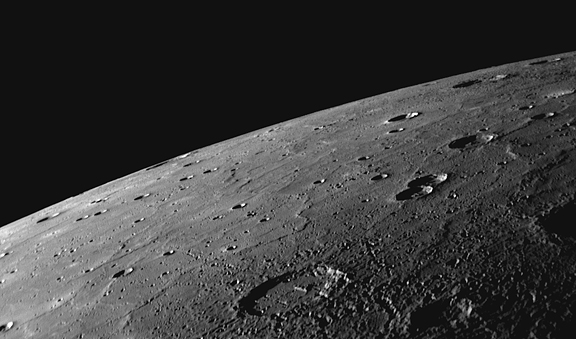
During MESSENGER’s approach to Mercury yesterday, the NAC acquired a high-resolution, 62-image mosaic of the sunlit crescent planet. Many of these images show portions of Mercury’s surface not previously seen by spacecraft, including the NAC image shown here. In this image, Mercury’s northern horizon cuts a crisp line against the blackness of space.
The surface in the lower right corner of the image is near Mercury’s terminator, the line between the light dayside and dark night side of the planet. Looking toward the horizon, smooth plains extend for large distances, similar to volcanic plains seen nearby during MESSENGER’s second flyby of Mercury.
Members of the MESSENGER Science Team are gathered today at the Johns Hopkins University Applied Physics Laboratory, discussing these high-resolution images in detail. Larger image
Credit: NASA/Johns Hopkins University Applied Physics Laboratory/Carnegie Institution of Washington.