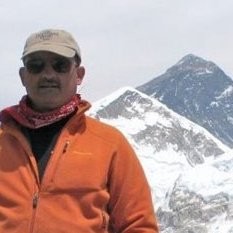
Scott Parazynski:Down Day at EBC
Day 30/April 20, 2009 (Monday)
You can’t just walk up to base camp, strap on your crampons and head for the summit, at least not here in the Himalayas. Climbing Everest is a marathon, and not a sprint. Morphing the kid’s riddle: “Q: How do you eat an elephant? A: One bite at a time!” Climbing Everest is “one step at a time, one day at a time…” [I apologize profusely to any card-carrying PETA members I may have inadvertently offended with this insensitive reference.] I’ve been back down at EBC for a couple of days now, and look forward to a couple more before heading back up progressively higher. I know the next trip up will be tougher than the last, and I need to stockpile my energy here in the thicker air of EBC…
Day 30/April 20, 2009 (Monday)
You can’t just walk up to base camp, strap on your crampons and head for the summit, at least not here in the Himalayas. Climbing Everest is a marathon, and not a sprint. Morphing the kid’s riddle: “Q: How do you eat an elephant? A: One bite at a time!” Climbing Everest is “one step at a time, one day at a time…” [I apologize profusely to any card-carrying PETA members I may have inadvertently offended with this insensitive reference.] I’ve been back down at EBC for a couple of days now, and look forward to a couple more before heading back up progressively higher. I know the next trip up will be tougher than the last, and I need to stockpile my energy here in the thicker air of EBC…
With that marathon theme in mind, how do people keep themselves from getting bored during the long waiting periods at EBC, in between rotations up the mountain? I take a lesson from the Nuclear Navy. I had the very good fortune to spend a day and night onboard the Trident submarine USS West Virginia, out of Kings Bay, Georgia. Myself and a couple of other astronauts, John Grunsfeld and Jim Halsell, submerged with the crew on a brief shakedown cruise before their X month deployment — one week before Thanksgiving. It was remarkable to see the efficiency and work ethic of these men, who would work 16 hour shifts and then have 8 hour periods to sleep, essentially 7 days a week. They kept their focus on mission by keeping their minds and bodies active. Becoming completely idle leads to lassitude and homesickness: when you lose your critical edge, errors are more likely to occur. Moreover, the time will seem to pass much more slowly.
OK, so Everest isn’t a submarine, but I keep myself busy here at base camp by spending time with my teammates (often with visits to the Everest bakery), writing dispatches for this blog, taking short hikes around “town,” reading well-worn books from the IMG “library,” and listening to my Zen Nano. Regrettably I didn’t update my music list from last season here on the mountain, so the music is getting a bit stale… I also have an occasional satphone call with family, but the difference in time zones (Nepal is 10 hours 45 minutes ahead of Houston!) make it difficult to synch up on a regular basis.
Postscript
As I suggested yesterday, all good plans are subject to change. I’ve elected to head up to Camp II a day early (Wednesday, April 22), based on consultations with others who have summited several times, to have just a bit more acclimatization before the big push up to Camp III (which I hope to accomplish before the NASA Trek Team arrives on 4/28 — weather and route conditions permitting).
Best regards to all,
Scott
—————————————————————-
Gearing Up for Everest, Gearing Up for EVA
If you’ve ever been rock climbing or mountaineering — or you’ve ever seen Clint Eastwood’s The Eiger Sanction — you know that moving up steep terrain takes lots of gear. Climbers love gear, not just for the cool factor, but because it provides protection in case of a fall. Gravity is the law, but climbers want to test their skills and work against gravity to the best of their abilities…
The core piece of safety gear we wear is a waist harness, to which we’ll tie into a rope: on the other end might be another climber, to share the responsibility for fall protection, or we might use a camming device called a Jumar to lock onto a fixed line should we fall. All sorts of other gizmos help us latch onto the vertical world: ice screws, pickets, snow anchors, tri-cams, nuts, pitons, ice axes, snow bollards and so on. Then there are helmets, crampons, prussiks, carabiners, descenders, pulleys and other hardware to help you move safely up or down the mountain. Finally, you’ve got protective garments for the often extreme temperatures; for Everest this includes a full down suit, mountaineering boots rated to -60 deg F, heavy mittens, a balaclava, thermal layers, goggles, an oxygen tank and a mask with reservoir. Throw in a radio to talk to base camp, plus a small video and/or digital camera, and you’re ready to head for the summit…
As a spacewalker, I have a similar respect for falling, with a twist. In low earth orbit, working outside the Space Shuttle or International Space Station, we are essentially in a free fall around the earth. Although Earth’s gravity is still tugging on us, our velocity around the planet is in equal balance, allowing for things to float — “zero gravity.” When outside on a spacewalk, if your tether were to break, you wouldn’t drop like a rock to the ocean below — you would merely end up in a slightly different orbit, and might not get back to the airlock before your oxygen ran out. As this is an unpleasant option, we are always tethered to our spacecraft whenever we’re outside — much like we clip onto the fixed lines in the difficult terrain of the Khumbu Icefall. We have safety tethers, tool tethers, power tools, wrenches, sockets and all sorts of other gear to “climb” or crawl all over the spacecraft we’re working on: the Space Shuttle, ISS or the Hubble Space Telescope. Our spacesuits are actually spacecraft in and of themselves: they provide us oxygen, remove carbon dioxide, protect us from the temperature extremes (-200 deg in orbital night, +300 deg in orbital daylight), allow us radio communication with Mission Control, provide a video feed from our helmet mounted cameras, and so on…
The harsh environments of mountaineering and spacewalking have similar challenges, and some unique solutions. The workload of a spacewalk can certainly be intense, but I suspect taking the final steps to the top of Everest will be orders of magnitude more work!
——————————————————————
Field Science on Everest
Conducting science in remote locations — the High Himalayas, the Antarctic, the Atacama Desert, Undersea, the Moon, Mars and beyond — requires careful design and planning. Getting to and surviving in these remote locations requires a lot of gear: shelter, special clothing, food, fuel, water, etc. Scientists have to design their experiments to handle their rugged conditions: temperature extremes, changes in atmospheric pressure, extreme ultraviolet light conditions and generally rough handling. Moreover, since getting to these places is often very difficult, the experiments must often be small and lightweight, and ideally require little power or human intervention. If the field scientist is wearing bulky mitts, making it easy to operate is key. Finally, if you can build some redundancy into the device — if one part fails, you don’t necessarily lose the entire experiment — you’ve built a great field experiment.
This season on Everest we hope to accomplish a number of pilot studies in “astrobiology” — the study of life in extreme environments, so as to understand how life might have once evolved on Mars, Europa or other planetary bodies. Moreover, we hope to field test special (now proprietary) hardware that has been developed for use in this harsh environment, in hopes that other mountaineers and explorers might find them of use. We’ll be using a special photographic device called a Gigapan camera mount to document the Everest environment in unprecedented resolution. I have in my possession an early prototype lunar geologic hammer, which I hope to take with me to the Yellow Band (~25,000 feet) next week: the YB is a limestone streak that may possess tiny fossils from ages ago… Finally, I have been wearing an “Actiwatch” throughout my trek into EBC and up high on the mountain. This device incorporates a light sensor and accelerometer, and measures my activity level as well as the quantity and quality of my sleep periods. Members of the NASA Trek Team, arriving here at EBC on April 28th, will also be participating in this study of sleep at altitude. [I have worn this same device on 3 of my Space Shuttle missions]
Much of the astrobiology gear is arriving in a week’s time with Keith and the NASA trek team. I’m anxious to deploy special temperature sensors up high — to determine if liquid water exists at these extreme heights, thus capable of life — and to take measurements of the ultraviolet light spectrum using sophisticated sensors. One thing that has amazed me thus far is the resilience of life up here. A few days ago I was at Camp II, 21,500 feet above sea level, and I saw numerous small birds flittering about for windblown sources of food — and perhaps leftovers from climbing teams. Yaks, common beasts of burden here in the Khumbu, frequent Everest base camp — their frequent presence is well known to anyone walking the messy trails around camp. Other raptors fly high above the icefall, and an occasional stray dog follows climbing teams or yak herders up to camp. Can life exist in any real sense on the summit of Everest? We’ll certainly look for clues in the weeks ahead…