Science with the Virtual Observatory: the AstroGrid VO Desktop
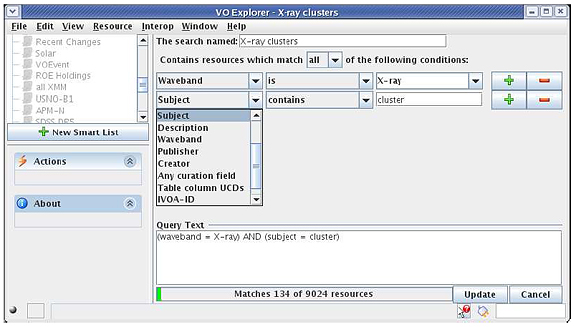
Figure 1. The VOExplorer resource search tool (part of the AstroGrid VODesktop software suite): build a list of VO registered resources matching all or any user defined conditions. In this example the user selects “all” resources where the waveband is “X-ray” and the subject contains the keyword “cluster” and 134 matches to these conditions are returned. The user can then filter and analyse the results further via an iTunes type interface as shown in Figure 2.
We introduce a general range of science drivers for using the Virtual Observatory (VO) and identify some common aspects to these as well as the advantages of VO data access. We then illustrate the use of existing VO tools to tackle multi wavelength science problems.
Figure 1. The VOExplorer resource search tool (part of the AstroGrid VODesktop software suite): build a list of VO registered resources matching all or any user defined conditions. In this example the user selects “all” resources where the waveband is “X-ray” and the subject contains the keyword “cluster” and 134 matches to these conditions are returned. The user can then filter and analyse the results further via an iTunes type interface as shown in Figure 2.
We introduce a general range of science drivers for using the Virtual Observatory (VO) and identify some common aspects to these as well as the advantages of VO data access. We then illustrate the use of existing VO tools to tackle multi wavelength science problems. We demonstrate the ease of multi mission data access using the VOExplorer resource browser, as provided by AstroGrid (this http URL) and show how to pass the various results into any VO enabled tool such as TopCat for catalogue correlation. VOExplorer offers a powerful data-centric visualisation for browsing and filtering the entire VO registry using an iTunes type interface. This allows the user to bookmark their own personalised lists of resources and to run tasks on the selected resources as desired. We introduce an example of how more advanced querying can be performed to access existing X-ray cluster of galaxies catalogues and then select extended only X-ray sources as candidate clusters of galaxies in the 2XMMi catalogue. Finally we introduce scripted access to VO resources using python with AstroGrid and demonstrate how the user can pass on the results of such a search and correlate with e.g. optical datasets such as Sloan. Hence we illustrate the power of enabling large scale data mining of multi wavelength resources in an easily reproducible way using the VO.
[More info] [ Full paper]
Comments: 8 pages; 7 figures; proceedings of invited talk at “Multi wavelength astronomy and the Virtual Observatory” conference, December 2008, EuroVO-AIDA program, European Space Astronomy Centre, Spain
Subjects: Instrumentation and Methods for Astrophysics (astro-ph.IM); High Energy Astrophysical Phenomena (astro-ph.HE)
Cite as: arXiv:0906.1535v1 [astro-ph.IM]
Submission history
From: Jonathan Tedds [view email]
[v1] Mon, 8 Jun 2009 16:40:21 GMT (1040kb)