18-month Mars500 Mission Has Begun

ESA: Mars500, the first full-length simulated mission to Mars, started today in Moscow at 13:49 local time (11:49 CET), when the six-man crew entered their ‘spacecraft’ and the hatch was closed. The experiment will end in November 2011.
ESA: Mars500, the first full-length simulated mission to Mars, started today in Moscow at 13:49 local time (11:49 CET), when the six-man crew entered their ‘spacecraft’ and the hatch was closed. The experiment will end in November 2011.
The mood was serious, intense but very determined in the Mars500 facility at the Institute of Biomedical Problems in Moscow this afternoon, as the crew of the Mars500 talked to the press and and then walked into the modules that will be their home for next 520 days.
The last and the most interesting part of the Mars500 isolation study is now underway. Diego Urbina and Romain Charles from Europe, Sukhrob Kamolov, Alexey Sitev, Alexandr Smoleevskiy and Mikhail Sinelnikov from Russia and Wang Yue from China face a mission that is as close as possible to a real space voyage. They will live and work like astronauts, eat special food and exercise in the same way as crews aboard the International Space Station.
Their mission is to ‘fly to Mars’ in 250 days, divide in two groups, ‘land on and explore Mars’ for a month and ‘return to Earth’ in 230 days, in their special facility imitating an interplanetary spacecraft, lander and martian terrain.
The hatch of the facility will remain closed until November 2011 and the crew has to manage using the food, equipment and all other material stored in the facility. Only electricity, water and some air will be fed into the compartments from outside.
In addition to evaluating many novel technologies, Mars500 is the ultimate test of human endurance. Staying almost 18 months inside the metallic containers will be hard, even when properly trained and briefed by astronauts and submariners. The crew will no doubt have ups and downs during their long mission and these psychological changes are a key part of the experiment.
The ‘astronauts’ will normally have 8 hours of work, 8 hours of free time and 8 hours of rest a day, with the weekends free (except in special situations). They have taken plenty of films, books, games, musical instruments and entertainment with them.
The physiological aspects of the experiments are also of great interest. Their bodies will start to adapt to new conditions – a closed environment with restricted space can quickly lead to poor physical condition. The crew needs to exercise up to two hours a day, but they can shower only once a week.
What have I forgotten? Preparing everything from soap and clothing to food and spare camera batteries for an autonomous 1.5-year-mission is a complex task, so the logistics are vital.
And finally the technology: the facility is not a spacecraft, but it uses many systems that will be used in some form when developing a real craft for a Mars mission. Testing these in realistic conditions is important. The crew has been trained to repair every single bolt of their ‘craft’ and outside help will be given only in extreme situations.
Throughout their mission, Diego Urbina and Romain Charles, the ESA-selected crewmembers, will send diary updates and videos to ESA’s Mars500 site. The first diary entry has been published today: “Goodbye Sun, goodbye Earth, we are leaving for Mars!”.
Mars500: Goodbye Sun, goodbye Earth, we are leaving for Mars!
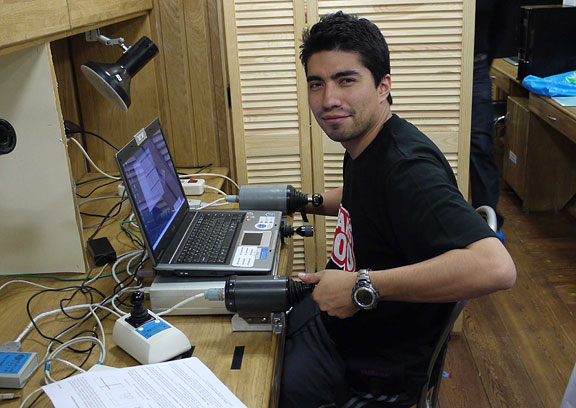
Image: Mars500 European crewmember Diego Urbina testing the computer with joysticks. During their 520-day mission, the duties of the crew will include regular playing of video games – though with a serious purpose: results from the games will help develop computerised ‘electronic partners’ to support crews on future deep space missions.
3 June 2010
This is the first entry of the Mars500 mission diary by European crewmembers Diego Urbina and Romain Charles.
Hello,
If you are reading these lines, I guess that you already know most of the technical characteristics of the Mars500 project. For our first diary, I would like to write some lines about our training and how it is from the inside.
The most significant point for me was the discovery of the ‘space world’ on one hand and the ‘research world’ on the other.
As you may know, my background is mainly industry and more specifically the automotive industry. Space was always a distant goal, almost unreachable. Today, I can hear this kind of comment around me: “I was in Cape Canaveral two days ago”, “I remember when I went to the Soyuz landing point… “, “Please meet my dear cosmonaut friend…”, etc.. It’s really exciting!
You also have to imagine all the researchers coming from all over the world to Moscow to explain to us their experiments. Having more than 100 experiments to perform, we can count on the support of (at least) 300 to 400 highly skilled scientists and doctors. This is not a privilege which is widely shared I guess.
If you add the international crew of 6, this multicultural ground is just perfect for a curious mind and I really felt stimulated during the training. Now, the big challenge is in front of us. Goodbye Sun, goodbye Earth, we are leaving for Mars!
Thanks Romain!
Although I had been involved in space projects before, Mars500 was not short of surprises for me. It started with the selection process: before arriving in Russia, I was not aware that such a quantity of medical tests could be performed on a human being. I was happy to know that I didn’t have any obscure disease that could only be diagnosed with giant O 3 million machine!
The training, as Romain said, promptly showed us the scale of the experiment. The internationalism of Mars500 does not only involve the crew, but also the researchers who come from so many countries that I could easily surpass the word limit in this blog post. This is for sure a strong point of Mars500, as no human flight to the Red Planet will be possible by one single Nation. Knowing how to collaborate at all levels is fundamental.
We learned that some of the tests can be fun, some are potentially annoying, but we sure know that all of them are worth it if we ever want to make it to places beyond the Moon. There are lots of them, so if you bear with us, we will be able to tell you a couple of facts about them, and how we execute them inside the modules.
We are so pleased to be part of such a nice crew and such an important experiment, and hope that some of you, among our readers, will actually be the ones who will step on Mars in the future. Through the entries in this blog, hopefully you will learn, in an informal way, the cool and the ugly things that you can expect on such a long journey. So… farewell Earth!!!