
Pulsar Bursts Coming From Beachball-Sized Structures
In a major breakthrough for understanding what one of them
calls “the most exotic environment in the Universe,” a team
of astronomers has discovered that powerful radio bursts
in pulsars are generated by structures as small as a beach ball.
“These are by far the smallest objects ever detected
outside our solar system,” said Tim Hankins, leader of
the research team, which studied the pulsar at the center
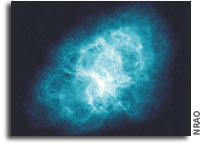
of the Crab Nebula, more than 6,000 light-years from Earth.
“The small size of these regions is inconsistent with all
but one proposed theory for how the radio emission is
generated,” he added.
The other members of the team are Jeff Kern, James
Weatherall and Jean Eilek. Hankins was a visiting scientist
at
Arecibo Observatory in Puerto Rico at the time the pulsar
observations were made. He and Eilek are professors
at the
New Mexico Institute of Mining and Technology
(New Mexico Tech) in Socorro, NM. Kern is a graduate
student at NM Tech and a predoctoral fellow at the
National Radio Astronomy Observatory (NRAO) in Socorro.
Weatherall is an adjunct professor at NM Tech, currently
working at the Federal Aviation Administration. The
astronomers reported their discovery in the March 13 edition
of the scientific journal Nature.
Pulsars are superdense neutron stars, the remnants of
massive stars that exploded as supernovae. Pulsars emit
powerful beams of radio waves and light. As the neutron
star spins, the beam sweeps through space like the beam
of a lighthouse. When such a beam sweeps across the
Earth, astronomers see a pulse from the pulsar. The
Crab pulsar spins some 33 times every second.
British radio astronomers won a Nobel Prize for discovering
pulsars in 1967. In the years since, the method by which
pulsars produce their powerful beams of electromagnetic
radiation has remained a mystery.
With the help of engineers at the NRAO, Hankins and his team
designed and built specialized electronic equipment that
allowed them to study the pulsar’s radio pulses on extremely
small time scales. They took this equipment to the National
Science Foundation’s giant,
1,000-foot-diameter radio telescope
at Arecibo. With their equipment, they analyzed the Crab
pulsar’s superstrong “giant” pulses, breaking them down into
tiny time segments.
The researchers discovered that some of the “giant” pulses
contain subpulses that last no longer than two nanoseconds.
That means, they say, that the regions in which these subpulses
are generated can be no larger than about two feet across
— the distance that light could travel in two nanoseconds.
This fact, the researchers say, is critically important
to understanding how the powerful radio emission is
generated.
A pulsar’s magnetosphere — the region above the neutron
star’s magnetic poles where the radio waves are
generated — is “the most exotic environment in the Universe,”
said Kern. In this environment, matter exists as a plasma,
in which electrically charged particles are free to respond
to the very strong electric and magnetic fields in the
star’s atmosphere.
The very short subpulses the researchers detected
could only be generated, they say, by a strange process in
which density waves in the plasma interact with their
own electrical field, becoming progressively denser
until they reach a point at which they “collapse explosively”
into superstrong bursts of radio waves.
“None of the other proposed mechanisms can produce such
short pulses,” Eilek said. “The ability to examine these
pulses on such short time scales has given us a new
window through which to study pulsar radio emission,”
she added.
The Crab pulsar is one of only three pulsars known to
emit superstrong “giant” pulses. “Giant” pulses occur
occasionally among the steady but much weaker “normal”
pulses coming from the neutron star.
Some of the brief subpulses within the Crab’s “giant” pulses
are second only to the Sun in their radio brightness in
the sky. Although the mechanism that converts the plasma
energy to radio waves in the Crab’s “giant” pulses may be
unique to the Crab pulsar, it is feasible that all radio
pulsars may operate the same way. The research team now
is observing signals from other pulsars to see if they
are fundamentally different. The subpulses in the Crab’s
“giant” pulses are so strong that the team’s equipment could
detect them even if they originated not in our own Milky
Way Galaxy, but in a nearby galaxy.
The Crab Nebula is a cloud of glowing debris from a star
that was seen to explode on July 4, 1054. Chinese
astronomers noted the bright new star that outshone the
planet Venus and was visible in daylight for 23 days. A
rock carving at
New Mexico’s Chaco Canyon probably
indicates that Native American skywatchers also noted
the bright intruder in the sky.
The nebula was discovered by John Bevis in 1731 and
independently rediscovered by French astronomer Charles
Messier on August 28, 1758. Messier made the Crab
Nebula (named because of its crab-like shape) the first
object in his famous catalog of non-stellar objects, a
catalog widely popular among amateur astronomers with
small telescopes.
In 1948, radio emission was discovered coming from
the Crab Nebula. In 1968, astronomers at Arecibo Observatory
discovered the pulsar in the heart of the nebula. The
following year, astronomers at Arizona’s Steward Observatory
discovered visible-light pulses also coming from the pulsar,
making this the first pulsar found to emit visible light
in addition to radio waves.
The
National Radio Astronomy Observatory is a facility of the
National Science Foundation, operated
under cooperative agreement by
Associated Universities, Inc. The
Arecibo Observatory is
part of the National Astronomy and
Ionosphere Center, which is operated by
Cornell University
under a cooperative agreement with the
National Science Foundation..
Contacts:
Dave Finley, National Radio Astronomy Observatory
Socorro, NM
(505) 835-7302
dfinley@nrao.edu
George Zamora, New Mexico Tech
(505) 835-5617
gzamora@nmt.edu
David Brand, Cornell University
(607) 255-3651
deb27@cornell.edu



