Intense Solar Activity Continues
Updated 13 April 2001
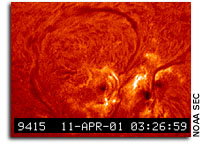
The sun is acting up again. This is just the latest in a series of outbursts whereby the sun continues to release massive amounts of energy in a display whose magnitude has not seen in decades. Several weeks ago, a solar flare caused effects that were felt for days.
Midday today a large wave of solar material slammed into Earth’s magentosphere causing a major geomagnetic storm to occur. The material originated from a solar flare that erupted yesterday from region 9415 on the sun’s surface. Large auroral displays are to be possible at low latitudes – depending upon the length and duration of this storm.
According to NASA the Sun “fired off another powerful X-class flare
Tuesday, April 10. X-class flares are the most powerful classification, and this flare, rated X-2, was the most recent in a series that included one of the most powerful solar blasts in 25 years.”
The space weather forecast, according to NOAA’s Space Environment Center calls for “Solar activity that is expected to be at moderate to high levels. Region 9415 is expected to produce another major flare during the period. Active to major storm levels are expected during this disturbance with brief severe storm levels possible at high latitudes. Unsettled to minor storm levels are expected on 13 April as the storm subsides.
A geomagnetic storm reaching G2 to G3 levels is expected to occur during April 11 – 12 due to a CME passage. Region 9415 is expected to produce isolated category R2 to R3 radio blackouts before it rotates to the far side of the Sun on April 16. A category S1 solar radiation storm began on April 10 and is expected to continue through April 11. Additional S1 storms will be possible during the period.”
15 April NOAA SEC update:
The sun is acting up again. Active region 9415 threw yet another intense flare on 15 April – one of the most powerful such events yet recorded. This explosion originated from a portion of the sun’s surface that is facing away from Earth. We won’t get hit directly this time.
12 April NOAA SEC update:
Another massive flare leapt off of the sun today. According to NOAA SEC: “Analysis of Solar Active Regions and Activity from 11/2100Z to 12/2100Z: Solar activity was high. Region 9415 (S22W43) produced an X2 flare at 12/1028 UTC. This flare was not optically correlated
at the peak time of the event, however EIT imagery and later optical flare observations have associated this flare with Region 9415.
The geomagnetic field is expected to be quiet to active for the first part of the period
until the arrival of an earth directed CME from the M2/1f event that occurred on 11/1326 UTC. This CME should arrive at earth sometime late on 13 April or early 14 April UTC. A second CME from today’s X2 event should arrive at earth late on 14 April or early 15 April UTC. Both arrivals should produce active to major storm levels with brief
severe storm levels at high latitudes possible.”
Related Links
° 15 April 2001: NOAA SEC Report of Solar-Geophysical Activity 12 Apr 2001
° 14 April 2001: NOAA SEC Report of Solar-Geophysical Activity 12 Apr 2001
° 13 April 2001: NOAA SEC Report of Solar-Geophysical Activity 12 Apr 2001
° 12 April 2001: NOAA SEC Report of Solar-Geophysical Activity 12 Apr 2001
° 11 April 2001: NOAA SEC Report of Solar-Geophysical Activity 11 Apr 2001
° 11 April 2001: Space Weather Outlook #01-4 — 11 Apr 2001
° 11 April 2001: Sun Takes Another Solar Shot – This Time at Earth, NASA
° 3 April 2001: More Bad Space Weather in the Forecast
Background Information
° Latest Solar Images and Data, SpaceRef Space Weather Guide
° Space Weather Now, NOAA Space Environment Center
° Solar and Heliospheric Observatory (SOHO), NASA GSFC
° Solar Terrestrial Interactions, SpaceRef Directory