Hubble Space Telescope Shuts Down Briefly Due to Sensor Confusion
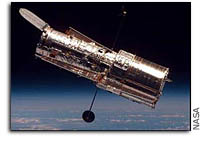
This past Monday, the Hubble Space Telescope (HST) went into a “safemode” condition and stopped performing data collection. The problem has since been rectified and the telescope is back in operation. The science that was supposed to have been performed will be rescheduled.
According to David Leckrone, Senior Project Scientist for the Hubble Space Telescope at NASA GSFC, this was a “relatively mild version of safemode”. During this safemode event the spacecraft automatically pointed its solar arrays to generate maximum amount of electricity and stopped all scientific observations. The telescope‘s aperture door remained open however.
Leckrone said that the HST goes in to safemode several times a year. With the exception of the gyroscope failures in 1997 which necessitated a special repair mission, these safemode events are somewhat routine.
The specific problem with HST this week is one that the HST team has encountered several times before. The HST uses four electromagnets arrayed around the spacecraft to serve as “brakes” to allow the motion of the spacecraft to be controlled as the telescope is moved or “slewed” from one target to another. This braking motion occurs via interactions between the electromagnets and Earth’s own magnetic field. These electromagnets – known as “Magnetic Torquers” – are controlled by their own electronic system – i.e. the “Magnetic Torquer Electronics”. When commands are sent to the Magnetic Torquer Electronics they are echoed back so as to confirm that the commands are indeed correct.
On Monday the information that was echoed back from the Magnetic Torquer Electronics did not match what was sent to the Magnetic Torquer Electronics in the first place. Normally when this happens, a quick check by mission controllers identifies the problem. However, on Monday, spacecraft controllers took more than 2 minutes to check what was going on. The HST noted that more than 2 minutes had passed, that the discrepancy still existed, and, having not been told to do otherwise, automatically went into safemode. Since the issue involved here was not a major problem, the spacecraft went into a safemode (Software Sunpoint – SWSP) which would be rather easy to recover from. The official descripton of the cause was being “due to the failure of the Magnetic Torquer Electronics #1 (MCE-1) command echo check.”
Leckrone said that a working theory is being developed to explain this phenomenon. According to current thinking the HST gets confused with regard to what magnetic field is being detected. At certain times in the HST’s orbit the spacecraft is oriented such that the readings it makes of Earth’s magnetic field are rather low. During these instances, so the theory goes, the spacecraft’s magnetometers actually register the magnetic field produced by the magnetic torquers as being the predominant magnetic field – not Earth’s. As such commands sent to the Magnetic Torquer Electronics comes back “a little confused” leading to the discrepancy between the signal sent to the magnetic torquer controllers and the signal which was echoed back from them.
This type of event has happened a dozen or so times since the HST was launched and seems to have some relationship to specific locations above the Earth – in this case the SAA – Southern Atlantic Anomaly – a region of significantly enhanced charged particle density. The SAA results because a part of the inner Van Allen belt dips down into the upper region of the atmosphere over the southern Atlantic Ocean. The magnetic axis of the Earth is tilted approximately 11 degrees from the spin axis, and the center of the magnetic field is offset from the geographical center of the Earth by 280 miles.
According to Leckrone there is some correlation between the SAA, the period of solar maximum, and the occurrence of this transient phenomenon.
The severity of this phenomenon, while manageable, has increased over time. NASA GSFC will appoint an “Anomaly Review Board” to go off and examine this problem and report back with an analysis and possible solutions to eliminate or alleviate the problem in the future.
According to the Space Telescope Science Institute “No astronomical or calibration observations are possible during passages of the spacecraft through the SAA because of the high background induced in the detectors. SAA passages limit the longest possible uninterrupted exposures, even in the Continuous Viewing Zones, to about 12 hours (or 8 orbits).”
Leckrone attributed this to learning the spacecaft’s idiosyncracies over time. One simple solution may be to just increase the 2 minute waiting period before the spacecraft automatically starts to go into safemode so as to allow ground controllers to more thoroughly examine future occurrences.
Related Links
° Hubble Space Telescope Daily Report 7 March 2001
° Hubble Space Telescope Daily Report 6 March 2001
Background Information
° Space Telescope Science Institute