Careers Spawned at Earth’s Largest Model Rocket Contest
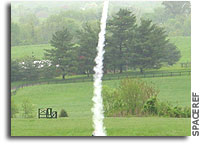
A hundred rockets soared more than a thousand feet into the sky last weekend in rural Virginia during the largest model rocket competition ever held – anywhere. With each launch soared a new career in aerospace. While some lucky teams walked away with prizes, all walked away winners.
The competition, titled “Team America”, was sponsored by the Aerospace Industries Association (AIA) and the National Association of Rocketry (NAR) to celebrate the 100th anniversary of flight.
According to a press release from the AIA “The top 100 teams came from 36 states across the nation, including the District of Columbia. Many of the teams’ travel expenses were paid for by AIA member companies and other companies from their home towns.”
All told some 700 students attended the event. These students represented the teams that had won previous regional competitions within which nearly 800 teams participated.
The competition’s rules focused on the launching of a rocket with two rather difficult requirements: the contestants had to build a two-stage rocket capable of flying fly to 1,500 feet “no more, no less”, release a payload consisting of two raw eggs, and then parachute the eggs back to the ground unbroken. The lower the numeric score, the better. Zero score is ideal – only one team got that: Boonsboro High School from Boonsboro, Maryland.
The competition was held at Great Meadow, a vast sylvan expanse in the midst of Northern Virginia’s “horse country”. The constant rain we’ve been having has served to make the renowned greenery of the area ever more so lush. Known for its horse racing and competitions, this facility is located south of Middleburg, home of Virginia’s landed gentry.
Among the local inhabitants is actor Robert Duval, who has a habit of walking around town as if he wasn’t the celebrity he is – indeed, I have seen him wandering the streets each of the three times I have visited in the past few years. Among Duvall’s more memorable film quotes comes from “Apocalypse Now” – “I love the smell of napalm in the morning – it smells like victory.”
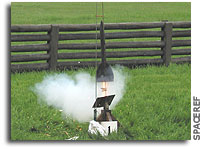
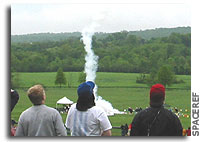
 With the humidity at 100%, and the smell of burnt rocket fuel ever-present, one could say that that there was quite a smell of success in the air at this rocket competition. After each launch, every rocket’s ascending plume was complemented by an almost organic mist of smoke which seemed to be tangled and slightly imprisoned within the luxuriant grass.
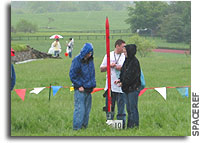
And then there was the mud. I came prepared. Others didn’t. With the rain, and the mud, some of the kids just gave up trying to stay dry all together. Despite the weather, all of the teams seemed undaunted and determined to give the competition their best.
For the most part, the rockets jumped off the pad on the first try, dropped their first stage, lit their second, and then deployed their parachute. Then there were the less than nominal launches. One in particular came a little close to comfort as I was up as close as one could get, trying to get some launch photos.
Each time something looked to be dangerous, the launch director would should “heads up” on the PA. Most of the time, the rocket parts would land without incident.
Every now and then parts would float down directly over the majority of the audience causing everyone to look skyward and point at the descending rocket parts. Other errant rockets remained under power as they dove back to earth making an eerily accurate recreation of V-2’s landing in downtown London.
Toward the end of the day several high power rockets were launched for demonstration purposes. These rockets dwarfed the ones used in the competition. Many use ammonium perchlorate composite propellant (APCP) as fuel. While the safety protocols followed during the competition ensure that the chance of anyone getting hurt is small – it is not zero.
Alas, in this post-911 world, these very same materials could find their way into the making of terrorist weapons. As a result tough legislation enacted to combat terrorism has had the unfortunate side effect of seriously restricting the pursuit of model rocketry.
The recently enacted Homeland Security Act contains the “Safe Explosives Act” which imposes new – and substantially increased restrictions on various forms of amateur and model rocketry – albeit not directly. Specifically, beginning on 24 May 2003, anyone wishing to purchase APCP will need an ATF permit. In addition, anyone who makes their own APCP propellants will need to get a permit. Previously, a permit was only needed if this material was to be transported across sate lines. In addition, black powder which is frequently used to make the charges that deploy parachutes from model rockets will no longer be able to be purchased without an ATF permit.
The way the legislation was written, a number of activities are affected. One United States Senator, Mike Enzi (R-WY) has taken the lead on an effort to remove these provisions. Enzi, who was once a model rocketeer himself, has introduced S.724 which would “amend title 18, United States Code, to exempt certain rocket propellants from prohibitions under that title on explosive materials.” Much more information can be found online here.
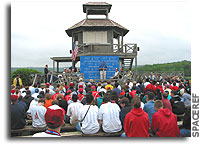
At the Awards ceremony at the end of the day (truncated by the threat of more rain) Sen. Enzi made mention of this bill and his hope that action will be taken before new regulations kick in on 24 May. Enzi mentioned that he had considered becoming an aerospace engineer at one point but that his life had taken another path. Enzi clearly sees model rocketry as important – not just in terms of education, but also in motivating young people “you will be making inventions that will help us all for years to come” he said to the contestants.
Another person closely associated with model rocketry was present – Homer Hickam the former NASA engineer who authored “Rocket Boys” the novel which served as the basis for the film “October Sky”.
Anyone who has read the book or seen the film knows Hickam’s story and how early experimentation with rocketry led to a long career at NASA. Indeed, someone in attendance gave a copy of an old model rocketry magazine to Hickam’s wife Linda. She showed me the page where a young Homer Hickam stood in front of his science fair presentation depicted in the film.
All through out the day Hickam was mobbed by kids – and their parents – and he was signing everything from rockets and books to people’s t-shirts.
Hickam has been active in pushing the Senate to act on Enzi’s bill. A hundred autographed copies of “Rocket Boys” were recently sent by Hickam, one to each Senator. The response has been rather hopeful thus far.
Hickam also addressed the contestants saying “when I told my 91 year old mother that I was going to be here today she told me “tell those kids what I told you 46 years ago: “don’t blow yourself up!” Hickam added that the “three p’s” that he and his boyhood rocket pals had coined- “passion, planning, and persistence” were just as applicable to today’s young rocket builders.
NASA was represented by Administrator Sean O’Keefe (who brought his two sons to the event) who said “there are no winners or losers – all of you are winners. You are working within a long lineage of folks who have also worked on this.” he said. Moments later, Marshall Space Flight Center Director Art Stephenson added “you are the next generation of explorers.”
NASA had a strong presence here: not only its Administrator and a center director (MSFC is heavily involved) but Astronaut Jay Apt also spent the day at the firing command center. A large traveling exhibit (including a full scale model of Robert Goddard’s first successful liquid-fueled rocket) was parked at the edge of the field, and a dozen or so representatives from other parts of the agency were present. A number of NASA educational programs were also in evidence – including the “Student Launch Initiative” and the Educator Mission Specialist program.
The path to the competition was paved with a lot of work – not just by the students, but by their parents, teachers, and the long list of corporate sponsors – ranging from industry giants such as Lockheed Martin down to mom and pop stores and bake sales back home. Despite the fact that someone eventually had to be declared the winner, I have to honestly say that I did not see a long face or any tears throughout the day.
Any activity that can challenge kids like this – and result in uniform satisfaction all around is worth emulating. As I mentioned before, the air was heavy with burnt rocket fuel. Given the reaction of the students, you could almost smell a thousand careers being launched – all accompanied by the unmistakable roar of a rocket jumping up into the sky.