
Towards a deterministic model of planetary formation. III. Mass distribution of short-period planets around stars of various masses
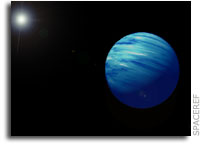
http://images.spaceref.com/news/extrasolar.28.jpg
Astrophysics, abstract
astro-ph/0502566
From: Shigeru Ida [view email]

Date: Mon, 28 Feb 2005 08:34:54 GMT   (293kb)
Towards a deterministic model of planetary formation. III. Mass
distribution of short-period planets around stars of various masses
Authors:
S. Ida,
D. N. C. Lin
Comments: accepted for publication in Astrophys. J
The origin of a recently discovered close-in Neptune-mass planet around GJ436
poses a challenge to the current theories of planet formation. Based on the
sequential accretion hypothesis and the standard theory of gap formation and
orbital migration, we show that around M dwarf stars, close-in Neptune-mass
ice-giant planets may be relatively common, while close-in Jupiter-mass
gas-giant planets are relatively rare. The mass distribution of close-in
planets generally has two peaks at about Neptune mass and Jupiter mass. The
lower-mass peak takes the maximum frequency for M dwarfs. Around more massive
solar-type stars (G dwarfs), the higher-mass peak is much more pronounced.
These are because planets tend to undergo type II migration after fully
accreting gas around G dwarfs while they tend to migrate faster than gas
accretion around M stars. Close-in Neptune-mass planets may also exist around G
dwarfs, though they tend to be mostly composed of silicates and iron cores and
their frequency is expected to be much smaller than that of Neptune-mass
planets around M dwarfs and that of gas giants around G dwarfs. We also show
that the conditions for planets’ migration due to their tidal interaction with
the disk and the stellar-mass dependence in the disk-mass distribution can be
calibrated by the mass distribution of short-period planets around host stars
with various masses.
Full-text: PostScript, PDF, or Other formats
References and citations for this submission:
SLAC-SPIRES HEP (refers to ,
cited by, arXiv reformatted);
CiteBase (autonomous citation navigation and analysis)
Which authors of this paper are endorsers?



