The Use of Transit Timing to Detect Extrasolar Planets with Masses as Small as Earth
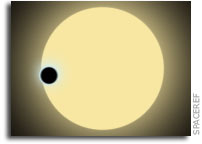
http://images.spaceref.com/news/extrasolar.40.jpg
Astrophysics, abstract
astro-ph/0412028
From: Matthew J. Holman [view email]

Date: Wed, 1 Dec 2004 18:31:17 GMT   (251kb)
The Use of Transit Timing to Detect Extrasolar Planets with Masses as
Small as Earth
Authors:
Matthew J. Holman (Harvard-Smithsonian Center for Astrophysics),
Norman W. Murray (Canadian Institute for Theoretical Astrophysics, University of Toronto)
Comments: 13 pages, 4 figures, submitted to Science
Future surveys for transiting extrasolar planets, including the space-based
mission Kepler (Borucki et al 2003), are expected to detect hundreds of Jovian
mass planets and tens of terrestrial mass planets. For many of these newly
discovered planets, the intervals between successive transits will be measured
with an accuracy of 0.1–100 minutes. We show that these timing measurements
will allow for the detection of additional planets in the system (not
necessarily transiting), via their gravitational interaction with the
transiting planet. The transit time variations depend on the mass of the
additional planet, and in some cases Earth-mass planets will produce a
measurable effect.
Full-text: PostScript, PDF, or Other formats
References and citations for this submission:
SLAC-SPIRES HEP (refers to ,
cited by, arXiv reformatted);
CiteBase (autonomous citation navigation and analysis)
Which authors of this paper are endorsers?