
National Environmental Policy Act; Mars Exploration Rover-2003 Project
[Federal Register: December 10, 2002 (Volume 67, Number 237)]
[Notices]
[Page 75863-75864]
From the Federal Register Online via GPO Access [wais.access.gpo.gov]
[DOCID:fr10de02-54]
NATIONAL AERONAUTICS AND SPACE ADMINISTRATION
[Notice (02-147)]
National Environmental Policy Act; Mars Exploration Rover-2003 Project
AGENCY: National Aeronautics and Space Administration (NASA).
ACTION: Notice of availability of final environmental impact statement
(FEIS) for implementation of the Mars Exploration Rover (MER)-2003
Project.
SUMMARY: Under the National Environmental Policy Act of 1969 (NEPA), as
amended (42 U.S.C. 4321 et seq.), the Council on Environmental Quality
(CEQ) Regulations for Implementing the Procedural Provisions of NEPA
(40 CFR parts 1500-1508), and NASA policy and procedures (14 CFR part
1216 subpart 1216.3), NASA has prepared a FEIS for the MER-2003
project. In the FEIS, NASA addresses the potential environmental
impacts associated with continuing the preparations for and
implementing the MER-2003 project. The purpose of the MER-2003 project
is to explore the surface of Mars.
The proposed action and preferred alternative for implementing the
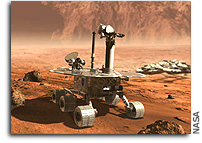
MER-2003 project includes two missions, each involving identical rover
spacecraft. NASA proposes to launch the first mission from Cape
Canaveral Air Force Station (CCAFS), Florida, in May or June 2003, on a
Delta II 7925, and the second mission from CCAFS in June or July 2003,
on a Delta II 7925 Heavy. Each rover would include two small
radioactive sources for instrument calibration and would use up to 11
radioisotope heater units (RHU) for thermal control.
NASA published a notice of availability (NOA) of the draft EIS
(DEIS) for the MER-2003 Project (67 FR 48490, July 24, 2002) and mailed
copies to 79 Federal, State and local agencies, organizations, and
individuals. In addition, NASA made the DEIS available in electronic
format on its website. The U.S. Environmental Protection Agency (EPA)
subsequently published its NOA (67 FR 48894, July 26, 2002). Comments
received during the 45-day comment period ending September 9, 2002,
have been addressed in the FEIS.
DATES: NASA will take no final action on the proposed MER-2003 missions
on or before January 9, 2003, or 30 days from the date of publication
in the Federal Register of the EPA notice of availability of the MER-
2003 project FEIS, whichever is later.
ADDRESSES: See SUPPLEMENTARY INFORMATION section for addresses for
reviewing the FEIS and obtaining copies of the record of decision.
FOR FURTHER INFORMATION CONTACT: David Lavery, Office of Space Science,
Mail Code SM, NASA Headquarters, Washington, DC 20546-0001, telephone
202-358-4800, or electronic mail marsnepa@hq.nasa.gov.
SUPPLEMENTARY INFORMATION: The proposed MER-2003 project is part of
NASA’s continuing efforts to: (1) Understand the atmosphere, surface,
and interior of Mars; (2) determine if life exists or has ever existed
on Mars; (3) and develop an understanding of Mars in support of
possible future human exploration. The aim of the MER-2003 project is
to determine the aqueous, climactic, and geologic history of two high
priority sites on Mars. In the FEIS, NASA considered and analyzed the
environmental impacts of the proposed action and the no action
alternative. The proposed action, which is the preferred alternative,
consists of continuing preparations for and implementing the MER-2003
project. The proposed action would include two missions that would
continue intensive studies of two Martian sites via identical rover
spacecraft. Operation of the rovers and their science instruments would
also benefit planning and design of future missions by: (1)
Demonstrating the capabilities and technologies for long-range
reconnaissance by mobile science platforms; (2) demonstrating complex
science operations through the simultaneous use of multiple mobile
laboratories; and (3) validating the standards, protocols, and
capabilities of the international Mars communications infrastructure.
The first mission (MER-A) would be launched on a Delta II 7925 from
CCAFS in May or June 2003. The second mission (MER-B) would be launched
on a Delta II 7925 Heavy from CCAFS in June or July 2003. Opportunities
to visit Mars occur every 26 months, but not all opportunities are the
same from the point of view of launch vehicle capability. The 2003
launch opportunity represents the most favorable opportunity for a
surface mission to Mars in decades. Programmatic issues (e.g., changes
in NASA priorities or
unforeseen circumstances), however, could necessitate modification to
the mission objectives and timing. Such modifications could result in
the need to launch one mission in 2003 and a second mission at a later
date, or not at all. Depending upon the significance of any new
information and whether any changes in the project are substantial,
NASA will consider preparing additional environmental documentation in
accordance with CEQ and NASA procedures.
For the MER-2003 missions, the potentially affected environment for
normal launches includes the area at and in the vicinity of the launch
site, CCAFS in Florida. The environmental impacts of normal launches of
the two missions for the proposed action would be associated
principally with the exhaust emissions from each of the Delta II launch
vehicles. These effects would include: (1) Short-term impacts on air
quality within the exhaust cloud and near the launch pads and (2) the
potential for acidic deposition on the vegetation and surface water
bodies at and near the launch complex, particularly if rain occurs
shortly after launch.
Potential launch accidents could result in the release of some of
the radioactive material on board the rover. Each rover would employ
two instruments that use small quantities of cobalt-57 (not exceeding
350 millicuries) and curium-244 (not exceeding 50 millicuries) as
instrument sources. Each rover would have up to 11 RHUs that use
plutonium dioxide to provide heat to the electronics and batteries on
board the rover. The radioisotope inventory of 11 RHUs would total
approximately 365 curies of plutonium.
The U.S. Department of Energy (DOE), in cooperation with NASA, has
performed a risk assessment of potential accidents for the MER-2003
project. This assessment used a methodology refined through
applications to the Galileo, Mars Pathfinder, and Cassini missions and
incorporates results of safety tests on the RHUs and an evaluation of
the January 17, 1997, Delta II accident at CCAFS. DOE’s risk assessment
for this project indicates that in the event of a launch accident the
expected impacts of released radioactive material at and in the
vicinity of the launch area, and on a global basis, would be small.
FEIS Review Copies
The FEIS may be reviewed during normal business hours at the
following locations:
- (a) NASA Headquarters, Library, Room 1J20, 300 E Street, SW., Washington, DC 20546.
- (b) Spaceport U.S.A., Room 2001, John F. Kennedy Space Center, FL 32899. Please call Lisa Fowler at 321-867-2201 so that arrangements can
- be made.
- (c) Jet Propulsion Laboratory, Visitors Lobby, Building 249, 4800 Oak Grove Drive, Pasadena, CA 91109 (818-354-5179).
In addition, the FEIS may be examined at the following NASA Centers
by contacting the Freedom of Information Act Office at the respective
Center:
- (d) NASA, Ames Research Center, Moffett Field, CA 94035 (650-604-1181).
- (e) NASA, Dryden Flight Research Center, P.O. Box 273, Edwards, CA 93523 (661-276-2704).
- (f) NASA, Glenn Research Center at Lewis Field, 21000 Brookpark Road, Cleveland, OH 44135 (216-433-2755).
- (g) NASA, Goddard Space Flight Center, Greenbelt Road, Greenbelt, MD 20771 (301-286-0730).
- (h) NASA, Johnson Space Center, Houston, TX 77058 (281-483-8612).
- (i) NASA, Langley Research Center, Hampton, VA 23681 (757-864-2497).
- (j) NASA, Marshall Space Flight Center, Huntsville, AL 35812 (256-544-2030).
- (k) NASA, Stennis Space Center, MS 39529 (228-688-2164).
Limited hard copies of the FEIS are available, on a first request
basis, by contacting David Lavery, Office of Space Science, Mail Code
SM, NASA Headquarters, Washington, DC 20546-0001, telephone 202-358-
4800, or electronic mail marsnepa@hq.nasa.gov.
Electronic Access
The FEIS is also available in Acrobat[reg] format at http://spacescience.nasa.gov/admin/pubs/mereis/index.htm
Copies of the Record of Decision
Copies of the record of decision, when issued, may be obtained upon
written request to David Lavery, Office of Space Science, Mail Code SM,
NASA Headquarters, Washington, DC 20546-0001.
Dated: December 5, 2002.
Jeffrey E. Sutton,
Assistant Administrator for Management Systems.
[FR Doc. 02-31127 Filed 12-9-02; 8:45 am]
BILLING CODE 7510-01-P



