
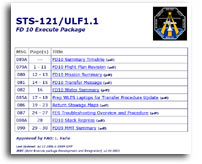
NASA STS-121/ULF1.1 FD 10 Execute Package
MSG 080 (13-0664) – FD10 MISSION SUMMARY
Page 1 of 2
Page 1 of 2, MSG 080 (13-0664)
Good morning, Discovery.
Since today is an off-duty day for you, the planning shift team has come up with a few ideas* to help you pass the time;
1) Who can toss the laptop the furthest down the station before it bounces off the wall (of course, we would appreciate it if you use Station assets for this one).
2) Arm wrestling: Big arm vs. little arm, David and Goliath II, the battle begins.
3) Boom toss – toss the boom between arms (just don’t tell the Canadians if you lose it)
4) Take all the CWCs into the Crew Lock, close the hatch, empty the CWCs and go for a swim (PBAs might be needed).
5) Lawn darts (if you need a target, remember that’s an Aggie compatible task)
6) Marco polo (the whole fish-out-of water thing would need to be tweaked though)
7) We could up-link a few appropriate computer games for you if you like – Asteroids, Space Invaders, or Star Wars’ Wing Commander.
And last but not least, here’s a haiku from our GC,
Day of Freedom Launch
Leonardo and Spacewalks
Crew now Chillaxin’
Enjoy your day off, it’s well deserved.
*None of these ideas have been approved by the MMT
YOUR CURRENT ORBIT IS: 191 X 177 NM
MSG 090 (13-0669) – FD09 MMT SUMMARY
Page 1 of 2
Page 1 of 2, MSG 090 (13-0669)
FD9 MMT Crew Summary
At the FD9 MMT both Programs were extremely happy with the results of EVA 3 including the get-ahead task of transferring the grapple bar to ISS. FYI-The spatula that was released inadvertently during the EVA is well clear of the orbiter and ISS. It was 4 miles in front of the ISS/Shuttle at crew sleep on FD9 and continues to move in front of and below the ISS with the distance increasing about 2 miles each rev. Overnight, we were able to get additional video of the SSRMS LEE snare cable using orbiter cameras A, B and C. With these pictures, we were able to clear the SSRMS for all FD11 activities including the MPLM and SSRMS walk off activities. The pictures confirm that the cable is not far enough out of the groove to interfere with grapple operations. There is no concern with MPLM reberth. The MMT also reviewed the late inspection analysis and reporting timeline and the details of that discussion are included below. The most significant item of discussion was two separate, distinct, unrelated APU problems: APU 1 fuel tank pressure decay and the APU 3 heater issues. More details on this subject and a few others are provided below.
Late Inspection – As you know LDRI will be used on FD11 to inspect the port wing and after undock on FD12 to inspect the starboard wing and nose cap. The imagery team and Debris Assessment Team (DAT) are estimating no more than 15 hours to review the port wing data. The starboard wing and nose cap should take no more than 18 hours. The DAT recommendation for entry will be provided to the flight control team no later than 11/19:30 MET which is in the middle of the crew day on FD13. The crew and MCC ops team will press on with the nominal day before entry activities and will only change course of action if formally notified by the MMT. The MMT stressed that this activity cannot and will not interfere with normal entry planning and preparation unless there is a significant item uncovered in the LDRI data. The good news is that the DAT and Imagery teams did a great job on FD2 and on FD4 and will have the data and experience from these earlier inspections to draw upon for the late inspection.
Transfer – The preliminary estimates from FD9 are that the MPLM is still ahead of schedule with about 90% of the total MPLM transfer complete with approximately 93% of the re33 supply and 89% of the return compete. The middeck transfer is ahead of schedule and is ~80% complete (75% re-supply/86% return complete) based on the data presented at the MMT. The MPLM weight will be ~55 lbs greater than what was analyzed pre-flight but the cg and individual rack mass properties are within VLA tolerances and all loads remain valid with positive margin. Additionally a total of 70-75 lbs of N2 has been transferred to the ISS.
APU 1 Tank Pressure Decay – The APU 1 fuel pressure is decaying differently than the other two tanks which is indicative of a small N2 or hydrazine leak. The data is very subtle so it has taken eight days to detect this change in slope between the three APU fuel tank plots. APU 2 and APU 3 shows a normal pressure decay of 6 psi over the eight days of the mission. This is due to the temperature change in the tanks which is caused by a 9-10 degrees Fahrenheit decrease in the tank temperatures as the aft structure cools. It takes some time to see this change because ascent does a good job of warming up this part of the vehicle. APU 1 Tank pressure has dropped a total of 22 psi over these eight days which is indicative of a leak which is most likely N2. The Entry Flight Director, CB Reps, and the entire APU community are meeting several times daily to understand the data and determine a forward plan of action. There was an N2 leak at the QD panel during a portion of the STS-121 OPF flow that was later fixed; that has many in the community thinking that the leak is N2. Analysis is in work to determine if it is feasible to leak hydrazine based on the very slow leak rate and the propensity of hydrazine to freeze and slow an actual 1 fuel leak. We hope to have more details on this subject tomorrow but as of today there is no change to any mission plans based on the data collected. The APU is not considered failed and the N2 pressure will be more than 100 psi above the lower operating limit at EOM.
APU 3 GG/Fuel Line/Pump/Valve Heater – Both the A and B heaters appear to be controlling at their upper limit on the overtemp thermostat. Initially the B heater appeared to fail ON, as indicated by the Supply Line Temp, increasing from ~82 deg F to 190 deg F. The heater then operated nominally for two cycles, and then failed ON again. MMACS asked to reconfigure the heater to the A system, where it is also operating on the overtemp thermostat. There are a few theories on the failure mode that could affect both the A and B heaters. This area was reworked before STS-121 with a new sealant such that the heaters were removed and rewrapped. If the wrap came loose on orbit, it would bias both thermostats cold and would appear as a failed on heater. If the heater is debonded, a similar signature would be expected. The teams continue to meet multiple times each day on this topic and additional data will be provided as the analyses mature. APU 3 is not considered failed for entry at this time and there are no significant impacts to entry operations.



