NASA Space Station On-Orbit Status 28 Oct 2003
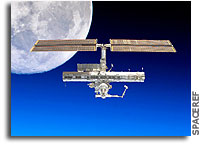
Welcome back home, Yuri, Ed and Pedro! After over half a year in space (182 days aboard ISS), the Expedition 7 crew landed successfully in Kazakhstan last night at 9:41pm EST in the 6S/Soyuz TMAS-2 Descent Module, bringing Expedition 7’s total mission elapsed time (MET), from launch to landing, to 184 days 22 hrs 47 min.
6S undocking of Malenchenko, Lu and Duque occurred right on time at 6:14pm EST in local daylight. [Hatch closure was at 3:14pm. After undock command at 6:14pm, separation springs imparted the spacecraft a delta-V of 0.12 m/s, followed at 6:19pm by a separation burn of 0.56 m/s delta-V. The spacecraft was visible to the ISS crew through nadir-facing windows until the station maneuvered from undock attitude back to LVLH duty attitude at 6:48pm. The four-minute deorbit burn began at 8:47pm, providing a directed braking impulse of 115 m/s delta-V in orbital nighttime, followed by entry interface at 9:17pm shortly before orbital sunrise. Landing site was at 49.57 N Lat, 67.02 E long, near the city of Arkhalyk in Turgay province of Kazakhstan (capital: Astana). After awaiting better weather conditions in Arkhalyk, the crew boarded the helicopter for the flight to Astana at 2:51am, accompanied by ISS Program Director Bill Gerstenmaier. The ISS crew was informed immediately of the flawless landing.]
On board the ISS, now under new management, all systems continue to function nominally, except as noted previously.
After sleeping in until 6:30am EST to make up for last night’s late turn-in, the new crew, Commander/Science Officer (CDR/SO) Michael Foale and Flight Engineer (FE) Alex Kaleri, began having the huge space station all to themselves, with an off-duty day for well deserved rest and acclimatization to the new living environment.
FE Kaleri destowed and started out on the Russian biomedical Braslet-M/Anketa (“bracelet/questionnaire”) test procedure which requires him evaluate a number of “bracelet” cuffs for their usefulness in suppressing the adverse effects of micro-G for the “newcomer” aboard the station during the acute phase of adaptation to weightlessness. [The “bracelets” are compression cuffs attached to a belt and worn on the upper thighs over the coveralls, intended as countermeasures against the initial micro-G effects of blood filling (vascularity) in the upper torso (heaviness and blood pulsation in the head), facial puffiness, nasal stuffiness, painful eye movement, and vestibular disorders (dizziness, nausea, vomiting). They create artificial blood accumulation in the upper thirds of the thighs, causing some of the circulating blood volume to relocate from the upper body to the lower extremities, thereby (hopefully) correcting the adverse hemodynamic effect of micro-G and thus improving the crewmember’s working capability. The actual compression cuff in the Braslet-Ì units is a combination of alternating multi-layer tensile and non-tensile elements, whose distension by body movements creates elastic forces that produce the necessary pressure on the body surface.]
Mike Foale installed a CCAA (common cabin air assembly) bypass jumper hose in the Airlock (A/L) TCS LTL (thermal control system low temperature loop).
Later, the A/L CCAA was deactivated by ground command, and Foale reconfigured the air duct, no longer required for crew comfort for the time being after the successful EMU activities last week.
In the Service Module (SM), Mike performed the routine technical maintenance of the SM’s SOZh environment control & life support system, incl. the toilet equipment (ASU).
Later, Mike called down the current O2 partial pressure of the cabin air. [O2 trending data are collected daily by the crew with the U.S. CSA-CP (compound specific analyzer-combustion products).]
The crew performed their physical exercise on TVIS treadmill (Foale) and VELO cycle ergometer with load trainer (Kaleri), starting out with a one-hour workout each.
The three-day leak test of the QDs (quick disconnects) on the low-pressure O2 line in the Airlock was terminated yesterday. [There were no indications of a leak in the O2 systems, but the test was performed to eliminate any possibility of a leak being masked by additional system malfunctions. The crew had been notified and informed of what to do in the event they need to access the O2 system.]
An energetic solar particle event (>100 MeV protons went above 1 particle flux unit) began at 6:52am EST. This increased the radiation dose rates at the high geomagnetic latitudes. At 7:50am EST the vehicle made its first pass through one of these high radiation areas, which put the crew into a “radiation contingency” (according to Flight Rule B14-7). The crew was informed of today’s high-dose-rate passes, and they were given the higher shielded locations within ISS (aft end of the SM and TESS [temporary sleep station]). The ISS will phase out of the high radiation areas (high magnetic latitudes) until approximately the same times tomorrow on 11/29.
ESA reported that Pedro Duque’s Cervantes program was a complete success, with results for all 22 Experiments (two physical science experiments, using the MSG Glovebox, four biological experiments, four human physiology experiments and several educational experiments and technology demonstrations). During his mission, Pedro Duque had numerous contacts with the media from Spain and Germany, talked via amateur radio with primary schoolchildren, winners of the Habla ISS competition, and spoke live from the ISS to Spanish President José María Aznar.
ISS Orbit (as of this morning, 6:38am EDT [= epoch]):
- Mean altitude — 379.1 km
- Apogee — 383.5 km
- Perigee — 374.6 km
- Period — 92.1 min.
- Inclination (to Equator) — 51.63 deg
- Eccentricity — 0.0006555
- Orbits per 24-hr. day — 15.63
- Mean altitude loss in last 24 hours — 100 m
- Revolutions since FGB/Zarya launch (Nov. ’98) — 28183
- For more on ISS orbit and worldwide naked-eye visibility dates/times, see http://www.hq.nasa.gov/osf/station/viewing/issvis.html