
NASA Space Station On-Orbit Status 20 Jan 2004
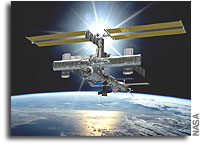
All ISS systems continue to function nominally, except as noted previously or below. Day 94 in space for Expedition 8 (92 days aboard ISS).
After station inspection and morning hygiene, before breakfast and first exercise, CDR/SO Michael Foale and FE Alexander Kaleri performed their sixth session of the periodic Russian biomedical assessments PZEh-MO-8 (body mass measurement) and PZEh-MO-7 (calf volume measurement). [Kaleri set up the BMM mass-measuring device, which uses calibrated springs to determine the subject’s mass in weightless space, and stowed it away after the tests. Calf measurements (left leg only) are taken with the ISOG device, a custom-sewn fabric cuff that fits over the calf, using the knee and lower foot as fixed reference points, to provide a rough index of deconditioning in zero-G and effectiveness of countermeasures.]
Mike Foale worked in the Airlock (A/L), reconfiguring its systems after last weekend’s leak-check isolation period. The task will be continued tomorrow. [This included reconfiguring the ELPS (emergency lighting power supply) and disconnecting the PCA VRA (pressure control assembly/vent relief assembly) power cable. Afterwards, the PCA was activated again from the ground. The work also included an inspection of panel clearance, with the intent to assure good clearance from the A/L panel # 1D0 to the VRA connectors, to prevent potential further connector damage. If clearance is OK, closeout panels can be reinstalled. If clearance is insufficient, the ELPS stays unpowered and panels are left uninstalled while the configuration is assessed.]
Later Foale continued post-isolation clean-up, transferring items from the Russian segment (RS) back to the U.S. segment (USOS).
The FE continued his current round of monthly preventive maintenance on RS air ventilation systems, today in the “Pirs” DC-1 docking compartment, where he cleaned the two PF1 & PF2 dust filters of its air duct system as well as the protective mesh screens of the V1 & V2 ventilator fans (last time done: 12/23).
Kaleri configured the Service Module (SM) Kurs-P automated rendezvous and approach radio system, for which he had collected equipment last week (1/15), today making connections as far as the signal amplifier. [Sasha was instructed to deactivate Kurs-P beforehand, to make connections wearing anti-static bracelets and to protect cables & connectors from mechanical damage, e.g., no bends with less than 100 mm in radius. The Kurs-P reconfiguration is intended for the upcoming Progress 13P docking on 1/31 (GMT). RSC-Energia wants to use the Kurs-P antenna (AKR-VKA) No. 2 on the tip of the SM starboard solar array No. 4, and the Soyuz TMA-3 Kurs-A antenna No. 3. Moscow will test a configuration that uses one omnidirectional antenna on a docked Soyuz/Progress, as a potential backup to the port-side SM Kurs-P antenna No. 1, which has suffered intermittent loss-of-signal anomalies during 7P and 5S rendezvous.]
The FE performed his third session with the Russian MedOps cardio experiment MO-1 (Study of the Bioelectric Activity of the Heart at Rest), with the CDR as CMO. [During the 30-min. test, the crew tagged up with ground specialists on a Russian ground site (RGS) pass on Daily Orbit 14 and downlinked data from the Gamma-1M ECG (electrocardiogram) for about 5-6 minutes.]
In the SM, Alex Kaleri switched channel #1 of the BMP harmful impurities unit from Regeneration back to Purify mode. Later, he started the regeneration cycle on absorbent bed #2. [The “baking-out” of the filter beds is repeated every 20 days. Each bakeout to space vacuum takes about 24 hours.]
Kaleri deployed two passive FMK (formaldehyde monitoring kit) sampling badges in the Lab (below CEVIS) and SM (most forward handrail), to catch any atmospheric formaldehyde on a sampling substrate for subsequent analysis.
Sasha also completed the daily RS life support systems (SOZh) maintenance (including toilet facility, food containers, water containers and solid waste containers) and prepared the daily IMS (inventory management system) “delta” update file.
Mike completed the periodic (every other week) inspection of the RED (resistive exercise device).
The crew performed their regular physical exercise on TVIS treadmill, RED, CEVIS ergometer and VELO bike with force loader.
Kaleri downloaded exercise files to the medical equipment computer (MEC) and performed the weekly maintenance of the TVIS, including the newly required weekly inspection of the TVIS wire ropes for signs of fraying.
At end of day, Sasha set up the test equipment for the periodic Russian MO-10 “Hematokrit” testing, scheduled for tomorrow. [MO-10 measures the hematocrit (red cell mass) value of the blood. [As a well-known phenomenon of space flight, red blood cell mass (normal range: 30-45%) tends to go down over time.]
Launch support activities planning has begun for the upcoming Soyuz TMA-4 (ISS Flight 8S) launch delivering the Expedition 9 crew to the ISS and for the landing of Soyuz TMA-3 (ISS Flight 7S) with the Expedition 8 crew onboard. Launch of 8S from the Baikonur Cosmodrome is planned for 4/19. The Expedition 8 crew is expected to land in Kazakhstan approximately 10 days after 8S launch. Joining the Expedition 9 crew with ISS CDR Leroy Chiao and FE Valery I. Tokarev will be ESA guest cosmonaut Andr Kuipers for his short-term visit to the ISS, returning with Mike Foale and Alex Kaleri.
Today’s CEO (crew earth observations) targets, in the current XPOP attitude constrained by flight rule to fewer near-vertical targets due to Lab window shutter closure and current condensation-prevention plan, were Falklands plankton blooms (Dynamic event. The SeaWiFS satellite shows the most vigorous blooms north of the Falkland Islands in the last two days: nadir pass. Two passes), S Georgia icebergs (Dynamic event. Crew was to look right about 2 deg off track for the big 1998 Weddell Sea icebergs [right and rearwards to get the South Georgia islands into any views]), SW Sudan inland deltas (panoramas looking obliquely right of track [up to 5 deg, as far as the Nile River] were requested to document poorly known landscapes [especially highly mobile stream courses]. A series of nested inland deltas is generating scientific interest [the size and number of inland deltas has been unappreciated by geologists]. This landscape is likely a new analog for known oil-rich rocks buried far beneath the surface), and New Zealand plankton (Dynamic event. SeaWiFS images show strong blooms around New Zealand’s South Island. Nadir views and views left and right of track were requested, including coastline features where possible).
CEO images can be viewed at the websites.
See also the website “Space Station Challenge” at
ISS Orbit (as of this morning, 2:58am EST [= epoch]):
- Mean altitude — 370.0 km
- Apogee — 375.5 km
- Perigee — 364.6 km
- Period — 91.9 min.
- Inclination (to Equator) — 51.63 deg
- Eccentricity — 0.0008062
- Orbits per 24-hr. day — 15.66
- Mean altitude loss last 24 hours — 135 m
- Revolutions since FGB/Zarya launch (Nov. ’98) — 29496
For more on ISS orbit and worldwide ISS naked-eye visibility dates/times, see http://www.hq.nasa.gov/osf/station/viewing/issvis.html



