
NASA Space Station On-Orbit Status 16 May 2004
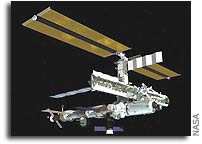
All ISS systems continue to function nominally except those noted previously. Sunday — off-duty for the crew.
CDR Padalka completed the weekly data collection of the Service Module (SM)’s toilet flush counter readings, with inspection of the urine collection (SP) & pretreat assembly and water supply status (SVO) counter readings, both for calldown to MCC-M/TsUP.
FE/SO Fincke performed the daily leak check of the Lab window’s inter-pane space (“Volume D”), using the “Aeolus” scopemeter with pressure probe.
Mike also had his weekly PFC (private family conference) via S-/Ku-band audio/video.
Working off the Russian discretionary task list, prior to physical exercise Gennady Padalka performed another session with the VC6 “Delta” program’s ETD experiment (Investigation of the Coordination of Eye and Head Movements). [After a calibration with the calibrating unit, the experiment investigated eye and head movement coordination, measured Listing’s plane, and determined the orientation of the vestibulo-ocular coordinate system. Each step required another prior calibration run, using visual target cues or the calibration unit.]
The crew unstowed the “Urolux” and PHS (periodic health status) equipment and set it up for their first session with the PZE MO-9 biochemical urinalysis test and PHS assessment, on tomorrow’s schedule for both crewmembers. [PZE MO-9 is conducted regularly every 30 days (and also before and after EVAs) and is one of five nominal Russian medical tests adopted by NASA for US crewmembers for IMG PHS (Integrated Medical Group/Periodic Health Status) evaluation as part of the “PHS/Without Blood Labs” exam. The analysis uses the sophisticated in-vitro diagnostic apparatus “Urolux” developed originally for the Mir program, and its results are entered in the medical equipment computer (MEC)’s special IFEP software (In-Flight Examination Program).]
Update on Reboost: Latest calculations for the ISS reboost scheduled for 5/18, at 12:49pm EDT TIG (time of ignition), now predict a burn duration of the Progress 13P thrusters of 7min 27s, for a delta-V of 2.25 m/s (7.38 ft/s), resulting in a mean altitude increase of 3.74 km (2.32 mi.). The station’s burn attitude this time will incorporate a 15 deg yaw, so that orbit inclination will also undergo a change,- by 0.004 degrees. [Since the last inclination correction roughly three years ago orbit inclination has decreased by approximately 0.01 deg to a current value roughly mid-way between the groundruled range of 51.62-51.68 deg. The lower limit would be approached in approximately 5 years, but doing part of the upward correction right now (while ISS mass is still low compared to Assembly Complete), propellant is more efficiently used. Once the inclination is adjusted to the upper limit, no further inclination adjustments should be required for the remaining life of the ISS.]
Today’s optional CEO targets, in the current LVLH attitude no longer limited by flight rule constraints on the use of the Lab nadir/science window, except for the shutter closure and condensation-prevention plan (limited to 90 min. in 24 hours), were East Indonesia (Dynamic event. Clear weather likely to persist over the string of smaller islands from Timor looking west to Java. All these islands are based on volcanoes. Panoramas of this chain of volcanic islands can be dramatic), Sumatra, Indonesia (Dynamic event. ISS passed over this large island crosswise from SW to NE with cloudfree conditions), Singapore (nadir pass over the island state at the tip of the Malay Peninsula. British guns in WWII were all emplaced facing out to sea. They were useless against the successful Japanese land attack which came down the peninsula from the north), Typhoon Nida, Philippines (Dynamic event. Predicted to be a category 3 storm by today, the crew should have gotten a good high oblique view–looking right in the low light of a setting sun), Betsiboka River Delta, Madagascar (nadir pass. Opportunity, between clouds, to get the delta at a different tidal phase. Underwater details should reveal the centers of new islands that will grow and become vegetated in the next decade), Zambian fires (Dynamic event. ISS pass crossed southern Africa towards the NE. Fires should have been visible in the thicker savanna forests the further north the station tracked in Zambia [following the line of increasing rainfall]. At the start of this 3-minute pass, the crew was to look just right for the most famous southern African wetland [the “Okavango inland delta” megafan] and then the vast Barotseland swamps of western Zambia left), and Omo River Delta, Ethiopia (looking left at the northernmost point of Lake Turkana for the delta of the Omo River. This river drains the south side of the Ethiopian Plateau. The non-outlet Lake Turkana is thus a sensitive barometer of precipitation in a large basin, and is especially interesting after this relatively long period of non-El Nino conditions).
CEO images can be viewed at the websites.
See also the website “Space Station Challenge” at
ISS Orbit (as of this afternoon, 3:22pm EDT [= epoch]):
- Mean altitude — 360.4 km
- Apogee — 367.7 km
- Perigee — 353.1 km
- Period — 91.75 min.
- Inclination (to Equator) — 51.6267 deg
- Eccentricity — 0.0010869
- Orbits per 24-hr. day — 15.69
- Mean altitude loss last 24 hours — 73 m
- Revolutions since FGB/Zarya launch (Nov. ’98) — 31339
For more on ISS orbit and worldwide ISS naked-eye visibility dates/times, see http://www.hq.nasa.gov/osf/station/viewing/issvis.html



