NASA Mars Exploration Rover Update: Opportunity Goes Sightseeing
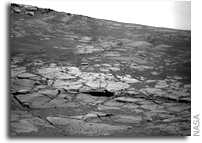
Opportunity Status for sol 1484-1490
Opportunity has begun the drive toward a spectacular cliff in the wall of “Victoria Crater” known as “Cape Verde,” about 30 meters (98 feet) away. The rover is expected to complete the drive in 6 to 7 segments, each covering an average distance of 5 meters (16 feet).
Along the way are several sandy patches. Before entering these sandy areas, Opportunity will stop for a “toe dip” — a scuff with the front wheels to assess the depth of the sand. Rover planners hope the sandy spots will turn out to be bedrock with only a sandy veneer.
Opportunity executed the first of the toe dips upon arriving at a sandy patch on Sol 1489 (April 1, 2008). The scuff was successful. Electrical currents indicated that despite relatively deep sand on both sides, the wheels had good purchase. The sand was 4 centimeters (1.5 inches) deep on the left and 6 to 8 centimeters (2 to 3 inches) deep on the right. The tilt of the rover indicated that the left wheel encountered rock quickly, experiencing large vibrations after a short, smooth period. The right wheel got into deep sand after only brief contact with rock. Wheel slip and bogie (wheel suspension) angles indicated the rover moved backward about 3 centimeters (1 inch) during the scuffing. Rover planners concluded that the terrain was drivable but required caution.
Opportunity remains healthy and all subsystems are performing as expected. Energy is around 360 watt-hours (100 watt-hours is the amount of energy needed to light a 100-watt bulb for one hour). As of sol 1490 (April 2, 2008), Tau measurements of atmospheric opacity caused by dust stood at 0.65. The dust factor, a measure of the proportion of sunlight penetrating dust on the solar arrays, stood at 0.69.
Power may fluctuate slightly as Opportunity continues the drive toward the Cape Verde promontory, depending on the slopes of the local terrain and the rover’s attitude relative to the Sun.
Sol-by-sol summary
In addition to receiving morning instructions directly from Earth via the rover’s high-gain antenna, sending data back to Earth via the UHF antenna on the Mars Odyssey orbiter, measuring atmospheric dust with the panoramic camera, monitoring dust accumulation on the rover mast, and surveying the sky for clouds with the navigation camera, Opportunity completed the following activities:
Sol 1484 (March 27, 2008): Opportunity began the drive to Cape Verde, advancing 5.55 meters (18.2 feet) and pausing midway through the drive to take full-color images, using all 13 filters of the panoramic camera, of the hole in the Gilbert rock layer created with the rover’s rock abrasion tool. After the drive, Opportunity acquired a 3-by-1 mosaic of images with the navigation camera and a 3-by-2 mosaic of images with the panoramic camera. The rover went into a deep sleep.
Sol 1485: After relaying data to Odyssey, Opportunity spent six hours using the alpha-particle X-ray spectrometer to measure argon gas in the Martian atmosphere and went into a mini-deep sleep.
Sol 1486: Opportunity advanced another 5.02 meters (16.5 feet) toward Cape Verde, acquired a post-drive, 3-by-1 tier of navigation-camera images, and went into a deep sleep.
Sol 1487: Opportunity acquired six movie frames in search of clouds with the navigation camera and a 6-by-3 mosaic of the base of the Cape Verde cliff. After relaying data to Odyssey, Opportunity spent six hours measuring atmospheric argon and went into a mini-deep sleep.
Sol 1488: Opportunity acquired six movie frames in search of clouds with the navigation camera, recharged the battery, and went into a deep sleep.
Sol 1489: Opportunity drove another 4.97 meters (16.3 feet) toward Cape Verde and acquired a 3-by-1 tier of post-drive, navigation-camera images. The rover also acquired post-drive shadow images of Cape Verde and went into a deep sleep.
Sol 1490 (April 2, 2008): Opportunity acquired a 5-by-1 tier of shadow images of Cape Verde, recharged the battery, and went into a deep sleep. Plans for the following morning called for the rover to take thumbnail images of the sky for calibration purposes with the panoramic camera.
Odometry
As of sol 1489 (April 1, 2008), Opportunity’s total odometry was 11,686.77 meters (7.26 miles).