
NASA ISS On-Orbit Status 8 April 2012
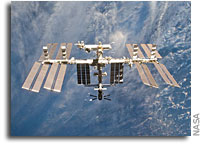
ISS On-Orbit Status 04/08/12
All ISS systems continue to function nominally, except those noted previously or below. Easter Sunday – Crew off duty. Ahead: Week 20 of Increment 30 (six-person crew).
HAPPY EASTER! С праздником Пасхи!
[Note: Russia’s Orthodox Church observes Easter (Pasha) this year on April 15, on the basis of the Julian calendar and the “paskhalias” – i.e. special “paschal” lunar tables – with khristosovanie traditions like triple kiss exchange and red eggs.]
After wakeup, FE-1 Shkaplerov performed the routine inspection of the SM (Service Module) PSS Caution & Warning panel as part of regular Daily Morning Inspection.
FE-6 Pettit continued his 4th (FD120) Pro K session with Day 3 for a 5-day period, with diet logging after the urine pH spot test. After recording his diet input today, Don broke out and set up the equipment for the associated urine collections tomorrow (4/9). Blood sampling will follow on Tuesday (4/10). [For Pro K, there are five in-flight sessions (FD15, FD30, FD60, FD120, FD180) of samplings, to be shared with the NUTRITION w/Repository protocol, each one with five days of diet & urine pH logging and photography on the last day (science sessions are often referred to by Flight Day 15, 30, 60, etc. However, there are plus/minus windows associated with these time points so a “Flight Day 15” science session may not actually fall on the crewmember’s 15th day on-orbit). The crewmember prepares a diet log and then annotates quantities of food packets consumed and supplements taken. On Days 4 & 5, urine collections are spread over 24 hrs; samples go into the MELFI (Minus Eighty Laboratory Freezer for ISS) within 30 min after collection. Blood samples, on the last day, are centrifuged in the RC (Refrigerated Centrifuge) and placed in MELFI at -80 degC. There is an 8-hr fasting requirement prior to the blood draw (i.e., no food or drink, but water ingestion is encouraged). MELFI constraints: Maximum MELFI Dewar open time: 60 sec; at least 45 min between MELFI dewar door openings.]
FE-1 Shkaplerov completed the routine daily servicing of the SOZh system (Environment Control & Life Support System, ECLSS) in the SM and FGB. [This included the weekly collection of the toilet flush (SP) counter and water supply (SVO) readings for calldown to TsUP-Moscow, as well as the weekly checkup on the Russian POTOK-150MK (150 micron) air filter unit of the SM’s & FGB’s SOGS air revitalization subsystem, gathering weekly data on total operating time & “On” durations for calldown. SOZh servicing includes checking the ASU toilet facilities, replacement of the KTO & KBO solid waste containers and replacement of EDV-SV waste water and EDV-U urine containers.]
CDR, FE-1 & FE-4 were scheduled for their weekly PFCs (Private Family Conferences), via S-band/audio and Ku-band/MS-NetMeeting application (which displays the uplinked ground video on an SSC laptop), Anton at ~10:50am, Dan at ~5:30pm, Oleg ~12:20pm EDT.
At ~1:40pm, Shkaplerov, Ivanishin & Kononenko are scheduled to support two Russian PAO events, downlinking greetings & well-wishes to (1) the International Youth Science Conference XXXVI Gagarin Readings, held between April 5 & 14 in Moscow at Russia’s K. E. Tsiolkovsky State Technology University (MATI); and (2) the participants of the UNESCO/ICES-hosted 13th Russian National Constellation Olympiad in Korolev in April, highlighting Man-Earth-Space environmental science and educational projects by children and young people. [The XXXVI Gagarin Readings’ science topics and their practical applications provide a great contribution to the training of specialists for aviation & space industries and the conference itself maintains a long standing tradition of promoting the achievements of national cosmonautics. The conference will be attended by representatives of over 100 training centers in Russia, former USSR republics and other countries.]
The crew worked out with their regular 2-hr physical exercise protocol on the CEVIS cycle ergometer with vibration isolation (FE-6), TVIS treadmill with vibration isolation & stabilization (FE-1, FE-2, FE-4), ARED advanced resistive exerciser (CDR, FE-1, FE-2, FE-5, FE-6), T2/COLBERT advanced treadmill (CDR, FE-5), and VELO ergometer bike with load trainer (FE-4). [FE-6 is on the special experimental SPRINT protocol which diverts from the regular 2.5 hrs per day exercise regime and introduces special daily sessions, followed by a USND (Ultrasound) leg muscle self scan in COL. Today’s exercise called for CEVIS, with ARED+T2, T2, ARED+T2 & CEVIS, following in the next 4 days. If any day is not completed, Don picks up where he left off, i.e., he would be finishing out the week with his last day of exercise on his off day
Tasks listed for Shkaplerov, Kononenko & Ivanishin on the Russian discretionary “time permitting” job for today were –
* A ~30-min. run of the GFI-8 “Uragan” (hurricane) earth-imaging program with the NIKON D3X digital camera with Sigma AF 300-800mm telelens, focusing on volcanoes Cordon-Kaul & Hudson, and the glaciers of Patagonia;
* A 10-min. photography session for the DZZ-13 “Seiner” ocean observation program, obtaining HDV (Z1) camcorder footage of color bloom patterns in the waters of the South-Eastern Pacific, then copying the images to the RSK-1 laptop,
* A ~30-min. session for Russia’s EKON Environmental Safety Agency, making observations and taking KPT-3 aerial photography of environmental conditions on Earth using the NIKON D3X camera with the RSK-1 laptop, and
* More preparation & downlinking of reportages (written text, photos, videos) for the Roskosmos website to promote Russia’s manned space program (max. file size 500 Mb).
No CEO (Crew Earth Observation) targets uplinked for today.
ISS Orbit (as of this morning, 5:20am EDT [= epoch])
Mean altitude – 393.0 km
Apogee height – 398.4 km
Perigee height – 387.7 km
Period — 92.42 min.
Inclination (to Equator) — 51.64 deg
Eccentricity — 0.0007906
Solar Beta Angle — 57.7 deg (magnitude increasing)
Orbits per 24-hr. day — 15.58
Mean altitude loss in the last 24 hours — 80 m
Revolutions since FGB/Zarya launch (Nov. 98) — 76,713
Time in orbit (station) — 4888 days
Time in orbit (crews, cum.) — 4175 days
Significant Events Ahead (all dates Eastern Time and subject to change):
————–Six-crew operations—————-
04/19/12 — Progress M-14M/46P undock (7:03am EDT)
46P Orbital Operations
04/20/12 — Progress M-15M/47P launch (8:50:26am EDT)
04/22/12 — Progress M-15M/47P docking (~10:40am)
04/27/12 — Soyuz TMA-22/28S undock (4:19am EDT)
04/27/12 — Soyuz TMA-22/28S landing (7:45am EDT; 2:45pm DMT/Moscow) (End of Increment 30)
04/28/12 — Progress M-14M/46P deorbit burn (6:33am EDT)
————–Three-crew operations————-
04/30/12 — SpaceX Dragon launch (12:22pm EDT; target date)
05/15/12 — Soyuz TMA-04M/30S launch – G.Padalka (CDR-32)/J.Acaba/S.Revin
05/17/12 — Soyuz TMA-04M/30S docking (MRM2)
————–Six-crew operations—————-
07/01/12 — Soyuz TMA-03M/29S undock/landing (End of Increment 31)
————–Three-crew operations————-
07/15/12 — Soyuz TMA-05M/31S launch – S.Williams (CDR-33)/Y.Malenchenko/A.Hoshide
07/17/12 — Soyuz TMA-05M/31S docking
07/20/12 — HTV3 launch (~10:18pm EDT)
07/31/12 — Progress M16M/48P launch
08/02/12 — Progress M16M/48P docking
————–Six-crew operations—————-
09/17/12 — Soyuz TMA-04M/30S undock/landing (End of Increment 32)
————–Three-crew operations————-
10/15/12 — Soyuz TMA-06M/32S launch – K.Ford (CDR-34)/O.Novitskiy/E.Tarelkin
10/17/12 — Soyuz TMA-06M/32S docking
————–Six-crew operations————-
11/01/12 — Progress M-17M/49P launch
11/03/12 — Progress M-17M/49P docking
11/12/12 — Soyuz TMA-05M/31S undock/landing (End of Increment 33)
————–Three-crew operations————-
12/05/12 — Soyuz TMA-07M/33S launch – C.Hadfield (CDR-35)/T.Mashburn/R.Romanenko
12/07/12 — Soyuz TMA-07M/33S docking
————–Six-crew operations————-
12/26/12 — Progress M-18M/50P launch
12/28/12 — Progress M-18M/50P docking
03/19/13 — Soyuz TMA-06M/32S undock/landing (End of Increment 34)
————–Three-crew operations————-
04/02/13 — Soyuz TMA-08M/34S launch – P.Vinogradov (CDR-36)/C.Cassidy/A.Misurkin
04/04/13 — Soyuz TMA-08M/34S docking
————–Six-crew operations————-
05/16/13 — Soyuz TMA-07M/33S undock/landing (End of Increment 35)
————–Three-crew operations————-
05/29/13 — Soyuz TMA-09M/35S launch – M.Suraev (CDR-37)/K.Nyberg/L.Parmitano
05/31/13 — Soyuz TMA-09M/35S docking
————–Six-crew operations————-
09/xx/13 — Soyuz TMA-08M/34S undock/landing (End of Increment 36)
————–Three-crew operations————-
09/xx/13 — Soyuz TMA-10M/36S launch – M.Hopkins/TBD (CDR-38)/TBD
09/xx/13 — Soyuz TMA-10M/36S docking
————–Six-crew operations————-
11/xx/13 — Soyuz TMA-09M/35S undock/landing (End of Increment 37)
————–Three-crew operations————-
11/xx/13 — Soyuz TMA-11M/37S launch – K.Wakata (CDR-39)/R.Mastracchio/TBD
11/xx/13 — Soyuz TMA-11M/37S docking
————–Six-crew operations————-
03/xx/14 — Soyuz TMA-10M/36S undock/landing (End of Increment 38)
————–Three-crew operations————-



