
NASA ISS On-Orbit Status 6 April 2012
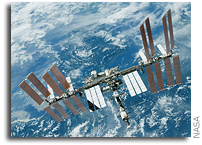
ISS On-Orbit Status 04/06/12
All ISS systems continue to function nominally, except those noted previously or below.
After breakfast, FE-2 Ivanishin performed the routine inspection of the SM (Service Module) PSS Caution & Warning panel as part of regular Daily Morning Inspection.
Upon wakeup, CDR Dan Burbank, FE-5 André Kuipers & FE-6 Don Pettit each completed another post-sleep session of the Reaction Self-Test (Psychomotor Vigilance Self-Test on the ISS) protocol, the 39th for Dan, the 33rd for André & Don. [RST is done twice daily (after wakeup & before bedtime) for 3 days prior to the sleep shift, the day(s) of the sleep shift and 5 days following a sleep shift. The experiment consists of a 5-minute reaction time task that allows crewmembers to monitor the daily effects of fatigue on performance while on ISS. The experiment provides objective feedback on neurobehavioral changes in attention, psychomotor speed, state stability, and impulsivity while on ISS missions, particularly as they relate to changes in circadian rhythms, sleep restrictions, and extended work shifts.]
FE-1 Shkaplerov terminated his 7th experiment session, started last night, for the long-term Russian sleep study MBI-12/Sonokard, taking the recording device from his Sonokard sports shirt pocket and later copying the measurements to the RSE-Med laptop for subsequent downlink to the ground. [Sonokard objectives are stated to (1) study the feasibility of obtaining the maximum of data through computer processing of records obtained overnight, (2) systematically record the crewmember’s physiological functions during sleep, (3) study the feasibility of obtaining real-time crew health data. Investigators believe that contactless acquisition of cardiorespiratory data over the night period could serve as a basis for developing efficient criteria for evaluating and predicting adaptive capability of human body in long-duration space flight.]
FE-6 Pettit began his 4th (FD120) suite of sessions with the controlled Pro K diet protocol (Dietary Intake Can Predict and Protect against Changes in Bone Metabolism during Spaceflight and Recovery), with diet logging after the urine pH spot test, for a 5-day period. After recording his diet input today, Don will begin the urine collections for pH value on Monday (4/9) and blood sampling on Tuesday (4/10). [For Pro K, there are five in-flight sessions (FD15, FD30, FD60, FD120, FD180) of samplings, to be shared with the NUTRITION w/Repository protocol, each one with five days of diet & urine pH logging and photography on the last day (science sessions are often referred to by Flight Day 15, 30, 60, etc. However, there are plus/minus windows associated with these time points so a “Flight Day 15” science session may not actually fall on the crewmember’s 15th day on-orbit). The crewmember prepares a diet log and then annotates quantities of food packets consumed and supplements taken. On Days 4 & 5, urine collections are spread over 24 hrs; samples go into the MELFI (Minus Eighty Laboratory Freezer for ISS) within 30 min after collection. Blood samples, on the last day, are centrifuged in the RC (Refrigerated Centrifuge) and placed in MELFI at -80 degC. There is an 8-hr fasting requirement prior to the blood draw (i.e., no food or drink, but water ingestion is encouraged). MELFI constraints: Maximum MELFI dewar open time: 60 sec; at least 45 min between MELFI dewar door openings.]
FE-2 Ivanishin did the T+7d inspection of the cultures taken with the ECOSFERA equipment for Stage 2 of the microbial air sampling run for the MedOps SZM-MO-21 experiment on 3/30 from ATV cabin surfaces, determining the quantity of grown organisms in the sample. [The Petri dishes with the cultures had been stowed in the KRIOGEM-03 thermostatic container at +37 degC for incubation. The equipment, consisting of an air sampler set, a charger and power supply unit, provides samples to help determine microbial contamination of the ISS atmosphere, specifically the total bacterial and fungal microflora counts and microflora composition according to morphologic criteria of microorganism colonies. Because the Ecosphere battery can only support 10 air samples on one charge, the sample collection was being performed in two stages.]
After reviewing IFM (Inflight Maintenance) procedures yesterday, FE-4 Kononenko today spent ~4 hrs installing the new EKTS (Integrated Command & Telemetry System) monoblock (Yu309) of the Regul-OS in the SM (as near as possible to the Russian ASN-M Satellite Navigation System navigation electronics units NPM-1,-2,-3,-4. Oleg then took documentary photography of the worksite. [Regul-OS is a subsystem of the RSUS Radio Control & Comm System of the RS (Russian Segment) for handling two-way voice communication, digital command/program information, and telemetry transmission via Russian RGS (Groundsites). Regul is the nominal uplink channel for all Russian commands; operating at a low data rate, it is equivalent to the US S-band system. The newly installed SA-325 block is one of three redundant transmitters, each containing a transceiver (PPA) and Digital Processor (UtsO).]
After the EKTS installation and the reactivation of BITS2-12 onboard telemetry measurement system and VD-SU control mode, flight controllers at TsUP-Moscow ran tests of the newly-installed Regul SA-325 transmitter set #1 by downlinking RS telemetry via Regul.
Also after BITS2-12 activation, the Elektron oxygen generator was powered up again, along with other RS systems which are off or without telemetry when BITS2-12 & VD-SU are off. [These other systems are: SKV air conditioners, Vozdukh carbon dioxide removal unit (no telemetry if in automatic mode, no impact if in manual mode), BMP micropurification unit, SKV-K condensate water processor, BRI data conversion unit (smart router), No dP/dt (pressure change) detection in RS, fire and smoke alarms (will annunciate with audio only onboard in the SM through the C&W panel (PSS) speaker, total pressure alarms (will annunciate with audio only onboard in the SM through the C&W panel speaker.]
CDR Burbank performed routine maintenance on the WRS (Water Recovery System) using the LFTP (Low Flow Transfer Pump) to transfer the contents of one Russian EDV water container (#977) to the WPA WWT (Water Processor Assembly / Waste Water Tank), emptying it via a particulate filter. [Transfer time: ~2h 10m. Max. allowable quantity in WWT: 89%.]
Later, Burbank completed the periodic manual fill of the WHC (Waste & Hygiene Compartment) EDV-SV (condensate container) flush water tank from the PWB (Potable Water Bus) for about 21 min, a partial fill during which WHC was not available,
In the JAXA JPM (JEM Pressurized Module), Don Pettit supported ground-commanded science research in the CBEF (Cell Biology Experiment Facility) with his 3rd CsPINs (Dynamism of Auxin Efflux Facilitators responsible for Gravity-regulated Growth & Development in Cucumber) session, fixating 2 MEU Bs (Measurement Experiment Units B) samples from the CBEF IU Micro-G IU (Incubation Unit) plus 2 MEU Bs from CBEF 1G IU in KFT (KSC Fixation Tubes) with Glutaraldehyde Paraformaldehyde and inserting the 4 KFTs (plus 1 spare if not used) into MELFI-1 (Minus Eighty Laboratory Freezer for ISS 1) at +2 degC. The dummy MEU B was detached from the CBEF Micro-G IU. [Video imagery had to be downlinked at fast via high-speed MPC (Multi-Protocol Converter) connection. CBEF was then closed out and the MSPR (Multi-purpose Small Payload Rack) communications components, consisting of VRU (Video Compression & Recording Unit), Hub and MPC.]
In the Lab, André Kuipers accessed the NanoRacks Modules 16 & 18 and collected data for subsequent transfer to the ER-1 (EXPRESS Rack 1) laptop.
Afterwards, André configured the GCP (Gas Control Panel) of the ATV-3 (Automated Transfer Vehicle) for first-time use, preparatory to atmosphere repressurization of ISS initiated by ground commanding from ATV-CC (Control Center/Toulouse). The air transfer was terminated after a repress with 10 mmHg of quantity from gas line #1. [FE-5 reoriented the AED (Air Exhaust Duct) outlet towards the GCP to maximize airflow to the GCP base since photos had shown that AED was not oriented suitably.]
Kuipers also conducted his weekly task of filling out his SHD (Space Headache) questionnaire which he started after Soyuz launch and continues on ISS (on an SSC/Station Support Computer) for every week after his first week in space.
In the SM, Kononenko worked on the RSE-1 laptop, replacing its shell #1183 (which has a failed USB connector) with a new shell (#2209) from spares. [Steps included replacement of HDDs (Hard Disk Drives) and then monitoring the RSE-1 #2209 loading with vers. 1.4 software and the loading of the #1183 RSK2 with vers. 1.0.]
With the RS STTS audio comm systems temporarily configured for crew research in MRM2 (Mini Research Module 2), Anton Shkaplerov conducted another active session for the Russian experiment KPT-10 “Kulonovskiy Kristall” (Coulomb Crystal), followed by downlinking the video footage obtained with a SONY HVR-Z1J camcorder over two RGS (Russian Groundsite) passes (12:35pm & 2:11pm) and reconfiguring STTS to nominal. [KPT-10 studies dynamic and structural characteristics of the Coulomb systems formed by charged dispersed diamagnetic macroparticles in the magnetic trap, investigating the following processes onboard the ISS RS: condensed dust media, Coulomb crystals, and formation of Coulomb liquids due to charged macroparticles. Coulomb systems are structures following Coulomb’s Law, a law of physics describing the electrostatic interaction between electrically charged particles. It was essential to the development of the theory of electromagnetism.]
FE-2 Ivanishin downloaded the new batch of structural dynamics measurements of the IMU-Ts microaccelerometer of yesterday’s ISS/ATV reboost, from the running experiment TEKh-22 “Identifikatsiya” (Identification) in MRM1 Rassvet to the RSE1 A31p laptop for subsequent downlink to the ground via OCA. [IMU-Ts is a part of the MRM1 SBI onboard measurement system, installed in PGO behind panel 104.]
Anatoly also took care of the daily IMS (Inventory Management System) maintenance, updating/editing its standard “delta file” including stowage locations, for the regular weekly automated export/import to its three databases on the ground (Houston, Moscow, Baikonur).
Anton Shkaplerov completed the routine daily servicing of the SOZh system (Environment Control & Life Support System, ECLSS) in the SM. [Regular daily SOZh maintenance consists, among else, of checking the ASU toilet facilities, replacement of the KTO & KBO solid waste containers, replacement of EDV-SV waste water and EDV-U urine containers and filling EDV-SV, KOV (for Elektron), EDV-ZV & EDV on RP flow regulator.]
Later, Anton conducted an audit/inventory of Russian post-fire protection equipment (SPPZ) to update the makeup and quantities of fire protection equipment in two SPPZ kits located in the FGB, going by an uplinked IMS listing, with ground tagup support.
FE-4 Kononenko completed his 7th data collection session for the psychological MBI-16 Vzaimodejstvie (“Interactions”) program, accessing and completing the computerized study questionnaire on the RSE-Med laptop and saving the data in an encrypted file. [The software has a “mood” questionnaire, a “group & work environment” questionnaire, and a “critical incidents” log. Results from the study, which is also mirrored by ground control subjects, could help to improve the ability of future crewmembers to interact safely and effectively with each other and with Mission Control, to have a more positive experience in space during multi-cultural, long-duration missions, and to successfully accomplish mission activities.]
Dan Burbank followed up on ground specialist findings on an ISS Safety Video shot by the crew on 1/24 which provided an excellent resource for the safety community and hardware owners to review the current (although ever changing) vehicle configuration and identify any areas of concern. [Dan’s activities today concerned the clearing of fire ports and an IMV (Intermodule Ventilation) grille shown to be obstructed in the video in Lab, Node-2, Node-3 & A/L (Airlock).]
Time again for recharging the Motorola Iridium-9505A satellite phones in the Soyuz Descent Modules, – completed by Anatoly Ivanishin for Soyuz TMA-22/28S (#232, docked at MRM2) and by Oleg Kononenko for Soyuz TMA-03M/29S (#703, docked at MRM1), a monthly routine job, 3rd time for 28S and 2nd time for 29S (last time for both: 1/12/12). [After retrieving the phones from their location in the spacecraft Descent Modules (SA, spuskayemyy apparat), the crewmembers initiated the recharge of the lithium-ion batteries, monitoring the process every 10-15 minutes as it took place. Upon completion, the phones were returned inside their SSSP Iridium kits and stowed back in the SA’s ODF (operational data files) container. The satphone accompanies returning ISS crews on Soyuz reentry & landing for contingency communications with SAR (Search-and-Rescue) personnel after touchdown (e.g., after an “undershoot” ballistic reentry, as happened during the 15S return). The Russian-developed procedure for the monthly recharging has been approved jointly by safety officials. During the procedure, the phone is left in its fire-protective fluoroplastic bag with open flap. The Iridium 9505A satphone uses the Iridium constellation of low-Earth orbit satellites to relay the landed Soyuz capsule’s GPS (Global Positioning System) coordinates to helicopter-borne recovery crews. The older Iridium-9505 phones were first put on board Soyuz in August 2003. The newer 9505A phone, currently in use, delivers 30 hours of standby time and three hours of talk, up from 20 and two hours, respectively, on the older units.]
André & Don took ~30 min to review briefing material on the JAXA SSHDTV (Super Sensitive High-Definition TV) video tasks scheduled from 4/9 for several days and then again for four days later in April. SSHDTV targets, from the Node-3/Cupola, are auroras and night views of Japan. Afterwards, Don set up the SSHDTV recorder in the Cupola with clock and time code.
Anatoly had ~1.5 hrs set aside to continue loading trash and discarded equipment on Progress 46P for disposal, while concurrently updating the IMS database.
The CDR retrieved new CSA- O2 (Compound Specific Analyzer- O2) units delivered on ATV-3 and then spent about an hour zero-calibrating the units.
In the Kibo JPM (JEM Pressurized Module), Don Pettit reconfigured a laptop cable, disconnecting it with its MMA (Microgravity Measurement Apparatus) parallel adapter card from MLT2 (MMA Laptop 2) and inserting it in the lower card slot of the Medical Laptop.
FE-6 had another time slot reserved for making entries in his electronic Journals on the personal SSC. [Required are three journaling sessions per week.]
Burbank, Kuipers & Pettit took turns as subjects for their 2nd onboard session with the 24S-delivered HMS (Health Maintenance System) Tonometry payload. Dan acted as CMO to measure Don’s & André’s intraocular pressure test; then he was the subject with Don as operator. The activities were supervised via live Ku-band video by medical ground personnel. [Data take was preceded by a skill refresher on an eye simulator, observed from the ground. Seven to 10 measurements are required for the Tonometer to calculate an eye pressure reading and the statistical confidence level. For the actual Tonometry, anesthetic eye drops (Proparacaine) are used that are effective in approx. 30 seconds and last for 20 minutes or longer. Tonometer measurements in micro-G will be used to assess the health of the crew’s eyes.]
Before sleeptime, Pettit was subject for the ocular research with the PanOptic eye test which requires application of eye drops (Tropicamide [Mydriacyl]) causing eye dilation for subsequent ophthalmic examination, performed by Burbank as CMO (Crew Medical Officer). Next, Dan underwent the eye test, administered by André as CMO. [The procedure, guided by special software on the T61p RoBOT laptop (#1026), captures still & video images of the eye, including the posterior poles, macula & optic disc with the optic nerve, for downlink and expert analysis. Prior to the test, André set up the equipment including video camera.]
Before Presleep, Burbank will turn on the MPC (Multi-Protocol Converter) and start the Ku-band data flow of video recorded during the day to the ground, with POIC (Payload Operations & Integration Center) routing the onboard HRDL (High-Rate Data Link). After about an hour, Dan turns MPC routing off again. [This is a routine operation which regularly transmits HD onboard video (live or tape playback) to the ground on a daily basis before sleeptime.]
At ~4:05am EDT, Burbank, Ivanishin, Shkaplerov, Kuipers, Kononenko & Pettit held the regular (nominally weekly) tagup with the Russian Flight Control Team (GOGU/Glavnaya operativnaya gruppa upravleniya), including Shift Flight Director (SRP), at TsUP-Moscow via S-band/audio, phone-patched from Houston and Moscow.
At ~8:30am, Dan conducted the regular IMS stowage conference with Houston stowage specialists.
At ~9:45am, Oleg, Anton & Anatoly linked up with TsUP-Moscow stowage specialists via S-band to conduct the weekly IMS tagup, discussing inventory & stowage issues, equipment locations and cargo transfers.
At ~2:50pm, the crew was scheduled for their regular weekly tagup with the Lead Flight Director at JSC/MCC-H.
The crew worked out with their regular 2-hr physical exercise protocol on the CEVIS cycle ergometer with vibration isolation (FE-5), TVIS treadmill with vibration isolation & stabilization (FE-1, FE-4), ARED advanced resistive exerciser (CDR, FE-1, FE-2, FE-5), T2/COLBERT advanced treadmill (CDR, FE-2), and VELO ergometer bike with load trainer (FE-4). [FE-6 is on the special experimental SPRINT protocol which diverts from the regular 2.5 hrs per day exercise regime and introduces special daily sessions, followed by a USND (Ultrasound) leg muscle self scan in COL. Today’s SPRINT exercise was on CEVIS. If any day is not completed, Don picks up where he left off, i.e., he would be finishing out the week with his last day of exercise on his off day If any day is not completed, Don picks up where he left off, i.e., he would be finishing out the week with his last day of exercise on his off day.]
Tasks listed for Shkaplerov, Kononenko & Ivanishin on the Russian discretionary “time permitting” job for today were –
* A ~30-min. run of the GFI-8 “Uragan” (hurricane) earth-imaging program with the NIKON D3X digital camera with Sigma AF 300-800mm telelens, focusing on the volcanoes Popocatepetl, Santa Maria, Fuego, Tanguaraua, Sangay, Huascaran, Cordon-Kaul & Hudson, the mountains of Bolivia, and the glaciers of Patagonia;
* A ~30-min. session for Russia’s EKON Environmental Safety Agency, making observations and taking KPT-3 aerial photography of environmental conditions on Earth using the NIKON D3X camera with the RSK-1 laptop, and
* More preparation & downlinking of reportages (written text, photos, videos) for the Roskosmos website to promote Russia’s manned space program (max. file size 500 Mb).
WRM Update: A new WRM (Water Recovery Management) “cue card” was uplinked to the crew for their reference, updated with their latest CWC (Contingency Water Container) water audit. [The new card (29-0008R) lists 19 CWCs (279.0 L total) for the five types of water identified on board: 1. Silver technical water (3 CWCs with 103.9 L, for Elektron electrolysis, plus 1 empty bag, all containing Wautersia bacteria; 2. Condensate water (3 CWCs with 14.0 L, plus 2 empty bags); 3. Iodinated water (7 CWCs with 121.8 L; 4. Waste water (1 bag with 10.6 L EMU waste water); and 5. Special fluid (1 CWC with 20.2 L, hose/pump flush). Also one leaky CWC (#1024) with 8.5L). Other CWCs are stowed behind racks and are currently not being tracked due to unchanging contents. Wautersia bacteria are typical water-borne microorganisms that have been seen previously in ISS water sources. These isolates pose no threat to human health.]
ISS/ATV Reboost: A one-burn reboost of the ISS with the ATV-3 OCS (Orbit Correction System) thrusters was performed yesterday as planned at 3:06pm EDT with a burn duration of 15 min 4 sec, achieving a Delta-V of 2.2 m/s (planned: 2.2 m/s), increasing mean altitude by 3.86km (planned: 3.82 km). After the burn, ISS was at 393.03 km mean altitude, with 395.61 km apogee height and 390.45 km perigee height. ISS attitude control authority was handed over to Russian MCS (Motion Control System) at ~1:20pm for ATV control in TEA (Torque Equilibrium Attitude) and was returned to US CMG momentum management at ~4:20pm. Purpose of the reboost was to set up phasing for Progress 47P launch, Soyuz 28S undock/landing and Soyuz 30S launch.
CEO (Crew Earth Observation) targets uplinked for today were Kerguelen Island, South Indian Ocean (there may have been a break in the cloud for near nadir views of this glacier-capped archipelago near the bottom of the orbit. Cook Glacier, on the high west side, is the focus of interest. With an area of ~403 km2 it is quoted as “France’s largest glacier,” since the islands are a French possession. ISS had a mid-afternoon pass with its approach from the W. Looking near nadir for views of this target area), Aurora Borealis, NW. North America, (DYNAMIC EVENT: A relatively active auroral display was expected over Alaska and much of northwestern North America for this pass. At this time the crew was to begin looking obliquely left of track for about 8-minutes of viewing opportunity), Manila, Philippines at Night (CITIES AT NIGHT: ISS had a fair weather pass for this target with the city just right of track as it approached from the SW. Manila has an estimated metropolitan population of 12 million in an area of about 250 square miles. Trying to improve on a 10-year old view in the CEO database), Rangoon, Myanmar at Night (CITIES AT NIGHT: Myanmar’s largest city has an estimated population of 4.5 million in an area of just over 232 square miles. ISS had a fair weather pass and an approach from the SW. At this time the crew was to begin looking for the city lights just left of track), and Mumbai, India at Night (CITIES AT NIGHT: ISS had a fair weather pass with some haze present for its approach of this target from the SW. At this time, as ISS tracked over the darkness of the Arabian Sea, the crew was to begin aiming just left of track for this mega-city on the coast with a population nearing 13 million in an area just over 233 square miles).
ISS Orbit (as of this morning, 9:58am EDT [= epoch])
Mean altitude – 393.1 km
Apogee height – 398.6 km
Perigee height – 387.7 km
Period — 92.42 min.
Inclination (to Equator) — 51.65 deg
Eccentricity — 0.0008086
Solar Beta Angle — 52.4 deg (magnitude increasing)
Orbits per 24-hr. day — 15.58
Mean altitude gain in the last 24 hours — 3664 m
Revolutions since FGB/Zarya launch (Nov. 98) — 76,685
Time in orbit (station) — 4886 days
Time in orbit (crews, cum.) — 4173 days
Significant Events Ahead (all dates Eastern Time and subject to change):
————–Six-crew operations—————-
04/19/12 — Progress M-14M/46P undock
04/20/12 — Progress M-15M/47P launch
04/22/12 — Progress M-15M/47P docking
04/27/12 — Soyuz TMA-22/28S undock/landing (End of Increment 30)
————–Three-crew operations————-
04/30/12 — SpaceX Dragon launch (12:22pm EDT; target date)
05/15/12 — Soyuz TMA-04M/30S launch – G.Padalka (CDR-32)/J.Acaba/S.Revin
05/17/12 — Soyuz TMA-04M/30S docking (MRM2)
————–Six-crew operations—————-
07/01/12 — Soyuz TMA-03M/29S undock/landing (End of Increment 31)
————–Three-crew operations————-
07/15/12 — Soyuz TMA-05M/31S launch – S.Williams (CDR-33)/Y.Malenchenko/A.Hoshide
07/17/12 — Soyuz TMA-05M/31S docking
07/20/12 — HTV3 launch (~10:18pm EDT)
07/31/12 — Progress M16M/48P launch
08/02/12 — Progress M16M/48P docking
————–Six-crew operations—————-
09/17/12 — Soyuz TMA-04M/30S undock/landing (End of Increment 32)
————–Three-crew operations————-
10/15/12 — Soyuz TMA-06M/32S launch – K.Ford (CDR-34)/O.Novitskiy/E.Tarelkin
10/17/12 — Soyuz TMA-06M/32S docking
————–Six-crew operations————-
11/01/12 — Progress M-17M/49P launch
11/03/12 — Progress M-17M/49P docking
11/12/12 — Soyuz TMA-05M/31S undock/landing (End of Increment 33)
————–Three-crew operations————-
12/05/12 — Soyuz TMA-07M/33S launch – C.Hadfield (CDR-35)/T.Mashburn/R.Romanenko
12/07/12 — Soyuz TMA-07M/33S docking
————–Six-crew operations————-
12/26/12 — Progress M-18M/50P launch
12/28/12 — Progress M-18M/50P docking
03/19/13 — Soyuz TMA-06M/32S undock/landing (End of Increment 34)
————–Three-crew operations————-
04/02/13 — Soyuz TMA-08M/34S launch – P.Vinogradov (CDR-36)/C.Cassidy/A.Misurkin
04/04/13 — Soyuz TMA-08M/34S docking
————–Six-crew operations————-
05/16/13 — Soyuz TMA-07M/33S undock/landing (End of Increment 35)
————–Three-crew operations————-
05/29/13 — Soyuz TMA-09M/35S launch – M.Suraev (CDR-37)/K.Nyberg/L.Parmitano
05/31/13 — Soyuz TMA-09M/35S docking
————–Six-crew operations————-
09/xx/13 — Soyuz TMA-08M/34S undock/landing (End of Increment 36)
————–Three-crew operations————-
09/xx/13 — Soyuz TMA-10M/36S launch – M.Hopkins/TBD (CDR-38)/TBD
09/xx/13 — Soyuz TMA-10M/36S docking
————–Six-crew operations————-
11/xx/13 — Soyuz TMA-09M/35S undock/landing (End of Increment 37)
————–Three-crew operations————-
11/xx/13 — Soyuz TMA-11M/37S launch – K.Wakata (CDR-39)/R.Mastracchio/TBD
11/xx/13 — Soyuz TMA-11M/37S docking
————–Six-crew operations————-
03/xx/14 — Soyuz TMA-10M/36S undock/landing (End of Increment 38)
————–Three-crew operations————-



