
NASA ISS On-Orbit Status 5 March 2012
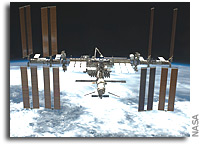
All ISS systems continue to function nominally, except those noted previously or below. Underway: Week 15 of Increment 30 (six-person crew).
After breakfast, FE-1 Shkaplerov performed the routine inspection of the SM (Service Module) PSS Caution & Warning panel as part of regular Daily Morning Inspection.
FE-1 also completed the weekly checkup behind ASU/toilet panel 139 in the SM on a fluid connector (MNR-NS) of the SM-U urine collection system, looking for potential moisture.
After wakeup, CDR Burbank, FE-5 Kuipers & FE-6 Pettit each completed another post-sleep session of the Reaction Self-Test (Psychomotor Vigilance Self-Test on the ISS) protocol, the 33rd for Dan, the 27th for Andre & Don. [RST is done twice daily (after wakeup & before bedtime) for 3 days prior to the sleep shift, the day(s) of the sleep shift and 5 days following a sleep shift. The experiment consists of a 5-minute reaction time task that allows crewmembers to monitor the daily effects of fatigue on performance while on ISS. The experiment provides objective feedback on neurobehavioral changes in attention, psychomotor speed, state stability, and impulsivity while on ISS missions, particularly as they relate to changes in circadian rhythms, sleep restrictions, and extended work shifts.]
FE-4 Kononenko started out on a 2-hr task of loading Progress M-14M/46P with disposable equipment and trash. [46P undocking is scheduled for 4/19.]
Kuipers spent some time taking photographs of the current MARES (Muscle Atrophy Research & Exercise System) configuration for ground documentation. [Of interest: Bottom part of HRF MARES Rack, with 120 VDC power & data cables routing from UIP (Utility Interface Panel) to PIU (Power Interface Unit), large views of the PIU installed on the seat rack, and full views of the MARES rack. The photos were loaded on SSC-20 (Station Support Computer 20) for downlink.]
With the MSG (Microgravity Science Glovebox) activated, Pettit configured the SLICE (Structure & Liftoff In Combustion Experiment) pyrometry hardware and performed the 6th flame test operation, today a test run with 70% methane. Later, FE-6 installed another burner tube in the SPICE Experiment Assembly, replaced the flash/memory card with a new one and ran the 70# CH4 flame test a second time. MSG was then deactivated. [The research goal is to gain unique data to extend scientists’ predictive capability. Earth application: Increased efficiency and reduced pollutant emission for practical combustion devices, improved numerical modeling, hence improved design tools, hence improved practical combustion on Earth (currently, the good modeling-experiment agreement breaks down when flames are lean or heavily sooting). Measurements: still images (with camera that was blackbody calibrated for pyrometry), video & radiometer. Hardware: SLICE is conducted in the MSG using the SPICE hardware.]
With Oleg Kononenko assisting as CMO (Crew Medical Officer), Anton Shkaplerov performed the Russian biomed assessment MO-14 (Assessment of Orthostatic Endurance w/o LBNP/Lower Body Negative Pressure) which examines the orthostatic stability of the crewmember’s cardiovascular system at rest using complex methods. The session, his first, was conducted at rest, using the KARDIOMED (Cardiomed) complex, without the Chibis-M ODNT and Holter BP (blood pressure) devices.
Supporting POIC (Payload Operations & Integration Center)/Huntsville on the CIR (Combustion Integrated Rack), CDR Burbank uninstalled & removed the three protective alignment guides from the rack, re-engaged the snubber pins and locked the safety pins to allow the PaRIS (Passive Rack Isolation System) to be active before begin of ground-commanded CIR operations requiring a microgravity environment.
Afterwards, Dan Burbank & Andre Kuipers had ~1h for the first part of cleaning up the PMM (Permanent Multipurpose Module). [The task concerns the relocation of some hardware from PMM rack fronts to PMM lockers/bays or other USOS (US Segment), organizing empty CTBs (Cargo Transfer Bags) and restowing hardware into the PMM endcone. It is estimated to require ~ 5 hrs total.]
Shkaplerov worked with the ground on activating of the Elektron-VM oxygen generator on DO3 (Daily Orbit 3), first pressurizing the BZh Liquid Unit with N2 (nitrogen) via laptop and later monitoring the external temperature of its secondary purification unit (BD) for the first 10 minutes of operations to ensure that there was no overheating. There was a problem on activating the unit on the first attempt; a second attempt was successful, and Elektron is currently working. The event is being investigated. [During nominal operations a gas analyzer is utilized to detect hydrogen (H2) in the O2 line (which could cause overheating) but is not included in the control algorithm until 10 minutes after Elektron startup.]
Anton also completed another 30-min. session for the DZZ-13 “Seiner” ocean observation program, obtaining HDV (Z1) camcorder footage of color bloom patterns in the waters of the Central-Eastern Atlantic, then copying the images to the RSK-1 laptop.
In the Kibo JPM (JEM Pressurized Module), Andre continued working with TNSC (Tanegashima Space Center, Japan) on checking out the PROX/Proximity Communication System in the ICS (Inter-Satellite Communication System) Rack for the HTV3 (H-II Transfer Vehicle 3). [After enabling a selfcheck of the HCP (HTV Control Panel), the checkout focused on PROX Baseband function performance and the command transmission from HCP to the HTV Simulator at the TNSC ground station.]
Afterwards, Kuipers had ~1h 15m to attend to a part of the uborka weekly house cleaning which was moved from Saturday into the week.
In response to the failure of the WPA (Water Processor Assembly, see 3/3 Status Report), FE-6 Pettit activated the pumping equipment for transferring water from CWC-I (Contingency Water Container-Iodinated) to the WPA (Water Processor Assembly) potable water tank using a “tee” hose and a fresh MRF (Microbial Removal Filter) as gas trap. During the run, FE-5 checked the transfer. After several hours, the CWC-I was swapped with another CWC-I after it was filled (to ~53%) by Pettit from the WPA WWT (Waste Water Tank). The WWT offloading was then repeated to a second CWC-I, for ~14% filling. Later, Don terminated the procedure and tore the equipment down for cleaning, using Povidone iodine wipes.
After charging its battery in the morning, Oleg Kononenko installed & started the equipment of the GFI-1 “Relaksatsiya” (Relaxation) Earth Observation experiment at SM window #9 for another run, using it to observe the Earth surface and atmosphere at terminator crossing in two parts, with spectrometer adjustment in between (10:50am-11:10am &11:10am-11:30am EST). Later, Oleg dismantled the equipment again and dumped the data from Laptop 3 via the RSS1 terminal. [By means of the GFI-1 UFK “Fialka-MV-Kosmos” ultraviolet camera, SP spectrometer and SONY HVR-Z7 HD (High Definition) camcorder, the experiment observes the Earth atmosphere and surface from window #9, with spectrometer measurements controlled from Laptop 3. “Relaxation”, in Physics, is the transition of an atom or molecule from a higher energy level to a lower one, emitting radiative energy in the process as equilibrium is achieved.]
FE-4 also retrieved and gathered tools and equipment needed for tomorrow’s scheduled R&R (removal & replacement) of the KVD Pressure Equalization Valve (PEV) #109 in the hatch between the SM and the FGB’s Instrumentation & Cargo Compartment (PGO/priborno gruzovoj otsek).
Afterwards, Oleg unstowed the Russian BAOK GANK Real-Time Monitoring Analyzer unit for measuring concentration of harmful contaminants in the cabin atmosphere, took some readings for reporting to the ground, and set it up for continuous air sampling in the Russian segment (RS). [The BAOK gas analyzer, a subsystem of the SKDS Pressure Control & Atmosphere Monitoring System, determines concentrations of CH4 (methane), NH3 (ammonia), CO (carbon monoxide), HCN (hydrogen cyanide), HF (hydrofluoric acid) and NO2 (nitric oxide) from air samples using electrochemical sensors, with measurements displayed on LCD (liquid crystal display) and stored on tapes.]
In the JAXA Kibo laboratory, Dan Burbank conducted another session with the CFE-2 VG2 (Capillary Flow Experiments 2 / Vane Gap 2) experiment, first preparing the MWA WSA (Maintenance Work Area \ Work Surface Area) and then running the 2-hr test with the VG2 “B” vessel. Afterwards, the equipment was torn down and stowed away. [CFE has applications to the management of liquid fuels, cryogens, water-based solutions and thermal fluids in spacecraft systems. To predict the behavior of liquids in microgravity, one tool scientists use is an open-source computer program called SE-FIT (Surface Evolver Fluid Interface Tool), which is an accurate predictor of the liquid-surface shape in space. For the CFE experiment, engineers are using SE-FIT to predict the behavior of liquids with varying test container shapes. The program’s predicted liquid-gas behavior has explained extremely small changes or even imperfections in container shape during the on-orbit study that led to large changes in liquid behavior. By using these predictions, engineers can design tanks & equipment to keep the fluids flowing with the correct distribution of liquids & gases in microgravity. This also means that under certain conditions pumps and other mechanical equipment, such as centrifuges or thruster firings, will not be necessary to move liquids through the plumbing structure of space vehicles. VG1 is one of three CFE experiments, the others being ICF (Interior Corner Flow) and CL (Contact Line). Each of the CFE experiments is represented with two unique experimental units (1,2), all of which use similar fluid-injection hardware, have simple and similarly sized test chambers, and rely solely on video for highly quantitative data. Silicone oil is the fluid used for all the tests, with different viscosities depending on the unit. Differences between units are primarily fluid properties, wetting conditions, and test cell cross section.]
In COL (Columbus Orbital Laboratory), Andre Kuipers set up the partially deployed PPFS (Portable Pulmonary Function System) hardware with power, data, front panel, and gas connections, including MBS (Mixing Bag System) for his next session with VO2max (Evaluation of Maximal Oxygen Uptake & Submaximal Estimates of VO2max before, during and after long-duration space station missions), scheduled tomorrow. [The VO2max assessment uses the PPFS, CEVIS ergometer cycle, PFS (Pulmonary Function System) gas cylinders and mixing bag system, plus multiple other pieces of hardware to measure oxygen uptake, cardiac output, and more. The exercise protocol consists of a 2-min rest period, then three 5-min stages at workloads eliciting 25%, 50% & 75% of aerobic capacity as measured pre-flight, followed by a 25-watt increase in workload every minute until the crewmember reaches maximum exercise capacity. At that point, CEVIS workload increase is stopped, and a 5-min cool down period follows at the 25% load. Rebreathing measurements are initiated by the subject during the last minute of each stage. Constraints are: no food 2 hrs prior to exercise start, no caffeine 8 hrs prior to exercise, and must be well hydrated.]
Ivanishin & Shkaplerov started a new round of periodic preventive maintenance of RS ventilation systems, today working in the FGB (Funktsionalnyi-Grusovoj Blok), where Anton cleaned the grilles of interior panels 201, 301 & 401 and Anatoly replaced the PS1 & PS2 dust filter cartridges with new spares and cleaned the GZhT-1,-2,-3 gas-liquid heat exchanger grills.
Afterwards, FE-1 & FE-2 had ~2 hrs set aside for relocating Russian cargo items in the FGB PGO from unauthorized stowage locations (i.e., from locations belonging to USOS), going by an uplinked tabular listing.
Ivanishin conducted the routine daily servicing of the SOZh system (Environment Control & Life Support System, ECLSS) in the SM. [Regular daily SOZh maintenance consists, among else, of checking the ASU toilet facilities, replacement of the KTO & KBO solid waste containers, replacement of EDV-SV waste water and EDV-U urine containers and filling EDV-SV, KOV (for Elektron), EDV-ZV & EDV on RP flow regulator.]
Kononenko took care of the daily IMS (Inventory Management System) maintenance, updating/editing its standard “delta file” including stowage locations, for the regular weekly automated export/import to its three databases on the ground (Houston, Moscow, Baikonur),
Pettit had another time slot reserved for making entries in his electronic Journal on the personal SSC. [Required are three journaling sessions per week.]
Before Presleep, Don will turn on the MPC (Multi-Protocol Converter) and start the Ku-band data flow of video recorded during the day to the ground, with POIC (Payload Operations & Integration Center) routing the onboard HRDL (High-Rate Data Link). After about an hour, Pettit turns MPC routing off again. [This is a routine operation which regularly transmits HD onboard video (live or tape playback) to the ground on a daily basis before sleeptime.]
At ~8:10am, Andre Kuipers had his weekly PFC (Private Family Conference), via S-band/audio and Ku-band/MS-NetMeeting application (which displays the uplinked ground video on an SSC laptop).
At ~1:15pm, ESA crewmember Andre Kuipers is scheduled for an ESA PAO event from the CeBIT Computer Expo in Hannover, Germany, responding to a call from German Chancellor Angela Merkel and Brazilian President Dilma Rousseff, with ESA’s Director of Human Space Flight Operations Thomas Reiter and SpaceLab students Sara and Simon Kopf.
At ~1:20pm, Burbank is scheduled to power up the SM’s amateur radio equipment (Kenwood VHF transceiver with manual frequency selection, headset, & power supply) and at 1:30pm to conduct a ham radio session with students at Dilworth Elementary School, San Jose, CA.
The crew worked out with their regular 2-hr physical exercise protocol on the TVIS treadmill with vibration isolation & stabilization (FE-1, FE-2, FE-4), ARED advanced resistive exerciser (CDR, FE-1, FE-2, FE-5, FE-6), T2/COLBERT advanced treadmill (CDR, FE-5, FE-6) and VELO ergometer bike with load trainer (FE-4). [FE-6 is on the special experimental SPRINT protocol which diverts from the regular 2.5 hrs per day exercise regime and introduces special daily sessions, followed by a USND leg muscle self scan in COL. Today’s exercise called for ARED, with T2, ARED+CEVIS (VO2max) and CEVIS following in the next 3 days. No exercise is being timelined for Fridays. If any day is not completed, Don picks up where he left off, i.e., he would be finishing out the week with his last day of exercise on his off day.]
Tasks listed for Shkaplerov, Kononenko & Ivanishin on the Russian discretionary “time permitting” job for today were –
* A ~30-min. run of the GFI-8 “Uragan” (hurricane) earth-imaging program with the NIKON D3X digital camera with Sigma AF 300-800mm telelens, focusing on Lake Baikal, Volcanoes Mount Etna, Stromboli, Hierro, Arenal, Poas and Popocatepetl volcano, Allalin Glacier, Volga River Delta, the Caspian Sea and the Aral Sea,
* A ~30-min. session for Russia’s EKON Environmental Safety Agency, making observations and taking KPT-3 aerial photography of environmental conditions on Earth using the NIKON D3X camera with the RSK-1 laptop, and
* More preparation & downlinking of reportages (written text, photos, videos) for the Roskosmos website to promote Russia’s manned space program (max. file size 500 Mb).
No CEO (Crew Earth Observation) targets uplinked for today
ISS Orbit (as of this morning, 9:14am EST [= epoch])
Mean altitude – 391.1 km
Apogee height – 403.3 km
Perigee height – 379.0 km
Period — 92.38 min.
Inclination (to Equator) — 51.64 deg
Eccentricity — 0.0017939
Solar Beta Angle — -48.8 deg (magnitude increasing)
Orbits per 24-hr. day — 15.59
Mean altitude loss in the last 24 hours — 100 m
Revolutions since FGB/Zarya launch (Nov. 98) — 76,186
Time in orbit (station) — 4854 days
Time in orbit (crews, cum.) — 4141days
Significant Events Ahead (all dates Eastern Time and subject to change):
————–Six-crew operations—————-
03/23/12 — ATV3 launch
03/28/12 — ATV3 docking
04/19/12 — Progress M-14M/46P undock
04/20/12 — Progress M-15M/47P launch
04/22/12 — Progress M-15M/47P docking
04/30/12 — Soyuz TMA-22/28S undock/landing (End of Increment 30)
————–Three-crew operations————-
05/15/12 — Soyuz TMA-04M/30S launch – G.Padalka (CDR-32)/J.Acaba/S.Revin
05/17/12 — Soyuz TMA-04M/30S docking (MRM2)
————–Six-crew operations—————-
07/01/12 — Soyuz TMA-03M/29S undock/landing (End of Increment 31)
————–Three-crew operations————-
07/15/12 — Soyuz TMA-05M/31S launch – S.Williams (CDR-33)/Y.Malenchenko/A.Hoshide
07/17/12 — Soyuz TMA-05M/31S docking
07/31/12 — Progress M16M/48P launch
08/02/12 — Progress M16M/48P docking
————–Six-crew operations—————-
09/17/12 — Soyuz TMA-04M/30S undock/landing (End of Increment 32)
————–Three-crew operations————-
10/15/12 — Soyuz TMA-06M/32S launch – K.Ford (CDR-34)/O.Novitskiy/E.Tarelkin
10/17/12 — Soyuz TMA-06M/32S docking
————–Six-crew operations————-
11/01/12 — Progress M-17M/49P launch
11/03/12 — Progress M-17M/49P docking
11/12/12 — Soyuz TMA-05M/31S undock/landing (End of Increment 33)
————–Three-crew operations————-
12/05/12 — Soyuz TMA-07M/33S launch – C.Hadfield (CDR-35)/T.Mashburn/R.Romanenko
12/07/12 — Soyuz TMA-07M/33S docking
————–Six-crew operations————-
12/26/12 — Progress M-18M/50P launch
12/28/12 — Progress M-18M/50P docking
03/19/13 — Soyuz TMA-06M/32S undock/landing (End of Increment 34)
————–Three-crew operations————-
04/02/13 — Soyuz TMA-08M/34S launch – P.Vinogradov (CDR-36)/C.Cassidy/A.Misurkin
04/04/13 — Soyuz TMA-08M/34S docking
————–Six-crew operations————-
05/16/13 — Soyuz TMA-07M/33S undock/landing (End of Increment 35)
————–Three-crew operations————-
05/29/13 — Soyuz TMA-09M/35S launch – M.Suraev (CDR-37)/K.Nyberg/L.Parmitano
05/31/13 — Soyuz TMA-09M/35S docking
————–Six-crew operations————-
09/xx/13 — Soyuz TMA-08M/34S undock/landing (End of Increment 36)
————–Three-crew operations————-
09/xx/13 — Soyuz TMA-10M/36S launch – M.Hopkins/TBD (CDR-38)/TBD
09/xx/13 — Soyuz TMA-10M/36S docking
————–Six-crew operations————-
11/xx/13 — Soyuz TMA-09M/35S undock/landing (End of Increment 37)
————–Three-crew operations————-
11/xx/13 — Soyuz TMA-11M/37S launch – K.Wakata (CDR-39)/R.Mastracchio/TBD
11/xx/13 — Soyuz TMA-11M/37S docking
————–Six-crew operations————-
03/xx/14 — Soyuz TMA-10M/36S undock/landing (End of Increment 38)
————–Three-crew operations————-



