
NASA ISS On-Orbit Status 30 September 2011
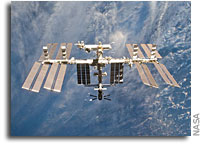
All ISS systems continue to function nominally, except those noted previously or below.
FE-4 Sergei Volkov performed the routine checkup of the SM (Service Module) PSS Caution & Warning panel as part of the regular Daily Morning Inspection.
Sergei also completed the daily inspection of the running Russian BIO-5 Rasteniya-2 (“Plants-2”) payload with its LADA-01 greenhouse, verifying proper watering of the KM A32 & A24 root modules. [Rasteniya-2 researches growth and development of plants (currently wheat) under spaceflight conditions in the LADA greenhouse from IBMP (Institute of Bio-Medical Problems, Russian: IMBP).]
CDR Fossum serviced the running BCAT-5 (Binary Colloidal Alloy Test-5) experiment, checking camera operations during the day and changing the camera battery in the morning and before sleeptime (change required after 8 hrs). [The new experiment session is with a Harvard University phase separation sample using a different setup than for the recent crystal samples 9 & 10, mainly requiring an SSC (Station Support Computer) laptop with EarthKAM timing software, power cables and camera USB cable. For illumination, the Mini-MagLite and Flash batteries do not need to be changed yet, but the camera will need a freshly charged battery. After Mike started the run on 9/21 by mixing the sample (#4) for phase separation and taking test photos, the EarthKAM (Earth Knowledge Acquired by Middle School Students) software on the SSC-13 laptop began taking pictures of Sample 4 for 13 days at different intervals throughout the run. This requires camera battery changes twice a day and image check with a battery change once per day. BCAT-5 is operating in the JPM (JEM Pressurized Module) because some time ago the crew deemed the US Lab too crowded for running it.]
In the Kibo laboratory, FE-5 Furukawa set up and conducted the fascinating JAXA EPO (Educational Payload Observation) demo INK BALL 2, the second onboard session, requiring about one hour and recording the making of the Ink Ball via G1 video camcorder for subsequent restricted downlink via MPC (Multi Protocol Converter). Afterwards, the experiment was closed out, and tools & equipment were stowed. [The INK BALL demo creates ink flow patterns/”marbling” on the Aquasphere water ball, then transfers the marbling from the water ball to handmade Japanese papers for recording. It is one of the eight fascinating initiatives of the Japanese EPO program. The others are: Life in the Universe (study of space environment effects on living things for educational purpose); Space Poem Chain (poems by famous poets and general public composed & recorded before the launch on a DVD, played and stored on ISS); Microgravity Clay (sculpting in clay to express the inspiration of human space flight); Aquasphere (recording the motion of a water sphere after external oscillations in micro-G environment with an HDTV camera, making various water shapes by vibration); Art (images taken with the HDTV camera on the ISS); Space Clothes (studying new clothing designs in space); and Photographing the Moon (images taken of the Moon from the station).]
CDR Fossum undertook the regular monthly session of the CHeCS (Crew Health Care Systems) emergency medical operations OBT (On-Board Training) drill, a 30-min. exercise to refresh his CMO (Crew Medical Officer) acuity in a number of critical health areas. The video-based proficiency drill today focused on a review of all topics. At the end, Mike completed a self-assessment questionnaire. Answers were then provided at test conclusion. [The HMS (Health Maintenance Systems) hardware, including ACLS (Advanced Cardiac Life Support) equipment, may be used in contingency situations where crew life is at risk. To maintain proficiency, crewmembers spend one hour per month reviewing HMS and ACLS equipment and procedures via the HMS and ACLS CBT (computer-based training). The training drill, each crewmember for him/herself, refreshes their memory of the on-orbit stowage and deployment locations, equipment etc. and procedures.]
FE-5 Furukawa completed his first session with the U.S. PFE (Periodic Fitness Evaluation) protocol as subject, a monthly 1.5-hr. procedure which checks up on BP (blood pressure) & ECG (electrocardiogram) during programmed exercise on the CEVIS cycle ergometer in the US Lab. Readings were taken with BP/ECG equipment and the HRM (heart rate monitor) watch with its radio transmitter. CDR Fossum assisted as Operator/CMO. The BP/ECG recordings were then transferred from the MEC (Medical Equipment Computer) to an SSC laptop for downlink to the ground. [BP/ECG provides automated noninvasive systolic and diastolic blood pressure measurements while also monitoring and displaying accurate heart rates on a continual basis at rest and during exercise.]
As a standard task for each Increment, Mike Fossum took POSSUM (Payload On-orbit Still Shots for Utilization and Maintenance) digital photography of all US payload racks which had undergone changes since the last POSSUM shoot (11/08/10), to document their current configurations. The imagery was then stored on SSC-8 for downlink. [POSSUM is a regular payload photo activity that obtains formal electronic situational still shots of any subrack & locker payload that has been moved or reconfigured. Personal items are removed from the rack fronts before photography.]
With its camcorder battery freshly charged, FE-4 Volkov conducted another 30-min. photography session for the DZZ-13 “Seiner” ocean observation program, obtaining HDV (Z1) video footage of nocturnal bio-luminescent glow of high-production zones in the Indian Ocean, then copying the images to the RSK-1 laptop. [Visual observations were conducted from SM window 9, with the camcorder set up on its bracket at window 7.]
Sergei also performed the routine daily servicing of the SOZh system (Environment Control & Life Support System, ECLSS) in the SM. [Regular daily SOZh maintenance consists, among else, of checking the ASU toilet facilities, replacement of the KTO & KBO solid waste containers, replacement of EDV-SV waste water and EDV-U urine containers and filling EDV-SV, KOV (for Elektron), EDV-ZV & EDV on RP flow regulator.]
As part of today’s SOZh activities, Sergei worked in the DC1 Docking Compartment to conduct another urine transfer from three EDV-U containers (840, 872, 999) to the BV2 Rodnik water storage tank of Progress 42P (#410), docked at DC1, using the usual pumping equipment with the electric compressor (#41). The BV2 bladder was checked for leak-tightness on 9/6. [Each of the spherical Rodnik tanks BV1 & BV2 consists of a hard shell with a soft membrane (bladder) composed of elastic fluoroplastic. The bladder is used to expel water from the tank by compressed air pumped into the tank volume surrounding the membrane and is leak-tested before urine transfers, i.e., with empty tanks, the bladders are expanded against the tank walls and checked for hermeticity.]
With the G1 HD camcorder set up in Kibo JPM (JEM Pressurized Module) for downlinking his activity, Satoshi conducted another ~2.5h “LEGO Bricks” EPO (Education Payload Activity) session in the JPM MWA (Maintenance Work Area), building a Trundle Wheel model from a guide book for ground audiences. [The MWA Containment System was required since Lego bricks can only be exposed to the open cabin air for a maximum of 2 hrs due to restrictions for flammable materials. After the demo recording, the MWA equipment was restowed.]
The CDR uninstalled the three alignment guides from CIR (Combustion Integrated Rack) at Lab bay S3 to allow the PaRIS (Passive Rack Isolation System) to be activated before begin of ground-commanded CIR operations requiring a microgravity environment.
Afterwards, Fossum worked several hours in the Kibo JPM, conducting the first operation on CFE (Capillary Flow Experiments) with the VG2 (Vane Gap 2) vessel, monitored from the ground on live video via MPC (Multi Protocol Converter) and Ku-band. This was a Dry Surface Test which, because being not repeatable, had to be recorded on the ground. The experiment was then terminated, the hardware torn down and everything put back in stowage. Mike’s CFE run last week was with VG1. [Mike’s activities include reviewing setup & operational procedures, preparing the MWA WSA (Maintenance Work Area / Work Surface Area), setting up the CFE hardware and performing the Dry Surface Test. CFE has applications to the management of liquid fuels, cryogens, water-based solutions and thermal fluids in spacecraft systems. VG is one of three CFE experiments, the others being Interior Corner Flow (ICF) and Contact Line (CL). Each of the CFE experiments is represented with two unique experimental units (1,2), all of which use similar fluid-injection hardware, have simple and similarly sized test chambers, and rely solely on video for highly quantitative data. Silicone oil is the fluid used for all the tests, with different viscosities depending on the unit. Differences between units are primarily fluid properties, wetting conditions, and test cell cross section.]
FE-4 Volkov performed periodic service of the RS (Russian Segment) radiation payload suite “Matryoshka-R” (RBO-3-2), initializing & deploying new Bubble dosimeters detectors and verifying proper function of the setup with the LULIN-5 electronics box, supported by ground specialist tagup. [A total of eight Bubble dosimeter detectors (A21, A22, A27, A28, A33, A34, A35, A36) were initialized in the Bubble dosimeter reader in the SM and positioned at new exposure locations. The deployment locations of the detectors were photo-documented with the NIKON D2X camera and also reported with initialization data to TsUP on log sheets via OCA. The complex Matryoshka payload suite is designed for sophisticated radiation studies. Note: Matryoshka is the name for the traditional Russian set of nested dolls.]
Next, Sergei completed the periodic (monthly) functional closure test of the Vozdukh CO2 (carbon dioxide) removal system’s spare AVK emergency vacuum valves, in the spare parts kit. [The AVKs are crucial because they close the Vozdukh’s vacuum access lines in the event of a malfunction in the regular vacuum valves (BVK) or a depressurization in the Vozdukh valve panel (BOA). Access to vacuum is required to vent CO2 during the regeneration of the absorbent cartridges (PP).]
Later, FE-4 conducted the periodic checkout & performance verification of IP-1 airflow sensors in the various RS hatchways. [Inspected IP-1s are in the passageways PrK (SM Transfer Tunnel)-RO (SM Working Compartment), PkhO (SM Transfer Compartment)-RO, PkhO-DC1, PkhO-FGB PGO, PkhO-MRM2, FGB GA-MRM1, FGB PGO-FGB GA, and FGB GA-Node-1.]
Satoshi Furukawa filled out his weekly FFQ (Food Frequency Questionnaire) on the MEC. [On the FFQs, USOS astronauts keep a personalized log of their nutritional intake over time on special MEC software. Recorded are the amounts consumed during the past week of such food items as beverages, cereals, grains, eggs, breads, snacks, sweets, fruit, beans, soup, vegetables, dairy, fish, meat, chicken, sauces & spreads, and vitamins. The FFQ is performed once a week to estimate nutrient intake from the previous week and to give recommendations to ground specialists that help maintain optimal crew health. Weekly estimation has been verified to be reliable enough that nutrients do not need to be tracked daily.]
At ~11:00am, Satoshi interrupted his LEGO EPO to perform another VHF-1 emergency communications proficiency check over NASA’s VHF (Very High Frequency) stations, today with the VHF sites at DRY/Dryden (11:03:37am-11:10:19am) and WHI/White Sands (11:05:33am-11:13:16am), for a voice check with Houston/Capcom, MSFC/PAYCOM (Payload Operation & Integration Center Communicator), Moscow/GLAVNI (TsUP Capcom), EUROCOM/Munich and JCOM/Tsukuba in the normal fashion via VHF radio from a handheld microphone and any of the USOS ATUs (Audio Terminal Units). [Purpose of the test is to verify signal reception and link integrity, improve crew proficiency, and ensure minimum required link margin during emergency (no TDRS) and special events (such as a Soyuz relocation).]
Before “Presleep” period tonight, FE-5 turns on the MPC and starts the Ku-band data flow of video recorded during the day to the ground, with POIC (Payload Operations & Integration Center) routing the onboard HRDL (High-Rate Data Link). After about an hour, Satoshi will turn MPC routing off again. [This is a routine operation which regularly transmits HD onboard video (live or tape playback) to the ground on a daily basis before sleeptime.]
At ~4:25am EDT, the three crewmembers held the regular (nominally weekly) tagup with the Russian Flight Control Team (GOGU/Glavnaya operativnaya gruppa upravleniya), including Shift Flight Director (SRP), at TsUP-Moscow via S-band/audio, phone-patched from Houston and Moscow.
At ~2:40pm, the crew is scheduled for their regular weekly tagup with the Lead Flight Director at JSC/MCC-H.
Tasks listed for Sergei Volkov on the Russian discretionary “time permitting” job for today were –
Continuing the preparation & downlinking of more reportages (written text, photos, videos) for the Roskosmos website to promote Russia’s manned space program (max. file size 500 Mb),
Completing the daily IMS (Inventory Management System) maintenance, updating/editing its standard “delta file” including stowage locations, for the regular weekly automated export/import to its three databases on the ground (Houston, Moscow, Baikonur), and
Continuing the current round of the monthly preventive maintenance of RS ventilation systems, today inspecting & cleaning “Group B1” ventilator fans & grilles in the SM with the vacuum cleaner.
The crew worked out with their regular 2-hr physical exercise protocol on the CEVIS cycle ergometer with vibration isolation (FE-5), TVIS treadmill with vibration isolation & stabilization (FE-4), ARED advanced resistive exercise device (FE-5) and VELO ergometer bike with load trainer (FE-4). No exercise reported for CDR.
WRM Update: A new WRM (Water Recovery Management) “cue card” was uplinked to the crew for their reference, updated with their latest CWC (Contingency Water Container) water audit. [The new card (29-0002B) lists 116 good CWCs (2,665.0 L total) for the five types of water identified on board: 1. technical water (30 CWCs with 1,249.2 L, for Elektron electrolysis, incl. 942.9 L in 24 bags containing Wautersia bacteria and 129 L in 3 clean bags for contingency use; 2. Silver potable water (no CWCs); 3. Iodinated water (74 CWCs with 1,333.6 L (also 33 expired bags with 603.2 L); 4. condensate water (45.2 L in 6 bags, plus 5 empty bags); and 5. waste/EMU dump and other (37.0 L in 2 CWCs, incl. 20.2 L from hose/pump flush). Wautersia bacteria are typical water-borne microorganisms that have been seen previously in ISS water sources. These isolates pose no threat to human health.]
CEO (Crew Earth Observation) targets uplinked for today were Lake Nasser, Toshka Lakes, Egypt (the Toshka Lakes formed in the late 1990’s when record high water in the Nile River and Lake Nasser spilled out into desert depressions to the west. Since then the lakes have persisted, but continue to slowly dry up. The crew was to update the CEO staff’s monitoring record of this event by carefully mapping the western [Toshka] lakes), Juba River fan, Somalia (ISS passed over the eastern part of the Juba River megafan site located along the Somalia coastline. Overlapping mapping frames of the eastern Juba megafan and lower Shebelle River floodplain were requested. The imagery will be of use to the Somalia Water and Land Information Management organization), Aurora Borealis (several successive opportunities), and Tropical Storm Ophelia, Atlantic Ocean (DYNAMIC EVENT: On 9/29 resurgent Tropical Storm Ophelia was slowly pulling away from the northern Leeward Island towards the NNW over the open waters of the North Atlantic. The compact circulation has continued to become better organized in satellite imagery and wind speeds are up to 50kts. The storm is forecast to continue strengthening and may be approaching hurricane force with 60kt winds by the time of today’s ISS pass today (9/30) with it moving in the general direction of Bermuda. The crew should have been well off the US east coast and approaching the area of Ophelia from the NW. Looking left of track and trying for short-lens, context views of the overall cloud pattern).
ISS Orbit (as of this morning, 9:27am EDT [= epoch])
Mean altitude – 387.3 km
Apogee height – 398.9 km
Perigee height – 375.7 km
Period — 92.30 min.
Inclination (to Equator) — 51.64 deg
Eccentricity — 0.0017148
Solar Beta Angle — 8.6 deg (magnitude increasing)
Orbits per 24-hr. day — 15.60
Mean altitude gain in the last 24 hours — 4.8 km
Revolutions since FGB/Zarya launch (Nov. 98) — 73,736
Time in orbit (station) — 4697 days
Time in orbit (crews, cum.) — 3984 days
Significant Events Ahead (all dates Eastern Time and subject to change):
————–Three-crew operations (Increment 29)————-
10/19/11 — ISS Reboost
10/29/11 — Progress M-10M/42P undocking
10/30/11 — Progress M-13M/45P launch
11/01/11 — Progress M-13M/45P docking
11/14/11 — Soyuz TMA-03M/28S launch – D.Burbank (CDR-30)/A.Shkaplerov/A.Ivanishin
11/16/11 — Soyuz TMA-03M/28S docking (MRM2)
————–Six-crew operations————-
11/22/11 — Soyuz TMA-02M/27S undock/landing (End of Increment 29)
————–Three-crew operations————-
11/30/11 — SpaceX Falcon 9/Dragon — Target date
12/26/11 — Soyuz TMA-04M/29S launch – O.Kononenko (CDR-31)/A.Kuipers/D.Pettit — (date “on or about”)
12/28/11 — Soyuz TMA-04M/29S docking (MRM1) — (date “on or about”)
————–Six-crew operations—————-
TBD — Progress M-13M/45P undock
TBD — Progress M-14M/46P launch
TBD — Progress M-14M/46P docking (DC-1)
02/29/12 — ATV3 launch readiness
TBD — Soyuz TMA-03M/28S undock/landing (End of Increment 30)
————–Three-crew operations————-
03/30/12 — Soyuz TMA-05M/30S launch – G.Padalka (CDR-32)/J.Acaba/K.Volkov
04/01/12 — Soyuz TMA-05M/30S docking (MRM2)
————–Six-crew operations—————-
05/05/12 — 3R Multipurpose Laboratory Module (MLM) w/ERA – launch on Proton (under review)
05/06/12 — Progress M-14M/46P undock
05/07/12 — 3R Multipurpose Laboratory Module (MLM) – docking (under review)
05/16/12 — Soyuz TMA-04M/29S undock/landing (End of Increment 31)
————–Three-crew operations————-
05/29/12 – Soyuz TMA-06M/31S launch – S.Williams (CDR-33)/Y.Malenchenko/A.Hoshide
05/31/12 – Soyuz TMA-06M/31S docking
————–Six-crew operations—————-
09/18/12 — Soyuz TMA-05M/30S undock/landing (End of Increment 32)
————–Three-crew operations————-
10/02/12 — Soyuz TMA-07M/32S launch – K.Ford (CDR-34)/O.Novitskiy/E.Tarelkin
10/04/12 – Soyuz TMA-07M/32S docking
————–Six-crew operations————-
11/16/12 — Soyuz TMA-06M/31S undock/landing (End of Increment 33)
————–Three-crew operations————-
11/30/12 — Soyuz TMA-08M/33S launch – C.Hadfield (CDR-35)/T.Mashburn/R.Romanenko
12/02/12 – Soyuz TMA-08M/33S docking
————–Six-crew operations————-
03/xx/13 — Soyuz TMA-07M/32S undock/landing (End of Increment 34)
————–Three-crew operations————-
03/xx/13 – Soyuz TMA-09M/34S launch – P.Vinogradov (CDR-36)/C.Cassidy/A.Misurkin
03/xx/13 – Soyuz TMA-09M/34S docking
————–Six-crew operations————-
05/xx/13 – Soyuz TMA-08M/33S undock/landing (End of Increment 35)
————–Three-crew operations————-
05/xx/13 – Soyuz TMA-10M/35S launch – M.Suraev (CDR-37)/K.Nyberg/L.Parmitano
05/xx/13 – Soyuz TMA-10M/35S docking
————–Six-crew operations————-
09/xx/13 – Soyuz TMA-09M/34S undock/landing (End of Increment 36)
————–Three-crew operations————-
09/xx/13 – Soyuz TMA-11M/36S launch – M.Hopkins/TBD (CDR-38)/TBD
09/xx/13 – Soyuz TMA-11M/36S docking
————–Six-crew operations————-
11/xx/13 – Soyuz TMA-10M/35S undock/landing (End of Increment 37)
————–Three-crew operations————-
11/xx/13 – Soyuz TMA-12M/37S launch – K.Wakata (CDR-39)/R.Mastracchio/TBD
11/xx/13 – Soyuz TMA-12M/37S docking
————–Six-crew operations————-
03/xx/14 – Soyuz TMA-11M/36S undock/landing (End of Increment 38)
————–Three-crew operations————-



