
NASA ISS On-Orbit Status 30 August 2011
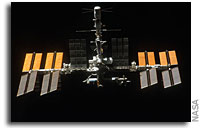
All ISS systems continue to function nominally, except those noted previously or below.
As part of the regular Daily Morning Inspection, FE-1 Samokutyayev performed the routine checkup of the SM (Service Module) PSS Caution & Warning panel.
FE-1 Samokutyayev conducted his 5th session with the Russian behavioral assessment TIPOLOGIA (MBI-20), setting up the workstation, connecting equipment, suiting up and launching the program on the RSK1 laptop for the 2h20m activity. [Andrey Borisenko assisted Sasha in donning the electrode cap, preparing his head for the electrodes, and applying electrode gel from the Neurolab-RM2 kit. Data were recorded on a PCMCIA memory card and downlinked via OCA comm. MBI-20 studies typological features of operator activity of the ISS crews in long-term space flight phases, with the subject using a cap with EEG (electroencephalogram) electrodes. The experiment, which records EEGs, consists of the Luescher test, “adaptive biological control” training, and the games Minesweeper and Tetris. The Luescher color diagnostic is a psychological test which measures a person’s psychophysical state, his/her ability to withstand stress, to perform and to communicate. It is believed to help uncover the cause of psychological stress, which can lead to physical symptoms. An EEG measures and records the electrical activity of the brain.]
FE-4 Volkov completed a major 2-hr IFM (Inflight Maintenance) in the FGB (Functional Cargo Block), replacing an 800A battery of its PSS (Power Supply System, Russian: SES/sistema elektrosnabzheniya) with a spare AB unit. The old unit was prepared for disposal on Progress 42P. [The full set of the FGB SES/EPS (Electrical Power System) storage units comprises six 800A batteries.]
In COL (Columbus Orbital Laboratory), FE-5 Furukawa & FE-6 Fossum worked their 2nd day on the IFM (Inflight Maintenance) of the MARES (Muscle Atrophy Research & Exercise System), consisting of bolt replacement and troubleshooting of its electronics box. [Today’s activities focused on the removal of bolts on both VIF (Vibration Isolation Frame) vertical bars and on the MARES Main Box and their replacement with newly launched modified bolts. (During the Increment 23/24 MARES VIF Bolt installation, two bolts in Bolt Cluster 4B were damaged; one bolt head was sheared off and the other bolt head was rounded). The completed work was photographed. Tomorrow, Satoshi & Mike are to reseat the battery and verify electronics connections in the Main Box, configure cables and power up MARES. During the Increment 23/24 MARES power verification activity, the Main Box failed to power on nominally. This on-orbit anomaly was duplicated on the ground by misaligning the electronics boxes. Tomorrow’s troubleshooting activities will involve partial disassembly of the electronics, inspecting connectors, and reinstalling the electronics ensuring proper alignment. Background: MARES is a dynamometer that will eventually be used for research on musculoskeletal, biomechanical, and neuromuscular physiology to better understand the effects of microgravity on the muscular system. MARES hardware comprises an adjustable chair and human restraint system, a pantograph (an articulated arm supporting the chair, used to properly position the user), a direct drive motor, associated electronics and experiment programming software, a linear adapter that translates motor rotation into linear movements, and a vibration isolation frame. It is capable of supporting measurements & exercise on seven different human joints, encompassing nine different angular movements, as well as two additional linear movements (arms and legs). It is considerably more advanced than current ground-based medical dynamometers (devices used to measure force or torque) and a vast improvement over existing ISS muscle research facilities. MARES may be used together with an associated device called the PEMS II (Percutaneous Electrical Muscle Stimulator II).]
FE-3 Garan & FE-6 Fossum performed extensive IFM on the APS (Automated Payload Switch), upgrading its two ORUs (Orbit Replaceable Units) as first step of installing the HRCS (High Rate Communications System). When completed, it will have the new capability to connect to the Ku-band communications unit, can be programmed via the Ethernet JSL (Joint Station Local Area Network), and – most importantly – allow for greatly increased payload data throughput. [After Mike accessed the APS ORUs in the Lab fwd endcone (requiring tilting the Lab D1 rack forward) and Ron had routed two HRCS cables to the worksite, Mike replaced the old ORUs with two new upgraded APS unit spares. Each of the old ORUs was powered off by the ground and allowed to cool down, before they were taken out. The new ORUs were to be checked out by the ground after installation and power-up. Last activity was closing out the worksite and rotating the rack up again.]
CDR Borisenko turned on the GA/gas analyzer (KM0305M1) in the Soyuz TMA-21/26S (#231) spacecraft, docked at MRM2 Poisk, and FE-4 Volkov did the same in “his” Soyuz TMA-02M/27S (#702), docked at MRM1 Rassvet. [The GA’s are activated periodically to check the cabin air in the Descent Modules.]
Volkov used the Russian GFI-8 “Uragan” (hurricane) earth-imaging program with FSS Photospectrograph science hardware at SM window #9 during a one-hour segment, taking pictures of targets along the flight track, including the Caspian Sea water area along the Apsheron-Cheleken line (oil contamination), Aral and near-Aral region (capturing real-time dust storms), detailed real-time photography of natural & man-made industrial center environment (at Karaganda quasi-synchronous aerial measurements were being scheduled), natural environment of mountainous Altai (Katun ridge with glaciers and Katun river enveloping the ridge), and the Lake Baikal water area. [The FSS (Fotospektralnaya sistema) consists of an image recording module with lens and a spectroradiometer module with an electronics module. FSS includes the ME Electronics Module & MRI Image Recording Module.]
Other activities completed by Sergei were –
* Inspecting the recently activated Russian BIO-5 Rasteniya-2 (“Plants-2”) payload with its LADA-01 greenhouse and verifying proper watering of the root modules, [Rasteniya-2 researches growth and development of plants (currently wheat) under spaceflight conditions in the LADA greenhouse from IBMP (Institute of Bio-Medical Problems, Russian: IMBP)],
* Periodic inspection of the SRV-K2M Condensate Water Processor’s sediment trap insert (VU) in the SM, [the VU insert was replaced with a spare on 6/3. The Russian SRVK-2M converts collected condensate into drinking water and dispenses the reclaimed potable water],
* Periodic checkout & performance verification of IP-1 airflow sensors in the various RS hatchways, [inspected IP-1s are in the passageways PrK (SM Transfer Tunnel)-RO (SM Working Compartment), PrK-Progress, DC1-Progress, PkhO (SM Transfer Compartment) – RO, PkhO-DC1, PkhO-FGB PGO, PkhO-MRM2, FGB GA-MRM1, FGB PGO-FGB GA, and FGB GA-Node-1],
* Periodic (monthly) functional closure test of the Vozdukh CO2 (carbon dioxide) removal system’s spare AVK emergency vacuum valves, in the spare parts kit [the AVKs are crucial because they close the Vozdukh’s vacuum access lines in the event of a malfunction in the regular vacuum valves (BVK) or a depressurization in the Vozdukh valve panel (BOA). Access to vacuum is required to vent CO2 during the regeneration of the absorbent cartridges (PP)],
* Use of the #41 compressor setup for flushing the line of the BV1 tank of Progress 42P (docked at DC1) using 2.5-3 liters of disinfectant from EDV container #999 (to be used afterwards for urine as EDV-U),
* Activating the RSE-LCS (Laser Communication System) A31p laptop in the SM to start recording data sent per auto control protocol from the BTLS-N External Onboard Laser Communication Terminal via RS-232 line for testing the TEKh-39 LCS (Russian: SLS) system, and later
* Dumping (copying) the data from the RSE-LCS to the RSS2 laptop for data downlinking,
* Routine daily servicing of the SOZh system (Environment Control & Life Support System, ECLSS) in the SM, [regular daily SOZh maintenance consists, among else, of checking the ASU toilet facilities, replacement of the KTO & KBO solid waste containers, replacement of EDV-SV waste water and EDV-U urine containers and filling EDV-SV, KOV (for Elektron), EDV-ZV & EDV on RP flow regulator], and
* Daily IMS (Inventory Management System) maintenance, updating/editing its standard “delta file” including stowage locations, for the regular weekly automated export/import to its three databases on the ground (Houston, Moscow, Baikonur).
FE-3 Garan completed his session with the U.S. HMS VIS (Health Maintenance Systems / Visual Acuity) testing program started on 8/15, recording additional data from the previous test which uses an eye chart for both far & near visual acuity and an eye questionnaire to be filled out and downloaded on a laptop for ground access.
Ron also performed an inspection of a specific CMS (Countermeasures System) Glenn harness for wear, taking documentary photography. [Ron was to look for indications of fraying, fabric damage, wrinkled fabric, bagging fabric or loose stitching. The Glenn body harness, for exercising, consists of chest buckle, hip buckle, shoulder harness, attachment straps, hip belt and Y strap.]
FE-6 Fossum installed the four PaRIS (Passive Rack Isolation System) lock-down alignment guides on the CIR (Combustion Integrated Rack) in the Lab at S3 to protect its ARIS (Active Rack Isolation System) from external loading (dynamic disturbances).
Mike also opened the protective window shutters of the Lab WORF (Window Observational Research Facility) for the ISSAC (ISS Agriculture Camera) equipment, so ground images can be captured today by ground commanding. At sleeptime tonight, FE-6 will close the shutters again. [ISSAC takes frequent visible-light & infrared images of vegetated areas on the Earth. The camera focuses principally on rangelands, grasslands, forests, and wetlands in the northern Great Plains and Rocky Mountain regions of the United States. The images may be delivered directly upon request to farmers, ranchers, foresters, natural resource managers and tribal officials to help improve their environmental stewardship of the land. The images will also be shared with educators for classroom use.]
Andrey Borisenko continued the current round of periodic preventive maintenance of RS (Russian Segment) ventilation systems by –
* Replacing the PF1-PF4 dust filter cartridges in the SM with fresh units from FGB stowage after taking documentary photography [the old cartridges were discarded and the IMS updated],
* Cleaning the VVPRK fan in the SM PrK (Transfer Tunnel),
* Cleaning the detachable fan screens of the three SOTR gas-liquid heat exchangers (GZhT1,2,3) in the FGB (Funktsionalnyi-Grusovoi Blok), and
* Inspecting & cleaning “Group C” ventilator fans & grilles in the MRM1 Rassvet module.
After disconnecting the Ku-band power supply, FE-3 Garan performed a checkout of four onboard Ku-band power supplies. [A ground technician discovered an ambiguity on the wiring schematic for this hardware, and Ron was to determine if the on-orbit units are wired correctly. The simple test consisted of two resistance measurements and a functional test. Similar tests on two other power supplies have confirmed mis-wiring, so Ron was warned he might find “unexpected” results.]
Ron also conducted the periodic (approx. weekly) WRS (Water Recovery System) sampling using the TOCA (Total Organic Carbon Analyzer), after first initializing the software and priming (filling) the TOCA water sample hose. [After the approximately 2-hr TOCA analysis, results were transferred to an SSC (Station Support Computer) laptop via USB drive for downlink, and the data were also logged. After the downlink, the USB stick was returned to TOCA.]
Later, Garan had ~2 hrs set aside (out of a total of 6 hrs planned) for relocating payload hardware from the PMM (Permanent Multipurpose Module) to appropriate locations in “their” science modules, in order to create some empty space in the PMM RSRs (Resupply Stowage Racks) to be used for upcoming stowage arrangements.
Alex Samokutyayev continued the ongoing inventorying/auditing of stowage contents in the FGB for another ~3 hrs, going by an uplinked roster listing 422 individual equipment (oborud) items.
At ~8:35am EDT, Satoshi Furukawa supported a JAXA PAO TV downlink, engaging in questions and answers with 12 students from Tokyo, Nagoya and Sendai of the Young Astronauts Club (YAC), Japan. [“If you have a broken bone in space, would the bone be cured quicker in space than on the ground? Would it take more time in space – or no change at all? When you have a cold or get sick in space, do you check your body temperature using the thermometer and take the medicine? How can you cure your illness in space? Does the space food taste the same in space as on the ground? In weightless condition, does the food taste different? Do you think your former job as a medical surgeon was very helpful for becoming an astronaut? Do you sleep well every day? Could you tell me what you do to take care of yourself for a good night’s sleep every day in space? What kind of behavior does the air bubble in the water tank do in space? You mentioned that “In space, you tend to feel the sense of a full stomach” in your Twitter. Is it really easy for dieting in space?”]
At ~2:00pm, Satoshi powered up the SM’s amateur radio equipment (Kenwood VHF transceiver with manual frequency selection, headset, & power supply) and at 2:05pm conducted a ham radio session with students at Merritt Island High School, Merritt Island, Florida.
The crew worked out with their regular 2-hr physical exercise protocol on the CEVIS cycle ergometer with vibration isolation (FE-5), TVIS treadmill with vibration isolation & stabilization (CDR, FE-1, FE-4), ARED advanced resistive exercise device (FE-1, FE-3, FE-4, FE-5, FE-6), T2/COLBERT advanced treadmill (FE-3, FE-6), and VELO ergometer bike with load trainer (CDR).
Robotics Update: SPDM (Special Purpose Dexterous Manipulator) “Dextre” activities are continuing nominally, all conducted remotely from the ground. Yesterday, robotics Ground Controllers operated the SPDM Arm-2 to unbolt and extract the spare RPCM (Remote Power Controller Module) from CTC-2 (Cargo Transporter Container #2). Arm-1 was then maneuvered to capture & extract the failed P1-1A-A RPCM from the worksite on the P1 truss. After reconfiguring the SPDM body and SSRMS (Space Station Remote Manipulator System), Arm 2 inserted the spare RPCM at the P1-1A-A worksite. The new RPCM was bolted in its worksite and successfully powered up. Arm-1 inserted the failed RPCM in the CTC in place of the spare RPCM. Later, Arm-1 stowed the RMCT-1 (Robot Micro Conical Tool #1) in the THA (Tool Holster Assembly), released the SPDM and backed it off from the RMCT fixture. CTC lid closing will be performed later today after MT (Mobile Transporter) translation to Worksite 2. Remaining activities include stowing the CTC and RRM (Robotics Refueling Mission) on the ELC4 (EXPRESS Logistics Carrier 4).
Conjunction Update: The conjunction of ISS with space debris (Object-81006, unknown), projected yesterday for this afternoon at a TCA (Time of Closest Approach) of 4:02:56pm EDT, has moved out of the box and is currently no longer of concern. No DAM (Debris Avoidance Maneuver), was required.
CEO (Crew Earth Observation) targets uplinked for today were Lake Nasser, Toshka Lakes, Egypt (ISS had a midday pass in clear weather with a near-nadir view of the western portion of this target area. The Toshka Lakes formed in the late 1990’s when record high water in the Nile River and Lake Nasser spilled out into desert depressions to the west. Since then the lakes have persisted, but continue to slowly dry up. As ISS approached the Nile River valley from the SW, the crew was to update CEO monitoring record of this event by carefully mapping the western [Toshka] lakes), Baku, Azerbaijan (this capital city of Azerbaijan with a population of 2 million is located in the extreme eastern part of the country and situated on the south side of the Abseron Peninsula which juts into the southwestern Caspian Sea. ISS had a near-nadir pass in fair weather with mid-afternoon lighting. As the crew began tracking over Caspian Sea, they were to aim just left of track for a mapping strip along the south side of the peninsula), Athens, Greece (the capital of Greece is an ancient city that dominates the south coast of the region known as Attica in the southeastern part of the mainland. ISS had a mid-afternoon pass in fair weather over this sprawling urban area of more than 3 million. As ISS approached Southern Greece from the SW, the aim was nadir for this target), San Marino, San Marino (ISS had a mid-afternoon pass in fair weather over this tiny capital city of this microstate within the target area. As ISS approached from the SW at this time, the crew was to try for a near-nadir mapping strip to acquire useful views. The Republic itself is land-locked and is located about 20 miles southwest of the Italian coastal city of Rimini. Best visual cues are Rimini’s small but prominent bay and a light-toned river which reaches the sea at this point), Kellogg Biological Station, Michigan (CEO objective for these LTER [Long Term Ecological Research] sites is to document land cover and land use change on a seasonal basis. The Kellogg site is located in SW Michigan in the eastern portion of the U.S. Corn Belt, 50 km east of Lake Michigan. Today’s fair-weather pass tracked northeastward over extreme southern Lake Michigan in mid-afternoon light. At the uplinked time, as ISS crossed the southeastern lake shore, the crew was to look nadir and try for a mapping strip across the target area), and Santa Barbara Coast, California (the Santa Barbara Coastal LTER site is located in the coastal zone of Southern California near Santa Barbara. It is bounded by the steep east-west trending Santa Ynez Mountains and coastal plain to the north and the unique Northern Channel Islands to the south. Point Conception, where the coast of California returns to a north to south orientation, lies at the western, and the Santa Clara River of the eastern boundary. Remotely sensed data such as ISS/CEO photos support studies of the effects of land use and ocean forcing on the processing and transport of nutrients and carbon to giant kelp forests as well as the role of climate change/variability and disturbance on near-shore population dynamics, community structure, and ecosystem processes. ISS had a pass approaching the coast from the SW in early afternoon light. Fair weather offered an opportunity for contextual mapping views along this dramatic coast).
ISS Orbit (as of this morning, 3:44am EDT [= epoch])
Mean altitude – 385.7 km
Apogee height – 394.3 km
Perigee height – 377.1 km
Period — 92.27 min.
Inclination (to Equator) — 51.64 deg
Eccentricity — 0.0012707
Solar Beta Angle — -1.6 deg (magnitude bottoming out)
Orbits per 24-hr. day — 15.61
Mean altitude loss in the last 24 hours — 79 m
Revolutions since FGB/Zarya launch (Nov. 98) – 73,248
Significant Events Ahead (all dates Eastern Time and subject to change):
————–Six-crew operations————-
09/xx/11 — Soyuz TMA-21/26S undock — UNDER REVIEW
09/xx/11 — Soyuz TMA-21/26S landing (End of Increment 28) — UNDER REVIEW
————–Three-crew operations————-
09/xx/11 — Soyuz TMA-03M/28S launch – D.Burbank (CDR-30)/A.Shkaplerov/A.Ivanishin — UNDER REVIEW
09/xx/11 — Soyuz TMA-03M/28S docking (MRM2) — UNDER REVIEW
————–Six-crew operations————-
10/xx/11 — Progress M-10M/42P undocking
10/xx/11 — Progress M-13M/45P launch
10/xx/11 — Progress M-13M/45P docking
11/16/11 — Soyuz TMA-02M/27S undock/landing (End of Increment 29)
————–Three-crew operations————-
11/29/11 — Soyuz TMA-04M/29S launch – O.Kononenko (CDR-31)/A.Kuipers/D.Pettit
12/01/11 — Soyuz TMA-04M/29S docking (MRM1)
————–Six-crew operations—————-
12/26/11 — Progress M-13M/45P undock (a late January 2012?)
12/27/11 — Progress M-14M/46P launch (a late January 2012?)
12/29/11 — Progress M-14M/46P docking (DC-1) (a late January 2012?)
02/29/12 — ATV3 launch readiness
03/05/12 — Progress M-12M/44P undock
03/16/12 — Soyuz TMA-03M/28S undock/landing (End of Increment 30)
————–Three-crew operations————-
03/30/12 — Soyuz TMA-05M/30S launch – G.Padalka (CDR-32)/J.Acaba/K.Volkov
04/01/12 — Soyuz TMA-05M/30S docking (MRM2)
————–Six-crew operations—————-
05/05/12 — 3R Multipurpose Laboratory Module (MLM) w/ERA – launch on Proton (under review)
05/06/12 — Progress M-14M/46P undock
05/07/12 — 3R Multipurpose Laboratory Module (MLM) – docking (under review)
05/16/12 — Soyuz TMA-04M/29S undock/landing (End of Increment 31)
————–Three-crew operations————-
05/29/12 – Soyuz TMA-06M/31S launch – S.Williams (CDR-33)/Y.Malenchenko/A.Hoshide
05/31/12 – Soyuz TMA-06M/31S docking
————–Six-crew operations—————-
09/18/12 — Soyuz TMA-05M/30S undock/landing (End of Increment 32)
————–Three-crew operations————-
10/02/12 — Soyuz TMA-07M/32S launch – K.Ford (CDR-34)/O.Novitskiy/E.Tarelkin
10/04/12 – Soyuz TMA-07M/32S docking
————–Six-crew operations————-
11/16/12 — Soyuz TMA-06M/31S undock/landing (End of Increment 33)
————–Three-crew operations————-
11/30/12 — Soyuz TMA-08M/33S launch – C.Hadfield (CDR-35)/T.Mashburn/R.Romanenko
12/02/12 – Soyuz TMA-08M/33S docking
————–Six-crew operations————-
03/xx/13 — Soyuz TMA-07M/32S undock/landing (End of Increment 34)
————–Three-crew operations————-
03/xx/13 – Soyuz TMA-09M/34S launch – P.Vinogradov (CDR-36)/C.Cassidy/A.Misurkin
03/xx/13 – Soyuz TMA-09M/34S docking
————–Six-crew operations————-
05/xx/13 – Soyuz TMA-08M/33S undock/landing (End of Increment 35)
————–Three-crew operations————-
05/xx/13 – Soyuz TMA-10M/35S launch – M.Suraev (CDR-37)/K.Nyberg/L.Parmitano
05/xx/13 – Soyuz TMA-10M/35S docking
————–Six-crew operations————-
09/xx/13 – Soyuz TMA-09M/34S undock/landing (End of Increment 36)
————–Three-crew operations————-
09/xx/13 – Soyuz TMA-11M/36S launch – M.Hopkins/TBD (CDR-38)/TBD
09/xx/13 – Soyuz TMA-11M/36S docking
————–Six-crew operations————-
11/xx/13 – Soyuz TMA-10M/35S undock/landing (End of Increment 37)
————–Three-crew operations————-
11/xx/13 – Soyuz TMA-12M/37S launch – K.Wakata (CDR-39)/R.Mastracchio/TBD
11/xx/13 – Soyuz TMA-12M/37S docking
————–Six-crew operations————-
03/xx/14 – Soyuz TMA-11M/36S undock/landing (End of Increment 38)
————–Three-crew operations————-



