
NASA ISS On-Orbit Status 3 April 2012
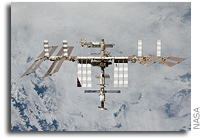
ISS On-Orbit Status 04/03/12
All ISS systems continue to function nominally, except those noted previously or below.
Upon wakeup, CDR Dan Burbank, FE-5 André Kuipers & FE-6 Don Pettit each completed another post-sleep session of the Reaction Self-Test (Psychomotor Vigilance Self-Test on the ISS) protocol, the 38th for Dan, the 32nd for André & Don. [RST is done twice daily (after wakeup & before bedtime) for 3 days prior to the sleep shift, the day(s) of the sleep shift and 5 days following a sleep shift. The experiment consists of a 5-minute reaction time task that allows crewmembers to monitor the daily effects of fatigue on performance while on ISS. The experiment provides objective feedback on neurobehavioral changes in attention, psychomotor speed, state stability, and impulsivity while on ISS missions, particularly as they relate to changes in circadian rhythms, sleep restrictions, and extended work shifts.]
After breakfast, Anton Shkaplerov performed the routine inspection of the SM (Service Module) PSS Caution & Warning panel as part of regular Daily Morning Inspection.
FE-4 Oleg Kononenko conducted the periodic maintenance of the active Russian BMP Harmful Impurities Removal System, starting the “bake-out” cycle to vacuum on absorbent bed #2 of the regenerable dual-channel filtration system. Anatoly will terminate the process at ~5:15pm EDT. Bed #1 regeneration was performed yesterday. (Done last: 3/13 & 3/14). [Regeneration of each of the two cartridges takes about 12 hrs and is conducted only during crew awake periods. The BMP’s regeneration cycle is normally done every 20 days.]
FE-2 Ivanishin & FE-1 Shkaplerov conducted their 2nd onboard session each of the Russian MedOps assessment MO-12, (“Study of the Veins in the Lower Extremities”), using the KARDIOMED (Cardiomed) complex with orthogonal leads, installed in the SM by Oleg Kotov in February 2010. [After loading the RSE-med laptop with the Cardiomed software, Anton set up the equipment, which involves KARDIOMED-TsB, KARDIOMED-KP, KARDIOMED-PMO and KARDIOMED-KRM assemblies with ECG (electrocardiogram) electrodes in a HOLTER monitor harness, a PLETISMOGRAF (Plethysmograph) instrument with calf measuring cuff, pneumatic hose, thigh occlusion cuff, hand pump & valve, and a DOPPLER complex. A Plethysmograph (sometimes called a “body box”) is an instrument for measuring changes in volume within an organ or the whole body (usually resulting from fluctuations in the amount of blood or air it contains). Anatoly stowed the equipment after his session.]
André Kuipers deployed four passive FMK (Formaldehyde Monitoring Kit) sampling assemblies in the Lab (at bay P3, below CEVIS) and SM (at the most forward handrail, on panel 307) for two days, to catch any atmospheric formaldehyde on a collector substrate for subsequent analysis on the ground. [Two monitors each are usually attached side by side, preferably in an orientation with their faces perpendicular to the direction of air flow.]
Afterwards, André worked in the JAXA JPM (JEM Pressurized Module) on the ER-4 (EXPRESS Rack 4), removing Locker 7 containing NanoRack Platform-2, transferring it to the US Lab and swapping it with Locker 7 of ER-1 in preparation for upcoming Module 16 and 18 installations. The ER-1 locker was then installed in ER-4 instead.
FE-6 Don Pettit started another sampling run with the AQM (Air Quality Monitor), deactivating the system ~5 hrs later. [Consisting of the EHS GC/DMS (Environmental Health Systems Gas Chromatograph / Differential Mobility Spectrometer), the system is controlled with “Sionex” expert software from the SSC (Station Support Computer)-12 laptop. The AQM demonstrates COTS (Commercial Off-the-Shelf) technology for identifying volatile organic compounds, similar to the VOA (Volatile Organics Analyzer). This evaluation will continue over the course of several months as it helps to eventually certify the GC/DMS as nominal CHeCS (Crew Health Care Systems) hardware.]
Dan Burbank collected air samples with new GSCs (Grab Sample Containers) in the SM (#2099), Lab (#2096) and Kibo JPM (#2081), sequenced with the AQM sampling for postflight comparison. [GSC samples are taken 1-3 hrs after AQM start.]
Pettit supported the ground in swapping the THC CCAA (Temperature & Humidity Control / Common Cabin Air Assembly) air conditioner in the U.S. Lab from starboard to port by closing off the S6 MFCV (Manual Flow Control Valve) and opening the P6 MFCV. This allowed the swapover from the CCAA starboard channel (S6) to the alternate system on port (P6). [The CCAA is a network of ducting that draws in the air through filters, delivers it for conditioning, and returns it to the modules. The swap-over between the CCAA channels is generally done by the ground once a month, with crew support, to dry out the heat exchanger of the deactivated side. MCC-H flight controllers command the required systems configurations for the dryout via S-band
Later, Don had ~3.5 hrs blocked out for uborka (house cleaning) which was deferred on Saturday/Sunday due to the ATV-3 power issue.
FE-2 Ivanishin & FE-4 Kononenko performed the periodic service of the RS (Russian Segment) radiation payload suite “Matryoshka-R” (RBO-3-2), collecting eight Bubble dosimeters (A41, A42, A43, A44, A45, A46, A47, A48) to read their recorded radiation traces in a special Reader. Afterwards the dosimeters were initialized for new measurements, redeployed at specific locations and photographed. Later, Anatoly also verified proper functioning of the RBO-3-2 Lulin-5 electronics box in MRM1 which is connected to the spherical sensor-equipped “phantom”. [The complex Matryoshka payload suite is designed for sophisticated radiation studies. Note: Matryoshka is the name for the traditional Russian set of nested dolls.]
Burbank had ~3.5 hrs allotted to work in Node-3 on the WHC (Waste & Hygiene Compartment), performing troubleshooting on the UMS (Urine Monitoring System) after its power anomaly on 3/13 (possible hot connector reported by Dan). To ensure full functionality of the WHC, the CDR used the electrical MultiMeter to measure resistance and voltage of UMS J5 power connector and UMS circuit breaker. [Steps included stowage retrieval, safing and setup, resistance and voltage measurements, WHC activation, UMS setup & measurement, and restowing.]
Later, Dan gathered & prepared equipment required for tomorrow’s planned R&R (removal & replacement) of the GPS1 receiver of the ACS GPS (Attitude Control System / Global Positioning System) in the Lab aft endcone.
After temporarily configuring the STTS communication system for crew presence (voice comm) in the MRM2 (Mini Research Module 2) Poisk, Anton Shkaplerov reviewed & set up the equipment for another active session with the Russian experiment KPT-10 “Kulonovskiy Kristall” (Coulomb Crystal), supported by ground specialist tagup. STTS was then reconfigured to nominal. Execution of the experiment is scheduled tomorrow. [KPT-10 studies dynamic and structural characteristics of the Coulomb systems formed by charged dispersed diamagnetic macroparticles in the magnetic trap, investigating the following processes onboard the ISS RS: condensed dust media, Coulomb crystals, and formation of Coulomb liquids due to charged macroparticles. Coulomb systems are structures following Coulomb’s Law, a law of physics describing the electrostatic interaction between electrically charged particles. It was essential to the development of the theory of electromagnetism.]
Later, Anton undertook the regular monthly session of the CHeCS (Crew Health Care Systems) emergency medical operations OBT (On-Board Training) drill, a 30-min. exercise to refresh his CMO (Crew Medical Officer) acuity in a number of critical health areas. The video-based proficiency drill today focused on a review of all topics. At the end, Anton completed a self-assessment questionnaire. Answers were provided at test conclusion. [The HMS (Health Maintenance Systems) hardware, including ACLS (Advanced Cardiac Life Support) equipment, may be used in contingency situations where crew life is at risk. To maintain proficiency, crewmembers spend one hour per month reviewing HMS and ACLS equipment and procedures via the HMS and ACLS CBT (computer-based training). The training drill, each crewmember for him/herself, refreshes their memory of the on-orbit stowage and deployment locations, equipment etc. and procedures.]
With its battery freshly charged in the morning, Oleg Kononenko conducted another session with the GFI-1 “Relaksatsiya” (Relaxation) Earth Observation experiment at SM window #9, using it to measure UV (ultraviolet) emissions in Earth’s upper atmosphere during global electromagnetic events (1:30pm-1:50pm EDT). Later, FE-4 dismantled the equipment and dumped the data from Laptop 3 via the RSS1 terminal. [By means of the GFI-1 UFK “Fialka-MV-Kosmos” ultraviolet camera, SP spectrometer and SONY HVR-Z7 HD (High Definition) camcorder, the experiment observes the Earth atmosphere and surface from window #9, with spectrometer measurements controlled from Laptop 3. “Relaxation”, in Physics, is the transition of an atom or molecule from a higher energy level to a lower one, emitting radiative energy in the process as equilibrium is achieved.]
After his preparations on 3/29 for ESA’s C13 (Cycle 13) flight software transition, André Kuipers today installed the new s/w Cycle 13 system on the PWS1 (Portable Workstation 1) A31p laptop in COL (Columbus Orbital Laboratory). [Afterwards, André switched off the Cycle 12 PWS-A31p and disconnected the LAN cables from both A31p machines. In Phase 1, on 2/28, André had set up two new Lenovo T61p machines as PWS laptops, additionally to the older A31p ThinkPads. The current Phase 2 of the transition, spanning 3 days, includes a ground segment and upgrades the COL PWS and nominal DMS (Data Management System) software. In Phase 3, not earlier than mid-April, COL will finally be integrated into the JSL (Joint Station LAN) network.]
Don Pettit also swapped laptops, replacing the A31p MLC (Microgravity Science Glovebox Computer) with a new T61p from the computer stowage “pantry”. After PRO (Payload Rack Officer) configured the RFCA (Rack Flow Control Assembly) and closed the RPC (Remote Power Controller) for MSG activation, FE-6 loaded MLC Vers. 3.1 software on the T61p laptop and later powered it down.]
FE-6 also printed out a revised procedure for rotating the Lab MT/LT (Moderate Temperature/Low Temperature) Rack and replaced the old procedure in the Leak Pinpoint & Repair Kit with it, then returned the kit to its stowage in PMA-1 (Pressurized Mating Adapter 1).
Shkaplerov & Ivanishin began the long-awaited repair of the Russian SKV-1 air conditioner in the SM, today gathering equipment and making preparations for the replacement of the system’s BPSKV power supply unit, scheduled tomorrow.
Afterwards, Anatoly replaced the ShchO-ShO1 lighting switchboard in SM with the ShchO-ShO panel from Progress 46P and installed the ShchO-ShO1 unit in Progress instead. FE-2 also removed an SSD305(A96) light fixture in 46P for stowage in SM as a spare.
In COL, FE-5 Kuipers set up the PPFS (Portable Pulmonary Function System) hardware plus MBS (Mixing Bag System) and configured it partially, in preparation for Don Pettit’s 4th session with the VO2max (Evaluation of Maximal Oxygen Uptake & Submaximal Estimates of VO2max before, during and after long-duration space station missions) assessment, scheduled tomorrow.
FE-1 Shkaplerov performed his 10th data collection session for the psychological MBI-16 Vzaimodejstvie (“Interactions”) program, accessing and completing the computerized study questionnaire on the RSE-Med laptop and saving the data in an encrypted file. [The software has a “mood” questionnaire, a “group & work environment” questionnaire, and a “critical incidents” log. Results from the study, which is also mirrored by ground control subjects, could help to improve the ability of future crewmembers to interact safely and effectively with each other and with Mission Control, to have a more positive experience in space during multi-cultural, long-duration missions, and to successfully accomplish mission activities.]
Anton also completed another 30-min. session for the DZZ-13 “Seiner” ocean observation program, obtaining SONY HDV-Z7E camcorder footage of color bloom patterns in the waters of the South-Eastern Pacific and off the Chile coastline, then copying the images to the RSK-1 laptop.
Anatoly took care of the daily IMS (Inventory Management System) maintenance, updating/editing its standard “delta file” including stowage locations, for the regular weekly automated export/import to its three databases on the ground (Houston, Moscow, Baikonur).
Oleg completed the routine daily servicing of the SOZh system (Environment Control & Life Support System, ECLSS) in the SM. [Regular daily SOZh maintenance consists, among else, of checking the ASU toilet facilities, replacement of the KTO & KBO solid waste containers, replacement of EDV-SV waste water and EDV-U urine containers and filling EDV-SV, KOV (for Elektron), EDV-ZV & EDV on RP flow regulator.]
CDR Burbank & FE-6 Pettit had another time slot reserved each for making entries in their electronic Journals on the personal SSC. [Required are three journaling sessions per week.]
Before sleeptime tonight, Anatoly Ivanishin will prepare the Russian MBI-12 payload and start his 6th Sonokard experiment session, using a sports shirt from the Sonokard kit with a special device in the pocket for testing a new method for acquiring physiological data without using direct contact on the skin. Measurements are recorded on a data card for return to Earth. [Sonokard objectives are stated to (1) study the feasibility of obtaining the maximum of data through computer processing of records obtained overnight, (2) systematically record the crewmember’s physiological functions during sleep, (3) study the feasibility of obtaining real-time crew health data. Investigators believe that contactless acquisition of cardiorespiratory data over the night period could serve as a basis for developing efficient criteria for evaluating and predicting adaptive capability of human body in long-duration space flight.]
Before Presleep, Burbank will turn on the MPC (Multi-Protocol Converter) and start the Ku-band data flow of video recorded during the day to the ground, with POIC (Payload Operations & Integration Center) routing the onboard HRDL (High-Rate Data Link). After about an hour, Dan turns MPC routing off again. [This is a routine operation which regularly transmits HD onboard video (live or tape playback) to the ground on a daily basis before sleeptime.]
Before sleeptime, Dan, André & Don had ~15 min set aside on their schedules for a joint review of an uplinked video on on-board safety, with general findings & reminders on critical issues such as fire port blockage, food shrink bag flammability, ventilation grille blockage, etc.
FE-1, FE-2, FE-4 & FE-5 had their regular weekly PMCs (Private Medical Conferences) via S- & Ku-band audio/video, André at ~10:40am, Anatoly at ~1:00pm, Anton at ~12:45pm, Oleg at ~2:35pm EDT.
At ~6:40am EDT, the six crewmembers joined up to support a Russian PAO TV downlink, transmitting messages of greetings from Node-2 aimed at four major events. [(1) the International Symposium at the United Nations on the occasion of the Day of Cosmonautics on April 12, (2) the 11th Youth Delphian Games of Russia, held from April 26 to May 3 in Moscow, involving more than two thousand young artists in 70 subjects, (3) the International Forum “Caspian Dialogue, 2012” on April 25, with the support of the Ministry of Energy, Ministry of Foreign Affairs, Ministry of Natural Resources and Environment, the Chamber of Commerce, Russian Academy of Sciences in Moscow and the World Trade Center, and (4) congratulations to the employees of the Baikonur Cosmodrome on the Day of Cosmonautics.]
At ~11:20am Burbank, Pettit & Kuipers supported an Educational PAO TV event, responding to questions from students at O. Henry Middle School in Austin, TX, and also downlinking a message of greetings to the North Carolina Museum of Natural Sciences in Raleigh, where the Destination: Station exhibit is currently.
The crew worked out with their regular 2-hr physical exercise protocol on the TVIS treadmill with vibration isolation & stabilization (FE-1, FE-4), ARED advanced resistive exerciser (CDR, FE-2, FE-5, FE-6), T2/COLBERT advanced treadmill (CDR, FE-1, FE-2, FE-5, FE-6), and VELO ergometer bike with load trainer (FE-4). [FE-6 is on the special experimental SPRINT protocol which diverts from the regular 2.5 hrs per day exercise regime and introduces special daily sessions, followed by a USND (Ultrasound) leg muscle self scan in COL. Today’s SPRINT exercise was on T2, with ARED+CEVIS (VO2max) & CEVIS in the next 2 days. If any day is not completed, Don picks up where he left off, i.e., he would be finishing out the week with his last day of exercise on his off day If any day is not completed, Don picks up where he left off, i.e., he would be finishing out the week with his last day of exercise on his off day.]
Before exercising on the ARED, Ivanishin set up the G1 video camera in Node-3 to cover his workout session on the machine, to meet the regular 30-day requirement for biomechanical evaluation of the on-orbit crewmembers, and evaluation of the hardware status. Afterwards, the video footage transferred to VTR (Video Tape Recorder) for ground downlink.
After his T2 session, Pettit closed down the T2 software on its laptop for data transfer, then turned off the T2 display.
Tasks listed for Shkaplerov, Kononenko & Ivanishin on the Russian discretionary “time permitting” job for today were –
* A ~30-min. run of the GFI-8 “Uragan” (hurricane) earth-imaging program with the NIKON D3X digital camera with Sigma AF 300-800mm telelens, focusing on volcanoes Popocatepetl, Santa Maria, Fuego, Huascaran, Cordon-Kaul & Hudson, the mountains of Bolivia, Mt. Illimani Ankouma, and the glaciers of Patagonia;
* A ~30-min. session for Russia’s EKON Environmental Safety Agency, making observations and taking KPT-3 aerial photography of environmental conditions on Earth using the NIKON D3X camera with the RSK-1 laptop, and
* More preparation & downlinking of reportages (written text, photos, videos) for the Roskosmos website to promote Russia’s manned space program (max. file size 500 Mb).
CEO (Crew Earth Observation) targets uplinked for today were Rangoon (Yangon), Myanmar at Night (Rangoon, the former capital, should have been visible just under track. This city of over 4 million is Myanmar’s largest city with an area of over 231 square miles. ISS/CEO nighttime imagery will complement the daylight imagery researcher currently have in their database), Chongqing, China at Night (this sprawling megacity of more than 29 million has a metropolitan area of 910 square miles. As ISS approached from the SW with a rare break in the weather, the crew was to aim just left of track for this illuminated target), and Mumbai, India at Night (Mumbai is located on the coast and is India’s most populous city with a metropolitan population of about 12.5 million in an area of 233 square miles. As ISS approached the Indian coast from the SW, the crew was to look nadir for the lights of this megacity).
ISS Orbit (as of this morning, 9:38am EDT [= epoch])
Mean altitude – 389.7 km
Apogee height – 398.8 km
Perigee height – 380.6 km
Period — 92.35 min.
Inclination (to Equator) — 51.64 deg
Eccentricity — 0.001342
Solar Beta Angle — 41.1 deg (magnitude increasing)
Orbits per 24-hr. day — 15.59
Mean altitude loss in the last 24 hours — 109 m
Revolutions since FGB/Zarya launch (Nov. 98) — 76,638
Time in orbit (station) — 4883 days
Time in orbit (crews, cum.) — 4170 days
Significant Events Ahead (all dates Eastern Time and subject to change):
————–Six-crew operations—————-
04/19/12 — Progress M-14M/46P undock
04/20/12 — Progress M-15M/47P launch
04/22/12 — Progress M-15M/47P docking
04/27/12 — Soyuz TMA-22/28S undock/landing (End of Increment 30)
————–Three-crew operations————-
04/30/12 — SpaceX Dragon launch (12:22pm EDT; target date)
05/15/12 — Soyuz TMA-04M/30S launch – G.Padalka (CDR-32)/J.Acaba/S.Revin
05/17/12 — Soyuz TMA-04M/30S docking (MRM2)
————–Six-crew operations—————-
07/01/12 — Soyuz TMA-03M/29S undock/landing (End of Increment 31)
————–Three-crew operations————-
07/15/12 — Soyuz TMA-05M/31S launch – S.Williams (CDR-33)/Y.Malenchenko/A.Hoshide
07/17/12 — Soyuz TMA-05M/31S docking
07/20/12 — HTV3 launch (~10:18pm EDT)
07/31/12 — Progress M16M/48P launch
08/02/12 — Progress M16M/48P docking
————–Six-crew operations—————-
09/17/12 — Soyuz TMA-04M/30S undock/landing (End of Increment 32)
————–Three-crew operations————-
10/15/12 — Soyuz TMA-06M/32S launch – K.Ford (CDR-34)/O.Novitskiy/E.Tarelkin
10/17/12 — Soyuz TMA-06M/32S docking
————–Six-crew operations————-
11/01/12 — Progress M-17M/49P launch
11/03/12 — Progress M-17M/49P docking
11/12/12 — Soyuz TMA-05M/31S undock/landing (End of Increment 33)
————–Three-crew operations————-
12/05/12 — Soyuz TMA-07M/33S launch – C.Hadfield (CDR-35)/T.Mashburn/R.Romanenko
12/07/12 — Soyuz TMA-07M/33S docking
————–Six-crew operations————-
12/26/12 — Progress M-18M/50P launch
12/28/12 — Progress M-18M/50P docking
03/19/13 — Soyuz TMA-06M/32S undock/landing (End of Increment 34)
————–Three-crew operations————-
04/02/13 — Soyuz TMA-08M/34S launch – P.Vinogradov (CDR-36)/C.Cassidy/A.Misurkin
04/04/13 — Soyuz TMA-08M/34S docking
————–Six-crew operations————-
05/16/13 — Soyuz TMA-07M/33S undock/landing (End of Increment 35)
————–Three-crew operations————-
05/29/13 — Soyuz TMA-09M/35S launch – M.Suraev (CDR-37)/K.Nyberg/L.Parmitano
05/31/13 — Soyuz TMA-09M/35S docking
————–Six-crew operations————-
09/xx/13 — Soyuz TMA-08M/34S undock/landing (End of Increment 36)
————–Three-crew operations————-
09/xx/13 — Soyuz TMA-10M/36S launch – M.Hopkins/TBD (CDR-38)/TBD
09/xx/13 — Soyuz TMA-10M/36S docking
————–Six-crew operations————-
11/xx/13 — Soyuz TMA-09M/35S undock/landing (End of Increment 37)
————–Three-crew operations————-
11/xx/13 — Soyuz TMA-11M/37S launch – K.Wakata (CDR-39)/R.Mastracchio/TBD
11/xx/13 — Soyuz TMA-11M/37S docking
————–Six-crew operations————-
03/xx/14 — Soyuz TMA-10M/36S undock/landing (End of Increment 38)
————–Three-crew operations————-



