
NASA ISS On-Orbit Status 29 November 2008
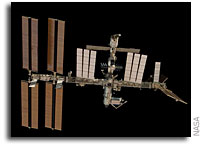
All ISS systems continue to function nominally, except those noted previously or below. Saturday – off-duty day for CDR Fincke, FE-1 Lonchakov & FE-2 Magnus. Crew wake-up 4:30am; sleep 6:00pm EST.
Yuri Lonchakov performed the periodic maintenance of the active Russian BMP (Harmful Impurities Removal System) by starting the "bake-out" cycle to vacuum on absorbent bed #2 of the regenerable dual-channel filtration system. The process will be terminated at ~5:45pm EST. Bed #1 regeneration was performed yesterday. [Regeneration of each of the two cartridges takes about 12 hours and is conducted only during crew awake periods. The BMP’s regeneration cycle, normally done every 20 days, is currently performed four times more frequently (last time: 11/7-8).]
In the Service Module (SM), the FE-1 completed the routine daily servicing of the SOZh system (ECLSS/Environment Control & Life Support System). [Regular daily SOZh maintenance consists, among else, of checking the ASU toilet facilities, replacement of the KTO & KBO solid waste containers, replacement of EDV-SV waste water and EDV-U urine containers and performing US condensate processing (transfer from CWC to EDV containers) if condensate is available.]
Yuri also temporarily powered down the Russian POTOK-150MK (150 micron) air filter unit of the SM’s SOGS air revitalization subsystem for the periodic cleaning of its pre-filter, using the vacuum cleaner with narrow-slit nozzle attachment.
For her initial use of the TVIS treadmill, Sandy Magnus installed and checked out the SPD (Subject Positioning Device) top assemblies for safety, required for her first seven TVIS uses.
In preparation for the Progress docking, FE-2 Magnus closed the protective window shutters in the Lab and Kibo JPM (Japanese Pressurized Module).
A new item added to Sandy’s voluntary “job jar” task list is to route a cable between the Node-2 and the HCP (Hardware Command Panel) in the JPM (but not yet mated since it is a hatch drag-thru line). [The HCP is part of the PROX system, mostly located in the ICS (Inter-orbit Communication System) Rack, consisting also of a PROX antenna, a PROX-GPS (Global Positioning System) antenna, and PROX comm equipment for the HTV (H-II Transfer Vehicle). When the HTV approaches the ISS, the external PROX antenna, which contains GPS receivers, will initiate communications with the HTV. The ISS orbital location and speed are immediately relayed to the HTV through the PROX. At the same time, data from the HTV are relayed to the ISS. In addition, the antenna relays commands sent from the ground to the HTV.]
Also showing on Magnus’ task list is software loading and hardware setup for the MERLIN (Microgravity Experiment Research Locker/Incubator) payload, with the latter requiring prior notification of POIC (Payload Operation & Integration Center/Huntsville).
Working from his discretionary “as time permits” task list, Yuri conducted another run of the Russian DZZ-2 "Diatomeya" ocean observations program, using the NIKON-F5 DCS still camera and the HDV (high-definition) video camcorder from SM window #7 for ~25 min to record Pacific Ocean surface features East of New Zealand and offshore of Panama, as affected by underlying terrain.
A second job for Yuri’s choice was another ECON KPT-3 test session, making observations and taking aerial photography of Pacific Ocean surface contaminations for Russia’s Environmental Safety Agency (ECON) using the D2X with SIGMA 300-800mm telephoto lens.
Fincke & Magnus are scheduled for their weekly PFCs (Private Family Conferences) via S-band/audio and Ku-band/MS-NetMeeting application (which displays the uplinked ground video on an SSC laptop), Sandy at ~1:30pm EST, Mike at ~3:05pm.
The ISS crew completed their physical workout program (about half of which is used for setup & post-exercise personal hygiene) on the CEVIS cycle ergometer (CDR), TVIS treadmill (FE-2, FE-1), RED resistive exercise device (CDR, FE-1, FE-2), and VELO bike with bungee cord load trainer (FE-1).
Mike & Yuri had a 1-hr. conference via S-band with ground specialists at TsUP-Moscow to discuss timeline and procedures for tomorrow’s Progress docking:
Timeline for Progress M-01M/31P Rendezvous & Docking on 11/30 (all times EST):
- SM Solar Arrays feathering ~5:30am
- VHF Comm Pass (RGS) 5:36-15:58am
- Kurs-A Activation 5:40am
- Kurs-P Activation 5:42am
- Kurs signal acquisition assured 6:09am (Т2)
- Kurs Test Disabled 6:38am (Т6)
- SM GO for final approach ~6:42am (T7)
- Begin Flyaround @ 400 m ~6:52am
- Begin stationkeeping ~7:01am
- Final approach init. ~7:16am
- Local Sunset 7:23am
- Contact (capture) ~7:25am (T9)
- SM Kurs-P deact. on mech. capture (Т3)
- Local Sunrise 7:56am
ISS Crew Sleep Shift Planning: To synchronize the ISS crew’s timeline with STS-126/ULF-2 undocking yesterday, ISS crew wake/sleep cycle has undergone a number of one-hour shifts which started on 11/25. For the next three days, the wake/sleep shift schedule is as follows, returning to “normal” on 12/1 (all times EST):
|
11/29 |
Wake: 4:30am – 6:00pm |
|
11/30 |
Wake: 2:30am – 4:30pm |
|
12/01 |
Wake: 1:00am – 4:30pm |
Weekly Science Update (Expedition Eighteen — Week 5)
3-D SPACE: Last (fourth) session for Greg has been successfully performed on 11/23. “Thank you, Greg, for your nice participation to the experiment as first test subject! We are glad that you also enjoyed it.”
ALTCRISS (Alteino Long Term monitoring of Cosmic Rays on the ISS): Complete.
ANITA (Analyzing Interferometer for Ambient Air): Continuing.
BCAT-3/4 (Binary Colloidal Alloy Test 3/4): No news.
BIO-4: Complete.
BIOLAB: Some BIOLAB troubleshooting activities, which consist of removing a stuck triple contained syringe, are currently planned on 12/2.
CARDIOCOG-2: Complete.
CCISS (Cardiovascular & Cerebrovascular Control on Return from ISS): In progress. For the next CCISS session, Mike will be using a newly refurbished unit that will arrive on ULF-2.
CFE (Capillary Flow Experiment): Reserve.
CW/CR (Cell Wall/Resist Wall) in EMCS (European Modular Cultivation System): Samples returned on 1J.
CSI-3/CGBA-5 (CGBA Science Insert #2/Commercial Generic Bioprocessing Apparatus 5): “The hungry caterpillars wish to thank you for supplying them with fresh food! We expect at least one or two of them to form chrysalises in the coming week. This past week we saw each spider build an excellent web. The smaller spider has been hiding the past two days and we suspect she is preparing to molt. We may see a much larger spider emerge if/when she comes out of hiding. The fruit flies are flourishing.”
CGBA-2 (Commercial Generic Bioprocessing Apparatus 2): Complete.
CSLM-2 (Coarsening in Solid-Liquid Mixtures 2): Complete.
EarthKAM (Earth Knowledge Acquired by Middle School Students): Complete.
EDR (European Drawer Rack): A software upgrade activity is currently planned on 12/03 with the support of the crew. This upgrade is required to prepare for the PCDF (Protein Crystallization Diagnostic Facility) experiment during the 15A Stage.
ELITE-S2 (Elaboratore Immagini Televisive – Space 2): Planned.
EPO (Educational Payload Operations): Reserve.
ETD (Eye Tracking Device): Completed.
EuTEF (European Technology Exposure Facility): The DHPU (Data Handling Processing Unit) MIL-BUS error occurred again on 11/20, but instruments were brought back to nominal operations within 2.5 hrs. Similar MIL Bus errors have occurred on 11/5, 11/15 and 11/17. Ground teams are now investigating what could cause this increased frequency of failures. — DEBIE-2: 24-hrs science script executed, to support debris monitoring in conjunction with the ULF2 EVAs to clean the SARJ. — DOSTEL: On-going science acquisition – nominal;– EuTEMP: Currently inactive as planned;– EVC: on 11/20, the instrument was within temperature limits to be re-activated, but due to a problem of High-Data Downlink no acquisition was made.– EXPOSE: On-going science acquisition – nominal;– FIPEX: Next script will run after the ULF2 EVAs are completed. Test of the atomic oxygen sensors has been performed on 11/25;– MEDET: On-going science acquisition – nominal; — PLEGPAY: Inactive, “Experiment 1” memory has been erased on 10/30. Plasma generation capability has been disabled;– TRIBOLAB: On 11/18 and 11/20, the instrument transitioned to non-nominal mode (NNM). Anomaly with the TRIBOLAB Ball Bearing experiment shaft motor, currently being analyzed, unfortunately it does not look good.
FSL (Fluid Science Laboratory): FSL is nominal.
GEOFLOW: Additional MMA (Microgravity Measurement Apparatus) measurements will be acquired during ULF-2 undocking, and during 31P docking (TBC). It is planned to resume the GEOFLOW science runs after 31P docking. Ground infrastructure at MARS USOC will be upgraded to support GEOFLOW science acquisition as of Week 7.
HDTV System Test DL (JAXA): Complete.
IMMUNO (Neuroendocrine & Immune Responses in Humans During & After Long Term Stay at ISS): Complete.
InSPACE-2 (Investigating the Structure of Paramagnetic Aggregates from Colloidal Emulsions 2): In progress.
Integrated Immune: “Sandra, thank you for your diligence in collecting your saliva samples for the Integrated Immune experiment. The data you are collecting falls in the middle of the experiments life, and therefore is critical in determining the significance of space flight altered immune function. The blood draw was on 11/27, fulfilling the other half of the data requirement and completing this immune session.”
KUBIK-FM1/ KUBIK-FM2 Centrifuge/Incubators: Completed.
LOCAD-PTS (Lab-on-a-Chip Application Development-Portable Test System): In progress.
Marangoni Experiment for ISS in JAXA FPEF (Fluid Physics Experiment Facility): In progress.
Micro-G Clay (JAXA EPO): Complete.
MISSE (Materials ISS Experiment): Ongoing.
Moon Photography from ISS (JAXA EPO): Complete.
MOP (Motion Perception in Zero-G): Three ULF-2 astronauts have participated in this experiment (daily questionnaires)
MSG-SAME (Microgravity Science Glovebox): Complete.
MTR-2 (Russian radiation measurements): Passive dosimeters measurements in DC1 “Pirs”.
MULTIGEN-1: Completed.
MUSCLE-G (LBP/Low Back Pain): Six ULF2 astronauts have participating in this experiment (daily questionnaires)
NOA-1/-2 (Nitric Oxide Analyzer, ESA): Complete.
NUTRITION w/REPOSITORY: In progress.
PADLES (Passive Dosimeter for Lifescience Experiment in Space): In progress.
PCRF (Protein Crystallization Research Facility) Reconfiguration (JAXA): Complete.
PMDIS (Perceptual Motor Deficits in Space): Complete.
SAMS/MAMS (Space & Microgravity Acceleration Measurement Systems): Ongoing.
SAMPLE: Complete.
SHERE (Shear History Extensional Rheology Experiment): The new Fluid Modules are now on-orbit. SHERE should be ready to begin flight operations after the first week of December.
SLEEP (Sleep-Wake Actigraphy & Light Exposure during Spaceflight): In progress.
SOLAR (Solar Monitoring Observatory): The Sun visibility window started on 11/21. Some anomalies are currently being worked for SOLACES and SOVIM instruments. A software patch was successfully uploaded on 11/20 and SOLAR is now running version 4.7 and is in Pointing Mode. The new SOLAR software release is currently loaded on the RAM memory, and it will be transferred to the SOLAR Flash Disk on 12/4. The current Sun observation window is planned to finish on 12/2. Several observation orbits (total: 22) had to be skipped during the ULF-2 mission, due to SARJ clean-up activities and STS water dumps.– SOVIM: No science acquisition, non-nominal mode: instrument power consumption was much lower than expected in nominal mode. Trouble-shooting activities were performed on 11/11 and these were not successful. Ground teams are analyzing the data, before next attempts are planned. — SOLSPEC: on-going science acquisition;– SOLACES: on-going science acquisition.
SOLO (Sodium Loading in Microgravity): Blood and urine samples from Greg Chamitoff are being returned with ULF-2.
SPHERES (Synchronized Position Hold, Engage, Reorient, Experimental Satellite): Reserve.
Swab (Characterization of Microorganisms & Allergens in Spacecraft): Complete.
TRAC (Test of Reaction & Adaptation Capabilities): Planned.
ULTRASOUND: Planned.
WAICO #1 (Waving and Coiling of Arabidopsis Roots at Different g-levels): New passive items have been launched with Progress 31P to prepare the next WAICO run.
CEO (Crew Earth Observations): “There won’t be any CEO inputs until 12/1. We stand down from CEO ops and assist with shuttle imagery tasks during shuttle missions.”
No CEO photo targets uplinked for today.
CEO photography can be studied at this “Gateway” website:
http://eol.jsc.nasa.gov (as of 9/1/08, this database contained 770,668 views of the Earth from space, with 324,812 from the ISS alone).
ISS Orbit (as of this morning, 8:01am EST [= epoch]):
Mean altitude — 354.2 km
Apogee height — 358.9 km
Perigee height — 349.6 km
Period — 91.62 min.
Inclination (to Equator) — 51.64 deg
Eccentricity — 0.0006898
Solar Beta Angle — -9.8 deg (magnitude increasing)
Orbits per 24-hr. day — 15.72
Mean altitude loss in the last 24 hours – 155 m
Revolutions since FGB/Zarya launch (Nov. 98) – 57454.
Significant Events Ahead (all dates Eastern Time, some changes possible.):
11/30/08 — STS-126/Endeavour/ULF-2 landing (nom. KSC, ~1:19pm; KSC/2nd: 2:55pm; EDW/1st: 4:24pm; EDW/2nd: 5:59pm.);
11/30/08 — Progress M-01M/31P docking – DC1 Nadir (~7:25am)
12/07/08 — Progress M-65/30P reentry (after 3 weeks autonomous flight for geophysical experiments)
12/17/08 — Progress M-01M/31P thruster firing (test with Soyuz docked at SM aft);
12/18/08 — Russian EVA-21
02/09/09 — Progress M-01M/31P undocking & deorbit
02/10/09 — Progress 32P launch
02/12/09 — Progress 32P docking
02/12/09 — STS-119/Endeavour/15A launch – S6 truss segment
02/14/09 — STS-119/Endeavour/15A docking
02/24/09 — STS-119/Endeavour/15A undocking
02/26/09 — STS-119/Endeavour/15A landing (nominal)
03/25/09 — Soyuz TMA-14/18S launch
03/27/09 — Soyuz TMA-14/18S docking (DC1)
04/05/09 — Soyuz TMA-13/17S undocking
04/07/09 — Progress 32P undocking & deorbit
05/15/09 — STS-127/Endeavour/2J/A launch – JEM EF, ELM-ES, ICC-VLD
05/27/09 — Soyuz TMA-15/19S launch
Six-person crew on ISS
07/30/09 — STS-128/Atlantis/17A – MPLM (P), last crew rotation
10/15/09 — STS-129/Endeavour/ULF3 – ELC1, ELC2
12/10/09 — STS-130/Endeavour/20A – Node-3 + Cupola
02/11/10 — STS-131/Atlantis/19A – MPLM(P)
04/08/10 — STS-132/Endeavour/ULF4 – ICC-VLD, MRM1 (contingency)
05/31/10 — STS-133/Endeavour/ULF5 – ELC3, ELC4 (contingency).
Note: The daily ISS On-Orbit Status reports can also be found at
http://www.hq.nasa.gov/osf/iss_reports/index.htm



