
NASA ISS On-Orbit Status 28 July 2008
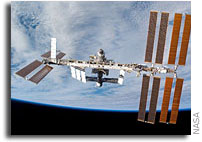
All ISS systems continue to function nominally, except those noted previously or below. Underway: Week 15 of Increment 17.
****Happy 50th Birthday, NASA!****
CDR Volkov began his workday again by attending to the current experiment session with the Russian/German TEKh-20 Plasma Crystal-3+ (Plazmennyi-Kristall/PK-3+) payload, activating the turbopump in the Service Module (SM)’s Transfer Compartment (PkhO) for keeping the vacuum chamber (ZB) in the SM Work Compartment (RO) evacuated. The turbopump will be deactivated again tonight at ~5:25pm EDT before sleeptime. [Main objective of PK-3 is to study dust plasma wave propagation and dispersion ratio at a specified power of HF discharge, pressure, and a varied number of particles.]
The CDR also performed the periodic service of the active Russian BMP (Harmful Impurities Removal System) by starting the "bake-out" cycle to vacuum on absorbent bed #1 of the regenerable dual-channel filtration system. The process will be terminated around sleeptime, at ~4:25pm EDT. Bed #2 regeneration follows tomorrow. [Regeneration of each of the two cartridges takes about 12 hours and is conducted only during crew awake periods. The BMP’s regeneration cycle, normally done every 20 days, is currently performed four times more frequently to remove any traces of leaked Freon-218 from the cabin atmosphere (last time: 7/22&23).]
FE-1 Kononenko performed more FGB outfitting with new stowage enclosures delivered by the ATV, built in Russia to provide new efficient stowage spaces behind FGB panels and improve airflow/circulation. [Today’s installations involved the spaces behind two panels (404, 405) in FGB zone 5, 8 & 9.]
Conducting more preparations for initiating payload operations in the JAXA Kibo JPM (JEM Pressurized Module), FE-2 Chamitoff verified the nominal performance of the ISPR (International Standard Payload Rack) power switch, using the SLT (Systems Laptop). Later, Greg collected the necessary parts for the reconnection of the CB (Clean Bench) subrack facility.
Also in the Kibo JPM, Gregory activated the PLT (Payload Laptop) for payload operation (after temporarily disconnecting the SSC-14/Station Support Computer 14 power cable to allow UOP/Utility Outlet Panel access), then turned off the PLT, relocated it for payload ops and powered it up again.
Afterwards, continuing FSL (Fluid Science Laboratory) commissioning in the COL (Columbus Orbital Laboratory), Chamitoff reconfigured the FSL by removing the OPT TGT (Optical Target) and inserting the GEOFLOW EC (Experiment Container), followed by unlocking and releasing the FSL FCE (Facility Core Element), setting up the FSL, and deactivating the PLT. [The installation involved the demating of ECP Video By-Pass Connector from the EC’s Panel Video P301. After some initial tests, the GEOFLOW science program is planned to start tomorrow.]
Sergey Volkov worked on the Service Module (SM) toilet systems (ASU), performing the monthly 30-min. maintenance/servicing of the facility, changing out replaceable ASU parts with new components, i.e., the urine receptacle (MP) and a filter insert (F-V). The old parts were discarded as trash.
After the FE-2 broke out the auditory test equipment, the three crewmembers took the periodic O-OHA (on-orbit hearing assessment) test, a 30-min. NASA environmental health systems examination to assess the efficacy of acoustic countermeasures, using a special MEC (Medical Equipment Computer) laptop application. It was Greg’s second O-OHA session, the third for Sergey & Oleg. [The O-OHA audiography test involves minimum audibility measurements for each ear over a wide range of frequencies (0.25-10 kHz) and sound pressure levels, with the crewmembers using individual-specific Prophonics earphones, Bose ANC headsets and the SLM (sound level meter). To conduct the testing, the experimenter is supported by special EarQ software on the MEC, featuring an up/down-arrow-operated slider for each test frequency that the crewmember moves to the lowest sound pressure level at which the tone can still be heard. The baseline test is required not later than about Flight Day 14 for each new Expedition and is then generally performed once per month. Note: There have been temporary hearing deficits documented on some U.S. and Russian crewmembers, all of which recovered to pre-mission levels.]
Working from the Russian RSE1 laptop, CDR Volkov loaded (ghosted) the RSK-1 laptop with upgrade software (Vers. 1.4) from a DVD via an HDD (Hard Disk Drive) “image”.
In the Lab, Chamitoff performed maintenance on the CGBA (Commercial Generic Bioprocessing Apparatus) after its use for SHERE session on last weekend’s VolSci (Voluntary Science) program, removing the CGBA-5 mufflers to clean the air inlet screens and then accessing and rotating the Silicate Garden Hab. CGBA-5 will be activated from the ground later this week.
The CDR continued the current round of the monthly preventive maintenance of RS (Russian Segment) ventilation systems in the Funktsionalnyi-Grusovoi Blok (FGB), cleaning the detachable fan screens 1, 2, and 3 of the three SOTR gas-liquid heat exchangers (GZhT4) and the fixed grill of GZhT #4.
Kononenko meanwhile had ~20 min set aside for reviewing an OBT (Onboard Training) for OpsLAN (Operations Local Area Network) reload procedures.
The FE-1 completed the routine daily servicing of the SOZh system (Environment Control & Life Support System, ECLSS) in the SM. [Regular daily SOZh maintenance consists, among else, of checking the ASU toilet facilities, replacement of the KTO & KBO solid waste containers and replacement of EDV-SV waste water and EDV-U urine containers.]
Oleg also performed the daily IMS (Inventory Management System) maintenance, updating/editing its standard “delta file” including stowage locations, for the regular weekly automated export/import to its three databases on the ground (Houston, Moscow, Baikonur).
The FE-2 completed the periodic (monthly) inspection of the RED (Resistive Exercise Device) canister cords and accessories.
The three crewmembers conducted their regular 2.5-hr. physical workout program (about half of which is used for setup & post-exercise personal hygiene) on the CEVIS cycle ergometer (FE-2), TVIS treadmill (CDR, FE-1), RED (CDR, FE-1, FE-2), and VELO bike with bungee cord load trainer (CDR, FE-1). Later, Sergey transferred the exercise data file to the MEC (Medical Equipment Computer) laptop for downlink, including the daily wristband HRM (Heart Rate Monitor) data of the workouts on RED, followed by their erasure on the HRM storage medium (done six times a week).
At ~1:05pm EDT, the Expedition 17 crew held their first “handover” conference with the E-18 crew, via S-band (audio).
As a discretionary job from the Russian “time permitting” task list, Oleg was perform the regular monitoring, picture-taking and downloading for the BIO-5 Rasteniya-3 ("Plants-3") experiment which researches growth and development of plants (peas) under spaceflight conditions in the Lada-13 greenhouse from IBMP (Institute of Bio-Medical Problems {Russian: IMBP}).
No CEO (Crew Earth Observations) photo targets uplinked for today.
CEO photography can be studied at this “Gateway” website:
http://eol.jsc.nasa.gov (as of 3/1/08, this database contained 757,605 views of the Earth from space, with 314,000 from the ISS alone).
SKV-2 Update: The Russian SKV-2 air conditioner was successfully recharged with fresh Khladon (Freon-218) coolant yesterday and is currently operating nominally, collecting the first condensate. TsUP-Moscow estimates that about 100 grams of Khladon leaked out during the recharge process. The BMP Micropurification Unit will be activated every 5 days for increased scrubbing of the cabin atmosphere (along with the previously reported Khladon spill).
Elektron Update: The Elektron oxygen generator was shut down over the last weekend due to a procedural error which introduced non-certified water into the Elektron water container. The unit was purged with nitrogen during the shutdown sequence as usual. It is scheduled to be re-activated on 7/30. An O2 repress from ATV storage will be conducted tomorrow to maintain proper ppO2 levels.
Significant Events Ahead (all dates Eastern Time, some changes possible.):
07/29/08 — NASA 50 Years
08/13/08 — ATV Reboost
08/30/08 — Progress M-64/29P undocking, from FGB nadir
09/05/08 — ATV1 undocking, from SM aft port (loiter until ~9/25 for nighttime reentry/observation)
09/10/08 — Progress M-65/30P launch
09/12/08 — Progress M-65/30P docking (SM aft port)
10/08/08 — STS-125/Atlantis Hubble Space Telescope Service Mission 4 (SM4)
10/11/08 — Progress M-65/30P undocking (from SM aft port)
10/12/08 — Soyuz TMA-13/17S launch
10/14/08 — Soyuz TMA-13/17S docking (FGB nadir port)
10/23/08 — Soyuz TMA-12/16S undocking (DC1 nadir)
11/10/08 — STS-126/Endeavour/ULF2 launch – MPLM Leonardo, LMC
11/12/08 — STS-126/Endeavour/ULF2 docking
11/20/08 — ISS 10 Years
11/26/08 — Progress M-66/31P launch
11/28/08 — Progress M-66/31P docking
02/10/09 — Progress M-67/32P launch
02/12/09 — Progress M-67/32P docking
02/12/09 — STS-119/Discovery/15A launch – S6 truss segment
03/25/09 — Soyuz TMA-14/18S launch
05/15/09 — STS-127/Endeavour/2J/A launch – JEM EF, ELM-ES, ICC-VLD
07/30/09 — STS-128/Atlantis/17A – MPLM(P), last crew rotation
05/27/09 — Six-person crew on ISS (following Soyuz 19S docking, May ’09)
10/15/09 — STS-129/Discovery/ULF3 – ELC1, ELC2
12/10/09 — STS-130/Endeavour/20A – Node-3 + Cupola
02/11/10 — STS-131/Atlantis/19A – MPLM(P)
04/08/10 — STS-132/Discovery/ ULF4 – ICC-VLD, MRM1
05/31/10 — STS-133/Endeavour/ULF5 – ELC3, ELC4 (contingency).



