
NASA ISS On-Orbit Status 26 March 2012
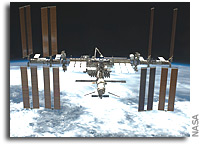
ISS On-Orbit Status 03/26/12
All ISS systems continue to function nominally, except those noted previously or below. Underway: Week 18 of Increment 30 (six-person crew).
After breakfast, FE-1 Shkaplerov performed the routine inspection of the SM (Service Module) PSS Caution & Warning panel as part of regular Daily Morning Inspection.
FE-2 Ivanishin completed the weekly checkup behind ASU/toilet panel 139 in the SM of a fluid connector (MNR-NS) of the SM-U urine collection system, looking for potential moisture.
CDR Burbank performed his 4th (FD135/Flight Day 135) ICV (Integrated Cardiovascular) Resting Echo Scan in the US Lab, assisted by Don Pettit who served as CMO (Crew Medical Officer) to operate the USND (Ultrasound) scans. [Wearing electrodes, ECG (Electrocardiograph) cable & VOX, Dan underwent the USND scan for ICV assessment, with video being recorded from the HRF (Human Research Facility) Ultrasound and COL cabin camera. Heart rate was tracked with the HRM (Heart Rate Monitor). There are dietary constraints, and no exercise is allowed 4 hrs prior to scan. After confirmed file transfer, the gear was powered down and stowed. Later, the data from the two HM-2 (Holter Monitor 2) HiFi Cards and two Actiwatch Spectrums were transferred from the USND-2 (Ultrasound 2) hard drive to the USND-2 USB drive. Voice required last 5 minutes for crew to inform ground copy process is complete. The USND echo experiment uses the Image Collector software on the laptop and requires VOX/Voice plus RT Video downlink during the activity. Goal of the ICV experiment is to quantify the extent, time course, and clinical significance of cardiac atrophy and identify its mechanisms. The ICV experiment consists of two separate but related activities over a one-week time period: an ultrasound echo scan & an ambulatory monitoring session. The sessions are scheduled at or around FD14, FD30, FD75, FD135 and R-15 (there are fewer sessions if mission duration is less than six months).]
In the COL (Columbus Orbital Laboratory), FE-5 Kuipers worked on the EMCS (European Modular Cultivation System) to exchange two water reservoirs in the center of the rotors, installing FM003 (Fluid Module 3) on rotor A and FM004 on rotor B. Afterwards, André configured ER3 (EXPRESS Rack 3) for ground-commanded power-up of the EMCS from POC (Payload Operations Center/Huntsville).
André also replaced 9V batteries (4 each) in all four US CQs (Crew Quarters). [André’s crew note: “All battery tests and Egress tone and light tests positive.”]
Dan Burbank conducted Part 1 of the periodic personal acoustic measurement protocol, distributing crew-worn acoustic dosimeters from the SMK (Sound Measurement Kit) to the Soyuz 28S crew, i.e., himself (#1003), Anton (#1004), Anatoly (#1005).
Oleg Kononenko spent another ~2 hrs with the KPT-2 payload and its BAR science instruments suite, using the AU-1 (Ultrasound Analyzer 1) to continue measuring acoustic background levels in order to pinpoint a high-intensity ultrasound frequency source. AU-1 can detect and locate tiny leaks by listening for “hissing” noise. [KPT-2 monitors problem areas, necessary to predict shell micro-destruction rate and to develop measures to extend station life. Data are copied to the RSE1 laptop for downlink to Earth via OCA, with photographs, and the activities are supported by ground specialist tagup as required. Objective of the Russian KPT-2/BAR science payload is to measure environmental parameters (temperature, humidity, air flow rate) and module shell surface temperatures behind RS (Russian Segment) panels and other areas susceptible to possible micro-destruction (corrosion), before and after insolation (day vs. night). Piren-V is a video-endoscope with pyrosensor, part of the methods & means being used on ISS for detecting tiny leaks in ISS modules which could lead to cabin depressurization. Besides KPT-2 Piren-V, the payload uses a remote infrared thermometer (Kelvin-Video), a thermohygrometer (Iva-6A), a heat-loss thermoanemometer/thermometer (TTM-2) and an ultrasound analyzer (AU-1) to determine environmental data in specific locations and at specific times. Activities include documentary photography with the NIKON D2X camera and flash.]
Later, Anton Shkaplerov & Anatoly Ivanishin also used the KPT-2 payload with its BAR science instruments Piren-V and Iva-6A for ~2 hrs to measure structural temperatures at specific locations in the RS (Russian Segment) to locate cold spots on the pressurized shell and window areas.
Don Pettit conducted the periodic (approx. weekly) WRS (Water Recovery System) sampling in Node-3 using the TOCA (Total Organic Carbon Analyzer), after first initializing the software and priming (filling) the TOCA water sample hose. [After the approximately 2-hr TOCA analysis, results were transferred to the SSC-5 (Station Support Computer 5) laptop via USB drive for downlink, and the data were also logged.]
After reviewing procedural material and conferring (~8:40am) with the PI (Principal Investigator), Don Pettit set up the video camera, activated the MSG (Microgravity Science Glovebox) and transitioned MSG from the SLICE to BASS (Burning and Suppression of Solids) experiments. Preparations included an internal inspection and cleaning of the SPICE hardware of soot, then calibrating the exhaust fan velocity. MSG was powered down after operations by André. [BASS uses SLICE equipment but burns solid fuel samples instead of gaseous jets. Each sample will be ignited several times for study.]
Using the new ATV (Automated Transfer Vehicle) rendezvous overlay for the ATV Simvol-Ts (“symbol center”) rendezvous simulator on an SSC (Station Support Computer at the SM Central Post, Oleg Kononenko & André Kuipers spent ~40 min on OBT (Onboard Training) drill #2 to get ready for the arrival of the European cargo ship which will dock at the SM aft end port. A tagup with ground specialists followed at ~10:05am EDT. [Today’s OBT practiced crew actions in the event of an off-nominal situation while monitoring rendezvous & docking, refreshing rendezvous & docking monitoring skills, and practicing crew interaction during rendezvous & docking monitoring.]
Later, Kuipers & Pettit conducted a ~30-min audio teleconference with ground experts to discuss ATV-3 cargo transfer activities, going over a draft cargo list und reviewing the planned “choreography” for the transfer operations.
Shkaplerov & Ivanishin had another ~3 hrs set aside for commemorative (“symbolic”) activities, today stamping 9 paintings by Shilov with certificates for Roskosmos and GRO/Russian Postal Service. The paintings were photographed, discussed on video according to an uplinked script and packed into kits for return on Soyuz TMA-22/28S spacecraft next month (4/30). [Alexander Maxovich Shilov, born 10/6/1943 in Moscow, is a prominent Soviet and Russian painter. In 1996 he donated to the Russian Government 365 portraits painted by him. Since 2001 he is a full member of the Russian Academy of Arts.]
Anton conducted the periodic (every Monday) verification of the automatic IUS AntiVirus definition update on the Russian VKS auxiliary network laptops RSS1, RSS2, RSK1-T61p & RSK2, as well as performed the manual update on the non-network laptops RSE-Med & RSE1. [Antivirus update procedures have changed since the SSCV4 software update. Before the installation (on 8/8) of the new automated procedure, the refresh was done manually on Mondays on RSS2, copying the files to the RSS2 service folder, then launching update scripts on the network laptops RSS1, RSK1-T61p & RSK2 and finally manually updating non-network laptops RSE-Med & RSE1. On Tuesdays, the anti-virus scanning results are regularly verified on all laptops. Nominally, Russian network laptops have software installed for automatic anti-virus update; fresh data is copied on RSK1-T61p & RRSK2 every time a computer is rebooted with a special login, and on RSS1 once daily. On Russian non-network laptops antivirus definition file update is done by the crew once every two weeks on Monday.]
FE-1 also worked with the CMS (Countermeasure System), a component of the SKDS GANK-4M suite, to check for CO (Carbon Monoxide) contamination in the SM, recording the measurements and updating the CO sensor coefficient for calibration. [CMS uses preprogrammed microchips to measure for numerous contaminants such as O-Xylol (1,2-Dimethylbenzol, C8H10), Hydrogen Chloride (HCl), Formaldehyde, Isopropanol, Methanol, Toluene, Mercaptan, Sulphur Dioxide, Hydrogen Cyanide, Phosgene, Ozone, Acetic Acid, Ammonia, Nitrogen Dioxide, Nitrous Oxides, Acetone, Benzene, Carbon Monoxide, etc.]
In the SM, FE-4 Kononenko completed the R&R (removal & replacement) of a faulty male connector of the SA-325-I transmitter unit of the Regul-OS, for which he had made preparations last week. [Located in the SM, Regul-OS is a subsystem of the RSUS Radio Control & Comm System of the RS (Russian Segment) for handling two-way voice communication, digital command/program information, and telemetry transmission via Russian RGS (Groundsites). Regul is the nominal uplink channel for all Russian commands; operating at a low data rate, it is equivalent to the US S-band system. The SA-325 block repaired today is one of three redundant transmitters, each containing a transceiver (PPA) and Digital Processor (UtsO).]
Before sleeptime, Oleg will set up the battery of the GFI-1 “Relaksatsiya” (Relaxation) Earth Observation experiment for overnight charging. [By means of the GFI-1 UFK “Fialka-MV-Kosmos” ultraviolet camera, SP spectrometer and SONY HVR-Z7 HD (High Definition) camcorder, the experiment observes the Earth atmosphere and surface from window #9, with spectrometer measurements controlled from Laptop 3. “Relaxation”, in Physics, is the transition of an atom or molecule from a higher energy level to a lower one, emitting radiative energy in the process as equilibrium is achieved.]
Working in the US A/L (Airlock), the CDR removed & replaced the middle of the three HEPA (high-efficiency particulate air) bacteria filters. [The other two had already been replaced earlier by Don Pettit.]
Anton performed the routine daily servicing of the SOZh system (Environment Control & Life Support System, ECLSS) in the SM. [Regular daily SOZh maintenance consists, among else, of checking the ASU toilet facilities, replacement of the KTO & KBO solid waste containers, replacement of EDV-SV waste water and EDV-U urine containers and filling EDV-SV, KOV (for Elektron), EDV-ZV & EDV on RP flow regulator.]
Later, FE-1 took care of the daily IMS (Inventory Management System) maintenance as part of the Russian discretionary “time permitting” task list, updating/editing its standard “delta file” including stowage locations, for the regular weekly automated export/import to its three databases on the ground (Houston, Moscow, Baikonur).
Anatoly completed another 30-min. session for the DZZ-13 “Seiner” ocean observation program, obtaining HDV (Z1) camcorder footage of color bloom patterns in the waters of the South-Eastern Pacific and off the Chilean coastline, then copying the images to the RSK-1 laptop.
FE-2 also had time set aside again for recording high-resolution video with the SONY HVR-Z7E to be used in a joint project of Roskosmos TV Studio with Karusel (Carousel) TV Channel for children ages 8 to 12 years, the “It’s Time to go to space!” program, which has a segment where Russian cosmonauts are discussing their work &, answer viewers’ questions (currently they are working on a New Year episode). The footage was then to be downlinked to TsUP-Moscow.
Before Presleep, the CDR will turn on the MPC (Multi-Protocol Converter) and start the Ku-band data flow of video recorded during the day to the ground, with POIC (Payload Operations & Integration Center) routing the onboard HRDL (High-Rate Data Link). After about an hour, Dan turns MPC routing off again. [This is a routine operation which regularly transmits HD onboard video (live or tape playback) to the ground on a daily basis before sleeptime.]
The crew worked out with their regular 2-hr physical exercise protocol on the CEVIS cycle ergometer with vibration isolation (CDR), TVIS treadmill with vibration isolation & stabilization (FE-1, FE-2, FE-4), ARED advanced resistive exerciser (CDR, FE-4, FE-5, FE-6), T2/COLBERT advanced treadmill (FE-5, FE-6), and VELO ergometer bike with load trainer (FE-1, FE-2). [FE-6 is on the special experimental PRINT protocol which diverts from the regular 2.5 hrs per day exercise regime and introduces special daily sessions, followed by a USND (Ultrasound) leg muscle self scan in COL. Today’s exercise called for ARED+T2, with T2, ARED+T2 & CEVIS following in the next 3 days. If any day is not completed, Don picks up where he left off, i.e., he would be finishing out the week with his last day of exercise on his off day.]
Tasks listed for Shkaplerov, Kononenko & Ivanishin on the Russian discretionary “time permitting” job for today were –
– A ~30-min. run of the GFI-8 “Uragan” (hurricane) earth-imaging program with the NIKON D3X digital camera with Sigma AF 300-800mm telelens, focusing on the volcanoes Kilimanjaro, Santa Maria, Fuego, San Cristobal, Arenal, Poas, Galeras, Reventador, Tanguraua, Sangay, Cleveland & Hudson and the glaciers of Patagonia;
– A ~30-min. session for Russia’s EKON Environmental Safety Agency, making observations and taking KPT-3 aerial photography of environmental conditions on Earth using the NIKON D3X camera with the RSK-1 laptop, and
– More preparation & downlinking of reportages (written text, photos, videos) for the Roskosmos website to promote Russia’s manned space program (max. file size 500 Mb).
ATV-3 Update: Ground analysis of the long-lens photography conducted by the crew yesterday has confirmed that the Proximity Antenna boom is properly deployed and in the locked position. ESA reports that ATV-3 is in good shape for rendezvous and docking.
No CEO (Crew Earth Observation) targets uplinked for today.
ISS Orbit (as of this morning, 9:38am EDT [= epoch])
Mean altitude – 388.7 km
Apogee height – 399.4 km
Perigee height – 378.1 km
Period — 92.33 min.
Inclination (to Equator) — 51.64 deg
Eccentricity — 0.0015748
Solar Beta Angle — 3.5 deg (magnitude increasing)
Orbits per 24-hr. day — 15.60
Mean altitude loss in the last 24 hours — 122 m
Revolutions since FGB/Zarya launch (Nov. 98) — 76,513
Time in orbit (station) — 4875 days
Time in orbit (crews, cum.) — 4162 days
Significant Events Ahead (all dates Eastern Time and subject to change):
————–Six-crew operations—————-
03/28/12 — ATV3 docking (~6:34pm EDT)
04/19/12 — Progress M-14M/46P undock
04/20/12 — Progress M-15M/47P launch
04/22/12 — Progress M-15M/47P docking
04/30/12 — SpaceX Dragon launch (12:22pm EDT; target date)
04/30/12 — Soyuz TMA-22/28S undock/landing (End of Increment 30)
————–Three-crew operations————-
05/15/12 — Soyuz TMA-04M/30S launch – G.Padalka (CDR-32)/J.Acaba/S.Revin
05/17/12 — Soyuz TMA-04M/30S docking (MRM2)
————–Six-crew operations—————-
07/01/12 — Soyuz TMA-03M/29S undock/landing (End of Increment 31)
————–Three-crew operations————-
07/15/12 — Soyuz TMA-05M/31S launch – S.Williams (CDR-33)/Y.Malenchenko/A.Hoshide
07/17/12 — Soyuz TMA-05M/31S docking
07/20/12 — HTV3 launch (~10:18pm EDT)
07/31/12 — Progress M16M/48P launch
08/02/12 — Progress M16M/48P docking
————–Six-crew operations—————-
09/17/12 — Soyuz TMA-04M/30S undock/landing (End of Increment 32)
————–Three-crew operations————-
10/15/12 — Soyuz TMA-06M/32S launch – K.Ford (CDR-34)/O.Novitskiy/E.Tarelkin
10/17/12 — Soyuz TMA-06M/32S docking
————–Six-crew operations————-
11/01/12 — Progress M-17M/49P launch
11/03/12 — Progress M-17M/49P docking
11/12/12 — Soyuz TMA-05M/31S undock/landing (End of Increment 33)
————–Three-crew operations————-
12/05/12 — Soyuz TMA-07M/33S launch – C.Hadfield (CDR-35)/T.Mashburn/R.Romanenko
12/07/12 — Soyuz TMA-07M/33S docking
————–Six-crew operations————-
12/26/12 — Progress M-18M/50P launch
12/28/12 — Progress M-18M/50P docking
03/19/13 — Soyuz TMA-06M/32S undock/landing (End of Increment 34)
————–Three-crew operations————-
04/02/13 — Soyuz TMA-08M/34S launch – P.Vinogradov (CDR-36)/C.Cassidy/A.Misurkin
04/04/13 — Soyuz TMA-08M/34S docking
————–Six-crew operations————-
05/16/13 — Soyuz TMA-07M/33S undock/landing (End of Increment 35)
————–Three-crew operations————-
05/29/13 — Soyuz TMA-09M/35S launch – M.Suraev (CDR-37)/K.Nyberg/L.Parmitano
05/31/13 — Soyuz TMA-09M/35S docking
————–Six-crew operations————-
09/xx/13 — Soyuz TMA-08M/34S undock/landing (End of Increment 36)
————–Three-crew operations————-
09/xx/13 — Soyuz TMA-10M/36S launch – M.Hopkins/TBD (CDR-38)/TBD
09/xx/13 — Soyuz TMA-10M/36S docking
————–Six-crew operations————-
11/xx/13 — Soyuz TMA-09M/35S undock/landing (End of Increment 37)
————–Three-crew operations————-
11/xx/13 — Soyuz TMA-11M/37S launch – K.Wakata (CDR-39)/R.Mastracchio/TBD
11/xx/13 — Soyuz TMA-11M/37S docking
————–Six-crew operations————-
03/xx/14 — Soyuz TMA-10M/36S undock/landing (End of Increment 38)
————–Three-crew operations————-



