
NASA ISS On-Orbit Status 24 June 2011
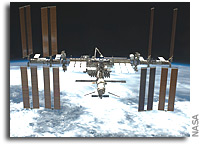
All ISS systems continue to function nominally, except those noted previously or below.
FE-6 Fossum concluded his first NUTRITION w/Repository 24-hr urine collection period (~3:00am EDT), with samples deposited in MELFI. Afterwards, Mike underwent the associated generic blood draw, with FE-3 Garan assisting with the phlebotomy as operator. FE-6 then set up the RC (Refrigerated Centrifuge) for spinning the samples prior to stowing them in the MELFI (Minus Eighty Laboratory Freezer for ISS). (Yesterday, the procedure was erroneously reported for FE-5 instead for FE-6). [The operational products for blood & urine collections for the HRP (Human Research Program) payloads were revised some time ago, based on crew feedback, new cold stowage hardware, and IPV capabilities. Generic blood & urine procedures have been created to allow an individual crewmember to select their payload complement and see specific requirements populated. Individual crewmembers will select their specific parameter in the procedures to reflect their science complement. Different crewmembers will have different required tubes and hardware configurations, so they must verify their choice selection before continuing with operations to ensure their specific instruction.]
In support of ground-commanded operation of the ISSAC (ISS Agricultural Camera) hardware, Furukawa opened the US Lab window shutter using the WORF (Window Observational Research Facility) shutter handle. [Shutter opening must be done “slowly and deliberately”.]
CDR Borisenko, FE-1 Samokutyayev & FE-4 Volkov had several hours set aside for unloading the Progress M-11M/43P cargo spacecraft, docked at SM (Service Module) aft end port, and transferring Russian, US & ESA cargo to the ISS for stowage, based on uplinked tabular listings. Time-critical items came first. [Total Russian cargo items on 43P: 588; total US cargo items on 43P: 297.]
Andrey also unpacked & deployed new 43P-arrived RODF (Russian Operations Data Files) documents. [This involved updates for the books/material on Plasma Crystal 3 Deactivation/Activation, Spacesuit Ops, Medical Operations (MO), RS EVA-29 Procedures, Progress ODF, etc.]
With Samokutyayev taking documentary photos, Sergei Volkov transferred the TKhN-9/KRISTALLIZATOR payload package for the JAXA PCG (Protein Crystal Growth) payload from Progress, inspected it and handed it over to Satoshi in the USOS (US Segment).
After receiving the PCG hardware from Sergei, Furukawa unpacked the launch bag in the Kibo JPM (JEM Pressurized Module), removed the PCRF (Protein Crystallization Research Facility) cables and installed the PCG canister in the PCRF in the Ryutai Rack, then configured the cabling and closed out the PCRF after taking documentary photography for ground inspection. [Time critical: the PCG installation had to be performed within 24 hrs after 43P docking.]
Furukawa later continued prepacking ULF7 return cargo, followed (~8:15am) by ground specialist tagup for debriefing.
As a post-docking activity, FE-1 Samokutyayev performed the periodic task of downloading structural dynamics measurements of the IMU-Ts microaccelerometer of the running experiment TEKh-22 “Identifikatsiya” (Identification) in MRM1 (Mini Research Module 1) Rassvet to the RSE1 A31p laptop for subsequent downlink to the ground via OCA. [IMU-Ts is a part of the MRM1 SBI onboard measurement system, installed in PGO behind panel 104.]
Afterwards, Aleksandr worked in Progress 43P to install the electronic LKT local temperature sensor commutator (TA251MB) of the BITS2-12 onboard telemetry measurement system and its PZU-1M ROM (read-only memory), using the LKT and PZU boxes removed from the previous Progress 42P and stowed in DC1.
FE-3 Garan assisted in 43P unloading by transferring the ESA PCBA (Portable Clinical Blood Analyzer) Cartridge Bag and the ESA kit with contents to their final stowage location in the COL (Columbus Orbital Laboratory).
SOLO (Sodium Loading in Microgravity) PCBA Measurement Pouches 1 & 2 were stowed by Ron into MEFLI (Minus Eighty Laboratory Freezer for ISS).
Afterwards, FE-3 set up the G1 HD video camcorder in the US Lab for recording his subsequent maintenance of the CSI (Commercial Generic Bioprocessing Apparatus 5 / Science Insert), deactivating & decabling CGBA-5, accessing CSI-05, performing spider feeding activity, then closing up CGBA, recabling and reactivating it. The spider girls have been spinning perfectly circular webs – which they are not known to do on Earth. [SHAB (Spider Hab) video is monitoring for 24 hours after feeding activity unit. The spider is called the Nephila clavipes. It is also known as the “Banana Spider” because of its yellow banana shaped body. It is sometimes referred to as the “Golden Silk” or “Golden Orb” spider because its web has a golden hue when viewed in the sunlight. It is commonly found in the southern parts of the US, particularly Florida, but it can be found throughout all parts of the southern United States including Alabama and Texas. The two spiders in the habitats are juvenile females and are only about in. long. When female Nephila clavipes complete their last molt and become mature adults, they can be over 3 in. long and their webs over 3 ft across. (Unfortunately, these space spiders will most likely not live until adulthood nor will they get quite that large). To keep the spiders as healthy as possible for as long as possible, they are given a diet of wild type fruit flies. The fruit flies are provided a diet enriched with extra protein. The protein is ground-up dog food that is added to their normal diet of potato flakes. The spider scientists are interested in the Nephila clavipes because she builds a three-dimensional web on the ground that appears disorganized but is in fact very ordered. The hypothesis is these spiders will not build as much 3 dimension into their web given the absence of gravity. This may help scientists more clearly understand the purpose of the 3D web on Earth.]
Garan later activated the Payload MPC (Multi-Protocol Converter) for playing back & downlinking the recorded spider feeding footage and then turned MPC off.
Ron also performed the weekly health check of the O2 sensor in CSA-O2 (Compound Specific Analyzer-Oxygen) #1045, which has exceeded its shelf life. [The health check, using both the #1045 and the #1046 unit, was performed in COL (Columbus Orbital Laboratory) since both MCAs (Major Constituency Analyzers) are currently down, i.e., unavailable for calibration, while the COL PPOS (Partial Pressure Oxygen Sensor) could be used for comparison. Afterwards, both CSA-O2s were deactivated and stowed.]
Mike Fossum & Ron Garan had another hour for a joint review of the EVA tasks and procedures for their ULF7 spacewalk, then (~1:20pm) tagged up with ground specialists in an audio teleconference to discuss their expected activities.
CDR Borisenko conducted the routine daily servicing of the SOZh system (Environment Control & Life Support System, ECLSS) in the SM. [Regular daily SOZh maintenance consists, among else, of checking the ASU toilet facilities, replacement of the KTO & KBO solid waste containers, replacement of EDV-SV waste water and EDV-U urine containers and filling EDV-SV, KOV (for Elektron), EDV-ZV & EDV on RP flow regulator.]
Later, Andrey worked in the starboard CQ (Crew Quarters) in the SM, installing 12 new IP-3MKS dosimeters of the RBO-3-4 MATRIOSHKA-R radiation suite in its protective shutter for the third run, supported by ground specialist tagup via S-band. [The arrangement covers the full body length of the occupant in the sleep station.]
After configuring the STTS communications system for working in the MRM2 “Poisk” module, Volkov continued installation and preparation for operating the new PK-3+ Plasma Crystal-3+ (Plazmennyi-Kristall-3 plus) Telescience payload, the first time for Expedition 28. Afterwards, the FE-4 conducted a leak check on the EB vacuum chamber, checking on internal vacuum several times. Later, the STTS comm system was returned to nominal. [The PK-3+ hardware comprises the EB (Eksperimental’nyj Blok) Experiment Module with a turbopump for evacuation, Ts laptop, video monitor, vacuum hoses, electrical circuitry, four hard storage disks for video, and one USB stick with the control application. After setting up the hardware yesterday in MRM2 (it used to be run in the SM), leak checking of the electronics box and evacuation of the vacuum work chamber (EB) with the turbopump, Sergei today conducted more hardware testing and calibration, uploading new software from a USB stick, checking out the software installation and verifying the readiness of the assembled apparatus. The resulting log file was downloaded to laptop for downlink via BSR-TM. The experiment is performed on plasma, i.e., fine particles charged and excited by HF (high frequency) radio power inside the evacuated work chamber. Main objective is to obtain a homogeneous plasma dust cloud at various pressures and particle quantities with or without superimposition of an LF (low frequency) harmonic electrical field. The experiment is conducted in automated mode. PK-3+ has more advanced hardware and software than the previously used Russian PKE-Nefedov payload.]
FE-5 Furukawa “scavenged” two cargo tie-down LSAs (Long Strap Assemblies) from the PMM (Permanent Multipurpose Module) “Leonardo” for use during ULF7.
Afterwards, Satoshi performed the periodic calibration check on the TOCA (Total Organic Carbon Analyzer) which usually pr4ecedes water sample analysis.
Later, FE-5 transferred archived T2 treadmill data to the file server for downlinking.
FE-3, FE-5 & FE-6 filled out their weekly FFQs (Food Frequency Questionnaires) on the MEC (Medical Equipment Computer). It was Ron’s 8th, Satoshi’s & Mike’s first time. [On the FFQs, NASA astronauts keep a personalized log of their nutritional intake over time on special MEC software. Recorded are the amounts consumed during the past week of such food items as beverages, cereals, grains, eggs, breads, snacks, sweets, fruit, beans, soup, vegetables, dairy, fish, meat, chicken, sauces & spreads, and vitamins. The FFQ is performed once a week to estimate nutrient intake from the previous week and to give recommendations to ground specialists that help maintain optimal crew health. Weekly estimation has been verified to be reliable enough that nutrients do not need to be tracked daily.]
Furukawa & Fossum spent about an hour with Garan in a handover session, their 3rd, during which Ron familiarized his crewmates with USOS (US Segment) activities.
At ~6:10am, the six crewmembers held the regular (nominally weekly) tagup with the Russian Flight Control Team (GOGU/Glavnaya operativnaya gruppa upravleniya), including Shift Flight Director (SRP), at TsUP-Moscow via S-band/audio, phone-patched from Houston and Moscow.
At ~6:30am, Sasha, Andrey & Sergei linked up with TsUP-Moscow stowage specialists via S-band to conduct the weekly IMS tagup, discussing inventory & stowage issues, equipment locations and cargo transfers.
At ~2:30pm, all six crewmembers joined for a Russian PAO TV event, downlinking messages of greetings to the unveiling of Yuri A. Gagarin’s monument in London, U.K. [The unveiling of the statue of Yury Alexeyevich Gagarin will take place in London, to commemorate the 50th anniversary of the first cosmonaut’s visit to Great Britain. The statue will be installed near the Trafalgar Square looking across the statue of James Cook, the legendary British explorer and pioneer. Among the participants of the celebration event will be Prince Michael of Kent, Martin Davidson, members of the British Council, Russia’s Ambassador in Great Britain, a Roskosmos delegation headed by V. A. Popovkin, Yelena Gagarina, Valentina Tereshkova, Sergey Krikalev, and others.] (Isn’t that really cool?)
At ~3:50pm, the three crewmembers had their regular weekly tagup with the Lead Flight Director at JSC/MCC-Houston.
Before “Presleep” period tonight, FE-3 powers on the MPC (Multi-Protocol Converter) and start the data flow of video recorded during the day to the ground, with POIC (Payload Operations & Integration Center) routing the onboard HRDL (High-Rate Data Link). After about an hour, MPC will be turned off again. [This is a routine operation which regularly transmits HD onboard video (live or tape playback) to the ground on a daily basis before sleeptime.]
The crew worked out with their regular 2-hr physical exercise protocol on the CEVIS cycle ergometer with vibration isolation (FE-3, FE-5), ARED advanced resistive exercise device (CDR, FE-3, FE-5), T2/COLBERT advanced treadmill (CDR, FE-1, FE-4), and VELO ergometer bike with load trainer (FE-1, FE-4).
CEO (Crew Earth Observation) targets uplinked for today were Colombo, Sri Lanka (Colombo is the capital city of Sri Lanka. Looking left of track and along the coast), Mbabane, Swaziland (this small capital city has a population of approximately 95,000 and lies in a wooded highland. CEO does not have images of this city in their database. Mapping pass, looking left of track), Tashkent, Uzbekistan (the capital city of Uzbekistan is located on a broad, agricultural plain west of the Altai Mountains and just north of the Chirchik River. Looking nadir for this sprawling urban area of well over 2 million. Trying for an update to this contextual view), Beirut, Lebanon (this capital city of over 2 million is located on the central Lebanese coast. After tracking over the Nile River Delta, the crew was advised to look right of track towards the coast for this roughly triangular-shaped, city on a peninsula jutting westward into the Mediterranean Sea), Valletta, Malta (the Maltese islands of Gozo and Malta in the central Mediterranean Sea lie about 100 miles south of the large island of Sicily. The capital city of Valletta with a population of just over 6,000 is located on the north coast of the larger island of Malta. Looking nadir for this small target), and Serra da Cangalha Impact Crater, Brazil (ISS had a nadir pass over this illusive target in the dissected highlands of northeastern Brazil. This 12 km in diameter crater located in Brazil is a subtle feature on the landscape. It is mainly defined by a circular drainage pattern surrounding the remnants of a central peak. This crater was last photographed by the astronauts on the Apollo Soyuz Test Project [ASTP]. An overlapping mapping strip was requested in order to acquire views of the crater).
Significant Events Ahead (all dates Eastern Time and subject to change):
————–Six-crew operations————-
07/08/11 — STS-135/Atlantis launch ULF7 (MPLM) – 11:26:46am
07/10/11 — STS-135/Atlantis docking ULF7 (MPLM) ~11:09am
07/18/11 — STS-135/Atlantis undock ULF7 (MPLM) – 1:59pm
07/20/11 — STS-135/Atlantis landing KSC ~7:07am
07/27/11 — Russian EVA #29
08/29/11 — Progress M-11M/43P undocking
08/30/11 — Progress M-12M/44P launch
09/01/11 — Progress M-12M/44P docking (SM aft)
09/08/11 – Soyuz TMA-21/26S undock/landing (End of Increment 28)
————–Three-crew operations————-
09/22/11 — Soyuz TMA-03M/28S launch – D.Burbank (CDR-30)/A.Shkaplerov/A.Ivanishin
10/02/11 – Soyuz TMA-03M/28S docking (MRM2)
————–Six-crew operations————-
10/25/11 — Progress M-10M/42P undocking
10/26/11 — Progress M-13M/45P launch
10/28/11 — Progress M-13M/45P docking (DC-1)
11/16/11 — Soyuz TMA-02M/27S undock/landing (End of Increment 29)
————–Three-crew operations————-
11/30/11 — Soyuz TMA-04M/29S launch – O.Kononenko (CDR-31)/A.Kuipers/D.Pettit
12/02/11 — Soyuz TMA-04M/29S docking (MRM1)
————–Six-crew operations—————-
12/26/11 — Progress M-13M/45P undock
12/27/11 — Progress M-14M/46P launch
12/29/11 — Progress M-14M/46P docking (DC-1)
02/29/12 — ATV3 launch readiness
03/05/12 — Progress M-12M/44P undock
03/16/12 — Soyuz TMA-03M/28S undock/landing (End of Increment 30)
————–Three-crew operations————-
03/30/12 — Soyuz TMA-05M/30S launch – G.Padalka (CDR-32)/J.Acaba/K.Volkov
04/01/12 — Soyuz TMA-05M/30S docking (MRM2)
————–Six-crew operations—————-
05/05/12 — 3R Multipurpose Laboratory Module (MLM) w/ERA – launch on Proton (under review)
05/06/12 — Progress M-14M/46P undock
05/07/12 — 3R Multipurpose Laboratory Module (MLM) – docking (under review)
05/16/12 — Soyuz TMA-04M/29S undock/landing (End of Increment 31)
————–Three-crew operations————-
05/29/12 – Soyuz TMA-06M/31S launch – S.Williams (CDR-33)/Y.Malenchenko/A.Hoshide
05/31/12 – Soyuz TMA-06M/31S docking
————–Six-crew operations—————-
09/18/12 — Soyuz TMA-05M/30S undock/landing (End of Increment 32)
————–Three-crew operations————-
10/02/12 — Soyuz TMA-07M/32S launch – K.Ford (CDR-34)/O.Novitskiy/E.Tarelkin
10/04/12 – Soyuz TMA-07M/32S docking
————–Six-crew operations————-
11/16/12 — Soyuz TMA-06M/31S undock/landing (End of Increment 33)
————–Three-crew operations————-
11/30/12 — Soyuz TMA-08M/33S launch – C.Hadfield (CDR-35)/T.Mashburn/R.Romanenko
12/02/12 – Soyuz TMA-08M/33S docking
————–Six-crew operations————-
03/xx/13 — Soyuz TMA-07M/32S undock/landing (End of Increment 34)
————–Three-crew operations————-
03/xx/13 – Soyuz TMA-09M/34S launch – P.Vinogradov (CDR-36)/C.Cassidy/A.Misurkin
03/xx/13 – Soyuz TMA-09M/34S docking
————–Six-crew operations————-
05/xx/13 – Soyuz TMA-08M/33S undock/landing (End of Increment 35)
————–Three-crew operations————-
05/xx/13 – Soyuz TMA-10M/35S launch – M.Suraev (CDR-37)/K.Nyberg/L.Parmitano
05/xx/13 – Soyuz TMA-10M/35S docking
————–Six-crew operations————-
09/xx/13 – Soyuz TMA-09M/34S undock/landing (End of Increment 36)
————–Three-crew operations————-
09/xx/13 – Soyuz TMA-11M/36S launch – M.Hopkins/TBD (CDR-38)/TBD
09/xx/13 – Soyuz TMA-11M/36S docking
————–Six-crew operations————-
11/xx/13 – Soyuz TMA-10M/35S undock/landing (End of Increment 37)
————–Three-crew operations————-
11/xx/13 – Soyuz TMA-12M/37S launch – K.Wakata (CDR-39)/R.Mastracchio/TBD
11/xx/13 – Soyuz TMA-12M/37S docking
————–Six-crew operations————-
03/xx/14 – Soyuz TMA-11M/36S undock/landing (End of Increment 38)
————–Three-crew operations————-



