
NASA ISS On-Orbit Status 23 September 2011
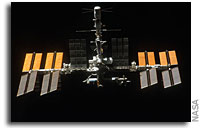
All ISS systems continue to function nominally, except those noted previously or below. Autumnal Equinox in the Northern Hemisphere (Vernal Equinox in the Southern Hemisphere). Summer goodbye!
FE-4 Sergei Volkov performed the routine checkup of the SM (Service Module) PSS Caution & Warning panel as part of the regular Daily Morning Inspection.
CDR Fossum serviced the running BCAT-5 (Binary Colloidal Alloy Test-5) experiment, checking camera operations and changing the camera battery in the morning and before sleeptime (change required after 8 hrs). [The new experiment run is with a Harvard University phase separation sample using a different setup than for the recent crystal samples 9 & 10, mainly requiring an SSC laptop with EarthKAM timing software, power cables and camera USB cable. For illumination, the Mini-MagLite and Flash batteries do not need to be changed yet, but the camera will need a freshly charged battery. After Mike started the run by mixing the sample (#4) for phase separation and taking test photos, the EarthKAM software on the SSC-13 laptop began taking pictures of Sample 4 for 13 days at different intervals throughout the run. This requires camera battery changes twice a day and image check with a battery change once per day. BCAT-5 is operating in the JPM (JEM Pressurized Module) because some time ago the crew deemed the US Lab too crowded for running it.]
After yesterday’s emptying of the WSTA (Wastewater Storage Tank Assembly) into an EDV-U container to reduce TOX2 (Toxicity Class 2) risk, Mike today tackled the major IFM (Inflight Maintenance) of removing & replacing the failed FCPA (Fluids Control & Pump Assembly) in WRS (Water Recovery System) rack 2 in Node-3 (loc. D4). The work was broken out in rotating the rack down to gain access (~25 min), removing the failed FCPA and replacing it with the spare (~40 min each), and closing out the worksite (~45 min.) [The R&R required careful demating & remating of 6 electrical connectors and numerous fluid QDs (quick disconnects), plus affixing connector caps on the failed unit. Since the FCPA contains TOX2 fluid (pretreated urine, sulfuric acid H2SO4 & chromic acid CrO3), Mike had to wear proper PPE (Personnel Protective Equipment), i.e., safety goggles, dust mask and nitrile gloves.]
After the FCPA R&R, the CDR worked on the WHC (Waste & Hygiene Compartment), configuring it to supply the UPA (Urine Processor Assembly) with urine for processing, instead of an EDV-U container. Ground controllers then reactivated the UPA remotely.
Also in Node-3, “next door” to Mike, FE-5 Furukawa meanwhile focused his attention on a major maintenance inspection (annual + quarterly + monthly) of the T2 advanced treadmill, requiring several hours on his work schedule. [The overhaul included inspections of the corner hardware witness marks to determine which hardware fasteners are backing off and to what degree and of the damaged rack composite for signs of additional wear, also wear-and-tear inspection of the upper isolators (2), springs & wire rope, the X-, Y- and Z-axis isolators (2 each), and a calibration of the T2 load cells to account for sensor drift, using the T2’s A31p laptop with updated software.]
Winding up the T2 treadmill maintenance, Satoshi performed an unmanned T2 Speed Characterization ACO (Activation & Checkout) test. Afterwards the resulting T2 PCMCIA memory card data were to be downlinked so engineers can begin their review. [After the data (video & audio) review, the ground was to provide a GO/NO GO call for the crew to resume nominal exercise.]
Starting a new round of the monthly preventive maintenance of RS (Russian Segment) ventilation systems, Sergei Volkov cleaned “Group B” fan screens in the MRM1 “Rassvet” module after taking documentary photography.
After charging its battery, Volkov installed & started the equipment of the GFI-1 “Relaksatsiya” (Relaxation) Earth Observation experiment at SM window #9 for another run, using it to observe the Earth atmosphere & surface at a specific uplinked time (6:40am-7:05am EDT). Later, FE-4 dismantled the equipment again and dumped the data via the RSS1 terminal. [By means of the GFI-1 UFK “Fialka-MV-Kosmos” ultraviolet camera, SP spectrometer and SONY HVR-Z7 HD (High Definition) camcorder, the experiment observes the Earth atmosphere and surface from window #9, with spectrometer measurements controlled from Laptop 3. “Relaxation”, in Physics, is the transition of an atom or molecule from a higher energy level to a lower one, emitting radiative energy in the process as equilibrium is achieved.]
Later, Volkov was scheduled to initiate, on Go-ahead from TsUP-Moscow, another 1-hr refresh of the ISS interior with an O2 repress from Progress M-10M/42P (#410) oxygen tankage, with the Russian Elektron O2 generator currently off.
Sergei also conducted the routine daily servicing of the SOZh system (Environment Control & Life Support System, ECLSS) in the SM. [Regular daily SOZh maintenance consists, among else, of checking the ASU toilet facilities, replacement of the KTO & KBO solid waste containers, replacement of EDV-SV waste water and EDV-U urine containers and filling EDV-SV, KOV (for Elektron), EDV-ZV & EDV on RP flow regulator.]
Fossum went on a search for missing CDs (Compact Disks) with ELC (EXPRESS Laptop Computer) Release 8 software not found on 9/21.
Mike then worked in the Kibo JPM (JEM Pressurized Module) on ER-4 (EXPRESS Rack 4), loading Release 7.0 common software on ELC4 at loc. F5, then following it up with new SNFM (Serial Network Flow Monitor) payload software for LAN (Local Area Network) data downlinking. [Steps included configuring & loading BIOS (Basic Input/Output System), setting up the laptop for operations on ER4, allowing 2 hrs for charging the battery after setup, and then loading the SNFM payload application on the laptop.]
Afterwards, Mike performed the midday camera image & battery check for the running BCAT-5 payload.
Later, Fossum had a fun task: checking out the new BCR/RFID (Bar Code Reader / Radio Frequency ID) system, to demonstrate its proper function for RFID finding and other features. [The WiFi (Wireless Fidelity) scanner system locates items identified to it by the item’s tag number, put in by the user, and then issues laser tones indicating the proximity of the looked-for item. The quicker the tonal sequence, the closer the item. Background: A WiFi network uses radio waves, just like cell phones, televisions and radios. Communicating across a wireless network is like two-way radio communication. A computer’s built-in WiFi “adapter” translates data into a radio signal and transmits it using an antenna. A wireless “router” receives the signal and decodes it. The router sends the information to the Internet using a physical wire, called an “Ethernet” connection. WiFi sometimes is also referred to as “802.11 networking”, from the IEEE (Institute of Electrical and Electronics Engineers) which sets standards for a range of technological protocols, using a numbering system to classify these standards. Another wireless standard with a slightly different number, 802.15, is used for WPANs (Wireless Personal Area Networks). It covers a very short range and serves a technology called “Bluetooth”.]
At ~11:00am EDT, the three crew members jointly undertook the standard 60-min. OBT (on-board training) session for Inc-29, with procedures to refresh their proficiency in responding to a rapid depressurization emergency. An introductory tagup preceded the drill, and a joint drill debrief with ground specialists via S-band at ~1:35pm wrapped up the exercise. [Objective of the exercise is to provide proficiency training for crew response during depressurization. The training exercise is performed under the most realistic emergency conditions possible. Instructors & OBT experts at the control centers (TsUP-Moscow, MCC-Houston, COL-CC/Oberpfaffenhofen and SSIPC/Tsukuba) stood by to send commands as required and respond to crew questions. The crew moved throughout the station in order to simulate emergency response actions per procedures at specific checkpoints; they communicated & coordinated simulated actions with the control centers as if this were a real event.]
Volkov collected & downloaded the periodic sensor readings of the Russian “Pille-MKS” (MKS = ISS) radiation dosimetry experiment which has 10 sensors placed at various locations in the RS (DC1, SM starboard & port cabin windows, ASU toilet facility, control panel, MRM2, MRM1,etc.) and one in Node-3, plus one, the “duty” dosimeter, in the Reader. The memory/flash card was then replaced Today’s readings were taken manually from all 11 deployed dosimeters and logged on a data sheet. Automatic mode was then reactivated and the dosimeters returned to their original locations. [The dosimeters take their readings automatically every 90 minutes.]
Fossum uninstalled the 3 alignment guides from CIR (Combustion Integrated Rack) at Lab S3 to allow the PaRIS (Passive Rack Isolation System) to be activated before begin of ground-commanded CIR operations requiring a microgravity environment.
Mike also filled out his weekly FFQ (Food Frequency Questionnaire) on the MEC (Medical Equipment Computer). [On the FFQs, USOS astronauts keep a personalized log of their nutritional intake over time on special MEC software. Recorded are the amounts consumed during the past week of such food items as beverages, cereals, grains, eggs, breads, snacks, sweets, fruit, beans, soup, vegetables, dairy, fish, meat, chicken, sauces & spreads, and vitamins. The FFQ is performed once a week to estimate nutrient intake from the previous week and to give recommendations to ground specialists that help maintain optimal crew health. Weekly estimation has been verified to be reliable enough that nutrients do not need to be tracked daily.]
Before “Presleep” period tonight, the CDR routes the running MPC (Multi Protocol Converter) to the ground, starting the data flow of video recorded during the day to the ground, with POIC (Payload Operations & Integration Center) routing the onboard HRDL (High-Rate Data Link). After about an hour, Mike will turn MPC routing off again. [This is a routine operation which regularly transmits HD onboard video (live or tape playback) to the ground on a daily basis before sleeptime.]
Before sleeptime, Sergei will activate the RSE-LCS (Laser Communication System) A31p laptop in the SM to start recording data sent overnight per auto control protocol from the BTLS-N External Onboard Laser Communication Terminal via RS-232 line. Tomorrow morning, FE-4 will dump (copy) the data from the RSE-LCS to the RSS2 laptop for data downlink, for another test of the TEKh-39 LCS (Russian: SLS) system.
At ~3:45am, the three crewmembers held the regular (nominally weekly) tagup with the Russian Flight Control Team (GOGU/Glavnaya operativnaya gruppa upravleniya), including Shift Flight Director (SRP), at TsUP-Moscow via S-band/audio, phone-patched from Houston and Moscow.
At ~3:05pm, the crew is scheduled for their regular weekly tagup with the Lead Flight Director at JSC/MCC-H.
Tasks listed for Sergei Volkov on the Russian discretionary “time permitting” job for today were –
* Continuing the preparation & downlinking of more reportages (written text, photos, videos) for the Roskosmos website to promote Russia’s manned space program (max. file size 500 Mb),
* Completing the daily IMS (Inventory Management System) maintenance, updating/editing its standard “delta file” including stowage locations, for the regular weekly automated export/import to its three databases on the ground (Houston, Moscow, Baikonur), and
* Performing the daily inspection of the recently activated Russian BIO-5 Rasteniya-2 (“Plants-2”) payload with its LADA-01 greenhouse and verifying proper watering of the KM A32 & A24 root modules; [Rasteniya-2 researches growth and development of plants (currently wheat) under spaceflight conditions in the LADA greenhouse from IBMP (Institute of Bio-Medical Problems, Russian: IMBP).]
The crew worked out with their regular 2-hr physical exercise protocol on the CEVIS cycle ergometer with vibration isolation (FE-5), TVIS treadmill with vibration isolation & stabilization (FE-4), and ARED advanced resistive exercise device (FE-4, FE-5). No exercise reported for CDR.
CEO (Crew Earth Observation) targets uplinked for today were Dushanbe, Tajikistan (this capital city with a population nearing 750,000 is located in an agricultural area of the western part of the country at the confluence of the Varzob and Kofarnihon Rivers. Looking nadir for the city), Merapi Volcano (ISS had a pass in relatively fair weather over Indonesia’s most active volcano located in the central part of the major island of Java. As ISS approached, the crew was to look left of track for this distinctive volcanic cone. There are numerous volcanoes in this area, but Merapi is the one most likely to have a plume), Chisinau, Moldova (ISS had a pass over this target in fair weather. The Moldovan capital is located near the center of the country and inland about 120 miles from the northwestern coast of the Black Sea. At this time the crew was to look slightly left for this urban area of nearly one million inhabitants), Tehran, Iran (the Iranian capital with a population nearing 9 million is located in the northern part of the country about 70 miles south of the coast of the Caspian Sea. As ISS tracked over the desert near the Alborz Range, the crew was to look left for this sprawling urban area), San Marino, San Marino (ISS had a nadir pass over this tiny capital city of this microstate within the target area. Trying for a mapping strip to acquire useful views. The Republic itself is land-locked and is located about 20 miles southwest of the Italian coastal city of Rimini. The crew’s best visual cues were Rimini’s small but prominent bay and a light-toned river which reaches the sea at this point), Tropical Storm Ophelia, Atlantic Ocean (DYNAMIC EVENT: Tropical storm Ophelia has continued to slowly strengthen in the tropical Atlantic about 1,000 miles east of the Lesser Antilles with winds up to 55kts. However, slight weakening to 50kts is forecast by the National Hurricane Center as the system moves westward at about 12kts. At this time as ISS tracked southeastward over the Atlantic Ocean, they were to look obliquely right of track for views of the cloud structures of this tropical cyclone), Chiricahua Mountains (orbital pass over one of many “sky islands”. With elevations ranging from about 4,000 to 9,800 feet, the Chiricahua support an ecologically diverse, higher-rainfall mountain woodland within the Sonoran Desert. These scattered highlands are known as the Madrean Sky Islands and straddle the border between northwestern Mexico and the southwestern United States. CEO is seeking detailed mapping views of this target for baseline and change detection [especially after fires in this area] of unique and threatened habitat), Hurricane Hilary, Pacific Ocean (DYNAMIC EVENT: Hurricane Hilary became the eastern Pacific’s 8th named tropical cyclone this season early on 9/21 not far from the southern coast of Mexico. Since that time it has rapidly strengthened to a Category 1 storm with maximum winds of 65kts as it moved west-northwestward at 8kts paralleling the coast. At this time as ISS tracked southeastward over interior Mexico, the crew was to look obliquely right of track for this hurricane. By then Hilary is forecast remain off the coast and to be nearing Category 3 strength with winds greater than 90kts. Trying for either broad views of the storm as a whole or, if an eye is visible, trying for detailed views of its structure), and Ubinas Volcano, Peru (ISS had a near-nadir pass over Peru’s most active volcano with fair skies expected. The summit caldera contains an ash cone, and debris avalanche deposits extending 10 km from the southeast flank of the volcano. Looking carefully for this isolated, usually snow-capped peak. Ground request was for overlapping frames of the volcano summit and flanks).
ISS Orbit (as of this morning, 8:31am EDT [= epoch])
* Mean altitude – 383.5 km
* Apogee height – 390.8 km
* Perigee height – 376.2 km
* Period — 92.22 min.
* Inclination (to Equator) — 51.64 deg
* Eccentricity — 0.0010771
* Solar Beta Angle — -21.8 deg (magnitude decreasing)
* Orbits per 24-hr. day — 15.61
* Mean altitude loss in the last 24 hours — 134 m
* Revolutions since FGB/Zarya launch (Nov. 98) — 73,626
* Time in orbit (station) — 4690 days
* Time in orbit (crews, cum.) — 3977 days
Significant Events Ahead (all dates Eastern Time and subject to change):
————–Three-crew operations (Increment 29)————-
10/05/11 — ISS Reboost
10/29/11 — Progress M-10M/42P undocking
10/30/11 — Progress M-13M/45P launch
11/01/11 — Progress M-13M/45P docking
11/14/11 — Soyuz TMA-03M/28S launch – D.Burbank (CDR-30)/A.Shkaplerov/A.Ivanishin
11/16/11 — Soyuz TMA-03M/28S docking (MRM2)
————–Six-crew operations————-
11/22/11 — Soyuz TMA-02M/27S undock/landing (End of Increment 29)
————–Three-crew operations————-
11/30/11 — SpaceX Falcon 9/Dragon — Target date
12/26/11 — Soyuz TMA-04M/29S launch – O.Kononenko (CDR-31)/A.Kuipers/D.Pettit — (date “on or about”)
12/28/11 — Soyuz TMA-04M/29S docking (MRM1) — (date “on or about”)
————–Six-crew operations—————-
TBD — Progress M-13M/45P undock
TBD — Progress M-14M/46P launch
TBD — Progress M-14M/46P docking (DC-1)
02/29/12 — ATV3 launch readiness
TBD — Soyuz TMA-03M/28S undock/landing (End of Increment 30)
————–Three-crew operations————-
03/30/12 — Soyuz TMA-05M/30S launch – G.Padalka (CDR-32)/J.Acaba/K.Volkov
04/01/12 — Soyuz TMA-05M/30S docking (MRM2)
————–Six-crew operations—————-
05/05/12 — 3R Multipurpose Laboratory Module (MLM) w/ERA – launch on Proton (under review)
05/06/12 — Progress M-14M/46P undock
05/07/12 — 3R Multipurpose Laboratory Module (MLM) – docking (under review)
05/16/12 — Soyuz TMA-04M/29S undock/landing (End of Increment 31)
————–Three-crew operations————-
05/29/12 – Soyuz TMA-06M/31S launch – S.Williams (CDR-33)/Y.Malenchenko/A.Hoshide
05/31/12 – Soyuz TMA-06M/31S docking
————–Six-crew operations—————-
09/18/12 — Soyuz TMA-05M/30S undock/landing (End of Increment 32)
————–Three-crew operations————-
10/02/12 — Soyuz TMA-07M/32S launch – K.Ford (CDR-34)/O.Novitskiy/E.Tarelkin
10/04/12 – Soyuz TMA-07M/32S docking
————–Six-crew operations————-
11/16/12 — Soyuz TMA-06M/31S undock/landing (End of Increment 33)
————–Three-crew operations————-
11/30/12 — Soyuz TMA-08M/33S launch – C.Hadfield (CDR-35)/T.Mashburn/R.Romanenko
12/02/12 – Soyuz TMA-08M/33S docking
————–Six-crew operations————-
03/xx/13 — Soyuz TMA-07M/32S undock/landing (End of Increment 34)
————–Three-crew operations————-
03/xx/13 – Soyuz TMA-09M/34S launch – P.Vinogradov (CDR-36)/C.Cassidy/A.Misurkin
03/xx/13 – Soyuz TMA-09M/34S docking
————–Six-crew operations————-
05/xx/13 – Soyuz TMA-08M/33S undock/landing (End of Increment 35)
————–Three-crew operations————-
05/xx/13 – Soyuz TMA-10M/35S launch – M.Suraev (CDR-37)/K.Nyberg/L.Parmitano
05/xx/13 – Soyuz TMA-10M/35S docking
————–Six-crew operations————-
09/xx/13 – Soyuz TMA-09M/34S undock/landing (End of Increment 36)
————–Three-crew operations————-
09/xx/13 – Soyuz TMA-11M/36S launch – M.Hopkins/TBD (CDR-38)/TBD
09/xx/13 – Soyuz TMA-11M/36S docking
————–Six-crew operations————-
11/xx/13 – Soyuz TMA-10M/35S undock/landing (End of Increment 37)
————–Three-crew operations————-
11/xx/13 – Soyuz TMA-12M/37S launch – K.Wakata (CDR-39)/R.Mastracchio/TBD
11/xx/13 – Soyuz TMA-12M/37S docking
————–Six-crew operations————-
03/xx/14 – Soyuz TMA-11M/36S undock/landing (End of Increment 38)
————–Three-crew operations————-



