
NASA ISS On-Orbit Status 23 April 2012
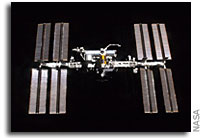
On-Orbit Status 04/23/12
All ISS systems continue to function nominally, except those noted previously or below. Underway: Week 22 of Increment 30 (six-person crew).
>>>Because of Progress 47P arrival yesterday and their busy Sunday schedule, Anton Shkaplerov & Anatoly Ivanishin had 1.5 hrs added to their sleep period this morning, with wake-up at 3:30am instead of 2:00am EDT.<<<
After breakfast, FE-1 Shkaplerov performed the routine inspection of the SM (Service Module) PSS Caution & Warning panel as part of regular Daily Morning Inspection.
FE-1 also completed the weekly checkup behind ASU/toilet panel 139 in the SM of a fluid connector (MNR-NS) of the SM-U urine collection system, looking for potential moisture.
First thing in post-sleep, prior to eating, drinking & brushing teeth, CDR Burbank, FE-5 Kuipers & FE-6 Pettit continued their first liquid saliva collection of the INTEGRATED IMMUNE protocol (Day 2). The collections are made every other day for six days. [INTEGRATED IMMUNE (Validating Procedures for Monitoring Crew member Immune Function) samples & analyzes participant’s blood, urine, and saliva before, during and after flight for changes related to functions like bone metabolism, oxidative damage and immune function to develop and validate an immune monitoring strategy consistent with operational flight requirements and constraints. The strategy uses both long and short duration crewmembers as study subjects. The saliva is collected in two forms, dry and liquid. The dry samples are collected at intervals during the collection day using a specialized book that contains filter paper. The liquid saliva collections require that the crewmembers soak a piece of cotton inside their mouths and place it in a salivette bag; there are four of the liquid collections during docked operations. The on-orbit blood samples are collected right before undocking and returned to the ground so that analysis can occur with 48 hours of the sampling. This allows assays that quantify the function of different types of white blood cells and other active components of the immune system. Samples are secured in the MELFI (Minus-Eighty Laboratory Freezer for ISS). Also included are entries in a fluid/medications intact log, and a stress-test questionnaire to be filled out by the subject at begin and end. Urine is collected during a 24-hour period, conventionally divided into two twelve-hour phases: morning-evening and evening-morning.]
FE-4 Kononenko started the day with his 4th MBI-24 “SPRUT-2” (“Squid-2”) test, part of Russian medical research on the distribution and behavior of human body fluids in zero gravity, along with PZEh-MO-8 BMM (body mass measurement) using the IM device. [Supported by the RSS-Med A31p laptop with new software (Vers. 1.6) in the SM, the test uses the Profilaktika kit, with data recorded on PCMCIA memory cards, along with Oleg’s body mass values and earlier recorded MO-10 Hematocrit value, but skipping “fat fold” measurements. Experiment requisites are the Sprut securing harness, skin electrodes (cuffs), and RSS-Med for control and data storage. The “Pinguin” suit or Braslet-M cuffs, if worn, have to be taken off first. Electrode measurements are recorded at complete rest and relaxed body position. The actual recording takes 3-5 minutes, during which the patient has to remain at complete rest.]
Kononenko also conducted the periodic maintenance of the active Russian BMP (Harmful Impurities Removal System) by starting the “bake-out” cycle to vacuum on absorbent bed #1 of the regenerable dual-channel filtration system. The process will be terminated at ~5:15pm EDT. Bed #2 regeneration will be done tomorrow. [Regeneration of each of the two cartridges takes about 12 hours and is conducted only during crew awake periods. The BMP’s regeneration cycle, normally done every 20 days, is currently performed four times more frequently (last time: 4/2 & 4/3).]
Later, Oleg performed the periodic (every Monday) verification of the automatic IUS AntiVirus definition update on the Russian VKS auxiliary network laptops RSS1, RSS2, RSK1-T61p & RSK2, as well as performed the manual update on the non-network laptops RSE-Med & RSE1. [Antivirus update procedures have changed since the SSCV4 software update. Before the installation (on 8/8) of the new automated procedure, the refresh was done manually on Mondays on RSS2, copying the files to the RSS2 service folder, then launching update scripts on the network laptops RSS1, RSK1-T61p & RSK2 and finally manually updating non-network laptops RSE-Med & RSE1. On Tuesdays, the anti-virus scanning results are regularly verified on all laptops. Nominally, Russian network laptops have software installed for automatic anti-virus update; fresh data is copied on RSK1-T61p & RRSK2 every time a computer is rebooted with a special login, and on RSS1 once daily. On Russian non-network laptops antivirus definition file update is done by the crew once every two weeks on Monday.]
André Kuipers started his workday with Day 5 of his current suite of sessions with the medical protocol Pro K (Dietary Intake Can Predict and Protect against Changes in Bone Metabolism during Spaceflight and Recovery), with diet logging after the urine pH spot test, for a 5-day period. This morning at ~6:15am EDT, FE-5 concluded his NUTRITION w/Repository 24-hr urine collection period, with samples deposited in MELFI (Minus Eighty Laboratory Freezer for ISS) in Kibo JPM (JEM Pressurized Module). Today, Kuipers also underwent the associated generic blood draw, then set up the RC (Refrigerated Centrifuge) in COL (Columbus Orbital Laboratory) for spinning the samples prior to stowing them in the JPM MELFI (JEM Pressurized Module Minus Eighty Laboratory Freezer for ISS). [The operational products for blood & urine collections for the HRP (Human Research Program) payloads were revised some time ago, based on crew feedback, new cold stowage hardware, and IPV capabilities. Generic blood & urine procedures have been created to allow an individual crewmember to select their payload complement and see specific requirements populated. Individual crewmembers will select their specific parameter in the procedures to reflect their science complement. Different crewmembers will have different required tubes and hardware configurations, so they must verify their choice selection before continuing with operations to ensure their specific instruction.]
With the protective shutters of the Kibo JPM (JEM Pressurized Module), Lab and Cupola windows closed by the CDR, Shkaplerov & Ivanishin prepared for Soyuz 28S undocking & deorbit on 4/27 by spending an hour in the TMA-22/28S Descent Module (SA) on MRM2 Poisk (7:20am-8:20am), supporting a ground-commanded thruster test and checkout of the Soyuz MCS (Motion Control System SUDN Mode 2/”Docked”) which included pressurization of the KDU (Combined Propulsion System) Section 2 and Tank 2, a test of the pilot’s rotational & translational hand controllers (RUD & RUO), and a hot firing of the DPO braking thrusters while ISS was in free drift. DPO retrograde thrusters were not fired. [For the RST (rasstjkovkoy / undocking) test, station attitude was handed over to Russian thruster control. The one-minute firing started on Daily Orbit 1 during an RGS (Russian Groundsite) pass. Attitude control was returned to the USOS (U.S. Segment) at 8:25am.]
After the test session, Anton Shkaplerov activated the ASU toilet facility in the Soyuz 28S spacecraft.
Next, Dan, Anton & Anatoly joined up in the Soyuz 28S Descent Module to conduct the standard 3-hr Soyuz descent drill #2, a standard training exercise for every crew returning on this spacecraft, supported by ground tagups. Each of the three crewmembers had three runs. Results of the exercise, which strictly forbids any command activation (except for switching the InPU display on the Neptun-ME console), were subsequently reported to ground control at TsUP/Moscow. Return equipment list and stowage were also discussed with the ground. [The session includes a review of the pertinent ODFs (operational data files), specifically the books on Soyuz Ascent & Descent Procedures, Emergency Descents, and Off-Nominal Situations, crew responsibilities when executing the flight program, visual crew recognition of SUS (Entry Control System) failures, spacesuit procedures, etc., with special emphasis on operations with the Neptune-ME cockpit console. The training uses a Descent Simulator application (Trenasher Spusk =”descent trainer”) on the RSK1 laptop. 28S will undock on 4/27 at ~4:19pm EDT and land in Kazakhstan at ~7:45am EDT (~2:45pm Moscow/DMT).
After the thruster test, FE-6 opened the protective window shutters of the Lab WORF (Window Observational Research Facility) for the ISSAC (ISS Agriculture Camera) equipment and activated the ISSAC laptop, so ground images can be captured by ground commanding. [ISSAC takes frequent visible-light & infrared images of vegetated areas on the Earth. The camera focuses principally on rangelands, grasslands, forests, and wetlands in the northern Great Plains and Rocky Mountain regions of the United States. The images may be delivered directly upon request to farmers, ranchers, foresters, natural resource managers and tribal officials to help improve their environmental stewardship of the land. The images will also be shared with educators for classroom use.]
In preparation for a future experiment work on the SCOF (Solution Crystallization Observation Facility) in the JAXA Kibo JPM, FE-6 Pettit removed the FACET cell from SCOF, followed by SCOF Air Circulation Cover removal & replacement. [FACET was an investigation of the mechanism of faceted cellular array growth. In order to investigate the phenomena at the solid-liquid interface in facet growth, in-situ observation of concentration and temperature diffusion field with two wavelength interferometer are carried out using transparent organic materials under microgravity condition. Results can provide the useful data on the optimization of the crystal growth condition not only in space but also on earth.]
Preparatory to work on the BLB (Biolab) in the ESA COL (Columbus Orbital Laboratory) on ER-3 (EXPRESS Rack 3), Burbank retrieved the HM (Handling Mechanism) arm gripper from its launch location inside ATV-3.
Dan also terminated dosimetry data collection of the ALTEA (Anomalous Long Term Effects on Astronauts) Shield from laptop at ER2. [ALTEA-Shield dosimetry uses the ALTEA (Anomalous Long Term Effects on Astronauts) hardware to survey the radiation environment in the US Lab in 3D. It also measures the effectiveness and shielding properties of several materials with respect to the perception of anomalous Light Flashes.]
Anatoly activated the Progress-delivered BTKh-14 BIOEMULSIYA biotechnology payload and placed it in the TBU thermostat-controlled incubator at +37 degC, with Anton taking documentary photography.
Oleg Kononenko meanwhile worked in the new Progress 47P vehicle to install the electronic LKT local temperature sensor commutator (TA251MB) of the BITS2-12 onboard telemetry measurement system and its PZU-1M ROM (read-only memory), using the LKT and PZU boxes removed from a previous Progress and stowed in DC1 (Docking Compartment).
Later, Kononenko took care of the daily IMS (Inventory Management System) maintenance, updating/editing its standard “delta file” including stowage locations, for the regular weekly automated export/import to its three databases on the ground (Houston, Moscow, Baikonur).
Oleg also completed the routine daily servicing of the SOZh system (Environment Control & Life Support System, ECLSS) in the SM. [Regular daily SOZh maintenance consists, among else, of checking the ASU toilet facilities, replacement of the KTO & KBO solid waste containers, replacement of EDV-SV waste water and EDV-U urine containers and filling EDV-SV, KOV (for Elektron), EDV-ZV & EDV on RP flow regulator.]
In the Lab, André Kuipers accessed the NanoRacks Modules and collected data for subsequent transfer to the ER-1 (EXPRESS Rack 1) laptop.
André Kuipers assembled the newly arrived EHS IV-TEPC (Environmental Health System – Intravehicular Tissue Equivalent Proportional Counter), installing its large & small detectors. After deploying it in the SM, FE-5 connected it to power and activated it for a functional checkout via its LCD (Liquid Crystal Display) which he also photographed for documentation.
In Node-3, FE-5 performed routine maintenance on the WRS (Water Recovery System), first changing out the TOCA WWB (Total Organic Carbon Analyzer Waste Water Bag), then taking water samples for analysis in the TOCA, after first initializing the software and priming (filling) the TOCA water sample hose with water from the WOPA (Water Processor Assembly) and buffer solution from the TOCA Buffer Container. [After the approximately 2 hr TOCA analysis, results were transferred to the SSC-5 (Station Support Computer 5) laptop via USB drive for downlink, and the data were also logged.]
Dan completed the monthly maintenance of the T2/COLBERT advanced treadmill, checking its components, pin alignment, rack centering and the snubber jam nut witness marks. [Witness marks (12 total) are applied to the X-, Y- & Z-axis jam nuts on each (of four) snubber arm; their inspection serves to determine to what degree and which jam nuts are backing off.]
In MRM2, Oleg connected the +Y Kurs-P AFU (Antenna Feeder Unit) to the K2-VKA antenna instrumentation unit in the SM, preparatory to the upcoming Soyuz 28S undocking. [Kurs is the automated radar approach & docking system on the Russian Soyuz & Progress vehicles, with the active (Kurs-A) component in the visiting vehicles and the passive transponder/repeater-type Kurs-P component in the SM.]
Don Pettit had 1.5 hrs reserved for ATV-3 (Automated Transfer Vehicle 3) cargo operations (unloading & unpacking into stowage) and bag cleaning, i.e., stowing discarded bags and foam packing material in “Edoardo Amaldi”.
André & Don had 2 hrs between them for relocating food stowage packages from Node-1 to the PMM (Permanent Multipurpose Module), in order to consolidate the food in PMM, then clean out Node-2 (O2) and move consolidated “next use” food to Node-1 (O2), verifying that no diffusers are blocked at that location at closure of activity.
Pettit also had another ~45 min for performing the continuing preventive inspection & cleaning of accessible AR (Atmosphere Revitalization) system bacteria filters in Node-1, Node-2, Node-3, Airlock and Lab.
FE-6 afterwards retrieved 3 or 4 technical CWCs (Contingency Water Containers) from the “water wall” behind Robonaut at Lab P1 and staged them in Node-2 (D2) for RS (Russian Segment) usage. [Desired were the oldest bags first, i.e., #1008, #1050, #1085, #1089.]
Burbank & Pettit had another time slot reserved each for making entries in their electronic Journals on the personal SSC. [Required are three journaling sessions per week.]
Before Presleep, the CDR will turn on the MPC (Multi-Protocol Converter) and start the Ku-band data flow of video recorded during the day to the ground, with POIC (Payload Operations & Integration Center) routing the onboard HRDL (High-Rate Data Link). After about an hour, Dan turns MPC routing off again. [This is a routine operation which regularly transmits HD onboard video (live or tape playback) to the ground on a daily basis before sleeptime.]
The crew worked out with their regular 2-hr physical exercise protocol on the TVIS treadmill with vibration isolation & stabilization (FE-1, FE-2, FE-4), ARED advanced resistive exerciser (CDR, FE-4, FE-5, FE-6), and T2/COLBERT advanced treadmill (CDR, FE-1, FE-2, FE-5, FE-6). [FE-6 is on the special experimental SPRINT protocol which diverts from the regular 2.5 hrs per day exercise regime and introduces special daily sessions, followed by a USND (Ultrasound) leg muscle self scan in COL. If any day is not completed, Don picks up where he left off, i.e., he would be finishing out the week with his last day of exercise on his off day.]
After his T2 session, Anton Shkaplerov closed down the T2 software on its laptop for data transfer, then turned off the T2 display. [After the display shutdown, the T2 rack is power cycled (turned off/on) from the ground, and T2 is then ready for use. These power cycles allow for the T2 data to be transferred to the Server for downlink.]
At ~8:20am EDT, André conducted the weekly ESA crew conference via phone with the EAC (European Astronaut Center) near Cologne /Germany.
Tasks listed for Shkaplerov, Kononenko & Ivanishin on the Russian discretionary “time permitting” job for today were –
* A ~30-min. run of the GFI-8 “Uragan” (hurricane) earth-imaging program with the NIKON D3X digital camera with Sigma AF 300-800mm telelens, focusing on Glaciers of Uzbekistan, Pamir glaciers Bear, Mabuza, RGS, Zaalai & Wali, South. shores of Lake Baikal, Aral Sea, the glaciers of Patagonia, Allalin glacier, and the Volcanoes Hudson, Mount Etna, Cordon-Kaul and Hierro;
* A ~30-min. session for Russia’s EKON Environmental Safety Agency, making observations and taking KPT-3 aerial photography of environmental conditions on Earth using the NIKON D3X camera with the RSK-1 laptop, and
* More preparation & downlinking of reportages (written text, photos, videos) for the Roskosmos website to promote Russia’s manned space program (max. file size 500 Mb).
No CEO (Crew Earth Observation) targets uplinked for today.
ISS Orbit (as of this morning, 9:10am EDT [= epoch])
Mean altitude – 391.6 km
Apogee height – 396.8 km
Perigee height – 386.3 km
Period — 92.39 min.
Inclination (to Equator) — 51.64 deg
Eccentricity — 0.0007786
Solar Beta Angle — 16.9 deg (magnitude decreasing)
Orbits per 24-hr. day — 15.59
Mean altitude loss in the last 24 hours — 148 m
Revolutions since FGB/Zarya launch (Nov. 98) — 76,949
Time in orbit (station) — 4903 days
Time in orbit (crews, cum.) — 4190 days
Significant Events Ahead (all dates Eastern Time and subject to change):
————–Six-crew operations—————-
04/27/12 — Soyuz TMA-22/28S undock (4:19am EDT)
04/27/12 — Soyuz TMA-22/28S landing (7:45am EDT; 2:45pm DMT/Moscow) (End of Increment 30)
04/28/12 — Progress M-14M/46P deorbit burn (6:33am EDT)
————–Three-crew operations————-
04/30/12 — SpaceX Dragon launch (12:22pm EDT; target date)
05/15/12 — Soyuz TMA-04M/30S launch – G.Padalka (CDR-32)/J.Acaba/S.Revin
05/17/12 — Soyuz TMA-04M/30S docking (MRM2)
————–Six-crew operations—————-
07/01/12 — Soyuz TMA-03M/29S undock/landing (End of Increment 31)
————–Three-crew operations————-
07/15/12 — Soyuz TMA-05M/31S launch – S.Williams (CDR-33)/Y.Malenchenko/A.Hoshide
07/17/12 — Soyuz TMA-05M/31S docking
07/20/12 — HTV3 launch (~10:18pm EDT)
07/22/12 — Progress M-15M/47P undock
07/24/12 — Progress M-15M/47P re-docking
07/30/12 — Progress M-15M/47P undocking/deorbit
07/31/12 — Progress M16M/48P launch
08/02/12 — Progress M16M/48P docking
————–Six-crew operations—————-
09/17/12 — Soyuz TMA-04M/30S undock/landing (End of Increment 32)
————–Three-crew operations————-
10/15/12 — Soyuz TMA-06M/32S launch – K.Ford (CDR-34)/O.Novitskiy/E.Tarelkin
10/17/12 — Soyuz TMA-06M/32S docking
————–Six-crew operations————-
11/01/12 — Progress M-17M/49P launch
11/03/12 — Progress M-17M/49P docking
11/12/12 — Soyuz TMA-05M/31S undock/landing (End of Increment 33)
————–Three-crew operations————-
12/05/12 — Soyuz TMA-07M/33S launch – C.Hadfield (CDR-35)/T.Mashburn/R.Romanenko
12/07/12 — Soyuz TMA-07M/33S docking
————–Six-crew operations————-
12/26/12 — Progress M-18M/50P launch
12/28/12 — Progress M-18M/50P docking
03/19/13 — Soyuz TMA-06M/32S undock/landing (End of Increment 34)
————–Three-crew operations————-
04/02/13 — Soyuz TMA-08M/34S launch – P.Vinogradov (CDR-36)/C.Cassidy/A.Misurkin
04/04/13 — Soyuz TMA-08M/34S docking
————–Six-crew operations————-
05/16/13 — Soyuz TMA-07M/33S undock/landing (End of Increment 35)
————–Three-crew operations————-
05/29/13 — Soyuz TMA-09M/35S launch – M.Suraev (CDR-37)/K.Nyberg/L.Parmitano
05/31/13 — Soyuz TMA-09M/35S docking
————–Six-crew operations————-
09/xx/13 — Soyuz TMA-08M/34S undock/landing (End of Increment 36)
————–Three-crew operations————-
09/xx/13 — Soyuz TMA-10M/36S launch – M.Hopkins/TBD (CDR-38)/TBD
09/xx/13 — Soyuz TMA-10M/36S docking
————–Six-crew operations————-
11/xx/13 — Soyuz TMA-09M/35S undock/landing (End of Increment 37)
————–Three-crew operations————-
11/xx/13 — Soyuz TMA-11M/37S launch – K.Wakata (CDR-39)/R.Mastracchio/TBD
11/xx/13 — Soyuz TMA-11M/37S docking
————–Six-crew operations————-
03/xx/14 — Soyuz TMA-10M/36S undock/landing (End of Increment 38)
————–Three-crew operations————-



