
NASA ISS On-Orbit Status 22 August 2009
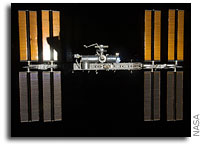
All ISS systems continue to function nominally, except those noted previously or below. Saturday — Crew rest day.
Upon wakeup, FE-2 Timothy Kopra continued his current experiment activity of SLEEP (Sleep-Wake Actigraphy & Light Exposure during Spaceflight), logging data from his Actiwatch to the HRF-1 (Human Research Facility 1) laptop as part of an extended session. [To monitor the crewmember’s sleep/wake patterns and light exposure, the crewmembers wear a special Actiwatch device which measures the light levels encountered by them as well as their patterns of sleep and activity throughout the Expedition and use the payload software for data logging and filling in questionnaire entries in the experiment’s laptop session file on the HRF-1 laptop. The log entries are done within 15 minutes of final awakening for seven consecutive days.]
The six-member crew performed the regular weekly three-hour task of thorough station cleaning, including COL (Columbus Orbital Laboratory) and Kibo. ["Uborka", usually done on Saturdays, includes removal of food waste products, cleaning of compartments with vacuum cleaner, damp cleaning of the SM (Service Module) dining table, other frequently touched surfaces and surfaces where trash is collected, as well as the sleep stations with a standard cleaning solution; also, fan screens and grilles are cleaned to avoid temperature rises. Special cleaning is also done every 90 days on the HEPA (high-efficiency particulate air) bacteria filters in the Lab.]
As part of the house cleaning, CDR Padalka & FE-3 Romanenko conducted regular maintenance inspection & cleaning on fan screens, Group A, in the FGB (TsV2), DC1 (V3), and SM (VPkhO, VPrK, FS5, FS6 & FS9), plus dust filter replacement in the FGB.
At ~9:05am EDT, the crew held their regular WPC (Weekly Planning Conference) with the ground, discussing next week’s "Look-Ahead Plan" (prepared jointly by MCC-Houston and TsUP-Moscow timeline planners) via S-band/audio, reviewing the monthly calendar, upcoming activities, and any concerns about future on-orbit events.
For today’s VolSci (Voluntary Weekend Science) activity, Mike Barratt conducted another LOCAD-PTS (Lab-on-a-Chip Application Development-Portable Test System) Phase 1 sampling session using only the LAL (Limulus amebocyte lysate) cartridges, setting up the equipment, preparing media and taking samples by swabbing. [LOCAD uses small, thumb-sized “microfluidic” cartridges that are read by the experiment reader. The handheld device tests a new analysis technology by sampling for the presence of gram negative bacteria in the sample in about 15 minutes. Lab-on-a-Chip technology has an ever-expanding range of applications in the biotech industry. Chips are available (or in development) which can also detect yeast, mold, and gram positive bacteria, identify environmental contaminants, and perform quick health diagnostics in medical clinics. The technology has been used to swab the MERs (Mars Exploration Rovers) for planetary protection. With expanded testing on ISS, this compact technology has broad potential applications in space exploration–from monitoring environmental conditions to monitoring crew health. After today, there are nine sessions remaining to complete the planned science requirements.]
Afterwards, Mike & FE-4 Bob Thirsk set up the CCISS (Cardiovascular & Cerebrovascular Control on Return from the ISS) hardware, with HM2 (Holter Monitor 2), CBPD (Continuous Blood Pressure Device), and Actiwatch to produce an educational 3-minute high-def video of a (simulated) CCISS session as a VolSci activity, without activating the hardware or initializing the Actiwatch.
Working on the WRS2 (Water Recovery System), FE-5 Frank De Winne configured and filled the RFTA QD (Recycle Filter Tank Assembly Quick Disconnect) hose for filter exchange by the backflow method.
Barratt completed the regular bi-monthly reboots of the OCA Router and File Server SSC (Station Support Computer) laptops.
The crew completed their regular daily 2.5-hr. physical workout program on the CEVIS cycle ergometer (FE-1), TVIS treadmill with vibration isolation (CDR, FE-2, FE-3, FE-4, FE-5), ARED advanced resistive exercise device (FE-1, FE-2, FE-3, FE-4, FE-5), and VELO cycle ergometer with bungee cord load trainer (CDR).
Afterwards, Mike transferred the exercise data files to the MEC (Medical Equipment Computer) for downlink, including the daily wristband HRM (Heart Rate Monitor) data of the workouts on ARED, followed by their erasure on the HRM storage medium (done six times a week).
At ~7:20am, the CDR had his weekly PFC (Private Family Conference), via S-band/audio and u-band/MS-NetMeeting application (which displays the uplinked ground video on an SSC laptop).
At ~8:48am, Bob Thirsk powered up the SM’s amateur radio equipment (Kenwood VHF transceiver with manual frequency selection, headset, & power supply) and conducted, at 8:53am, a ham radio exchange with Swiss Girl and Boy Scouts of Maur at “Pfadimuur”, Forch, Switzerland. [The International Year of Astronomy inspired a few scout guides from Maur near Zuerich, Switzerland to create a special scout event, the Astrocamp 2009, where participants from 5 to 20 years shall learn about the following three topics which are scout qualifications: astronomy and space technology, communication technologies, journalism and public relation. Therefore they planned three Saturdays, where about 100 active Pfadi Muur scouts have the possibility to visit one of the above named workshops. The event began with the ARISS (Amateur Radio on ISS) contact, where 20 children got the opportunity to talk to an astronaut and at the end of the course they will present the workshop results such as a planet route, a telescope made out of a drain (astronomy) or a broadcasting local UKW radio station (journalism) as well as a self-constructed aircraft radio receiver in a second event open for public on September 19. The Swiss astronomy expert Bruno Stanek will hold a speech and together with people of a local observatory the scouts will have a look into the sky. The technical team that will provide the equipment for the ARISS contact is led by Mario Malacarne who has established two ARISS contacts so far.]
At ~12:55pm, Roman Romanenko & Gennady Padalka downlinked PAO TV messages and greetings to TsUP-Moscow for three events: (1) to the birthday of Sergey Aleksandrovich Derepko, the head of the Yaroslavskiy Military Academy of Finance and Economics, who will turn 55 years old on 8/25; (2) to the residents & guests at the 80th Anniversary of the Shcholkovskiy municipal region of Moscow Oblast where Russian and foreign delegations from Shcholkovo’s sister cities in Germany, Finland, Ukraine, Belarus, and China will participate in the ceremonies at the palace of culture in the city of Shcholkovo; and (3) to the Model Rocket Festival "Rocketafest 2009" which will take place on 8/29 in Moscow on Cosmonaut Avenue in front of the Memorial Museum of Astronautics. The festival takes place through the support of the Moscow Public Affairs Committee.
Weekly Science Update (Expedition Twenty — Week 12)
3-D SPACE: Mike, thank you for your support on your fourth session on 8/20)! Thanks also to Bob for his support for the writing part. Bob, thanks for the performance of your third session on 8/19! Thanks also to Frank for his support for the writing part. Tim, thanks for the performance of your third session on 8/14! Thanks also to Bob for his support for the writing part.”
AgCam (Agricultural Camera): “Mike, thanks very much for your assistance on AgCam. We knew the close coordination with ground commanding would be a challenge but it went very well. While in the end we still have no joy on fixing the primary problem, we were able to eliminate a number of potential root causes. On a positive note, ground commanding earlier in the week was able to confirm a workaround for part of the problem, though our main issue of random intermittent failure to take images remains. We look forward to getting the additional files from you, and will update you once decisions on next steps are made. Thanks again and good work.”
ALTCRISS (Alteino Long Term monitoring of Cosmic Rays on the ISS): Complete.
ALTEA DOSI (NASA/ASI): Standing by.
BCAT-4/5 (Binary Colloidal Alloy Test 4/5): No report.
BIOLAB (ESA): No report.
Biological Rhythms (JAXA, BIORHYTHMS): “Session #2 by Thirsk was completed on FD69. Data download was completed. We confirmed that the noise on a channel only continued 2 hours and did not impact science analysis. Session #2 by De Winne was completed on FD71. Data download was completed.”
BISE (CSA, Bodies in the Space Environment): No report.
BISPHOSPHONATES: “Bob, thanks for completing your pill ingestion. Your next session is scheduled for 8/24.”
CARD (Long Term Microgravity: Model for Investigating Mechanisms of Heart Disease, ESA): No report.
CARDIOCOG-2: Complete.
CB (JAXA Clean Bench): No report.
CBEF (JAXA Cell Biology Experiment Facility): Planning temporary fan repair during 17A flight.
CCISS (Cardiovascular & Cerebrovascular Control on Return from ISS): “Bob, thanks for completing your FD 75 ICV with CCISS session. Dr. Hughson is currently analyzing the data.”
CFE (Capillary Flow Experiment): Reserve.
CSI-3/CGBA-5 (CGBA Science Insert #2/Commercial Generic Bioprocessing Apparatus 5): Complete.
CGBA-2 (Commercial Generic Bioprocessing Apparatus 2): Complete.
CIR (Combustion Integrated Rack): See MDCA/Flex.
CSLM-2 (Coarsening in Solid-Liquid Mixtures 2): Complete.
Commercial 2 (JAXA): Completed.
Commercial 3 (JAXA): Completed.
CW/CR (Cell Wall/Resist Wall) in EMCS (European Modular Cultivation System): Complete.
DomeGene (JAXA): Complete.
DOSIS (ESA): Experiment is progressing nominally with active and passive dosimeters measurements.
EarthKAM (Earth Knowledge Acquired by Middle School Students): Planned.
EDR (European Drawer Rack, ESA): The rack is continuously active in support of the Protein Crystallization Diagnostic Facility (PCDF) experiment. EDR is providing power/data and temperature control (via cooling loop) to PCDF.
ELITE-S2 (Elaboratore Immagini Televisive – Space 2): Planned.
ENose (Electronic Nose): No report.
EPM (European Physiology Module): No report.
EPO (Educational Payload Operations, NASA): “No report.
EPO 3-min Video (JAXA): No report.
EPO J-Astro Report (JAXA): Ongoing.
EPO Space Clothes (JAXA): Complete.
EPO Hiten (Dance, JAXA): No report.
EPO Moon Score (JAXA): The last session is expected on 8/23 as Voluntary Science. Thank you for choosing this as a Voluntary Science activity.
EPO Try Zero-G (JAXA): “No report.
EPO Kibo Kids Tour (JAXA): Complete.
EPO Spiral Top (JAXA): No report.
ETD (Eye Tracking Device): Completed.
EuTEF (European Technology Exposure Facility): EuTEF platform and its instruments have been running nominally during this reporting period. — DEBIE-2 instrument continues to regularly generate empty science packets, and as a work-around the instrument script includes a daily power cycle command, which is skipped from ground if the science packets remain nominal. — EXPOSE-E lids and valves were successfully closed on 8/20 in preparation for EuTEF return on 17A. R/T video allowed for immediate implementation feedback of lids closure commands.– FIPEX Link error occurred on 8/14 between EuTEF and the instrument. A new science script was started on 8/19 to resume nominal science data acquisition.– MEDET: On-going science acquisition. Parameters update commanding performed on 8/17 to change the acquisition frequency for spectrometer measurements and to change the accumulation time of the spectrometer measurements. MEDET was rebooted on 8/19 to recover from an issue with the spectrometer measurements.– EVC: multiple re-activation attempts: some HRD could be obtained and finally images could be acquired on 8/20.– PLEGPAY Long Duration Tests (LDT) from 8/11 to 8/16, from 8/16 to 8/19. New LDT started on 8/19.– DOSTEL acquiring science data.
FACET (JAXA): No report.
FSL (Fluid Science Laboratory): No report.
GEOFLOW: No report.
HDTV System (JAXA): To be launched by HTV1.
Holter ECG (JAXA): No report.
HQPC (JAXA): To be launched by 34P.
ICE CRYSTAL (JAXA): Complete.
ICV (Integrated Cardiovascular): “Bob, as you can see you are more than half way done with your ICV sessions. The PI team is very enthusiastic regarding the exceptional data quality they have seen after each session. Thanks to you and Frank for a flawlessly executed FD75 data transfer/download session. The team could not have asked for a better start to the experiment.”
IMMUNO (Neuroendocrine & Immune Responses in Humans During & After Long Term Stay at ISS): Complete.
INTEGRATED IMMUNE: No report.
InSPACE-2 (Investigating the Structure of Paramagnetic Aggregates from Colloidal Emulsions 2): “Frank, thank you again for your assistance with InSPACE-2. The latest set of observations including the "buckling instability" in test run #58, which had a higher magnetic field strength, and the observed "buckling instability" occurring much earlier during this test will help us define the region where this instability occurs.”
IRIS (Image Reversal in Space): No report.
LOCAD-PTS (Lab-on-a-Chip Application Development-Portable Test System): “Mike and Tim, great work for LOCAD. All the data you are collecting is being analyzed by the LOCAD team and going into the next scientific paper on LOCAD ISS results (for Expeditions 17 – 20). Here is some feedback on recent results. To recap, Parameter 1 is the “Sample reading”. This number tells you how much microbial “stuff” is in the swab. Normally, all four swabs from one site have similar Sample readings. But sometimes one swab gives an anomalously high (or low) Sample reading. That is not a bad thing. It is simply due to that particular swab hitting a microbial-rich (or low) area. Interestingly, that’s what happened in both of your previous sessions: Tim, your tests of the MERLIN door on Friday gave three low Sample readings (~0.05 Endotoxin Units (EU)/mL) and the 4th swab contained higher endotoxin (0.143 EU/mL). Mike, your tests of the Node 2 crew quarters on Saturday gave three low Sample readings (~0.05 EU/mL), and the Swab #3 gave higher endotoxin (0.206 EU/mL). This Node 2 test was interesting, as Mike found low glucan at this same site on July 14. If you see variation in Parameter 1 readings again, feel free to note if that “anomalous area” was different. Was it visually dirtier, touched more often, or had a different texture to the other three areas? You are both becoming excellent in-flight microbiologists, which is great to see, as our goal is to reduce dependence upon the ground for microbial monitoring. Feel free to swab any ISS module of your choice and keep up the great work!
MEIS (Marangoni Experiment for ISS) in JAXA FPEF (Fluid Physics Experiment Facility): “Experiment is going very well. Hard drive (VRU) exchange by Crew member was conducted on GMT219 & 222. Up to now, we have successfully formed taller liquid bridge which length varied from 22.5 to 60 mm with 30 mm diameter. In each liquid bridge, the onset of oscillatory convection was able to be detected and the transition temperature difference to oscillation was determined precisely.
W18 & W19:
Experiment#3 (GMT 215) L/D=0.15 &0.18
Experiment#4(GMT 216) 0.20 &0.50
Experiment#5 (GMT 217) L/D=1.0
Experiment#6 (GMT 218) L/D=0.5
Experiment#7 (GMT 220) L/D=0.5
Experiment#8 (GMT 222) L/D=2.0
Experiment#9 (GMT 223) L/D=1,5
Experiment#10 (GMT 224) L/D=0.75
Experiment#11 (GMT225) L/D=2.0
Video Recoding Unit Hard Drive Exchange (GMT 226)
Experiment#12 (GMT229) L/D=1.75
Experiment#13 (GMT230) L=18.9mm
Experiment#14 (GMT231) – We will reach full success level soon.”
MAXI (Monitor of All-sky X-ray Image, JAXA): Medium Rate Data Line checkout #3 for MAXI complete (6 Aug); Attitude Determination System (ADS) C/O1 complete (8 Aug); All the 12 Gas Slit Cameras (GSC) have been turned on (13 Aug); Set Gas Slit Camera (GSC) protection (14 Aug); Upload alignment parameter. Start GSC commissioning (15 Aug); Cooling system of SSC on. CCD of GSC temp reached -60 degree (16 Aug); Initial set of SSC. GSC performing mostly as expected (17 Aug); Released the first light image of MAXI (18 Aug) http://maxi.riken.jp/top/; Continuing several tunings.
MDCA/Flex: No report.
Micro-G Clay (JAXA EPO): Complete.
MMA (JAXA/Microgravity Measurement Apparatus): MMA data downlink performed on 7/1. FSL Optical Target #4 check-out was completed by 7/1.
MISSE (Materials ISS Experiment): Ongoing.
Moon Photography from ISS (JAXA EPO): No report.
MSG-SAME (Microgravity Science Glovebox): Complete.
MTR-2 (Russian radiation measurements): Passive dosimeters measurements in DC1 “Pirs”.
MULTIGEN-1: Completed.
NEUROSPAT (ESA/Study of Spatial Cognition, Novelty Processing and Sensorimotor Integration): No report.
NOA-1/-2 (Nitric Oxide Analyzer, ESA): Complete.
NUTRITION w/REPOSITORY: Ongoing.
PADLES (JAXA, Area PADLES 3; Passive Area Dosimeter for Lifescience Experiment in Space): Plan to retrieve on 17A. Removing for return is scheduled on FD2 of 17A.
PCDF-PU (Protein Crystallization Diagnostic Facility – Process Unit): The PCDF Process Unit (PCDF-PU) has been nominally returned with 2J/A. Experiment reactors have been de-assembled and shipped to Belgium. Science analysis will soon start on ground with X-Ray analysis of the crystals grown in microgravity.
PCG (JAXA, Protein Crystal Growth): “We started the experiment as scheduled. Crystallization is continuing in the PCG/PCRF automatically until PCG retrieval by 18S. To obtain the high quality protein crystals, 47 protein crystallizations will be conducted in microgravity environment for 74 days at 20 degrees C. Temperature monitoring by ground operation is now in progress.
PCRF (Protein Crystallization Research Facility) Reconfiguration (JAXA): Complete.
PMDIS (Perceptual Motor Deficits in Space): Complete.
POLCA/GRAVIGEN (ESA): Complete.
RadGene & LOH (JAXA): Complete.
SAMS/MAMS (Space & Microgravity Acceleration Measurement Systems): Ongoing.
SAMPLE: Complete.
SEDA-AP (Space Environment Data Acquisition Equipment-Attached Payload, JAXA): Heavy Ion Telescope/ Plasma Monitor C/O complete (7 Aug); Neutron Monitor C/O Complete (8 Aug); Standard Dose Monitor C/O complete (12 Aug); Electronic Device Evaluation Equipment C/O complete (11 Aug); Electric Device Evaluation Equipment (EDEE) started (8/16);
(Remaining mission equipment to verify is the Atomic Oxygen Monitor). Expect to finish all commissioning at the end of August.
SHERE (Shear History Extensional Rheology Experiment): Complete.
SLEEP (Sleep-Wake Actigraphy & Light Exposure during Spaceflight): “Mike, thank you for your work on the Sleep Actiwatch data download. The science teams on the ground will analyze the data.
SMILES (JAXA): Exposed Payload, to be launched by HTV1.
SOLAR (Solar Monitoring Observatory): The current Sun observation window started on 8/14 and is proceeding well. SOLAR safing was performed on 8/18 for thruster test and on 8/19 for solar array testing.– SOLSPEC: acquiring science data, including special VIS and UV measurements; — SOLACES: acquiring science data with daily scripts.
SOLO (Sodium Loading in Microgravity): “Mike, we want to pass on to you very appreciative words of thanks for your participation in SOLO. All activities have been completed nominally for the SOLO diet session#2 and the science team looks very much forward to the analysis of the samples, logs and data. We hope you enjoy all the food and drinks of your choice now.”
SPHERES (Synchronized Position Hold, Engage, Reorient, Experimental Satellite): “Mike and Tim, we want to thank you again for selecting SPHERES for your Voluntary Science Saturday. We had a highly productive session and accomplished all of the tests in all three groups we were most interested in. All of the tests ran smoothly and as expected, so we are confident we collected valuable science.”
SPICE (Smoke Point In Co-flow Experiment): No report.
SWAB (Characterization of Microorganisms & Allergens in Spacecraft): “Mike, thanks for completing the first in-flight SWAB water collection operations! The expiration dates you noticed on the hardware had been reassessed on the ground some time ago and were deemed unneeded, so, we will update our words for future operations to address that issue. In regards to the sample mixing, the PI team is working on some ideas to ease that activity for the next ops and thank you very much for your description of the issue along with your explanation of how you made it work!”
TRAC (Test of Reaction & Adaptation Capabilities): Planned.
ULTRASOUND: Planned.
VLE (Video Lessons ESA): VLE-1 completed.
WAICO #1/#2 (Waving and Coiling of Arabidopsis Roots at Different g-levels): Complete/Planned (2J/A Stage). No report.
CEO (Crew Earth Observations): Through 8/19, the ground has received a total of 22,216 frames of ISS CEO imagery for review and cataloguing. “We are pleased to confirm your acquisition of views of the following targets: Hurricane Bill – your imagery is now being used by PAO; Seattle, Washington – excellent, fair-weather coverage with both detail and context views; Heidelberg, Germany – two good frames provide complete, detailed coverage; Bucharest, Romania – excellent, fair-weather coverage; and Istanbul, Turkey – complete coverage except for some clouds. Earlier this month you acquired an excellent view of Mount Hood in Oregon that beautifully illustrates the structure and current snow cover/glacier conditions on this classic stratovolcano. It was published on NASA/GSFC’s Earth Observatory website this past weekend. Kudos to the crew! Thanks also for your excellent, unsolicited views of several large forest fires in California. Your oblique views and use of the variable zoom for both context and detail showed great technique and composition. Keep up the good work!”
CEO (Crew Earth Observation) photo targets uplinked for today were Toshka Lakes, Egypt (images to document water levels in the lakes for this hot season are needed. Targets appear well west of the River Nile. Images of Lake Nasser, Aswan Dam and Aswan Airport have already been acquired. Looking left of the ISS descending pass), Hurricane Bill, Atlantic Ocean (Dynamic Event: According to NOAA’s National Hurricane Center, as of Friday Hurricane Bill has weakened considerably and the eye wall is now barely visible. Wind shear may be responsible for the weakening of the storm. At the time of this orbital pass Bill should have been off the coast of North Carolina and Virginia. It is expected to curve to the NE and then go through a "modest" re-intensification. By Sunday, Bill will be moving over the colder waters of the Atlantic and it should weaken considerably. Winds from Hurricane Bill are predicted to be around 110 knots at the time of this orbital pass. Looking left of track and trying for a context view), and All Saints Bay, Salvador, Brazil (HMS Beagle Site: The Beagle anchored in All Saints Bay on 28 Feb 1832. Darwin was able to spend a few days exploring the tropical rain forests. He was deeply impressed and described it as beautiful beyond his wildest dreams. On March 18 the Beagle departed. Looking slightly right of track, context view of the bay is desirable).
CEO photography can be studied at this “Gateway” website:
http://eol.jsc.nasa.gov (as of 9/1/08, this database contained 770,668 views of the Earth from space, with 324,812 from the ISS alone).
Significant Events Ahead (all dates Eastern Time, some changes possible!):
08/25/09 — STS-128/Discovery/17A launch – MPLM (P), LMC (~1:36am EDT)
09/06/09 — STS-128/Discovery/17A landing (KSC; ~8:38pm)
09/10/09 — H-IIB (JAXA HTV-1) launch (~1:04pm EDT)
09/16/09 — H-IIB (JAXA HTV-1) berth w/SSRMS
09/29/09 — Progress 34P undock
09/30/09 — Soyuz TMA-16/20S launch
10/02/09 — Soyuz TMA-16/20S docking (SM aft, until MRM-2 w/new port)
10/11/09 — Soyuz TMA-14/18S undock
10/14/09 — H-IIB (JAXA HTV-1) unberth
10/15/09 — Progress 35P launch
11/10/09 — 5R/MRM-2 (Russian Mini Research Module 2) on Soyuz-U
11/12/09 — STS-129/Atlantis/ULF3 – ELC1, ELC2
12/07/09 — Soyuz TMA-17/21S launch
12/26/09 — Progress 36P launch
02/03/10 — Progress 37P launch
02/04/10 — STS-130/Endeavour/20A – Node-3 + Cupola
03/18/10 — STS-131/Discovery/19A – MPLM(P), LMC
04/02/10 — Soyuz TMA-18/22S launch
04/27/10 — Progress 38P launch
05/14/10 — STS-132/Atlantis/ULF4 – ICC-VLD, MRM-1
05/29/10 — Soyuz TMA-19/23S launch
06/25/10 — Progress 39P launch
07/29/10 — STS-133/Endeavour (ULF5 – ELC4, MPLM) or STS-134/Discovery (ULF6 – ELC3, AMS)
08/11/10 — Progress 40P launch
09/16/10 — STS-133/Endeavour (ULF5 – ELC4, MPLM) or STS-134/Discovery (ULF6 – ELC3, AMS)
09/29/10 — Soyuz TMA-20/24S launch
10/19/10 — Progress 41P launch
11/??/10 — ATV2 – Ariane 5 (ESA)
12/??/11 — 3R Multipurpose Laboratory Module (MLM) w/ERA – on Proton



