
NASA ISS On-Orbit Status 20 July 2008
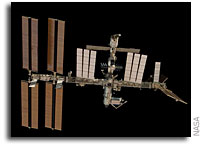
All ISS systems continue to function nominally, except those noted previously or below. Sunday – rest day for CDR Volkov, FE-1 Kononenko & FE-2 Chamitoff. Ahead: Week 14 of Increment 17.
Today 39 years ago (July 20, 1969), Apollo 11 fulfilled a dream of Earth people when Neil Armstrong and Buzz Aldrin landed their LM “Eagle” on the Moon at Tranquility Base, with Michael Collins orbiting overhead in the mothership Columbia.
Crew sleep cycle has returned to normal times: wake-up — 2:00am EDT, sleeptime — 5:30pm.
Continuing the extended leak checking of the spare BZh Liquid Unit (#056) for the Elektron O2 generator, Kononenko charged the unit once again with pressurized N2 from the BPA Nitrogen Purge Unit (#23) to 1 atm (1 kg/cm2). The last test pressurization to monitor for leakage was on 6/27. [During Elektron operation, the inert gas locked up in the BZh has the purpose to prevent dangerous O2/H2 mixing. A leaking BZh cannot be used.]
For his Voluntary Weekend Science (VolSci) program today, FE-2 Chamitoff has selected a session with the new SHERE (Shear History Extensional Rheology Experiment) payload, first activating the MSG (Microgravity Science Glovebox), powering on the experiment, aligning the disk, then performing the four checkout tests that will verify proper operation of the SHERE hardware (force transducer, laser micrometer test, camera, data transfer), followed by experiment shutdown and MSG deactivation. [SHERE, which has never before been performed in micro-G, studies the effect of preshearing (rotation) on the stress and strain response of a polymer fluid (a complex fluid containing long chains of polymer molecules) being stretched in micro-G. The fundamental understanding & measurement of the extensional rheology of complex fluids is important for understanding containerless processing, an important operation for fabrication of parts (such as adhesives or fillers) using elastomeric materials on future exploration missions. This knowledge can be applied as well to controlling and improving Earth-based manufacturing processes.]
Sergey Volkov conducted the routine daily servicing of the SOZh system (Environment Control & Life Support System, ECLSS) in the Service Module (SM), including the weekly collection of the toilet flush (SP) counter and water supply (SVO) readings for calldown to TsUP-Moscow. [Regular daily SOZh maintenance consists, among else, of checking the ASU toilet facilities, replacement of the KTO & KBO solid waste containers and replacement of EDV-SV waste water and EDV-U urine containers.]
The crew conducted their regular 2.5-hr. physical workout program (about half of which is used for setup & post-exercise personal hygiene) on the TVIS treadmill (CDR, FE-1, FE-2), RED resistive exercise device (CDR, FE-1, FE-2), and VELO bike with bungee cord load trainer (CDR, FE-1).
Working off his suggested “time permitting” task list, FE-1 Kononenko conducted another session of the Russian GFI-8 "Uragan" (hurricane) earth-imaging program, using the D2X digital camera with the F800 telephoto lens. [Uplinked target areas were Patagonian glaciers and icebergs near South Georgia Island.]
Also working from the discretionary task list, Oleg conducted another run of the Russian DZZ-2 "Diatomeya" ocean observations program, using the NIKON-F5 DCS still camera and the HDV (high-definition) video camcorder from SM window 8 for ~20 min to record high production water areas for obtaining data on color field composition in dynamic regions of the ocean and in near-estuary areas of large rivers, plus the current cloud cover above these waters, its rating, and special forms of cloud formation. [Target zones today in the South Atlantic were the Parana river runoff area (Argentina), Bahia Grande (Argentina), the Falkland Islands, and the Namibia offshore area.]
For the CDR, a discretionary task list job was another session for Russia’s Environmental Safety Agency (EKON), making observations and taking KPT-3 aerial photography of environmental conditions of the Indian Ocean (Chagos Archipelago) and the New Zealand islands coastal area.
MEC Failure: Yesterday, the Medical Equipment Computer (MEC) failed while Gregory was setting up for the BP/ECG (Blood Pressure/Electrocardiogram) Checkout activity. Even after multiple reboots the laptop could not be used. Since MEC is an integral part of the BP/ECG Checkout, no BP/ECG data could be collected. In addition, the MEC is necessary for recording and storing all crew medical and exercise data. The lack of a MEC also prevents the execution of the PFE w/OUM (Periodic Fitness Evaluation with Oxygen Uptake Measurement) activity next week since no BP/ECG or Heart Rate Monitor data can be collected. Thus, the PFE w/OUM session scheduled on 7/22 was removed from the plan and will be rescheduled. The MEC hard drive swap and software reloads previously scheduled for 7/25 have been moved forward to tomorrow in order to expedite the recovery of the MEC.
No CEO (Crew Earth Observations) photo targets uplinked for today.
CEO photography can be studied at this “Gateway” website:
http://eol.jsc.nasa.gov (as of 3/1/08, this database contained 757,605 views of the Earth from space, with 314,000 from the ISS alone).
ISS Orbit (as of this morning, 7:43am EDT [= epoch]):
Mean altitude — 344.2 km
Apogee height — 350.8 km
Perigee height — 337.5 km
Period — 91.42 min.
Inclination (to Equator) — 51.64 deg
Eccentricity — 0.0009861
Solar Beta Angle — 71.9 deg (magnitude decreasing)
Orbits per 24-hr. day — 15.75
Mean altitude loss in the last 24 hours — 33 m
Revolutions since FGB/Zarya launch (Nov. 98) — 55377
Significant Events Ahead (all dates Eastern Time, some changes possible.):
07/23/08 — ATV1 reboost (~12:06pm EDT)
08/30/08 — Progress M-64/29P undocking, from FGB nadir
09/05/08 — ATV1 undocking, from SM aft port (loiter until ~9/25 for nighttime reentry/observation)
09/10/08 — Progress M-65/30P launch
09/12/08 — Progress M-65/30P docking (SM aft port)
10/01/08 — NASA 50 Years
10/08/08 — STS-125/Atlantis Hubble Space Telescope Service Mission 4 (SM4)
10/11/08 — Progress M-65/30P undocking (from SM aft port)
10/12/08 — Soyuz TMA-13/17S launch
10/14/08 — Soyuz TMA-13/17S docking (FGB nadir port)
10/23/08 — Soyuz TMA-12/16S undocking (DC1 nadir)
11/10/08 — STS-126/Endeavour/ULF2 launch – MPLM Leonardo, LMC
11/12/08 — STS-126/Endeavour/ULF2 docking
11/20/08 — ISS 10 Years
11/26/08 — Progress M-66/31P launch
11/28/08 — Progress M-66/31P docking
02/10/09 — Progress M-67/32P launch
02/12/09 — Progress M-67/32P docking
02/12/09 — STS-119/Discovery/15A launch – S6 truss segment
03/25/09 — Soyuz TMA-14/18S launch
05/15/09 — STS-127/Endeavour/2J/A launch – JEM EF, ELM-ES, ICC-VLD
07/30/09 — STS-128/Atlantis/17A – MPLM(P), last crew rotation
05/27/09 — Six-person crew on ISS (following Soyuz 19S docking, May ’09)
10/15/09 — STS-129/Discovery/ULF3 – ELC1, ELC2
12/10/09 — STS-130/Endeavour/20A – Node-3 + Cupola
02/11/10 — STS-131/Atlantis/19A – MPLM(P)
04/08/10 — STS-132/Discovery/ ULF4 – ICC-VLD, MRM1
05/31/10 — STS-133/Endeavour/ULF5 – ELC3, ELC4 (contingency).



