
NASA ISS On-Orbit Status 2 January 2012
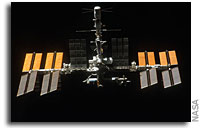
All ISS systems continue to function nominally, except those noted previously or below. US Holiday. Crew off duty. Underway: Week 7 of Increment 30 (six-person crew).
After wakeup, FE-2 Ivanishin performed the routine inspection of the SM (Service Module) PSS Caution & Warning panel as part of regular Daily Morning Inspection, while FE-1 Shkaplerov completed the weekly checkup behind ASU/toilet panel 139 in the SM on a fluid connector (MNR-NS) of the SM-U urine collection system, looking for potential moisture.
During morning inspection, Ivanishin conducted the periodic checkup of the circuit breakers & fuses in the DC1 Docking Compartment. [The monthly checkup in DC1, MRM1 & MRM2 looks at AZS circuit breakers on the BVP Amp Switch Panel (they should all be On) and the LEDs (light-emitting diodes) of 14 fuses in fuse panels BPP-30 & BPP-36. MRM2 & MRM1 were derived from the DC1 concept and are very similar to it.]
FE-4 Kononenko tended the current experiment with the Russian/German KPT-21 Plasma Crystal-3+ (Plazmennyi-Kristall/PK-3+) payload, running in the MRM2 “Poisk” module, by checking the hermeticity of *the evacuated EB vacuum chamber after wakeup and before bedtime (any pressure increase above the vacuum should stay within 5 mmHg). [Main objective of PK-3 is to study wave propagation and dispersion ratio in a dust plasma, i.e., fine particles charged and excited by HF (high frequency) radio power inside the evacuated work chamber, at a specified power of HF discharge, pressure, and a varied number of particles.]
FE-5 Kuipers started his workday with the 5th and final day of his first (FD15) suite of sessions with the medical protocol Pro K (Dietary Intake Can Predict and Protect against Changes in Bone Metabolism during Spaceflight and Recovery), ending his 24-hr urine collections after the urine pH spot test. Afterwards, Andre underwent the associated generic blood draw with self-phlebotomy. FE-5 then set up the RC (Refrigerated Centrifuge) for spinning the samples prior to stowing them in the MELFI. [For Pro K, there are five in-flight sessions (FD15, FD30, FD60, FD120, FD180) of samplings, to be shared with the NUTRITION w/Repository protocol, each one with five days of diet & urine pH logging and photography on the last day (science sessions are often referred to by Flight Day 15, 30, 60, etc. However, there are plus-minus windows associated with these time points so a “Flight Day 15” science session may not actually fall on the crewmember’s 15th day on-orbit). The crewmember prepares a diet log and then annotates quantities of food packets consumed and supplements taken. Urine collections are spread over 24 hrs; samples go into the MELFI (Minus Eighty Laboratory Freezer for ISS) within 30 min after collection. Blood samples, on the last day, are centrifuged in the RC (Refrigerated Centrifuge) and placed in MELFI at -80 degC. There is an 8-hr fasting requirement prior to the blood draw (i.e., no food or drink, but water ingestion is encouraged). MELFI constraints: Maximum MELFI Dewar open time: 60 sec; at least 45 min between MELFI Dewar door openings.]
FE-6 Pettit had Day 3 of his first Pro K session, with diet logging after the urine pH spot test, for a 5-day period. Before sleeptime, Don sets up the equipment for the associated NUTRITION/Repository/Pro K 24-hr urine collections starting tomorrow.
Pettit also concluded his first (FD15) ICV (Integrated Cardiovascular) Ambulatory Monitoring session, doffing the two Actiwatches and HM2 (Holter Monitor 2) about 24 hrs after the end of yesterday’s “midpoint” activity (~11:50am EST). The laptop was then powered off. The downloading of the two Actiwatch Spectrums and copying of data from the 2 HM2 HiFi CF Cards to the HRF PC was deferred to later. [For the ICV Ambulatory Monitoring session, during the first 24 hrs (while all devices are worn), ten minutes of quiet, resting breathing are timelined to collect data for a specific analysis. The nominal exercise includes at least 10 minutes at a heart rate >=120 bpm (beats per minute). After 24 hrs, the Cardiopres/BP is doffed and the HM2 HiFi CF Card and AA Battery are changed out to allow continuation of the session for another 24 hours, with the Makita batteries switched as required. After data collection is complete, the Actiwatches and both HM2 HiFi CF Cards are downloaded to the HRF PC1, while Cardiopres data are downloaded to the EPM (European Physiology Module) Rack and transferred to the HRF PC1 via a USB key for downlink.]
CDR Burbank & FE-5 Kuipers verified availability of 4 collapsible food containers to be used for the upcoming ESA SOLO (Sodium Loading in Microgravity) experiment protocol.
Anatoly performed the periodic (every Monday) verification of the automatic IUS AntiVirus program on the Russian VKS auxiliary network laptops RSS1, RSS2, RSK1-T61p & RSK2, as well as the manual update on the non-network laptops RSE-Med & RSE1. [Antivirus update procedures have changed since the SSCV4 software update. Before the installation (on 8/8) of the new automated procedure, the refresh was done manually on Mondays on RSS2, copying the files to the RSS2 service folder, then launching update scripts on the network laptops RSS1, RSK1-T61p & RSK2 and finally manually updating non-network laptops RSE-Med & RSE1. On Tuesdays, the anti-virus scanning results are regularly verified on all laptops. Nominally, Russian network laptops have software installed for automatic anti-virus update; fresh data is copied on RSK1-T61p & RRSK2 every time a computer is rebooted with a special login, and on RSS1 once daily. On Russian non-network laptops antivirus definition file update is done by the crew once every two weeks on Monday.]
In Node-3, the CDR removed the ARFTA (Advanced Recycle Filter Tank Assembly) and replaced it with a new unit. The old tank was drained with the Russian Kompressor-M into an EDV-U container (#935), capped and stowed in the JAXA JLP (JEM Logistics Pressurized Segment).
Anton Shkaplerov performed the routine daily servicing of the SOZh system (Environment Control & Life Support System, ECLSS) in the SM. [Regular daily SOZh maintenance consists, among else, of checking the ASU toilet facilities, replacement of the KTO & KBO solid waste containers, replacement of EDV-SV waste water and EDV-U urine containers and filling EDV-SV, KOV (for Elektron), EDV-ZV & EDV on RP flow regulator.]
Andre started another sampling run with the AQM (Air Quality Monitor) and deactivating the system ~5 hrs later. [Consisting of the EHS GC/DMS (Environmental Health Systems Gas Chromatograph / Differential Mobility Spectrometer), the system is controlled with “Sionex” expert software from the SSC (Station Support Computer)-12 laptop. The AQM demonstrates COTS (Commercial Off-the-Shelf) technology for identifying volatile organic compounds, similar to the VOA (Volatile Organics Analyzer). This evaluation will continue over the course of several months as it helps to eventually certify the GC/DMS as nominal CHeCS (Crew Health Care Systems) hardware.]
Later, FE-5 pre-installed the NES/NeuroSpat payload equipment in COL (Columbus Orbital Laboratory) at the EPM (European Physiology Module) for his upcoming first session and set up the MPPLL (Multipurpose Laptop).
Andre also used the CSA-O2 (Compound Specific Analyzer-O2) units (#1043, #1048) to take oxygen partial pressure readings in the SM and COL.
With the Elektron oxygen generator currently off, Kononenko, on TsUP Go, was to initiate refreshing the cabin interior with pressurized O2 (oxygen) from Progress 45P tankage for about an hour.
Andre & Oleg took the (approx.) monthly O-OHA (On-Orbit Hearing Assessment) test, their first, a 30-min NASA environmental health systems examination to assess the efficacy of acoustic countermeasures, using a special software application on the MEC (Medical Equipment Computer) laptop. [The O-OHA audiography test involves minimum audibility measurements for each ear over a wide range of frequencies (0.25-10 kHz) and sound pressure levels, with the crewmembers using individual-specific Prophonics earphones, new Bose ANC headsets (delivered on 30P) and the SLM (sound level meter). To conduct the testing, the experimenter is supported by special EarQ software on the MEC, featuring an up/down-arrow-operated slider for each test frequency that the crewmember moves to the lowest sound pressure level at which the tone can still be heard. The baseline test is required not later than about Flight Day 14 for each new Expedition and is then generally performed once per month. Note: There has been temporary hearing deficits documented on some U.S. and Russian crewmembers, all of which recovered to pre-mission levels.]
Before sleeptime, Anton will initiate battery charging for the Russian GFI-8 “Uragan” (hurricane) earth-imaging program with FSS science hardware. [The FSS system consists of an image recording module with lens and a spectroradiometer module with an electronics module. FSS includes the ME Electronics Module & MRI Image Recording Module.]
Kuipers conducted the periodic (approx. weekly) WRS (Water Recovery System) sampling in Node-3 using the TOCA (Total Organic Carbon Analyzer), after first initializing the software and priming (filling) the TOCA water sample hose. [After the approximately 2-hr TOCA analysis, results were transferred to the SSC-5 (Station Support Computer 5) laptop via USB drive for downlink, and the data were also logged.]
Pettit & Burbank had another time slot reserved for making entries in their electronic Journals on personal SSC (Station Support Computer). [Required are three journaling sessions per week.]
Before Presleep, the CDR will turn on the MPC (Multi Protocol Converter) and start the Ku-band data flow of video recorded during the day to the ground, with POIC (Payload Operations & Integration Center) routing the onboard HRDL (High-Rate Data Link). After about an hour, Dan will turn MPC routing off again. [This is a routine operation which regularly transmits HD onboard video (live or tape playback) to the ground on a daily basis before sleeptime.]
The crewmembers worked out with their regular 2-hr physical exercise on the CEVIS cycle ergometer with vibration isolation (CDR, FE-5), TVIS treadmill (FE-1, FE-2, FE-4), ARED advanced resistive exerciser (CDR, FE-4, FE-6), T2/COLBERT advanced treadmill (FE-5, FE-6) and VELO ergometer bike with bungee cord load trainer (FE-1, FE-2).
At ~5:25am EST, Oleg Kononenko supported a Russian PAO TV event, downlinking a message of greetings to Grandfather Durov’s Corner theater on its 100th anniversary. [On 1/8, Grandfather Durov’s Corner Theater will turn 100 years old. Grandfather Durov’s Corner, Grandfather Durov’s Wonderland, V. L. Durov Animal Theater, these are the names familiar not only among Muscovites or residents of other Russian cities, but among many guests from abroad. And indeed, this is an unusual house equal to none. Peace and harmony reins here between Man and Nature. Fantasy and reality live here side by side. Vladimir Leonidovich Durov, an illustrious circus performer, clown-comedian, animal trainer, writer, scientist-animal psychologist, the first Russian Honored Circus Performer, opened the Corner on 1/8/1912. He developed his own training method refusing to use a whip or a stick when working with animals. “Cruelty is humiliating, only kindness can be wonderful” insisted Durov.]
At ~6:55am, the CDR powered up the SM’s amateur radio equipment (Kenwood VHF transceiver with manual frequency selection, headset, & power supply) and at 7:00am conducted a ham radio session with students at Zespol Szkol nr. 2, Zuromin, Poland.
Tasks listed for Shkaplerov, Kononenko & Ivanishin on the Russian discretionary “time permitting” job for today were C
* A ~30-min. run of the GFI-8 “Uragan” (hurricane) earth-imaging program with the NIKON D3X digital camera with Sigma AF 300-800mm telelens, aiming for, aiming for Christmas Island (Kiribati) in nadir [Christmas Island, in the Line Islands in the Northern Pacific, is the world’s largest atoll. Based on a 1995 realignment of the International Date Line, Kiribati is now the easternmost country in the world, i.e., “seeing the Sun (and New Year) first”],
* More preparation & downlinking of reportages (written text, photos, videos) for the Roskosmos website to promote Russia’s manned space program (max. file size 500 Mb), and
* Completing Soyuz 29S unloading, with logging in IMS (Inventory Management System) database.
No CEO (Crew Earth Observation) targets uplinked for today.
Conjunction Alert: Flight controllers are tracking a new conjunction with Object 09617 (DELTA 1 debris). TCA (Time of Closest Approach): 6:53pm EST on 1/4 (Wednesday). Tracking continues. If a DAM (Debris Avoidance Maneuver) is required, Go/NoGo decision will have to be tomorrow (1/3) at 7:23pm and TIG (Time of Ignition) at 4:35pm EST on 1/4.
ISS Orbit (as of this morning, 7:14am EST [= epoch])
Mean altitude C 390.9 km
Apogee height C 407.1 km
Perigee height C 374.8 km
Period — 92.38 min.
Inclination (to Equator) — 51.64 deg
Eccentricity — 0.0023917
Solar Beta Angle — -47.0 deg (magnitude increasing)
Orbits per 24-hr. day — 15.59
Mean altitude loss in the last 24 hours — 93 m
Revolutions since FGB/Zarya launch (Nov. 98) — 75,202
Time in orbit (station) — 4791 days
Time in orbit (crews, cum.) — 4078 days
Significant Events Ahead (all dates Eastern Time and subject to change):
————–Six-crew operations—————-
01/18/12 — ISS Reboost (set up phasing for 46P)
01/24/12 — Progress M-13M/45P undock
01/25/12 — Progress M-14M/46P launch
01/27/12 — Progress M-14M/46P docking (DC-1)
02/07/12 — SpaceX Falcon 9/Dragon launch — (target date)
02/10/12 — SpaceX Falcon 9/Dragon berthing — (target date)
02/14/12 — Russian EVA
02/23/12 — SpaceX Falcon 9/Dragon unberth — (target date)
03/09/12 — ATV3 launch — (target date)
03/16/12– Soyuz TMA-22/28S undock/landing (End of Increment 30)
————–Three-crew operations————-
03/30/12 — Soyuz TMA-04M/30S launch C G.Padalka (CDR-32)/J.Acaba/K.Volkov — (Target Date)
04/01/12 — Soyuz TMA-04M/30S docking (MRM2) — (Target Date)
————–Six-crew operations—————-
TBD — 3R Multipurpose Laboratory Module (MLM) w/ERA C launch on Proton (under review)
04/24/12 — Progress M-14M/46P undock
04/25/12 — Progress M-15M/47P launch
04/27/12 — Progress M-15M/47P docking
TBD — 3R Multipurpose Laboratory Module (MLM) C docking (under review)
05/16/12 — Soyuz TMA-03M/29S undock/landing (End of Increment 31)
————–Three-crew operations————-
05/30/12 — Soyuz TMA-05M/31S launch C S.Williams (CDR-33)/Y.Malenchenko/A.Hoshide
06/01/12 — Soyuz TMA-05M/31S docking
————–Six-crew operations—————-
06/26/12 — HTV-3 launch (target date)
09/12/12 — Soyuz TMA-04M/30S undock/landing (End of Increment 32)
————–Three-crew operations————-
09/26/12 — Soyuz TMA-06M/32S launch C K.Ford (CDR-34)/O.Novitskiy/E.Tarelkin
09/28/12 C Soyuz TMA-06M/32S docking
————–Six-crew operations————-
11/12/12 — Soyuz TMA-05M/31S undock/landing (End of Increment 33)
————–Three-crew operations————-
11/26/12 — Soyuz TMA-07M/33S launch C C.Hadfield (CDR-35)/T.Mashburn/R.Romanenko
11/28/12 C Soyuz TMA-07M/33S docking
————–Six-crew operations————-
03/19/13 — Soyuz TMA-06M/32S undock/landing (End of Increment 34)
————–Three-crew operations————-
04/02/13 C Soyuz TMA-08M/34S launch C P.Vinogradov (CDR-36)/C.Cassidy/A.Misurkin
04/04/13 C Soyuz TMA-08M/34S docking
————–Six-crew operations————-
05/16/13 C Soyuz TMA-07M/33S undock/landing (End of Increment 35)
————–Three-crew operations————-
05/29/13 C Soyuz TMA-09M/35S launch C M.Suraev (CDR-37)/K.Nyberg/L.Parmitano
05/31/13 C Soyuz TMA-09M/35S docking
————–Six-crew operations————-
09/xx/13 C Soyuz TMA-08M/34S undock/landing (End of Increment 36)
————–Three-crew operations————-
09/xx/13 C Soyuz TMA-10M/36S launch C M.Hopkins/TBD (CDR-38)/TBD
09/xx/13 C Soyuz TMA-10M/36S docking
————–Six-crew operations————-
11/xx/13 C Soyuz TMA-09M/35S undock/landing (End of Increment 37)
————–Three-crew operations————-
11/xx/13 C Soyuz TMA-11M/37S launch C K.Wakata (CDR-39)/R.Mastracchio/TBD
11/xx/13 C Soyuz TMA-11M/37S docking
————–Six-crew operations————-
03/xx/14 C Soyuz TMA-10M/36S undock/landing (End of Increment 38)
————–Three-crew operations————-



