
NASA ISS On-Orbit Status 2 April 2012
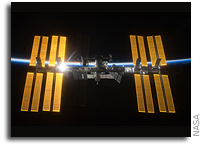
ISS On-Orbit Status 04/02/12
All ISS systems continue to function nominally, except those noted previously or below. Underway: Week 19 of Increment 30 (six-person crew).
USOS crewmembers Dan Burbank, Andre Kuipers, Don Pettit today are enjoying an off-duty day, as “payback” to their weekend activities associated with the restoration of power to ATV-3 (Automated Transfer Vehicle 3) “Edoardo Amaldi”.
After breakfast, FE-1 Shkaplerov performed the routine inspection of the SM (Service Module) PSS Caution & Warning panel as part of regular Daily Morning Inspection.
FE-2 Ivanishin completed the weekly checkup behind ASU/toilet panel 139 in the SM of a fluid connector (MNR-NS) of the SM-U urine collection system, looking for potential moisture.
FE-4 Oleg Kononenko conducted the periodic maintenance of the active Russian BMP (Harmful Impurities Removal System) by starting the “bake-out” cycle to vacuum on absorbent bed #1 of the regenerable dual-channel filtration system. The process will be terminated at ~5:15pm EDT. Bed #2 regeneration will be done tomorrow. [Regeneration of each of the two cartridges takes about 12 hours and is conducted only during crew awake periods. The BMP’s regeneration cycle, normally done every 20 days, is currently performed four times more frequently (last time: 3/13 & 3/14).]
The three Russian crewmembers started a new round of periodic preventive maintenance of RS (Russian Segment) ventilation systems, –
– Shkaplerov working in the SM cleaning “Group B1” ventilator fans & grilles with the vacuum cleaner,
– Ivanishin in the MRM1 Rassvet module to replace the SKPF 1 & SKPF2 dust filters with new units and to clean the SOTR gas-liquid heat exchangers (GZhT4), and then moving to the DC1 to clean the VD1 & VD2 air ducts, V1,V2 & V3 fan grills and to replace the PF1 & PF1 dust filter cartridges, and
– Kononenko in the FGB, cleaning ventilation screens on interior panels 201, 301 & 401.
Anton also completed the periodic routine maintenance in the SM’s ASU toilette facility, replacing the filter insert (F-V) and the urine receptacle (MP) with new spares.
Afterwards, FE-1 used the CMS (Countermeasure System), a component of the SKDS GANK-4M suite, to check for CO (Carbon Monoxide) contamination in the SM, recording the measurements and updating the CO sensor coefficient for calibration. [CMS uses preprogrammed microchips to measure for numerous contaminants such as O-Xylol (1,2-Dimethylbenzol, C8H10), Hydrogen Chloride (HCl), Formaldehyde, Isopropanol, Methanol, Toluene, Mercaptan, Sulphur Dioxide, Hydrogen Cyanide, Phosgene, Ozone, Acetic Acid, Ammonia, Nitrogen Dioxide, Nitrous Oxides, Acetone, Benzene, Carbon Monoxide, etc.]
Oleg set up the Russian GFI-8 “Uragan” (hurricane) earth-imaging program with FSS science hardware and the overnight freshly charged FSS photo spectrograph battery at SM window #9, taking pictures of targets along the flight track during a 30-minute segment, covering land & water areas in South America (Argentina). [The FSS (Fotospektralnaya sistema) consists of an image recording module with lens and a spectroradiometer module with an electronics module. FSS includes the ME Electronics Module & MRI Image Recording Module.]
Afterwards, Kononenko had ~3h 25m set aside for continuing loading trash and excessed cargo on Progress 46P while concurrently updating the IMS (Inventory Management System) database.
After starting charging of the BAR TTM-2 battery at wakeup (turning it off at sleeptime), Anton & Anatoly used the KPT-2 payload and its BAR science instruments suite for measuring background noise near valves and in the window areas of the SM PkhO (Transfer Compartment) and the FGB with the AU-1 (Ultrasound Analyzer 1) which can detect and locate tiny leaks by listening for “hissing” noise. The crew also took environmental data behind specific FGB panels. [KPT-2 monitors problem areas, necessary to predict shell micro-destruction rate and to develop measures to extend station life. Data are copied to the RSE1 laptop for downlink to Earth via OCA, with photographs, and the activities are supported by ground specialist tagup as required. Objective of the Russian KPT-2/BAR science payload is to measure environmental parameters (temperature, humidity, air flow rate) and module shell surface temperatures behind RS (Russian Segment) panels and other areas susceptible to possible micro-destruction (corrosion), before and after insolation (day vs. night). Piren-V is a video-endoscope with pyrosensor, part of the methods & means being used on ISS for detecting tiny leaks in ISS modules which could lead to cabin depressurization. Besides KPT-2 Piren-V, the payload uses a remote infrared thermometer (Kelvin-Video), a thermohygrometer (Iva-6A), a heat-loss thermoanemometer/thermometer (TTM-2) and an ultrasound analyzer (AU-1) to determine environmental data in specific locations and at specific times. Activities include documentary photography with the NIKON D2X camera and flash.]
Later, Shkaplerov removed the Russian GB (Glovebox) from its stowage in MRM2 (Mini Research Module 2) Poisk and installed it in the MRM1 Rassvet module, supported by ground specialist tagup.
Ivanishin meanwhile completed another 30-min. session for the DZZ-13 “Seiner” ocean observation program, obtaining SONY HDV-Z7E camcorder footage of color bloom patterns in the waters of the South-Eastern Pacific and off the Chile coastline, then copying the images to the RSK-1 laptop.
Oleg Kononenko took care of the daily IMS maintenance, updating/editing its standard “delta file” including stowage locations, for the regular weekly automated export/import to its three databases on the ground (Houston, Moscow, Baikonur).
Anton Shkaplerov completed the routine daily servicing of the SOZh system (Environment Control & Life Support System, ECLSS) in the SM. [Regular daily SOZh maintenance consists, among else, of checking the ASU toilet facilities, replacement of the KTO & KBO solid waste containers, replacement of EDV-SV waste water and EDV-U urine containers and filling EDV-SV, KOV (for Elektron), EDV-ZV & EDV on RP flow regulator.]
Before Presleep, CDR Burbank will turn on the MPC (Multi-Protocol Converter) and start the Ku-band data flow of video recorded during the day to the ground, with POIC (Payload Operations & Integration Center) routing the onboard HRDL (High-Rate Data Link). After about an hour, Dan turns MPC routing off again. [This is a routine operation which regularly transmits HD onboard video (live or tape playback) to the ground on a daily basis before sleeptime.]
The crew worked out with their regular 2-hr physical exercise protocol on the CEVIS cycle ergometer with vibration isolation (FE-5), TVIS treadmill with vibration isolation & stabilization (FE-1, FE-2, FE-4), ARED advanced resistive exerciser (CDR, FE-1, FE-2, FE-5, FE-6), T2/COLBERT advanced treadmill (FE-6), and VELO ergometer bike with load trainer (FE-4). [FE-6 is on the special experimental SPRINT protocol which diverts from the regular 2.5 hrs per day exercise regime and introduces special daily sessions, followed by a USND (Ultrasound) leg muscle self scan in COL. Today’s SPRINT exercise was on ARED+T2, with T2, ARED+CEVIS (VO2max) & CEVIS in the next 3 days. If any day is not completed, Don picks up where he left off, i.e., he would be finishing out the week with his last day of exercise on his off day If any day is not completed, Don picks up where he left off, i.e., he would be finishing out the week with his last day of exercise on his off day.]
Tasks listed for Shkaplerov, Kononenko & Ivanishin on the Russian discretionary “time permitting” job for today were –
– A ~30-min. run of the GFI-8 “Uragan” (hurricane) earth-imaging program with the NIKON D3X digital camera with Sigma AF 300-800mm telelens, focusing on the volcanoes Hierro, Cordon-Kaul & Kilauea, Darwin Island, and the glaciers of Patagonia;
– A ~30-min. session for Russia’s EKON Environmental Safety Agency, making observations and taking KPT-3 aerial photography of environmental conditions on Earth using the NIKON D3X camera with the RSK-1 laptop, and
– More preparation & downlinking of reportages (written text, photos, videos) for the Roskosmos website to promote Russia’s manned space program (max. file size 500 Mb).
No CEO (Crew Earth Observation) targets uplinked for today.
Propellant Transfers: At ~2:55pm EDT today, TsUP/Moscow starts fuel (UDMH/unsymmetrical dimethyl hydrazine) & oxidizer (NTO/nitrogen tetroxide) transfer from Progress 46P KDU Combined Propulsion System section 1 tankage to the short fuel & oxidizer tanks TBG/O 1,2,3,4 in the FGB module. No crew action is required. Afterwards, the FGB tanks will be connected to the SM and Progress 46P thrusters for attitude control (SM for Pitch & Yaw; 46P for Roll). [SM’s automated daily timeline sequencer (SPP) will command transition to propellant transfer mode, then commence prop transfer from the KDU tanks of Progress 46P to the four tanks (TBG/O 1-4) of the FGB via prop lines passing through the SM, lasting about 1-1.5 hrs.]
ISS Orbit (as of this morning, 6:11am EDT [= epoch])
Mean altitude – 389.8 km
Apogee height – 399.0 km
Perigee height – 380.6 km
Period — 92.35 min.
Inclination (to Equator) — 51.64 deg
Eccentricity — 0.0013613
Solar Beta Angle — 36.8 deg (magnitude increasing)
Orbits per 24-hr. day — 15.59
Mean altitude loss in the last 24 hours — 64 m
Revolutions since FGB/Zarya launch (Nov. 98) — 76,620
Time in orbit (station) — 4882 days
Time in orbit (crews, cum.) — 4169 days
Significant Events Ahead (all dates Eastern Time and subject to change):
————–Six-crew operations—————-
04/19/12 — Progress M-14M/46P undock
04/20/12 — Progress M-15M/47P launch
04/22/12 — Progress M-15M/47P docking
04/27/12 — Soyuz TMA-22/28S undock/landing (End of Increment 30)
————–Three-crew operations————-
04/30/12 — SpaceX Dragon launch (12:22pm EDT; target date)
05/15/12 — Soyuz TMA-04M/30S launch – G.Padalka (CDR-32)/J.Acaba/S.Revin
05/17/12 — Soyuz TMA-04M/30S docking (MRM2)
————–Six-crew operations—————-
07/01/12 — Soyuz TMA-03M/29S undock/landing (End of Increment 31)
————–Three-crew operations————-
07/15/12 — Soyuz TMA-05M/31S launch – S.Williams (CDR-33)/Y.Malenchenko/A.Hoshide
07/17/12 — Soyuz TMA-05M/31S docking
07/20/12 — HTV3 launch (~10:18pm EDT)
07/31/12 — Progress M16M/48P launch
08/02/12 — Progress M16M/48P docking
————–Six-crew operations—————-
09/17/12 — Soyuz TMA-04M/30S undock/landing (End of Increment 32)
————–Three-crew operations————-
10/15/12 — Soyuz TMA-06M/32S launch – K.Ford (CDR-34)/O.Novitskiy/E.Tarelkin
10/17/12 — Soyuz TMA-06M/32S docking
————–Six-crew operations————-
11/01/12 — Progress M-17M/49P launch
11/03/12 — Progress M-17M/49P docking
11/12/12 — Soyuz TMA-05M/31S undock/landing (End of Increment 33)
————–Three-crew operations————-
12/05/12 — Soyuz TMA-07M/33S launch – C.Hadfield (CDR-35)/T.Mashburn/R.Romanenko
12/07/12 — Soyuz TMA-07M/33S docking
————–Six-crew operations————-
12/26/12 — Progress M-18M/50P launch
12/28/12 — Progress M-18M/50P docking
03/19/13 — Soyuz TMA-06M/32S undock/landing (End of Increment 34)
————–Three-crew operations————-
04/02/13 — Soyuz TMA-08M/34S launch – P.Vinogradov (CDR-36)/C.Cassidy/A.Misurkin
04/04/13 — Soyuz TMA-08M/34S docking
————–Six-crew operations————-
05/16/13 — Soyuz TMA-07M/33S undock/landing (End of Increment 35)
————–Three-crew operations————-
05/29/13 — Soyuz TMA-09M/35S launch – M.Suraev (CDR-37)/K.Nyberg/L.Parmitano
05/31/13 — Soyuz TMA-09M/35S docking
————–Six-crew operations————-
09/xx/13 — Soyuz TMA-08M/34S undock/landing (End of Increment 36)
————–Three-crew operations————-
09/xx/13 — Soyuz TMA-10M/36S launch – M.Hopkins/TBD (CDR-38)/TBD
09/xx/13 — Soyuz TMA-10M/36S docking
————–Six-crew operations————-
11/xx/13 — Soyuz TMA-09M/35S undock/landing (End of Increment 37)
————–Three-crew operations————-
11/xx/13 — Soyuz TMA-11M/37S launch – K.Wakata (CDR-39)/R.Mastracchio/TBD
11/xx/13 — Soyuz TMA-11M/37S docking
————–Six-crew operations————-
03/xx/14 — Soyuz TMA-10M/36S undock/landing (End of Increment 38)
————–Three-crew operations————-



