NASA ISS On-Orbit Status 16 September 2009
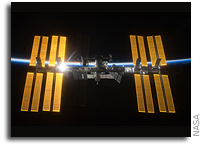
All ISS systems continue to function nominally, except those noted previously or below. Tomorrow: HTV Berthing!
Upon wakeup, FE-1 Barratt, FE-2 Stott, FE-4 Thirsk & FE-5 DeWinne continued their new week-long session of the experiment SLEEP (Sleep-Wake Actigraphy & Light Exposure during Spaceflight), Nicole–s first, logging data from their Actiwatch to the HRF-1 (Human Research Facility 1) laptop as part of a week-long session. [To monitor the crewmembers– sleep/wake patterns and light exposure, the crewmembers wear a special Actiwatch device which measures the light levels encountered by them as well as their patterns of sleep and activity throughout the Expedition and use the payload software for data logging and filling in questionnaire entries in the experiment–s laptop session file on the HRF-1 laptop. The log entries are done within 15 minutes of final awakening for seven consecutive days.]
Nicole continued her first ICV (Integrated Cardiovascular) Ambulatory Monitoring session. Upon reaching the midpoint (~10:30am EDT), FE-2 ended the Cardiopres/BP (blood pressure) data collection, changed out the HM2 (Holter Monitor 2) HiFi CF Card and AA Battery, and began the next 24-hour data collection, today using the TVIS treadmill (instead of the CEVIS cycle) to meet the ICV heart rate requirement. [ICV activities consist of two separate but related parts over a one-week time period: an ultrasound echo scan & an ambulatory monitoring session. Today, wearing electrodes, the HM2 (Holter Monitor 2) for recording ECG (Electrocardiogram) for 48 hours, the ESA Cardiopres to continuously monitor blood pressure for 24 hours (terminated ~10:30am), and two Actiwatches (hip/waist & ankle) for monitoring activity levels over 48 hours, Nicole continues Part 2 of the ICV assessment. During the first 24 hrs (while all devices were worn), ten minutes of quiet, resting breathing are timelined to collect data for a specific analysis. The nominal exercise includes at least 10 minutes at a heart rate –120 bpm (beats per minute). After 24 hrs, the Cardiopres was doffed and the HM2 HiFi CF Card and AA Battery were changed out to allow continuation of the session for another 24 hours, with the Makita batteries switched as required. After data collection is complete, the Actiwatches and both HM2 HiFi CF Cards are downloaded to the HRF PC1, while Cardiopres data are downloaded to the EPM (European Physiology Module) Rack and transferred to the HRF PC1 via a USB key for downlink. The sessions are scheduled at or around FD14, FD30, FD75, FD135 and R-15 (there will be fewer sessions if mission duration is less than six months). The FD75 echo scan will include an exercise component with a second scan (subset of the first) completed within 5 minutes after the end of exercise. The primary objective of the accompanying CCISS (Cardiovascular Control on return from the ISS) experiment is to maximize the information about changes in cardiovascular and cerebrovascular function that might compromise the ability of astronauts to meet the challenge of return to an upright posture on Earth.]
Robert Thirsk undertook the U.S. PFE (Periodic Fitness Evaluation) protocol, a monthly 1.5-hr. procedure which checks up on BP & ECG during programmed exercise on the CEVIS cycle ergometer in the US Lab. Readings were taken with the BP/ECG (blood pressure/electrocardiograph) and the HRM (heart rate monitor) watch with its radio transmitter. Frank De Winne acted as Operator/CMO. [BP/ECG provides automated noninvasive systolic and diastolic blood pressure measurements while also monitoring and displaying accurate heart rates on a continual basis at rest and during exercise.]
Gennady Padalka broke out and set up the hardware for the Russian MBI-21 PNEVMOKARD experiment and conducted the 1h15m session, his sixth, which forbids moving or talking during data recording. The experiment is controlled from the RSE-med A31p laptop, equipped with new software, and uses the TENZOPLUS sphygmomanometer to measure arterial blood pressure. The experiment, supported by ground specialist tagup, was then closed out and the test data stowed for return to the ground on Soyuz TMA-14. [PNEVMOKARD (Pneumocard) attempts to obtain new scientific information to refine the understanding about the mechanisms used by the cardiorespiratory system and the whole body organism to spaceflight conditions. By recording (on PCMCIA cards) the crewmember–s electrocardiogram, impedance cardiogram, low-frequency phonocardiogram (seismocardiogram), pneumotachogram (using nose temperature sensors), and finger photoplethismogram, the experiment supports integrated studies of (1) the cardiovascular system and its adaptation mechanisms in various phases of a long-duration mission, (2) the synchronization of heart activity and breathing factors, as well as the cardiorespiratory system control processes based on the variability rate of physiological parameters, and (3) the interconnection between the cardiorespiratory system during a long-duration mission and the tolerance of orthostatic & physical activities at the beginning of readaptation for predicting possible reactions of the crewmembers organism during the their return to ground.]
Mike Barratt & Nicole Stott took the periodic CHeCS (Crew Health Care Systems) Emergency Health Maintenance System Contingency Drill Training, which gives crewmembers the opportunity to work as a team in resolving a simulated medical emergency onboard ISS. [The training refreshes their memory of the on-orbit stowage and deployment locations, equipment use, and procedures.]
FE-4 Thirsk completed the regular monthly session of the HMS (Health Maintenance System) training protocol, a 30-min. exercise to refresh his CMO (Crew Medical Officer)–s acuity in a number of critical health areas. The proficiency drill today focused on Airway Management. [The HMS hardware, including ACLS (Advanced Cardiac Life Support) equipment, may be used in contingency situations where crew life is at risk. To maintain proficiency, crewmembers spend one hour per month reviewing HMS and ACLS equipment and procedures via the HMS and ACLS CBT (computer-based training). The impact of not maintaining proficiency with the HMS hardware and procedures could lead to a substantial impact to ISS operations, potential evacuation of ISS, and loss of crew life.]
In the Soyuz TMA-15/19S crew return vehicle, Gennady, Mike & Nicole conducted the standard 30-min. fit check of the Kazbek couches, the contoured shock absorbing seats in the Descent Module (SA) of the spacecraft docked at the FGB Nadir Port. [For the fit check, crew members remove their cabin suits and don Sokol KV-2 suit and comm caps, get into in their seats and assess the degree of comfort & uniform body support provided by the seat liner. Using a ruler, they then measure the gap between the top of the head and the top edge of the structure facing the head crown. The results are reported to TsUP-Moscow. Kazbek-UM couches are designed to withstand g-loads during launch and orbital insertion as well as during reentry and brake-rocket-assisted landing. Each seat has two positions: cocked (armed) and noncocked. In cocked position, they are raised to allow the shock absorbers to function during touchdown. The fit check assures that the crewmembers, whose bodies gain in length during longer-term stay in zero-G, will still be adequately protected by the seat liners for their touchdown in Kazakhstan, either emergency or regular return.]
In the SM (Service Module), FE-1 Barratt & FE-3 Romanenko performed an extensive (5h) IFM (Inflight Maintenance) on the TVIS exercise machine, removing & replacing springs in the forward right stabilizer of the treadmill. The IFM was successful. [In Part 1 of the task, Mike & Roman had to open the stabilizer in question, remove three springs remaining plus their headless fasteners, and then install four new springs. In Part 2, after the lunch break, they had to close the stabilizer and reinstall it on the TVIS at its front right position. After the crew removed a broken spring from it on 6/4/09, the S4 Stabilizer has been operating in a three-spring configuration. Four replacement springs and associated fasteners were delivered on 2J/A.]
Romanenko terminated the discharge/charge cycle on the second pack of NiMH (Nickel Metal Hydride) batteries for the Russian BMD (Biomedical Device) PZE STIMUL-01 payload in the payload–s charger device. [The neuromuscular myostimulator suit STIMUL-1, which uses electrical stimulation to contract and relax leg muscle fibers for conditioning, is part of the suite of BMS (Biomedical Support) systems under development at the Moscow IBMP (Institute for Biomedical Problems) for long-duration spaceflights including piloted Mars missions.]
Afterwards, the FE-3 performed the periodic (annual) accuracy check on seven RS (Russian Segment) vacuum pressure gauges (MV). [Three in the SM, one in the DC1 Docking Compartment, and one each in the Soyuz TMA-14 & TMA-15 Orbital Compartments (BO).]
Roman also started the new version of the Russian BIO-5 Rasteniya-2 ("Plants-2") experiment in the SM, planting the seeds (Mizuna) in the root module, connecting the assembly to the RBS-20 power outlet and activating the hardware (BU/Control Unit, computer), set up in –growth mode–. [Rasteniya-2 researches growth and development of plants under spaceflight conditions in the LADA-16 greenhouse from IBMP (Institute of Bio-Medical Problems, Russian: IMBP). Mizuna (Brassica rapa nipposinica) is a tasty variety of Japanese mustard greens, also known as California Peppergrass, eaten as a salad.]
Before starting out with today–s JEMRMS (JEM Robotic Maneuvering System) activities, Stott & De Winne tagged up with KIBOTT at SSIPC (Space Station Integration & Promotion Center, Tsukuba) to discuss the work ahead. [KIBOTT, the Kibo Robotics Team, is responsible for the overall operation of the JPM (JEM Pressurized Module)–s robotic arms, scientific airlock, and other associated mechanisms. During robotic arm & airlock ops, KIBOTT prepares & monitors the related systems necessary for the flight crew to perform the appropriate tasks aboard Kibo.]
Also preparatory to the robotics work, Frank –
- Activated the JEM RLT (Robotic Laptop Terminal),
- Configured a drag-thru video cable from Lab RWS (Robotic Workstation), set up for VTR (Video Tape Recorder) Bypass, to a JPM SSC (Station Support Computer) as an additional video monitor,
- Performed final JEM RMS activation (CCP/Camera Control Panel, two RMS monitors, etc.), and
- Reviewed the DOUG (Dynamic Dynamic Onboard Ubiquitous Graphics) software covering HTV Install and EP (Exposed Pallet) Extract/ Insert Operations.
Afterwards, Nicole & Frank worked through a 2-hr activity of prepared the Kibo RMS for the HTV post-berthing operations, calibrating it for the EFU (Exposed Facility Unit) Target view provided by the TV camera at the MA EE (Main Arm End Effector). Later, De Winne deactivated the RMS complex.
Frank then completed preparations by configuring the HTV HCP (Hardware Command Panel) in the Kibo laboratory (with HCP & PROX power/data cables through the U.S. Lab), and performing an HCP selfcheck, initiated by a button in Test mode.
CDR Padalka conducted another periodic health check of the KhSA Cooler/Dehumidifier Assembly–s V1 fan in the Soyuz 18S spacecraft–s DM (Descent Module) by turning the V2 fan on and the V1 fan off, then checking air flow. [On 6/25, a planned replacement of the apparently faulty fan in the Soyuz 18S DM with a new unit proved to be not necessary after Padalka configured a jumper bypass which successfully recovered functionality of the air conditioner fan. Today–s activity was to check up on the fix.]
In the DC1, the CDR also worked on the #6 Orlan-MK spacesuit, running tests on its GA gas analyzer sampling/return line for CO2 & delta-CO2 data & its fittings, then installed a backup gas sampling line for the delta-CO2 channel.
With Bob Thirsk observing (per on-orbit training), Nicole serviced the MDS (Mice Drawer System), today refilling its potable water supply.
The FE-4 also had time set aside to gather exact information on CEVIS hardware locations, for the purpose of updating ground models and to determine potential rearrangements of this hardware for upcoming operation of the new VO2Max payload. [The area of most concern is the clearance between the CEVIS frame and the WRS1 (Water Recovery System 1)-to-WRS2 Utility Cover and the cables beneath it. VO2Max, from sports medicine, (also maximal oxygen consumption, maximal oxygen uptake or aerobic capacity) is the maximum capacity of an individual’s body to transport and utilize oxygen during incremental exercise, which reflects the physical fitness of the individual. VO2Max is expressed either as an absolute rate in liters of oxygen per minute (l/min) or as a relative rate in milliliters of oxygen per kilogram of bodyweight per minute (ml/kg/min), the latter expression often being used to compare the performance of endurance sports athletes.]
For tomorrow–s HTV rendezvous, Nicole Stott & Bob Thirsk unstowed and set up the HHL (Hand Held Lidar) with battery and night scope to check out its functionality, then switched it off and temporarily stowed it. It will be used during the Japanese vehicle–s R-Bar approach. [The Hand Held Lidar (Light Detection & Ranging), used before on the Shuttle, employs a laser light beam for measuring distance and velocity. Range or speed data are obtained by shooting out light pulses (generally one mark per second) with a trigger, which are then reflected back into the instrument and converted to numerical data (either velocity or range, selected by toggle).]
The FE-3 conducted another 30-min. session with the new Russian ocean observations program, DZZ-13 –Seiner–, to obtain data on color field patterns and current cloud cover conditions over the south-east Pacific between the geographic location east of New Zealand and the coast of Chile. [The experiment uses visual observation, videography (HDV camcorder, PAL mode) and selective photography (NIKON D2X with AF-S Zoom-Nikkor 80-200 mm lens) of color-contrast images and large discontinuities in cloud fields along the flight path, controlled from the RSK-1 laptop. Roman–s photography had to be accompanied by a continuous non-stop video recording of underlying terrain using the HDV camera securely fixed above SM Window #8 precisely in nadir using the LIV adapter.]
Mike Barratt performed the periodic status & screen check on the payload CGBA-5 (Commercial Generic Bioprocessing Apparatus), located in the ER-2 (EXPRESS Rack 2).
Gennady completed the periodic checkout & performance verification of IP-1 airflow sensors in the various RS (Russian Segment) hatchways.
Later, the CDR did the daily IMS (Inventory Management System) maintenance, updating/editing its standard –delta file– including stowage locations, for the regular weekly automated export/import to its three databases on the ground (Houston, Moscow, Baikonur).
Padalka also completed the routine daily servicing of the SOZh system (Environment Control & Life Support System, ECLSS) in the SM. [Regular daily SOZh maintenance consists, among else, of checking the ASU toilet facilities, replacement of the KTO & KBO solid waste containers and replacement of EDV-SV waste water and EDV-U urine containers.]
Gennady had another hour reserved for more loading of disposed cargo on the Progress 34P, set for undocking on 9/21. Gathering U.S. trash for 34P was on Bob–s schedule for today.
The crew performed their regular daily 2.5-hr. physical workout program on the CEVIS cycle ergometer (FE-2), TVIS treadmill with vibration isolation (CDR, FE-1, FE-3, FE-4, FE-5), ARED advanced resistive exercise device (CDR, FE-1, FE-2, FE-4, FE-5), and VELO cycle ergometer with bungee cord load trainer (FE-3).
Afterwards, Frank transferred the exercise data files to the MEC (Medical Equipment Computer) for downlink, including the daily wristband HRM (Heart Rate Monitor) data of the workouts on ARED, followed by their erasure on the HRM storage medium (done six times a week).
At ~3:08am EDT, Frank De Winne powered up the SM’s amateur radio equipment (Kenwood VHF transceiver with manual frequency selection, headset, & power supply) and at ~3:13am conducted a ham radio session with students at the Euro Space Center in Transinne, Belgium. [Approximately 500 youngsters from different schools in the French part of Belgium come together with astronauts, cosmonauts and a taikonaut who participate in the "Belgian Space Week 2009" from 9/14 to 9/18. Theme of the event in the Euro Space Center is Life in Space. Students were hoping to be able to talk to Belgian ESA astronaut Frank De Winne, to ask him questions about his life in the ISS and about his experience as UNICEF ambassador. The ARISS (Amateur Radio on ISS) contact was performed in the presence of first Belgian astronaut Dirk Frimout and more than 10 colleagues space flyers.]
At ~2:15pm EDT, speaking from COL (Columbus Orbital Laboratory), Frank De Winne discussed the upcoming ESA Inflight Call for the German Space Day with ground personnel at ESTEC/Holland. [On Sunday, 9/20, as every two years, ESA–s EAC (European Astronaut Center) near Cologne/Germany, will host German Space Day. Frank is scheduled for a downlink from the ISS at 8:05am EDT, with the audio/video connection routed through Col-CC at Oberpfaffenhofen.]
CEO (Crew Earth Observation) photo targets uplinked for today were Dead Sea, Israel (weather is predicted to be clear during the ISS pass over the Dead Sea. Researchers are interested in general context views of the entire Sea; they recommended taking overlapping mapping frames as ISS passed from SW to NE), Port Desire, Patagonia, Argentina (Beagle Site. Weather was expected clear over Port Desire by the time of the overpass. This port city, now known as Puerto Deseado, is located on the estuary of the Deseado River. Looking to the right of track for the river and small town), and High Central Andean Glaciers, South America (weather was predicted to be mostly clear over the Andes Mountains. Looking for small mountain glaciers on the upper slopes and summits of the mountains – these glaciers are sensitive indicators of regional climate change. Requested were overlapping, nadir viewing mapping frames taken along track as ISS passed over the mountains).
CEO photography can be studied at this –Gateway– website:
http://eol.jsc.nasa.gov (as of 9/1/08, this database contained 770,668 views of the Earth from space, with 324,812 from the ISS alone).
ISS Orbit (as of this morning, 8:45am EDT [= epoch])
Mean altitude — 347.1 km
Apogee height – 353.4 km
Perigee height — 340.7 km
Period — 91.48 min.
Inclination (to Equator) — 51.64 deg
Eccentricity — 0.0009383
Solar Beta Angle — 21.4 deg (magnitude decreasing)
Orbits per 24-hr. day — 15.74
Mean altitude loss in the last 24 hours — 50 m
Revolutions since FGB/Zarya launch (Nov. 98) — 62033
Three-Soyuz Evacuation Procedures: TsUP-Moscow & MCC-Houston are working on definitions and planning constraints to support emergency crew evacuation from the ISS when three Soyuz vehicles are docked, as will be the case between the arrival of Soyuz TMA-16/20S (10/02) and departure of Soyuz TMA-14/18S (10/11). Note: After 18S departure, there will also be a period with only 5 crewmembers on the ISS (until arrival of STS-129/Atlantis) and just two crewmembers in late November/early December, between 19S departure and 21S arrival.
HTV Update: Since yesterday, the HTV has performed four nominal burns using the Main Engines:
PCM1 (9/15, 2:51pm EDT),
HAM1 (9/15, 8:01pm),
M2 (9/15, 9:31pm),
PM2 (9/15, 10:18 pm).
On FD6 (last night, 11:30 pm), the vehicle was 5,300 km behind and 33 km below ISS. It continues its planned trajectory for rendezvous with the ISS, and consumables remain within normal limits.
HTV Flight Day (FD) Overview:
FD 7 (today): Far field rendezvous
— ISS: Route HCP cable, setup RWS (SSC, video, etc) Done
FD 8 (tomorrow): Prox ops, capture, installation
— Demonstrations
o Relative GPS Performance
o RVS Performance
o R-Bar Retreat
o R-Bar Hold
o Laser Retro Reflector (LRR) Check
— Final approach (30 m to Capture) — ~3:30pm
o HTV approaches from 30 meters (max rate of 2.5 cm/sec)
o HTV performs capture point hold (8.9 meters)
o Crew confirms HTV is controlling within ICV
o Crew commands HTV free drift (99 second clock for capture)
— Capture, PCBM Inspection, berthing, gross leak check — ~3:50pm
— Critical vestibule outfitting and activation
— Grapple Exposed Pallet (EP) to power payloads
FD 9: Crew half off duty day, Ingress
— Vestibule outfitting, CPA removal
— Ingress, Emer Book PCN incorporation
— PBA, PFE Installation
— Critical transfers
FD 11+: EP Transfer to JEM-EF
— EP removal from ULC via SSRMS
— SSRMS to JEM RMS handoff of EP
— JEM RMS installation of EP on JEM-EF
FD 12+: Payload Transfer
— JEM RMS transfer of HREP from EP to JEM-EF
— JEM RMS transfer of NASA SMILES from EP to JEM-EF
FD 13+: EP Transfer to HTV
— JEM RMS removal of EP
— JEM RMS to SSRMS handoff of EP
— SSRMS installation of EP into HTV
FD 14-38: Cargo Transfer
— 70 hours of soft stowage transfer and trash stow
— 1 rack transfer
FD 38+: Prep for Release
— Remove GLAs, smoke detector, PFE/PBAs
— Install CPAs
— IMV deactivation
— SSRMS grapple HTV
FD 39+: Deactivation and Release
— Vestibule de-outfitting
— HTV deactivation
— CBM unberthing
— SSRMS maneuver to release position
— GNC activation, propulsion system priming
— SSRMS release and departure burns
Departure Sequence
— SSRMS unberths HTV and maneuvers HTV to release point (12 m)
— Crew releases HTV (initiates 90 second Retreat initiation clock)
— Crew commands Retreat
o Initiates HTV opening rate down R-Bar
o Initiates departure 4 burn sequence
— Trajectory is 24-hour safe and outside the approach ellipsoid after 2ndburn
FD 40+: Re-entry.
Significant Events Ahead (all dates Eastern Time, some changes possible!):
09/17/09 — HTV1 (H-IIB Transfer Vehicle 1) rendezvous & berthing (~3:50pm)
— Arrive at Capture Point – 3:30pm
— Capture Window opens (sunset) – 3:45pm
— Capture & berth w/SSRMS – ~3:50pm
— Capture Window closes (sunrise) – 4:20:34pm
— Backup Capture & berth w/SSRMS – 5:20pm
09/21/09 — Progress 34P undock
09/30/09 — Soyuz TMA-16/20S launch
10/02/09 — Soyuz TMA-16/20S docking (SM aft, until MRM-2 w/new port)
10/11/09 — Soyuz TMA-14/18S undock
10/14/09 — H-IIB (JAXA HTV-1) unberth (under review)
10/15/09 — Progress 35P launch
11/10/09 — 5R/MRM-2 (Russian Mini Research Module 2) on Soyuz-U
11/12/09 — 5R/MRM-2 docking (SM zenith)
11/12/09 — STS-129/Atlantis/ULF3 – ELC1, ELC2 (may move up to 11/9)
11/23/09 – Soyuz TMA-15/19S undock
12/07/09 — Soyuz TMA-17/21S launch
12/09/09 — Soyuz TMA-17/21S (FGB nadir)
12/24/09 — Soyuz relocation (20S from SM aft to MRM2)
12/26/09 — Progress 36P launch
02/03/10 — Progress 37P launch
02/04/10 — STS-130/Endeavour/20A – Node-3 + Cupola
03/05/10 — Progress 38P launch
03/18/10 — STS-131/Discovery/19A – MPLM(P), LMC
04/02/10 — Soyuz TMA-18/22S launch
04/30/10 — Progress 39P launch
05/14/10 — STS-132/Atlantis/ULF4 – ICC-VLD, MRM-1
05/29/10 — Soyuz TMA-19/23S launch
06/30/10 — Progress 40P launch
07/29/10 — STS-133/Endeavour (ULF5 – ELC4, MPLM) or STS-134/Discovery (ULF6 – ELC3, AMS)
07/30/10 — Progress 41P launch
09/16/10 — STS-133/Endeavour (ULF5 – ELC4, MPLM) or STS-134/Discovery (ULF6 – ELC3, AMS)
09/30/10 — Soyuz TMA-20/24S launch
12/??/10 — ATV2 – Ariane 5 (ESA)
12/??/11 — 3R Multipurpose Laboratory Module (MLM) w/ERA – on Proton