
NASA ISS On-Orbit Status 16 July 2008
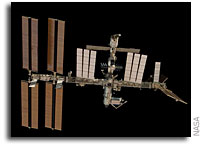
All ISS systems continue to function nominally, except those noted previously or below. Rest day for ISS.
Crew Sleep Cycle: After this morning’s sleeptime at 12:20am EDT, wakeup today was delayed to 9:50am. Bedtime tonight moves to a more “normal” 8:00pm for the rest of this week.
To provide cooling for today’s ground-commanded re-activation of the U.S. CDRA (Carbon Dioxide Removal Assembly), FE-2 Chamitoff after wakeup connected the regular ITCS LTL (Internal Thermal Control System/Low Temperature Loop) coolant jumper connection to the CDRA support rack LAB1D6. The ground then lowered the temperature setpoint in Node-2 to control for humidity across the USOS. [CDRA was activated at 1:25pm-7:25pm EDT to control ppCO2 (CO2 partial pressure) level.]
Gregory reconfigured the POC (Portable Onboard Computer) laptops in the USOS from “uncrewed” to nominal OpsLAN operations, including NetMeeting and KFX (Ku-band File Transfer) functions. [Reconfiguration activities included relocating the SSC-5 (Station Support Computer 5) A31p laptop back to its nominal location in the Lab and reconnecting it to power, plus relocating four A31p battery packs from the Soyuz spacecraft to the Lab for temporary stowage.]
Greg’s restoration activities also included –
- Transferring the FGB PCS (Portable Computer System) A31p laptop with cabling to the Lab Cupola RWS (Robotic Workstation) and connecting it, while stowing the RS (Russian Segment) DC power cable and A31p 28V DC power supply,
- Relocating the SSC-5 (Station Support Computer 5) laptop from the Soyuz SA (Descent Module) to the Lab, reconnecting it to power & Ethernet (ISL user cable) and powering on the “Cobalt brick” power unit,
- Turning off the PWS (Portable Workstation) laptops in the COL (Columbus Orbital Laboratory),
- Activating the SLT (System Laptop) in the Kibo JEM (Japanese Experiment Module), Activation Activate SLT
- Opening remaining USOS hatches (JPM (JEM Pressurized Module) starboard & overhead, JLP (JEM Logistics Pressurized Segment) deck, COL, NODE-2 portside & starboard),
- Returning unused consumable and other items from Soyuz to the USOS.
CDR Sergey Volkov cleaned up after the EVA by returning the medical kits to their nominal stowage location and reconfiguring the REGUL-Packet communications link from Set 1 to Set 2.
In the Service Module (SM), Sergey completed the routine maintenance of the SOZh/ECLSS system, including ASU toilet facilities systems/replaceables. [Regular daily SOZh maintenance consists of replacement of the KTO & KBO solid waste containers, replacement of an EDV-SV waste water and EDV-U urine container, and processing U.S. condensate water as it becomes available in a filled CWC from the Lab humidifier.]
The CDR performed the periodic service of the active Russian BMP (Harmful Impurities Removal System) by starting the "bake-out" cycle to vacuum on absorbent bed #1 of the regenerable dual-channel filtration system. Bed #2 regeneration follows tomorrow. [Regeneration of each of the two cartridges takes about 12 hours and is conducted only during crew awake periods. The BMP’s regeneration cycle, normally done every 20 days, is currently performed four times more frequently to remove any lingering Freon-218 from the cabin atmosphere (last time: 6/23&24).]
Cleanup activities by FE-1 Oleg Kononenko consisted of –
- Taking post-EVA radiation readings of the “Pille-MKS” dosimeters carried by the spacewalkers in their Orlan suits,
- Downlinking EVA-20 digital photography,
- Activating the ALTCRISS (Alteino Long Term monitoring of Cosmic Rays on the ISS/ALC) Spectrometer (AST), and
- Setting up 825M3 Orlan batteries for complete discharge/recharge.
Kononenko also spent a few minutes on the weekly inspection of the TVIS treadmill roller bearings, checking the treadmill’s belt both left and right for any noticeable depressions due to seized or worn rollers. [With the TVIS treadmill rollers approaching their end-of-life, the frequency of their inspection has recently been increased for safety.]
Afterwards, Oleg completed closeout ops on the BIORISK-MSN payload which he had brought in from EVA-20.
The two spacewalkers had their regular post-EVA PMCs (Private Medical Conferences) via Ku- & S-band audio/video, Sergey at ~4:15pm EDT, Oleg at ~4:50pm.
Gregory filled out the regular FFQ (Food Frequency Questionnaire), his fifth, on the MEC (Medical Equipment Computer). [On the FFQs, NASA astronauts keep a personalized log of their nutritional intake over time on special MEC software. Recorded are the amounts consumed during the past week of such food items as beverages, cereals, grains, eggs, breads, snacks, sweets, fruit, beans, soup, vegetables, dairy, fish, meat, chicken, sauces & spreads, and vitamins. The FFQ is performed once a week to estimate nutrient intake from the previous week and to give recommendations to ground specialists that help maintain optimal crew health. Weekly estimation has been verified to be reliable enough that nutrients do not need to be tracked daily.]
The three crewmembers conducted an abbreviated physical workout program on the CEVIS cycle ergometer (FE-2) and TVIS treadmill (CDR, FE-1). Before sleeptime tonight, Oleg is to transfer the exercise data file to the MEC laptop for downlink, including the daily wristband HRM (Heart Rate Monitor) data of the workouts on RED, followed by their erasure on the HRM storage medium (done six times a week
Before sleeptime, FE-2 Chamitoff started out on his second session with the NASA SLEEP (Sleep-Wake Actigraphy & Light Exposure during Spaceflight) experiment by initializing and donning an Actiwatch, using the HRF-1 (Human Research Facility 1) laptop. [As other crewmembers before him, to monitor his sleep/wake patterns and light exposure, Gregory will be wearing the special Actiwatch device which measures the light levels encountered by him as well as his patterns of sleep and activity throughout this week, for the last time. The log entries are done within 15 minutes of final awakening for seven consecutive days.]
S-band Forward Link Dropout: After crew ingress from EVA-20 and DC-1 repressurization, an unexpected loss of S-Band forward link (ground-to-ISS) impacted MCC-Houston’s ability to command to ISS and to communicate with the crew (whose voices came through clearly). The S-Band loss was due to a misconfiguration in the ground network, but other means of informing the crew were available. After 45 minutes, communications were re-established OK.
CEO (Crew Earth Observations) photo targets uplinked for today were Iceberg A43f (DYNAMIC EVENT: This large iceberg broke away from the Antarctic Ice Shelf near the Antarctic Peninsula over 18 months ago. It is now in the area just north of South Georgia Island. Conditions were marginal for viewing as the ISS pass was in the low light of winter at mid-afternoon. Clouds were expected to be broken to scattered. ISS approach was from the W. Looking well right of track for this high contrast feature in the darkness of the sea and using the long lens settings for detail), and Polar Mesospheric Clouds (PMC) over Northwestern Europe (DYNAMIC EVENT: The ISS window of opportunity for this pass ran for about 10-12 minutes from just north of the Canary Islands to the eastern Ukraine. These were to be high oblique views left of track towards the Earth’s limb).
CEO photography can be studied at this “Gateway” website:
http://eol.jsc.nasa.gov (as of 3/1/08, this database contained 757,605 views of the Earth from space, with 314,000 from the ISS alone).
ISS Orbit (as of this morning, 7:49am EDT [= epoch]):
Mean altitude — 344.3 km
Apogee height — 350.7 km
Perigee height — 337.9 km
Period — 91.42 min.
Inclination (to Equator) — 51.64 deg
Eccentricity — 0.0009467
Solar Beta Angle — 65.3 deg (magnitude increasing)
Orbits per 24-hr. day — 15.75
Mean altitude loss in the last 24 hours — 45 m
Revolutions since FGB/Zarya launch (Nov. 98) — 55314
Significant Events Ahead (all dates Eastern Time, some changes possible.):
07/18/08 — ATV1 reboost
08/30/08 — Progress M-64/29P undocking, from FGB nadir
09/05/08 — ATV1 undocking, from SM aft port (loiter until ~9/25 for nighttime reentry/observation)
09/10/08 — Progress M-65/30P launch
09/12/08 — Progress M-65/30P docking (SM aft port)
10/01/08 — NASA 50 Years
10/08/08 — STS-125/Atlantis Hubble Space Telescope Service Mission 4 (SM4)
10/11/08 — Progress M-65/30P undocking (from SM aft port)
10/12/08 — Soyuz TMA-13/17S launch
10/14/08 — Soyuz TMA-13/17S docking (FGB nadir port)
10/23/08 — Soyuz TMA-12/16S undocking (DC1 nadir)
11/10/08 — STS-126/Endeavour/ULF2 launch – MPLM Leonardo, LMC
11/12/08 — STS-126/Endeavour/ULF2 docking
11/20/08 — ISS 10 Years
11/26/08 — Progress M-66/31P launch
11/28/08 — Progress M-66/31P docking
02/10/09 — Progress M-67/32P launch
02/12/09 — Progress M-67/32P docking
02/12/09 — STS-119/Discovery/15A launch – S6 truss segment
03/25/09 — Soyuz TMA-14/18S launch
05/15/09 — STS-127/Endeavour/2J/A launch – JEM EF, ELM-ES, ICC-VLD
07/30/09 — STS-128/Atlantis/17A – MPLM(P), last crew rotation
05/27/09 — Six-person crew on ISS (following Soyuz 19S docking, May ’09)
10/15/09 — STS-129/Discovery/ULF3 – ELC1, ELC2
12/10/09 — STS-130/Endeavour/20A – Node-3 + Cupola
02/11/10 — STS-131/Atlantis/19A – MPLM(P)
04/08/10 — STS-132/Discovery/ ULF4 – ICC-VLD, MRM1
05/31/10 — STS-133/Endeavour/ULF5 – ELC3, ELC4 (contingency).



