
NASA ISS On-Orbit Status 16 February 2012
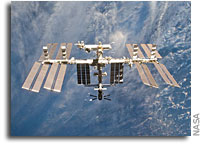
All ISS systems continue to function nominally, except those noted previously or below.
Sleep cycle shift: To accommodate today’s Russian EVA-30 (egress 9:31am EST), crew wake/sleep cycle changes are in effect, featuring today a lengthened work day (by 3 hrs) and tomorrow a shortened work day (by 4 hrs), returning to regular times thereafter.
. Wake – 1:00am EST (this morning, regular)
. Snack1 – 4:50am – 5:35am
. Snack2 – 4:40pm – 5:10pm
. Sleep – 7:30pm (tonight)
. Wake – 1:00am (2/17)
. Sleep – 4:30pm (2/17, regular).
The Russian Orlan EVA-30 by FE-4 Oleg Kononenko (EV1) & FE-1 Anton Shkaplerov (EV2) concluded at 3:46pm EST, with a total duration of 6h 15m (begin: 9:31am). It was the 5th EVA to utilize the Orlan telemetry via S-Band matching unit, instead of executing the EVA on VHF over RGS (Russian Ground Sites).
Tasks completed by the spacewalkers were –
* Space crane Strela 1 relocation from DC1 to MRM2, using Strela 2 (deferred from EVA-29),
* Jettison MLI (Multi-Layer Insulation) cover,
* Installing the 46-ft Strela 1 on MRM2 (to aid future EVAs)
* Stowing Strela 2 at DC1,
* Installing the Vinoslivost Materials Sample Experiment on the DC1,
* Taking a sample from the MLI insulation of the SM to look for any signs of living organisms, and
* Collecting one (of two planned) samples from the “Test” experiment..
Since the Strela activities took more time than expected, the crew was unable to perform the installation of 5 SMDPs (Service Module Debris Panels) on SM RO1 (small diameter segment) handrails, or the projected get-ahead tasks of (1) collecting one (of two) “Test” experiment samples on SM RO1, and (2) installing support struts for EVA ladder on DC1.
EVA-30 was the 162nd spacewalk in support of space station assembly and maintenance, totaling 1021h 47m. Kononenko now has three EVAs on his account, totaling 18h 27m. For Shkaplerov it was the first spacewalk.
Before the US SARJs (Solar Alpha Rotary Joints) were feathered in Park position preparatory to attitude control handover to Russian MCS (Motion Control System) thrusters at~6:45am (return to CMGs at ~9:40am), CDR Burbank closed the protective window shutters in the Lab, Node-3/Cupola and Kibo JPM (JEM Pressurized Module).
Burbank also prepared both D2Xs cameras for Anton’s & Anatoly’s use during the EVA by replacing their batteries and testing their functionality.
In preparing the RS (Russian Segment) for the spacewalk by shutting down selected systems, FE-2 Ivanishin also shut SM windows (##12-14, #6, ##8-9) and then supported TsUP in deactivating the Elektron O2 generator (~4:30am). As part of the standard deactivation process Anatoly purged the Elektron with N2 (nitrogen), controlled from laptop.
Before breakfast, Shkaplerov & Kononenko completed the standard pre-EVA session with the Russian crew health monitoring program’s medical assessment MO-9/Biochemical Urinalysis. Involving visual urine assessment, MO-9 is one of 4 Russian crew health status checkups currently being conducted (the other three: MO-3 (Physical Fitness Evaluation), MO-7 (Calf Volume Measurement) & MO-8 (Body Mass Measurement). [MO-9 is conducted every 30 days (and also before and after EVAs) and is one of five nominal Russian medical tests adopted by NASA for U.S. crewmembers for IMG PHS (Integrated Medical Group/Periodic Health Status) evaluation as part of the “PHS/Without Blood Labs” exam, also conducted today. The analysis uses the sophisticated in-vitro diagnostic apparatus Urolux developed originally by Boehringer (Mannheim/Germany) for the Mir program. Afterwards, the data are entered in the MEC (Medical Equipment Computer)’s special IFEP software (In-Flight Examination Program).]
After setting up the MRM2 module for their lockout, Ivanishin removed the air ducts from the DC-1 (leaving the V3 fan in place) and MRM2.
At ~7:00am, Dan Burbank & Anatoly Ivanishin entered MRM2 Poisk module for their ~9h isolation period during the spacewalk, with access to Soyuz 28S. It also allowed for the use of the SM’s forward compartment as a backup airlock in case of a problem with the MRM2 airlock. FE-5 Kuipers & FE-6 Pettit were sequestered in the USOS with free access to FGB, MRM1 and contingency access to Soyuz 29S, docked at MRM1 Rassvet. Both Soyuz spacecraft were activated in case of a depressurization contingency.
During his lockout, Dan worked on the IMS (Inventory Management System) database to update it with the recent crew provisions audit/inventory.
After conclusion of EVA-30 at (((5:13pm))), Oleg & Anton –
* Repressurized the SM PkhO transfer compartment,
* Doffed their suits,
* Conducted their second MO-9 “Urolux” biochemical urine test,
* Reset STTS communications in the SM/PkhO,
* Restored systems configurations in the SM to pre-EVA conditions, and
* Set up the Orlan-MK suits, gloves, umbilicals and BSS interface units for drying out.
Anatoly, who had remained isolated in the MRM2 during EVA-30 with Dan, –
* Opened the MRM2-to-SM(SU) hatches,
* Deactivated the Soyuz 28S spacecraft, including toilet,
* Installed the air ducts in SM, MRM2 and DC-1, and
* Conducted post-EVA MRM2 reconfiguration to nominal.
Later tonight, Ivanishin will also assist in the ground-commanded activation of the Elektron oxygen generator (~5:30pm EST) by monitoring the external temperature of its secondary purification unit (BD) for the first 10 minutes of operations to ensure that there was no overheating. [The gas analyzer used on the Elektron during nominal operations for detecting hydrogen (H2) in the O2 line (which could cause overheating) is not included in the control algorithm until 10 minutes after Elektron startup. Elektron was turned off as long as the cabin air was being refreshed from Progress 45P O2 stores.]
After wakeup this morning, FE-2 performed the routine inspection of the SM (Service Module) PSS Caution & Warning panel as part of regular Daily Morning Inspection.
In the Kibo JPM (JEM Pressurized Module), Don Pettit serviced the running BCAT-6 (Binary Colloidal Alloy Test-6) by replacing the BCAT-6 battery early in the morning with a fresh one and repeating the replacement about 8 hrs later. Sample 4 session reached its midpoint yesterday. [The NIKON D2Xs with EarthKAM software running on an SSC laptop takes automated flash photography controlled by the software, photographing Sample 4 once every two hours for seven days. Crew performs two camera battery changes and a camera check each day. The camera battery changes are scheduled to be performed approximately every 8 hours per Mike Fossum’s recommendation during past BCAT-6 activities.]
With initial assist by Don Pettit, Andre Kuipers deployed the MARES (Muscle Atrophy Research and Exercise System) hardware in the COL (Columbus Orbital Laboratory) from stowed configuration and installed its associated laptop. Later, Andre configured the cabling and went on testing the rigidity of the MARES VIF (Vibration Isolation Frame) using a mechanical dynamometer. This was followed by executing a specific battery charge process and an integrity test of the MARES HDD (Hard Disk Drive) and the spare disk. [The configuration involved setting up the connections between the PIU (Power Interface Unit) and the J02 UIP (Utility Interface Panel) at F3 and then to MARES, plus installing the EPM (European Physiology Module) laptop and its connection to the MARES pantograph connectors for Ethernet and power. Afterwards, MARES and laptop were powered off.]
In the Lab, Kuipers & Pettit temporarily installed a spare (the Protoflight Unit 2) of the EHS TOCA (Environmental Health System / Total Organic Carbon Analyzer) with its N2 (nitrogen), H2O (water) and power connections, then activated the Gas Mass Flow Controller and cycled its valve for the spare TOCA, in order to mitigate stiction and potential failure of the spare unit.
Afterwards, Kuipers completed the periodic manual fill of the WHC (Waste & Hygiene Compartment) EDV-SV (condensate container) flush water tank from the PWB (Potable Water Bus) for about 17 min, a partial fill during which WHC was not available,
Ivanishin performed the routine daily servicing of the SOZh system (Environment Control & Life Support System, ECLSS) in the SM. [Regular daily SOZh maintenance consists, among else, of checking the ASU toilet facilities, replacement of the KTO & KBO solid waste containers, replacement of EDV-SV waste water and EDV-U urine containers and filling EDV-SV, KOV (for Elektron), EDV-ZV & EDV on RP flow regulator.]
FE-6 Pettit worked ~1.5 hrs in the PMM (Permanent Multipurpose Module) endcone area, continuing the cleanup of the endcone to enable creation of a trash staging area prior to Progress loading.
Don also performed troubleshooting on the A31p- laptop of the unpowered MSG (Microgravity Science Glovebox) at Lab loc. S2, swapping its power cable with a new cable and stowed the old one, marked “Suspect”.
Later, Pettit reviewed OBT (Onboard Training) material for the VCAM (Vehicle Cabin Atmosphere Module), then replaced the VCAM’s calibration Gas Supply ORU (Orbit Replaceable Unit). [Steps included turning VCAM off, removing its acoustic blanket, opening the access door, replacing the VCAM Gas Supply ORU and then backing out, reversing all steps and powering the instrument on. The JPL-developed VCAM identifies gases that are present in minute quantities in the ISS breathing air that could be harmful to crew health. If successful, instruments like VCAM could accompany crewmembers during long-duration exploration missions. Similar to the earlier employed VOA (Volatile Organic Analyzer), VCAM can provide a means for monitoring the air within enclosed environments, using a miniature pre-concentrator, GC (gas chromatograph), and mass spectrometer for unbiased detection of a large number of organic species. VCAM’s software can identify whether the chemicals are on a targeted list of hazardous compounds and their concentration. A VCAM calibration gas is used periodically to check how the instrument’s components are actually performing. The raw data, calibration data, and analysis results are all sent to the ground for further assessment to validate the instrument’s detection, identification, and quantification results.]
Andre conducted the weekly 10-min. CWC (Contingency Water Container) inventory as part of the on-going WRM (Water Recovery & Management) assessment of onboard water supplies. Updated “cue cards” based on the crew’s water calldowns are sent up every other week for recording changes. [The current card (29-0008J) lists 23 CWCs (375.4 L total) for the five types of water identified on board: 1. Silver technical water (4 CWCs with 154.8 L, for Elektron electrolysis, all containing Wautersia bacteria, plus 1 empty bag; 2. Condensate water (2 CWCs with 9.8 L, plus 2 empty bags); 3. Iodinated water (6 CWCs with 79.9 L; also 6 expired bags with 104.3 L); 4. Waste water (1 bag with 6.4 L EMU waste water); and 5. Special fluid (1 CWC with 20.2 L, hose/pump flush). Other CWCs are stowed behind racks and are currently not being tracked due to unchanging contents. Wautersia bacteria are typical water-borne microorganisms that have been seen previously in ISS water sources. These isolates pose no threat to human health.]
Burbank & Pettit each had another time slot reserved for making entries in their electronic Journal on the personal SSC (Station Support Computer). [Required are three journaling sessions per week.]
Before Presleep, the CDR will turn on the MPC (Multi-Protocol Converter) and start the Ku-band data flow of video recorded during the day to the ground, with POIC (Payload Operations & Integration Center) routing the onboard HRDL (High-Rate Data Link). After about an hour, Dan will turn MPC routing off again. [This is a routine operation which regularly transmits HD onboard video (live or tape playback) to the ground on a daily basis before sleeptime.]
The crew worked out with their regular 2-hr physical exercise protocol on the CEVIS cycle ergometer with vibration isolation (FE-5, FE-6), ARED advanced resistive exerciser (CDR, FE-5, FE-6), and T2/COLBERT advanced treadmill (CDR).
CEO (Crew Earth Observation) targets uplinked today were South Desolation Point, S Chile (HMS BEAGLE SITE: Looking right of track. The target lies among numerous islands south of the mainland. Clouds were expected to be reduced or “as good as it gets” for this part of the world. Darwin’s journal entry June 10, 1834, reads: “…The western coast generally consists of low, rounded, quite barren hills of granite and greenstone. Sir J. Narborough called one part South Desolation, because it is ‘so desolate a land to behold:’ and well indeed might he say so. Outside the main islands, there are numberless scattered rocks on which the long swell of the open ocean incessantly rages… and a little farther northward there are so many breakers that the sea is called the Milky Way. One sight of such a coast is enough to make a landsman dream for a week about shipwrecks…”), Porto-Novo, Benin (CAPITAL CITIES COLLECTION. Looking left along the coast, as ISS passed over Lagos. Lake Nokoue is a more local visual cue. The capital city of the West African nation of Benin has a population of about a quarter of a million. A recent dust storm has scoured the clouds from the region, but the atmosphere may still be somewhat turbid on this mid-morning nadir pass), Bissau, Guinea-Bissau (CAPITAL CITIES COLLECTION. Near nadir pass over this capital city of 400,000. The major Geba River estuary is the visual cue, with the city located on the north shore), Castries, St. Lucia (CAPITAL CITIES COLLECTION. Nadir pass. This tiny capital city of only about 11,000 is located on the northwest coast of the island of St. Lucia), and Roseau, Dominica (CAPITAL CITIES COLLECTION. Second of two close-spaced Caribbean targets. Looking left of track for this island nation which is 50 km long, with the capital city on its southwest shore. Population of the nation is 72,000. Interestingly, all the capital cities in these small Caribbean islands are located on the less windy west coasts of their respective islands).
ISS Orbit (as of this morning, 7:27am EST [= epoch])
Mean altitude – 390.7 km
Apogee height – 404.6 km
Perigee height – 376.7 km
Period — 92.37 min.
Inclination (to Equator) — 51.64 deg
Eccentricity — 0.0020598
Solar Beta Angle — 24.0 deg (magnitude decreasing)
Orbits per 24-hr. day — 15.59
Mean altitude loss in the last 24 hours — 91 m
Revolutions since FGB/Zarya launch (Nov. 98) — 75,904
Time in orbit (station) — 4836 days
Time in orbit (crews, cum.) — 4123 days
Significant Events Ahead (all dates Eastern Time and subject to change):
————–Six-crew operations—————-
02/16/12 — Russian EVA-30
03/09/12 — ATV3 launch — (target date)
03/19/12 — ATV3 docking — (target date)
04/19/12 — Progress M-14M/46P undock
04/20/12 — Progress M-15M/47P launch
04/22/12 — Progress M-15M/47P docking
xx/xx/12 — SpaceX Falcon 9/Dragon launch
xx/xx/12 — SpaceX Falcon 9/Dragon berthing
xx/xx/12 — SpaceX Falcon 9/Dragon unberth
04/30/12 — Soyuz TMA-22/28S undock/landing (End of Increment 30)
————–Three-crew operations————-
05/15/12 — Soyuz TMA-04M/30S launch – G.Padalka (CDR-32)/J.Acaba/K.Volkov (target date)
05/17/12 — Soyuz TMA-04M/30S docking (MRM2) (target date)
————–Six-crew operations—————-
07/01/12 — Soyuz TMA-03M/29S undock/landing (End of Increment 31)
————–Three-crew operations————-
07/15/12 — Soyuz TMA-05M/31S launch – S.Williams (CDR-33)/Y.Malenchenko/A.Hoshide
07/17/12 — Soyuz TMA-05M/31S docking
07/31/12 — Progress M16M/48P launch
08/02/12 — Progress M16M/48P docking
————–Six-crew operations—————-
09/17/12 — Soyuz TMA-04M/30S undock/landing (End of Increment 32)
————–Three-crew operations————-
10/15/12 — Soyuz TMA-06M/32S launch – K.Ford (CDR-34)/O.Novitskiy/E.Tarelkin
10/17/12 — Soyuz TMA-06M/32S docking
————–Six-crew operations————-
11/01/12 — Progress M-17M/49P launch
11/03/12 — Progress M-17M/49P docking
11/12/12 — Soyuz TMA-05M/31S undock/landing (End of Increment 33)
————–Three-crew operations————-
12/05/12 — Soyuz TMA-07M/33S launch – C.Hadfield (CDR-35)/T.Mashburn/R.Romanenko
12/07/12 — Soyuz TMA-07M/33S docking
————–Six-crew operations————-
12/26/12 — Progress M-18M/50P launch
12/28/12 — Progress M-18M/50P docking
03/19/13 — Soyuz TMA-06M/32S undock/landing (End of Increment 34)
————–Three-crew operations————-
04/02/13 — Soyuz TMA-08M/34S launch – P.Vinogradov (CDR-36)/C.Cassidy/A.Misurkin
04/04/13 — Soyuz TMA-08M/34S docking
————–Six-crew operations————-
05/16/13 — Soyuz TMA-07M/33S undock/landing (End of Increment 35)
————–Three-crew operations————-
05/29/13 — Soyuz TMA-09M/35S launch – M.Suraev (CDR-37)/K.Nyberg/L.Parmitano
05/31/13 — Soyuz TMA-09M/35S docking
————–Six-crew operations————-
09/xx/13 — Soyuz TMA-08M/34S undock/landing (End of Increment 36)
————–Three-crew operations————-
09/xx/13 — Soyuz TMA-10M/36S launch – M.Hopkins/TBD (CDR-38)/TBD
09/xx/13 — Soyuz TMA-10M/36S docking
————–Six-crew operations————-
11/xx/13 — Soyuz TMA-09M/35S undock/landing (End of Increment 37)
————–Three-crew operations————-
11/xx/13 — Soyuz TMA-11M/37S launch – K.Wakata (CDR-39)/R.Mastracchio/TBD
11/xx/13 — Soyuz TMA-11M/37S docking
————–Six-crew operations————-
03/xx/14 — Soyuz TMA-10M/36S undock/landing (End of Increment 38)
————–Three-crew operations————-



