
NASA ISS On-Orbit Status 15 October 2011
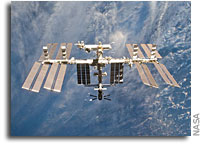
All ISS systems continue to function nominally, except those noted previously or below. Saturday – Crew off duty.
At wake-up, CDR Mike Fossum & FE-5 Satoshi Furukawa completed another post-sleep session of the Reaction Self Test (Psychomotor Vigilance Self Test on the ISS) protocol. [RST is done twice daily (after wakeup & before bedtime) for 3 days prior to the sleep shift, the day(s) of the sleep shift and 5 days following a sleep shift. The experiment consists of a 5-minute reaction time task that allows crewmembers to monitor the daily effects of fatigue on performance while on ISS. The experiment provides objective feedback on neurobehavioral changes in attention, psychomotor speed, state stability, and impulsivity while on ISS missions, particularly as they relate to changes in circadian rhythms, sleep restrictions, and extended work shifts.]
FE-4 Sergei Volkov performed the routine checkup of the SM (Service Module) PSS Caution & Warning panel as part of the regular Daily Morning Inspection.
Sergei Volkov completed the daily inspection of the recently activated Russian BIO-5 Rasteniya-2 (“Plants-2”) payload with its LADA-01 greenhouse, verifying proper watering of the KM A32 & A24 root modules. [Rasteniya-2 researches growth and development of plants (currently wheat) under spaceflight conditions in the LADA greenhouse from IBMP (Institute of Bio-Medical Problems, Russian: IMBP).]
Mike, Sergei & Satoshi joined in conducting the regular weekly three-hour task of thorough cleaning of their home, including COL (Columbus Orbital Laboratory) and Kibo JPM (JEM Pressurized Module). [“Uborka”, usually done on Saturdays, includes removal of food waste products, cleaning of compartments with vacuum cleaner, damp cleaning of the SM (Service Module) dining table, other frequently touched surfaces and surfaces where trash is collected, as well as the sleep stations with a standard cleaning solution; also, fan screens and grilles are cleaned to avoid temperature rises. Special cleaning is also done every 90 days on the HEPA (high-efficiency particulate air) bacteria filters in the Lab.]
As part of Uborka house cleaning, Volkov completed regular weekly maintenance inspection & cleaning of fan screens in the FGB (TsV2) plus Group E fan grilles in the SM (VPkhO, FS5, FS6, VP) and the BMP Harmful Contaminants Removal System grille in the SM. Before the cleaning, all fan screens were photographed for ground inspection.
Fossum filled out his weekly FFQ (Food Frequency Questionnaire) on the MEC. [On the FFQs, USOS astronauts keep a personalized log of their nutritional intake over time on special MEC software. Recorded are the amounts consumed during the past week of such food items as beverages, cereals, grains, eggs, breads, snacks, sweets, fruit, beans, soup, vegetables, dairy, fish, meat, chicken, sauces & spreads, and vitamins. The FFQ is performed once a week to estimate nutrient intake from the previous week and to give recommendations to ground specialists that help maintain optimal crew health. Weekly estimation has been verified to be reliable enough that nutrients do not need to be tracked daily.]
Volkov performed the routine daily servicing of the SOZh system (Environment Control & Life Support System, ECLSS) in the SM. [Regular daily SOZh maintenance consists, among else, of checking the ASU toilet facilities, replacement of the KTO & KBO solid waste containers, replacement of EDV-SV waste water and EDV-U urine containers and filling EDV-SV, KOV (for Elektron), EDV-ZV & EDV on RP flow regulator.]
With both ERB2 (Erasmus Recording Binocular 2) batteries freshly charged and lights switched on in the cabin, Fossum conducted a “Flythrough” of the ISS, taking HD 3D video with the ERB2 camera from Node-1 through PMA-1 (Pressurized Mating Adapter 1), FGB, and SM and back.
Working a VolSci (Voluntary Weekend Science) task for the JAXA EPO (Educational Payload Operations) program, Satoshi Furukawa prepared Reports Nr. 14 & Nr. 15, i.e., written short reports showing ordinary life in space which, as is expected, will attract children and the general public’s attention for future human space exploration. [JAXA EPO Report 14, for THE MAINICHI papers (07), had as topic “Whether mankind (so-called ordinary people) can settle down in space in the future, what kinds of medical (psychological and physical) issues are being considered in such cases and how the stay on the ISS helps overcome those issues”, while Report 15, also for MAINICHI newspapers (08), had “Review of his first stay in space” as topic.]
At ~5:40am EDT, Satoshi powered up the SM’s amateur radio equipment (Kenwood VHF transceiver with manual frequency selection, headset, & power supply) and at 5:45am conducted a ham radio session with students at school with students at the Amateur Radio Morioka Club, Morioka, Japan.
At ~7:50am, the three crewmembers held the regular WPC (Weekly Planning Conference) with the ground, discussing next week’s “Look-Ahead Plan” (prepared jointly by MCC-H and TsUP-Moscow timeline planners), via S-band/audio, reviewing upcoming activities and any concerns about future on-orbit events.
At ~10:40am, Sergei Volkov had his weekly PFC (Private Family Conference), via S-band/audio and Ku-band/MS-NetMeeting application (which displays the uplinked ground video on an SSC laptop).
The crew worked out with their regular 2-hr physical exercise protocol on the TVIS treadmill with vibration isolation & stabilization (FE-4), ARED advanced resistive exercise device (CDR, FE-4, FE-5), and T2/COLBERT advanced treadmill (CDR, FE-5).
Tasks listed for Sergei Volkov on the Russian discretionary “time permitting” job for today were –
* Continuing the preparation & downlinking of more reportages (written text, photos, videos) for the Roskosmos website to promote Russia’s manned space program (max. file size 500 Mb),
* Another ~30-min. run of the GFI-8 “Uragan” (hurricane) earth-imaging program with the NIKON D3X digital camera with Sigma AF 300-800mm telelens, aiming for the mountain peaks of the Andes and Patagonia ice fields, and
* Another ~30-min. session for Russia’s EKON Environmental Safety Agency, making observations and taking KPT-3 aerial photography of environmental conditions on Earth using the NIKON D3X camera with the RSK-1 laptop.
Weekly Science Update (Expedition Twenty-Nine — Week 4)
2D NANO Template (JAXA): No report.
3D SPACE: Complete.
AgCam (Agricultural Camera): No report.
ALTCRISS (Alteino Long Term monitoring of Cosmic Rays on the ISS): Complete.
ALTEA SHIELD (NASA/ASI): ALTEA-SHIELD Survey experiment aims at characterizing the radiation environment of the ISS with active detectors. The current part of the study foresees measurements at various locations, as a first step. Later on, shielding materials will be tested with the same instrument. Expected spin-offs are development of a radiation-protected area for new space vehicles or inhabited space modules. Thanks to Satoshi for power cycling ALTEA-SHIELD on 10/12. Power cycling brought back all 6 SDUs (Silicon Detector Units) to science data collection and measurements in all 3 directions.”
AMS-02 (Alpha Magnetic Spectrometer): All AMS Payload and Laptop operations are nominal.
APEX (Advanced Plant Experiments on Orbit) -Cambium: No report.
APEX-TAGES (Transgenic Arabidopsis Gene Expression System): No report.
Asian Seed 2010 (JAXA): Returned on ULF6.
BCAT-4/5 (Binary Colloidal Alloy Test 4/5): The second Harvard University, Phase Separation sample (number 5), in BCAT-5 was completed on 10/11. The images are nearly flawless (no shadow, bubbles, or focus imperfections). The evolution of phase separation is clearly visible without post processing by the science team. The Phase Separation specialty of Soft Condensed Matter Physics answers commercial questions about what model should be used for the design of and for predicting the shelf life of consumer and medical products. This is the last sample for BCAT-5. We have included some images that show the evolution of the sample as it phase separates. This evolution (change of state/phase) is difficult to observe on earth due to sedimentation of the particles. On orbit in microgravity it occurs over many days and is much more easily observed.
BIOLAB (ESA): No report.
BIORHYTHMS (JAXA, Biological Rhythms): No report.
BISE (CSA, Bodies in the Space Environment): No report.
BISPHOSPHONATES: No report.
BXF-Facility (Boiling eXperiment Facility, NASA): No report.
BXF-MABE (Microheater Array Boiling Experiment, NASA): No report.
BXF-NPBX (Pool Boiling Experiment, NASA): No report.
CARD (Long Term Microgravity: Model for Investigating Mechanisms of Heart Disease, ESA): No report.
CARDIOCOG-2: Complete.
CB (JAXA Clean Bench): No report.
CBEF-2 (JAXA Cell Biology Experiment Facility)/SPACE SEED: No report.
CCISS (Cardiovascular & Cerebrovascular Control on Return from ISS): No report.
CERISE (JAXA): No report.
CCF (Capillary Channel Flow, NASA): The Capillary Channel Flow Experiment (CCF) is continuing a 25-day period of 24/7 operations on ISS. The CCF hardware continues to operate nominally. The German (ZARM) team has completed both the steady-state and transient critical flow test matrices. The US (Portland State Univ) team has completed a preliminary flow regime map for gas bubble separation from liquid flow in a wedge-shaped channel, consisting of 270 test points. The second MSG camera that Mike installed has allowed the team to increase the number of test points to as many as a 100 per 8 hr shift. The PIs for both teams are very pleased with the data collected to date.
CFE-2 (Capillary Flow Experiment 2, NASA): “Mike, we didn’t have any CFE-2 ops this week but we wanted to share a video of the Filled Perforations Test you performed with the Vane Gap 1 (VG1) vessel back on 9/15. One of the PI’s graduate students condensed the video from that 2 hour test into ~30 seconds. In it, you can see 1) all the critical wetting angles that you found over the span of the test, i.e. where the fluid wicks up either the smooth or serrated edge of the vane, and 2) the bulk shift in the fluid at the base of the container, near angles of 90 deg (where the vane is perpendicular to the camera view).”
CFS-A (Colored Fungi in Space-A, ESA): No report.
CSI-5/CGBA-5 (CGBA Science Insert #5/Commercial Generic Bioprocessing Apparatus 5): We have completed 3 out of the 4 plantings planned. “Thank you, Mike, for performing the 3rd planting for CSI-05. All seeds germinated. Thank you so much for recording the 21-minute video. That will add a lot of value for the students participating in this program and the PI.”
CGBA-2 (Commercial Generic Bioprocessing Apparatus 2): Complete.
CIR (Combustion Integrated Rack), MDCA/Flex: No report.
Commercial (Inc 23&24, JAXA): No report.
Commercial (Inc 25 & 26, JAXA): Sample returned by ULF6.
CSLM-2 (Coarsening in Solid-Liquid Mixtures 2): No report.
CsPins (JAXA): No report.
CubeLab: No report.
CW/CR (Cell Wall/Resist Wall) in EMCS (European Modular Cultivation System): Complete.
DECLIC-ALI (Device for the Study of Critical Liquids & Crystallization-ALICE-like, CNES/NASA): No report.
DomeGene (JAXA): Complete.
DOSIS (Dose Distribution Inside ISS, ESA): No report.
EarthKAM (Earth Knowledge Acquired by Middle School Students): No report.
EDR (European Drawer Rack, ESA): No report.
EKE (Endurance Capacity by Gas Exchange and Heart Rate Kinetics During Physical Training, ESA): “Mike, you also collected a data set for the EKE experiment as part of your VO2max sessions, thanks to a data sharing between the two experiments.”
ELITE-S2 (Elaboratore Immagini Televisive – Space 2): Planned.
EMCS (European Modular Cultivation System): Nominal water pump servicing was performed by ground commanding on 10/13.
ENose (Electronic Nose): No report.
EPM (European Physiology Module): No report.
EPO (Educational Payload Operations, NASA) (Eye in the Sky; Sleep 2): “Thank you for completing the Eye in the Sky demo and the Sleep demo. You covered all of the points intended. Great job presenting the content on a level that K-12 audience will be able to understand. Good camera work. We will be able to edit the video footage into multiple segments for use on the Day in the Life Aboard the ISS website.”
EPO (Educational Payload Operations, NASA) (Sesame Street): No report.
EPO (Educational Payload Operations, NASA) (Kids in Micro-G): No report.
EPO (Educational Payload Operations, NASA) (Earth/Moon/Mars Demo): No report.
EPO LES-2 (ESA): No report.
EPO GREENHOUSE (ESA): No report.
EPO 3-min Video (JAXA): No report.
EPO J-Astro Report (JAXA): On 10/8, Satoshi completed JAXA Report 12 for the newspaper company Mainichi, and also completed JAXA Report 13 for the newspaper company Nikkei: online web site to http://www.nikkei.com/tech/trend/page/p=9694E0E6E2E4E0E2E3E3EAE5E5E2
EPO Dewey’s Forest (JAXA): Closed out on 3/15.
EPO Space Clothes (JAXA): Complete.
EPO Hiten (Dance, JAXA): No report.
EPO Lego Bricks (NASA, JAXA): Clutch Power Test, Living and Working Interiors, Space Shuttle, and Hubble activities have been completed.
EPO-5 SpaceBottle (Message in a Bottle, JAXA): No report.
EPO Moon Score (JAXA): No report.
EPO-7 Try Zero-G (JAXA): No report.
EPO Kibo Kids Tour (JAXA): Complete.
EPO Paper Craft (Origami, JAXA): No report.
EPO Poem (JAXA): No report.
EPO-6 Spiral Top 2 (JAXA): No report.
EPO-7 Doctor Demo (JAXA): No report.
EPO-7 Green Tea Preparation (JAXA): No report.
EPO-7 Ink Ball (JAXA): No report.
EPO-7 Video (JAXA):
ERB-2 (Erasmus Recording Binocular, ESA): [ERB-2 aims are to develop narrated video material for various PR & educational products & events, including a 3D interior station view.] No report.
ETD (Eye Tracking Device): Completed.
FACET-2 (JAXA): No report.
FERULATE (JAXA): No report.
FIR/LMM/CVB (Fluids Integrated Rack / Light Microscopy Module / Constrained Vapor Bubble): “Mike: Great job changing out the PACE Tissue Samples this week. You’ve become quite fast at these changeouts! On GMT 284, you installed the second of three PACE Tissue Samples, which contains a butterfly wing. On GMT 286, you installed the last tissue sample, which contains a leaf, a bee, a fluorescent sample, and a letter from the alphabet. We’re using these samples to characterize the LMM Microscope for the Advanced Colloids Experiment (ACE) scheduled to begin in 2012.”
Fish Scales (JAXA): Completed on FD7/ULF-4 and returned on STS-132.
FOAM STABILITY (ESA): No report.
FOCUS: No report.
FSL (Fluid Science Laboratory, ESA): FSL VMU Hybrid Test and troubleshooting were successfully completed.
FWED (Flywheel Exercise Device, ESA): No report.
GENARA-A (Gravity Regulated Genes in Arabidopsis A/ESA): No report.
GEOFLOW-2 (ESA): GEOFLOW-2 science runs are on hold due the USOC preparing for other experiment’s ops.
HAIR (JAXA): No report.
HDTV System (JAXA): No report.
Hicari (JAXA): On 10/10, Satoshi completed inspection for trouble shooting of KOBAIRO GHF End Heater Unit. Ground side has determined that the End Heater Unit will not be removed. “Very great thanks for your hard work.”
Holter ECG (JAXA): No report.
HQPC (JAXA): Was delivered by 34P.
HREP (HICO/Hyperspectral Imager for the Coastal Ocean & RAIDS/Remote Atmospheric & Ionospheric Detection System/JAXA): HICO has taken 4275 images to-date. The most recent HICO images include north east coast of Australia, part of the Maldives and part of the New Zealand coast. RAIDS has lost low-rate telemetry data as of Day 264 and is currently troubleshooting the problem with NASA engineers.
HydroTropi (Hydrotropism & Auxin-Inducible Gene Expression in Roots Grown under Microgravity Conditions/JAXA): No report.
ICE CRYSTAL (JAXA): Complete.
ICV (Integrated Cardiovascular): No report.
IMMUNO (Neuroendocrine & Immune Responses in Humans During & After Long Term Stay at ISS): Complete.
INTEGRATED IMMUNE: “Mike & Satoshi, thanks to all of you for a successful blood draw on 9/14. The PI team is looking forward to analyzing the data.”
InSPACE-2 (Investigating the Structure of Paramagnetic Aggregates from Colloidal Emulsions 2): No report.
IRIS (Image Reversal in Space, CSA): No report.
ISS Amateur/Ham Radio:
ISSAC (ISS Agricultural Camera, NASA):
IV Gen (Intravenous Fluids Generation): No report.
KID/KUBIK6: No report.
KUBIK 3 (ESA): No report.
LMM/PACE-2 (Light Microscopy Module / Preliminary Advanced Colloids Experiment): We have finished powered operations with the PACE Particle Samples. Next, we plan to observe and image the PACE Tissue Samples.”
LOCAD-PTS (Lab-on-a-Chip Application Development-Portable Test System): No report.
Marangoni Exp (JAXA): “Ground Activities completed for MEIS3-9, MEIS3-10 and MEIS3-11 by 10/10, and we plan to complete MEIS3-12 on 10/13. We are continuing the experiment, and thank you for your effort to exchange the Hard Disk.”
Marangoni DSD – Dynamic Surf (JAXA): Payload name was change from Marangoni DSD to Dynamic Surf.
Marangoni UVP (JAXA): No report.
MARES (Muscle Atrophy Research & Exercise System, ESA/NASA): No report.
Matryoshka-2 (RSA): No report.
MAXI (Monitor of All-sky X-ray Image, JAXA): Continuing telemetry monitoring.
MDCA/Flex: “Mike: Thank you for replacing the CIR Manifold Bottle. You installed a bottle containing an oxygen/helium/nitrogen mixture so CIR/MDCA can continue test points in helium-diluted ambient environments. Now that we have found the Flammability Boundary for both heptane and methanol fuels with helium in 1-atm oxygen/nitrogen mixtures, we are starting test points in 0.7-atm chamber atmospheres to find those Flammability Boundaries. Last week and early this week, CIR/MDCA performed six test points from the science matrix at three different chamber atmospheres. We skipped two test points because we found the Flammability Boundary for methanol fuel with helium in oxygen/nitrogen mixtures.”
MEIS (Marangoni Experiment for ISS) in JAXA FPEF (Fluid Physics Experiment Facility): No report.
Microbe-2 (JAXA): Sample returned by ULF6.
Micro-G Clay (JAXA EPO): Complete.
MISSE-8 (Materials ISS Experiment 8): MISSE-8 is operating nominally although the Communication Interface Board (CIB) has reset daily over this past week. When the CIB resets, commands have to be sent by the ground controllers to restart the polling for experiment data. Also the ReflectArray experiment was powered off due to high temperatures but it is expected to be re-enabled on 10/14. PASCAL is monitoring the status of the solar cells and analyzing data gathered from previous commanding. The SpaceCube experiment is running code for new radiation hardening by software.
MMA (JAXA/Microgravity Measurement Apparatus): No report.
MPAC/SEED (JAXA): No report.
MSG-SAME (Microgravity Science Glovebox-Smoke Aerosol Measurement Experiment): No report.
MSPR (Multi Purpose Small Payload Rack, JAXA): A USB checkout was performed on 9/29; it was successful.
MSL (Materials Science Laboratory, ESA): Science program is on hold pending engineering assessment after the MSRR / MSL power-down due to P/L MDM crashes on 9/29. The assessment on whether any changes related to processing of the second SETA cartridge are necessary is on-going.
MTR-2 (Russian radiation measurements): Passive dosimeters measurements in DC-1 “Pirs”.
MULTIGEN-1: Completed.
MYCO 3 (JAXA): On 9/22, Mike and Satoshi completed sample collection.
MyoLab (JAXA): Completed on 4/20.
NANOSKELETON (Production of High Performance Nanomaterials in Microgravity, JAXA): No report.
NEURORAD (JAXA): No report.
NEUROSPAT (ESA/Study of Spatial Cognition, Novelty Processing and Sensorimotor Integration): No report.
NOA-1/-2 (Nitric Oxide Analyzer, ESA): Complete.
NUTRITION w/REPOSITORY/ProK: No report.
ODK (Onboard Diagnostic Kit, JAXA): On 10/8, Satoshi completed manual check as Voluntary Science.
PACE-2 (Preliminary Advanced Colloids Experiment 2, NASA): (please see under FIR).
PADIAC (Pathway Different Activators, ESA): No report.
PADLES (JAXA, Area PADLES 3/4; Passive Area Dosimeter for Lifescience Experiment in Space): No report.
PASSAGES (JAXA): No report.
PCDF-PU (Protein Crystallization Diagnostic Facility – Process Unit): No report.
PCG (JAXA, Protein Crystal Growth): Returned on 26S on 9/16.
PCRF (Protein Crystallization Research Facility) Reconfiguration (JAXA): See PCG.
PLSG (Plant Signaling, NASA/ESA): No report.
PMDIS (Perceptual Motor Deficits in Space): Complete.
POLCA/GRAVIGEN (ESA): Complete.
Portable PFS: No report.
Pro K: No report.
RadGene & LOH (JAXA): Complete.
RadSilk (JAXA): No report.
Reaction Self Test (RST/Psychomotor Vigilance Self Test on the ISS): “Mike and Satoshi, y’all are awesome. Keep up the good work with Reaction Self Test!”
Robonaut (NASA): No report.
RYUTAI Rack (JAXA): No report.
SAIBO Rack (JAXA): No report.
SAMS/MAMS (Space & Microgravity Acceleration Measurement Systems): No report.
SAMPLE: Complete.
SCOF (Solution Crystallization Observation Facility, JAXA): No report.
SEDA-AP (Space Environment Data Acquisition Equipment-Attached Payload, JAXA): Continuing telemetry monitoring.
SHERE II (Shear History Extensional Rheology Experiment II): No report.
SLAMMD (Space Linear Acceleration Mass Measurement Device): No report.
SLEEP (Sleep-Wake Actigraphy & Light Exposure during Spaceflight): No report.
SMILES (JAXA): Continuing telemetry monitoring.
SODI/IVIDIL (Selectable Optical Diagnostics Instrument/Influence of Vibration on Diffusion in Liquids, ESA): No report.
SODI/COLLOID (Selectable Optical Diagnostics Instrument/Colloid): “Satoshi, since you will be installing the COLLOID2 experiment in the MSG on Monday, 10/17, we thought we could provide you with some background description on the experiment (by separate file).”
SOLAR (Solar Monitoring Observatory, ESA): Out of Sun Visibility Window (SVW). Warming of SOLACES instrument to avoid contamination between the SVWs. SOLSPEC calibration was successfully performed on 10/13.
SOLO (Sodium Loading in Microgravity): No report.
Space-DRUMS (Space Dynamically Responding Ultrasonic Matrix System): No report.
Space Food (JAXA): No report.
SPHERES (Synchronized Position Hold, Engage, Reorient, Experimental Satellite): No report.
SPHINX (SPaceflight of Huvec: an Integrated eXperiment, ESA): No report.
SPICE (Smoke Point In Co-flow Experiment): No report.
SPINAL (Spinal Elongation): No report.
SPRINT: No report.
SS-HDTV (Super Sensitivity High Definition Camera, JAXA): On 10/8, Satoshi completed video recording for Meteor Shower “Comet Giacobinids”. On 10/10, Satoshi completed Video TAKE P2.
STP-H3 (Space Test Program – Houston 3): MHTEX is performing tests in high power mode this week. Canary is analyzing the results from previous data takes. VADER is cycling between voltages to measure the difference in states and the amount of repeatability between high and low emissivity states. DISC has taken more images this week and is processing images that were taken in previous weeks.
SWAB (Characterization of Microorganisms & Allergens in Spacecraft): No report.
TASTE IN SPACE (ESA): No report.
THERMOLAB (ESA): “The human body regulates its core temperature to ensure that the temperature for the vital organs (brain, heart, liver and kidneys) is continuously at 37*C. Sweating or shivering are two of the mechanisms how the thermoregulatory system maintains the core temperature. In microgravity the thermoregulatory system is impaired. For example, sweating is no longer an efficient method of cooling down the body temperature, due to the absence of convection – warm air no longer rises up. Thermolab measures body skin temperature during strenuous exercises up to the maximum workout and oxygen uptake intensity, using two body temperature sensors positioned on the forehead and chest. The Thermolab experiment investigates how the body heats up and afterwards cools down in microgravity and then compares these temperature curves with the ones measured on the same crewmember on the ground before and after the mission. “Thanks, Mike, for replacing the THERMOLAB batteries and performing another THERMOLAB data recording in parallel to your VO2max session on 10/12. The THERMOLAB science team confirmed already they see good data!”
TRAC (Test of Reaction & Adaptation Capabilities): Planned.
TREADMILL KINEMATICS: “Thanks very much for the makeup session, Mike!”
TRIPLELUX-B (ESA): No report.
ULTRASOUND: Planned.
UMS (Urine Monitoring System (NASA): No report.
VASCULAR (CSA): “Thank you, Mike and Satoshi, for completing this first blood draw for Vascular. Your second (and last) draw is planned for next week. The team really appreciated that you took the time to send a crew note identifying the tubes bar codes. This will facilitate our job when we receive these samples on the ground!”
VCAM (Vehicle Cabin Atmosphere Module, NASA): No report.
VESSEL ID System (ESA): Acquiring science data with NorAIS receiver.
VESSEL IMAGING (ESA): “Satoshi, since you will be performing your first session of the VESSEL IMAGING experiment next week, we thought we could provide you with some background description on the experiment (by separate file).”
VIABLE (eValuatIon And monitoring of microBiofiLms insidE the ISS Payload Touch, NASA): No report.
VO2max (NASA): “Mike, great job on your VO2max session Wednesday! Like we said at the beginning of exercise, the error we saw during calibrations turned out to be a non-issue, but we couldn’t tell for sure until the first rebreathing. Hopefully that wasn’t too confusing. You’re in the home stretch- only one session left! Also, we gave Dan some additional training this week and were able to incorporate much of the info you have provided us about hardware issues, stowage, etc. Thanks for the help with that!”
VLE (Video Lessons ESA): No report.
WAICO #1/#2 (Waving and Coiling of Arabidopsis Roots at Different g-levels; ESA): No report.
YEAST B (ESA): No report.
CEO (Crew Earth Observation): Through 10/11, the ground has received 16,798 CEO frames for review and cataloging. “We are pleased to report your acquisition of imagery this week with times corresponding to those of our CEO Daily Target Lists for the following targets: Aurora Australis – an automated session – the display was much less significant than we had anticipated; Ampato Glaciers, Peru – a long session is still under evaluation for content; Mbabane, Swaziland – site was not identifiable in your imagery – more clouds were present than anticipated; Kerguelen Islands, S. Indian Ocean – several frames acquired of the southwestern part of this archipelago – again clouds were heavier than anticipated; Ubinas Volcano, Peru – long session includes several good views of other volcanoes in the area; and Lake Poopo, Bolivia – no images of the target were obtained, probably because of the cloudiness you reported at that time. These targets will remain on our list and we will continue to request them as viewing opportunities occur. Thanks for your extra effort to notify us of your attempts at our targets. This helps us to anticipate when key imagery for cataloging will become available. Your first-ever ISS image of the Bigach Impact Crater, Kazakhstan was published on the NASA/GSFC’s Earth Observatory website recently. This barely-visible impact site has eluded crews for several years now, but your excellent context view will help to acquire more detailed imagery in the future. Kudos to the crew for a very useful image! One more neat application of the time-lapse videos of your imagery has been reported to us: Two of these videos have been included in a visual backdrop to be premiered with a performance of the Pacific Symphony in Orange, CA next week.”
CEO (Crew Earth Observation) targets uplinked for today were Southeastern USA (night imagery pass) (if the crew had the opportunity, they were to try night imaging [starting in Nebraska] of cities in the Mississippi R. valley and Gulf of Mexico coastline should have been good), and Nile Valley, Red Sea, Mesopotamia (night imagery pass), (the crew’s prior night sequences suggest forward-looking imagery with short lenses could capture wide swaths of night lights in the Middle East. If the crew had the opportunity, Nile valley and Tigris-Euphrates cities should have been clear. Looking somewhat off track will show lights of cities on the east coast of the Mediterranean and the very bright Persian Gulf cities. Caspian cities predicted under cloud).
ISS Orbit (as of this morning, 9:09am EDT [= epoch])
* Mean altitude – 385.3 km
* Apogee height – 396.2 km
* Perigee height – 374.4 km
* Period — 92.26 min.
* Inclination (to Equator) — 51.64 deg
* Eccentricity — 0.0016163
* Solar Beta Angle — 41.8 deg (magnitude decreasing)
* Orbits per 24-hr. day — 15.60
* Mean altitude loss in the last 24 hours — 181 m
* Revolutions since FGB/Zarya launch (Nov. 98) — 73,970
* Time in orbit (station) — 4712 days
* Time in orbit (crews, cum.) — 3999 days
Significant Events Ahead (all dates Eastern Time and subject to change):
————–Three-crew operations (Increment 29)————-
10/19/11 — ISS Reboost
10/29/11 — Progress M-10M/42P undocking (5:01am EDT)
10/30/11 — Progress M-13M/45P launch (6:11am)
11/02/11 — Progress M-13M/45P docking (~7:42am)
11/13/11 — Soyuz TMA-03M/28S launch – D.Burbank (CDR-30)/A.Shkaplerov/A.Ivanishin (11:14pm EST)
11/16/11 — Soyuz TMA-03M/28S docking (MRM2) (~00:45am EST)
————–Six-crew operations————-
11/22/11 — Soyuz TMA-02M/27S undock/landing (End of Increment 29) (~9:21pm)
————–Three-crew operations————-
11/30/11 — SpaceX Falcon 9/Dragon — Target date
12/26/11 — Soyuz TMA-04M/29S launch – O.Kononenko (CDR-31)/A.Kuipers/D.Pettit — (date “on or about”)
12/28/11 — Soyuz TMA-04M/29S docking (MRM1) — (date “on or about”)
————–Six-crew operations—————-
TBD — Progress M-13M/45P undock
TBD — Progress M-14M/46P launch
TBD — Progress M-14M/46P docking (DC-1)
02/29/12 — ATV3 launch readiness
TBD — Soyuz TMA-03M/28S undock/landing (End of Increment 30)
————–Three-crew operations————-
03/xx/12 — Soyuz TMA-05M/30S launch – G.Padalka (CDR-32)/J.Acaba/K.Volkov
04/xx/12 — Soyuz TMA-05M/30S docking (MRM2)
————–Six-crew operations—————-
05/05/12 — 3R Multipurpose Laboratory Module (MLM) w/ERA – launch on Proton (under review)
05/06/12 — Progress M-14M/46P undock
05/07/12 — 3R Multipurpose Laboratory Module (MLM) – docking (under review)
05/xx/12 — Soyuz TMA-04M/29S undock/landing (End of Increment 31)
————–Three-crew operations————-
05/xx/12 – Soyuz TMA-06M/31S launch – S.Williams (CDR-33)/Y.Malenchenko/A.Hoshide
05/xx/12 – Soyuz TMA-06M/31S docking
————–Six-crew operations—————-
09/xx/12 — Soyuz TMA-05M/30S undock/landing (End of Increment 32)
————–Three-crew operations————-
10/xx/12 — Soyuz TMA-07M/32S launch – K.Ford (CDR-34)/O.Novitskiy/E.Tarelkin
10/xx/12 – Soyuz TMA-07M/32S docking
————–Six-crew operations————-
11/xx/12 — Soyuz TMA-06M/31S undock/landing (End of Increment 33)
————–Three-crew operations————-
11/xx/12 — Soyuz TMA-08M/33S launch – C.Hadfield (CDR-35)/T.Mashburn/R.Romanenko
12/xx/12 – Soyuz TMA-08M/33S docking
————–Six-crew operations————-
03/xx/13 — Soyuz TMA-07M/32S undock/landing (End of Increment 34)
————–Three-crew operations————-
03/xx/13 – Soyuz TMA-09M/34S launch – P.Vinogradov (CDR-36)/C.Cassidy/A.Misurkin
03/xx/13 – Soyuz TMA-09M/34S docking
————–Six-crew operations————-
05/xx/13 – Soyuz TMA-08M/33S undock/landing (End of Increment 35)
————–Three-crew operations————-
05/xx/13 – Soyuz TMA-10M/35S launch – M.Suraev (CDR-37)/K.Nyberg/L.Parmitano
05/xx/13 – Soyuz TMA-10M/35S docking
————–Six-crew operations————-
09/xx/13 – Soyuz TMA-09M/34S undock/landing (End of Increment 36)
————–Three-crew operations————-
09/xx/13 – Soyuz TMA-11M/36S launch – M.Hopkins/TBD (CDR-38)/TBD
09/xx/13 – Soyuz TMA-11M/36S docking
————–Six-crew operations————-
11/xx/13 – Soyuz TMA-10M/35S undock/landing (End of Increment 37)
————–Three-crew operations————-
11/xx/13 – Soyuz TMA-12M/37S launch – K.Wakata (CDR-39)/R.Mastracchio/TBD
11/xx/13 – Soyuz TMA-12M/37S docking
————–Six-crew operations————-
03/xx/14 – Soyuz TMA-11M/36S undock/landing (End of Increment 38)
————–Three-crew operations————-



