
NASA ISS On-Orbit Status 13 April 2012
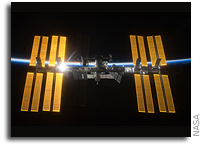
ISS On-Orbit Status 04/13/12
All ISS systems continue to function nominally, except those noted previously or below.
After breakfast, FE-4 Kononenko performed the routine inspection of the SM (Service Module) PSS Caution & Warning panel as part of regular Daily Morning Inspection.
FE-5 Kuipers tended to the JAXA SSHDT (Super Sensitive High Definition TV), transferred from the JPM (JEM Pressurized Module) to the Node-3/Cupola for taking video of North Pole auroras and night views of Japan for 5 days (i.e., 4/9 – 4/13). [About 4 hrs later, André exchanged the 32GB memory card and the lens, then restarted the recording (once a day). For the first 3 days, the SSHDTV used a single 4.8mm focus lens with IR Cut Filter 3 and for the remaining 2 days a single focus 8mm lens.]
CDR Burbank re-installed the three PaRIS (Passive Rack Isolation System) lock-down alignment guides on the CIR (Combustion Integrated Rack) at Lab bay S3, engaged the snubber pins and locked safety pins to protect its ARIS (Active Rack Isolation System) from external loading (dynamic disturbances).
Kononenko performed routine maintenance on the SM SRVK-2M Condensate Water Processor system by replacing its BKO multifiltration unit with a spare, discarding the old unit and updating the IMS (Inventory Management System). (Last time done: 11/21/11). [BKO contains five purification columns to rid the condensate of dissolved mineral and organic impurities. It has a service lifetime of ~450 liters throughput. The water needs to be purified for proper electrolysis in the Elektron O2 generator.]
In the Lab, André Kuipers accessed the NanoRacks Modules and collected data for subsequent transfer to the ER-1 (EXPRESS Rack 1) laptop.
Dan Burbank undertook the regular monthly session of the CHeCS (Crew Health Care Systems) emergency medical operations OBT (On-Board Training) drill, a 30-min. exercise to refresh his CMO (Crew Medical Officer) acuity in a number of critical health areas. The video-based proficiency drill today focused on a review of all topics. At the end, the CDR completed a self-assessment questionnaire. Answers were provided at test conclusion. [The HMS (Health Maintenance Systems) hardware, including ACLS (Advanced Cardiac Life Support) equipment, may be used in contingency situations where crew life is at risk. To maintain proficiency, crewmembers spend one hour per month reviewing HMS and ACLS equipment and procedures via the HMS and ACLS CBT (computer-based training). The training drill, each crewmember for him/herself, refreshes their memory of the on-orbit stowage and deployment locations, equipment etc. and procedures.]
FE-1 Shkaplerov took care of the daily IMS (Inventory Management System) maintenance, updating/editing its standard “delta file” including stowage locations, for the regular weekly automated export/import to its three databases on the ground (Houston, Moscow, Baikonur).
Anton also completed the routine daily servicing of the SOZh system (Environment Control & Life Support System, ECLSS) in the SM. [Regular daily SOZh maintenance consists, among else, of checking the ASU toilet facilities, replacement of the KTO & KBO solid waste containers, replacement of EDV-SV waste water and EDV-U urine containers and filling EDV-SV, KOV (for Elektron), EDV-ZV & EDV on RP flow regulator.]
After charging the BAR TTM-2 battery at wakeup, FE-1 used the KPT-2 payload and its BAR science instruments suite for measuring environmental data in the RS (Russian Segment), today focusing with the TTM-2 hotwire anemometer on flow rates and structural temperatures in the SM PrK (Transfer Tunnel), hatches and other locations. Afterwards, Anton started recharge of the TTM-2 battery and terminated it before sleeptime. [KPT-2 monitors problem areas, necessary to predict shell micro-destruction rate and to develop measures to extend station life. Data are copied to the RSE1 laptop for downlink to Earth via OCA, with photographs, and the activities are supported by ground specialist tagup as required. Objective of the Russian KPT-2/BAR science payload is to measure environmental parameters (temperature, humidity, air flow rate) and module shell surface temperatures behind RS (Russian Segment) panels and other areas susceptible to possible micro-destruction (corrosion), before and after insolation (day vs. night). Piren-V is a video-endoscope with pyrosensor, part of the methods & means being used on ISS for detecting tiny leaks in ISS modules which could lead to cabin depressurization. Besides KPT-2 Piren-V, the payload uses a remote infrared thermometer (Kelvin-Video), a thermohygrometer (Iva-6A), a heat-loss thermoanemometer/thermometer (TTM-2) and an ultrasound analyzer (AU-1) to determine environmental data in specific locations and at specific times. Activities include documentary photography with the NIKON D2X camera and flash.]
FE-4 Kononenko completed his 4th session with the Russian behavioral assessment TIPOLOGIA (MBI-20), setting up the workstation, connecting equipment, suiting up and launching the program on the RSK1 laptop. [Ivanishin stood by to assist Oleg in donning the electrode cap, preparing the head for the electrodes and applying electrode gel from the Neurolab-RM2 kit plus taking documentary photography. Data were recorded on a PCMCIA memory card and downlinked via OCA comm. MBI-20 studies typological features of operator activity of the ISS crews in long-term space flight phases, with the subject using a cap with EEG (electroencephalogram) electrodes. The experiment, which records EEGs, consists of the Lüscher test, “adaptive biological control” training, and the games Minesweeper and Tetris. The Lüscher color diagnostic is a psychological test which measures a person’s psychophysical state, his/her ability to withstand stress, to perform and to communicate. It is believed to help uncover the cause of psychological stress, which can lead to physical symptoms. An EEG measures and records the electrical activity of the brain.]
FE-6 Pettit performed troubleshooting on the Cupola PCS (Portable Computer System) laptop, attempting to recover its connectivity to the C&C MDM (Command & Control Multiplexer/Demultiplexer) computer. [IFM (Inflight Maintenance) steps included switching out the 1553 card and the cable. If unsuccessful, Don was to swap Cupola PCS shell, 1553 card & cable with the shell, 1553 card & cable of the Node-3 PCS.]
Working in the US Lab on AV-2 (Avionics Rack 2, at bay D1), Don Pettit disconnected the Ethernet cable of the JSL iAPS (Joint Station LAN / Improved Automated Payload Switch) hardware at the ISL (Integrated Station LAN) Interface Panel where he had connected it on 4/11 for ground-commanded software loading.
Anatoly Ivanishin started a new round of periodic preventive maintenance of RS (Russian Segment) ventilation systems, today working in the FGB (Funktsionalnyi-Grusovoi Blok). [Using a vacuum cleaner and soft brush, Anatoly cleaned filters and fan grilles of the TsV1,2 central circulation ventilators, replaced the PS1 & PS2 dust filter cartridges with fresh units, and cleaned the detachable VT7 fan screens of the three SOTR gas-liquid heat exchangers (GZhT4), plus the fixed GZhT4 grill.]
Shkaplerov & Ivanishin had an hour set aside each for personal crew departure preparations which are standard pre-return procedures for crewmembers.
Oleg Kononenko had 2 hrs for conducting an audit/inventory of SOP food waste bags to establish quantity, guided by an uplinked listing of 12 stowage locations.
Burbank & Pettit had another time slot reserved each for making entries in their electronic Journals on the personal SSC. [Required are three journaling sessions per week.]
Before Presleep, the CDR will turn on the MPC (Multi-Protocol Converter) and start the Ku-band data flow of video recorded during the day to the ground, with POIC (Payload Operations & Integration Center) routing the onboard HRDL (High-Rate Data Link). After about an hour, Dan turns MPC routing off again. [This is a routine operation which regularly transmits HD onboard video (live or tape playback) to the ground on a daily basis before sleeptime.]
At ~4:25am EDT, Ivanishin, Shkaplerov, Kononenko, Burbank, Kuipers & Pettit held the regular (nominally weekly) tagup with the Russian Flight Control Team (GOGU/Glavnaya operativnaya gruppa upravleniya), including Shift Flight Director (SRP), at TsUP-Moscow via S-band/audio, phone-patched from Houston and Moscow.
At ~4:40am, Anton, Anatoly & Oleg linked up with TsUP-Moscow stowage specialists via S-band to conduct the weekly IMS tagup, discussing inventory & stowage issues, equipment locations and cargo transfers.
At ~4:55am, Burbank, Shkaplerov & Ivanishin tagged up with the Russian KTO ground Technical Support Team via S-band.
At ~5:15am, Anton & Anatoly tagged up with ground specialists to discuss open issues of cargo transfers and loading on Soyuz 28S, including cargo transfer to the representative of the KTO Technical Support Team at the landing site, and layout of containers and equipment in the SA Descent Module.
At ~6:10am, André conducted the weekly ESA crew conference via phone with COL-CC at Oberpfaffenhofen/Germany.
At ~11:15am, Burbank & Pettit supported a PAO TV event, participating in the NPR (National Public Radio) program “Science Friday” with Ira Flatow.
At ~12:40pm, Oleg Kononenko supported a PAO TV downlink, transmitting messages of greetings and congratulations, (1) to the veteran-employees of the Savings Bank on the occasion of the grand opening of the Russia’s Savings Bank Joint Stock Company Museum facility on 5/4, and (2) to the Russian Red Cross Society (NGO) which is turning 145 in May 2012. [From the very first day of its existence the Russian Red Cross pulled together courageous, dedicated, and generous people to its ranks who would go out on the first call to help the wounded on the battle fields and in hospitals. Today the Russian Red Cross is a public charitable organization which is a participant in the International Red Cross and Red Crescent Movement, and its activity is aimed to assisting people who need help.]
At ~1:40pm, Don Pettit powered up the SM’s amateur radio equipment (Kenwood VHF transceiver with manual frequency selection, headset, & power supply) and at 1:50pm conducted a ham radio session with students at Academia Cotopaxi, Quito, Ecuador.
At ~3:10pm, the crew is scheduled for their regular weekly tagup with the Lead Flight Director at JSC/MCC-H.
The crew worked out with their regular 2-hr physical exercise protocol on the CEVIS cycle ergometer with vibration isolation (CDR), TVIS treadmill with vibration isolation & stabilization (FE-1, FE-2, FE-4), ARED advanced resistive exerciser (CDR, FE-4, FE-5), and T2/COLBERT advanced treadmill (FE-1, FE-2, FE-5). [FE-6 is on the special experimental SPRINT protocol which diverts from the regular 2.5 hrs per day exercise regime and introduces special daily sessions, followed by a USND (Ultrasound) leg muscle self scan in COL. No exercise is being timelined for Fridays. If any day is not completed, Don picks up where he left off, i.e., he would be finishing out the week with his last day of exercise on his off day.]
Tasks listed for Shkaplerov, Kononenko & Ivanishin on the Russian discretionary “time permitting” job for today were –
* A ~30-min. run of the GFI-8 “Uragan” (hurricane) earth-imaging program with the NIKON D3X digital camera with Sigma AF 300-800mm telelens, focusing on the volcanoes Idzhen, Hudson, Huascaran, Arenal, Poas & San Cristobal, Darwin Island, and the Patagonian glaciers Upsala, Viedma and Chico;
* A ~30-min. session for Russia’s EKON Environmental Safety Agency, making observations and taking KPT-3 aerial photography of environmental conditions on Earth using the NIKON D3X camera with the RSK-1 laptop, and
* More preparation & downlinking of reportages (written text, photos, videos) for the Roskosmos website to promote Russia’s manned space program (max. file size 500 Mb).
WRM Update: A new WRM (Water Recovery Management) “cue card” was uplinked to the crew for their reference, updated with their latest CWC (Contingency Water Container) water audit. [The new card (29-0008S) lists 18 CWCs (223.47 L total) for the five types of water identified on board: 1. Silver technical water (2 CWCs with 65.5 L, for Elektron electrolysis, plus 1 empty bag, all containing Wautersia bacteria; 2. Condensate water (3 CWCs with 14.0 L, plus 2 empty bags); 3. Iodinated water (7 CWCs with 121.8 L; 4. Waste water (1 bag with 13.67 L EMU waste water); and 5. Special fluid (1 empty CWC). Also one leaky CWC (#1024) with 8.5L). Other CWCs are stowed behind racks and are currently not being tracked due to unchanging contents. Wautersia bacteria are typical water-borne microorganisms that have been seen previously in ISS water sources. These isolates pose no threat to human health.]
CEO (Crew Earth Observation) targets uplinked for today were Merapi Volcano, Java, Indonesia (ISS had a pass in relatively fair weather over Indonesia’s most active volcano located in the central part of the major island of Java. As ISS approached the coast of Java from the SW in mid-afternoon light, the crew was to look just left of track for this distinctive volcanic cone. There are numerous volcanoes in this area, but Merapi is the one most likely to have a plume. Trying for detailed views of the summit area. If the crew could not spot Merapi or it was too cloudy, they were to aim immediately right of track for the next target in this area Semeru Volcano further east on Java), Semeru Volcano, Java, Indonesia (this target, at 12,060 ft, is the highest peak on the island of Java. Semeru rises abruptly from the coastal plains and has multiple calderas with lakes. On this mid-afternoon pass with an approach from the SW, fair weather was expected, providing good views of this massive volcano, just right of track. Using the long lens setting for detailed views of the summit area. CEO database has no useful photos of this target to date), Pretoria, South Africa (CAPITAL CITIES COLLECTION: The administrative capital of South Africa is located in the northeastern part of the country within a series of ridges about 35 miles north of the major city of Johannesburg. ISS had a mid-afternoon pass, in fair weather with its approach from the SW. At this time, after passing the much larger urban area of Johannesburg, the crew was to look just right of track for this city of about 600,000, trying for single-frame views of the urban area), SW Glaciers of S. Patagonian Ice Field (ISS had a late morning pass with much of this target area just left of track. The crew may have found sufficient breaks in the cloud field for detailed views of these rarely-photographed glaciers near the southern end of this large ice field. As ISS approached the coast from the WNW at this time, the crew was to look for these glaciers ending in long fjords), and South Desolation Point, S. Chile (HMS BEAGLE SITE: Darwin and the Beagle navigated the treacherous Strait of Magellan on June 10, 1834 and passed South Desolation Point into the open Pacific where the long swell of the open ocean constantly rages. Desolation Island is on the south side of the Strait and marks the western end of Tierra del Fuego. ISS had a late morning pass in partly cloudy weather. As it tracked eastward at this time, the crew was to look well right of track for shots of this challenging target).
ISS Orbit (as of this morning, 9:36am EDT [= epoch])
Mean altitude – 392.7 km
Apogee height – 397.8 km
Perigee height – 387.5 km
Period — 92.41 min.
Inclination (to Equator) — 51.64 deg
Eccentricity — 0.000762
Solar Beta Angle — 56.2 deg (magnitude decreasing)
Orbits per 24-hr. day — 15.58
Mean altitude loss in the last 24 hours — 83 m
Revolutions since FGB/Zarya launch (Nov. 98) — 76,794
Time in orbit (station) — 4893 days
Time in orbit (crews, cum.) — 4180 days
Significant Events Ahead (all dates Eastern Time and subject to change):
————–Six-crew operations—————-
04/19/12 — Progress M-14M/46P undock (7:03am EDT)
46P Orbital Operations
04/20/12 — Progress M-15M/47P launch (8:50:26am EDT)
04/22/12 — Progress M-15M/47P docking (~10:40am)
04/27/12 — Soyuz TMA-22/28S undock (4:19am EDT)
04/27/12 — Soyuz TMA-22/28S landing (7:45am EDT; 2:45pm DMT/Moscow) (End of Increment 30)
04/28/12 — Progress M-14M/46P deorbit burn (6:33am EDT)
————–Three-crew operations————-
04/30/12 — SpaceX Dragon launch (12:22pm EDT; target date)
05/15/12 — Soyuz TMA-04M/30S launch – G.Padalka (CDR-32)/J.Acaba/S.Revin
05/17/12 — Soyuz TMA-04M/30S docking (MRM2)
————–Six-crew operations—————-
07/01/12 — Soyuz TMA-03M/29S undock/landing (End of Increment 31)
————–Three-crew operations————-
07/15/12 — Soyuz TMA-05M/31S launch – S.Williams (CDR-33)/Y.Malenchenko/A.Hoshide
07/17/12 — Soyuz TMA-05M/31S docking
07/20/12 — HTV3 launch (~10:18pm EDT)
07/31/12 — Progress M16M/48P launch
08/02/12 — Progress M16M/48P docking
————–Six-crew operations—————-
09/17/12 — Soyuz TMA-04M/30S undock/landing (End of Increment 32)
————–Three-crew operations————-
10/15/12 — Soyuz TMA-06M/32S launch – K.Ford (CDR-34)/O.Novitskiy/E.Tarelkin
10/17/12 — Soyuz TMA-06M/32S docking
————–Six-crew operations————-
11/01/12 — Progress M-17M/49P launch
11/03/12 — Progress M-17M/49P docking
11/12/12 — Soyuz TMA-05M/31S undock/landing (End of Increment 33)
————–Three-crew operations————-
12/05/12 — Soyuz TMA-07M/33S launch – C.Hadfield (CDR-35)/T.Mashburn/R.Romanenko
12/07/12 — Soyuz TMA-07M/33S docking
————–Six-crew operations————-
12/26/12 — Progress M-18M/50P launch
12/28/12 — Progress M-18M/50P docking
03/19/13 — Soyuz TMA-06M/32S undock/landing (End of Increment 34)
————–Three-crew operations————-
04/02/13 — Soyuz TMA-08M/34S launch – P.Vinogradov (CDR-36)/C.Cassidy/A.Misurkin
04/04/13 — Soyuz TMA-08M/34S docking
————–Six-crew operations————-
05/16/13 — Soyuz TMA-07M/33S undock/landing (End of Increment 35)
————–Three-crew operations————-
05/29/13 — Soyuz TMA-09M/35S launch – M.Suraev (CDR-37)/K.Nyberg/L.Parmitano
05/31/13 — Soyuz TMA-09M/35S docking
————–Six-crew operations————-
09/xx/13 — Soyuz TMA-08M/34S undock/landing (End of Increment 36)
————–Three-crew operations————-
09/xx/13 — Soyuz TMA-10M/36S launch – M.Hopkins/TBD (CDR-38)/TBD
09/xx/13 — Soyuz TMA-10M/36S docking
————–Six-crew operations————-
11/xx/13 — Soyuz TMA-09M/35S undock/landing (End of Increment 37)
————–Three-crew operations————-
11/xx/13 — Soyuz TMA-11M/37S launch – K.Wakata (CDR-39)/R.Mastracchio/TBD
11/xx/13 — Soyuz TMA-11M/37S docking
————–Six-crew operations————-
03/xx/14 — Soyuz TMA-10M/36S undock/landing (End of Increment 38)
————–Three-crew operations————-



