
NASA ISS On-Orbit Status 12 March 2012
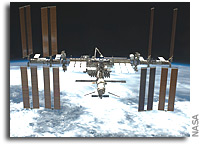
All ISS systems continue to function nominally, except those noted previously or below. Underway: Week 16 of Increment 30 (six-person crew).
After breakfast, FE-4 Kononenko performed the routine inspection of the SM (Service Module) PSS Caution & Warning panel as part of regular Daily Morning Inspection.
FE-4 also completed the weekly checkup behind ASU/toilet panel 139 in the SM on a fluid connector (MNR-NS) of the SM-U urine collection system, looking for potential moisture.
CDR Burbank performed his 5th session, deferred from yesterday, with the MedOps psychological evaluation experiment WinSCAT (Spaceflight Cognitive Assessment Tool for Windows), logging in on the MEC (Medical Equipment Computer) laptop and going through the psychological evaluation exercise on the PC-based WinSCAT application. [WinSCAT is a monthly time-constrained questionnaire test of cognitive abilities, routinely performed by astronauts aboard the ISS every 30 days before or after the PHS (periodic health status) test or on special CDR’s, crewmembers or flight surgeons request. The test uses cognitive subtests that measure sustained concentration, verbal working memory, attention, short-term memory, spatial processing, and math skills. The five cognitive subtests are Coding Memory – Learning, Continuous Processing Task (CPT), Match to Sample, Mathematics, and Coding Delayed Recall. These WinSCAT subtests are the same as those used during NASA’s long-duration bed rest studies.]
In COL (Columbus Orbital Laboratory), FE-5 Andre Kuipers configured the equipment for the ESA ICV (Integrated Cardiovascular) experiment and then began his 3rd (FD75) session, after preparing the Actiwatches, electrode sites, attaching the harness and donning the Cardiopres with the assistance of Dan Burbank. At ~8:30am EDT, Andre observed the initial 10-min rest period under quiet, restful conditions before going about his business. [ICV activities consist of two separate but related parts over a one-week time period: an ultrasound echo scan & an ambulatory monitoring session. Today, wearing electrodes, the HM2 (Holter Monitor 2) for recording ECG (Electrocardiogram) for 48 hours, the ESA Cardiopres to continuously monitor blood pressure for 24 hours, and two Actiwatches (hip/waist & ankle) for monitoring activity levels over 48 hours, Andre started the ambulatory monitoring part of the ICV assessment. During the first 24 hrs (while all devices are worn), ten minutes of quiet, resting breathing are timelined to collect data for a specific analysis. The nominal exercise includes at least 10 minutes at a heart rate >=120 bpm (beats per minute). After 24 hrs, the Cardiopres is doffed and the HM2 HiFi CF Card and AA Battery are changed out to allow continuation of the session for another 24 hours. After data collection is complete, the Actiwatches and both HM2 HiFi CF Cards are downloaded to the HRF PC1, while Cardiopres data are downloaded to the EPM (European Physiology Module) Rack and transferred to the HRF PC1 via a USB key for downlink. The sessions are scheduled at or around FD14, FD30, FD75, FD135 and R-15 (there will be fewer sessions if mission duration is less than six months). The FD75 echo scan will include an exercise component with a second scan (subset of the first) completed within 5 minutes after the end of exercise. The primary objective of the accompanying CCISS (Cardiovascular Control on return from the ISS) experiment is to maximize the information about changes in cardiovascular and cerebrovascular function that might compromise the ability of astronauts to meet the challenge of return to an upright posture on Earth.]
FE-1 Shkaplerov used the Russian GFI-8 “Uragan” (hurricane) earth-imaging program with FSS science hardware at SM window #9 and the overnight freshly charged FSS photo spectrograph battery, taking pictures of targets along the flight track during a one-hour segment, covering Ireland, Great Britain, the English Channel (water & coastal zone), France, Allalin Glacier, water & coastal area of the Adriatic Sea, Slovenia, Croatia, Bosnia and Herzegovina, Yugoslavia water & coastal area of the Aegean and the Mediterranean Sea (island of Cyprus), Turkey and Saudi Arabia (sands). [The FSS (Fotospektralnaya sistema) consists of an image recording module with lens and a spectroradiometer module with an electronics module. FSS includes the ME Electronics Module & MRI Image Recording Module.]
After charging its battery in the morning, Anton Shkaplerov & Anatoly Ivanishin worked ~1h 20m in the FGB with the KPT-2 payload with its BAR science instruments suite, using the Piren-V and Iva-6A instruments to collect air temperature & humidity measurements behind panels and then taking temperature readings of surface locations on the pressurized shell. [Problem area monitoring is necessary to predict shell micro-destruction rate and to develop measures to extend station life. Data were copied to the RSE1 laptop for downlink to Earth via OCA, with photographs, and the activities were supported by ground specialist tagup as required. Objective of the Russian KPT-2/BAR science payload is to measure environmental parameters (temperature, humidity, air flow rate) and module shell surface temperatures behind RS (Russian Segment) panels and other areas susceptible to possible micro-destruction (corrosion), before and after insolation (day vs. night). Piren-V is a video-endoscope with pyrosensor, part of the methods & means being used on ISS for detecting tiny leaks in ISS modules which could lead to cabin depressurization. Besides KPT-2 Piren-V, the payload uses a remote infrared thermometer (Kelvin-Video), a thermohygrometer (Iva-6A), a heat-loss thermoanemometer/thermometer (TTM-2) and an ultrasound analyzer (AU-1) to determine environmental data in specific locations and at specific times. Activities include documentary photography with the NIKON D2X camera and flash.]
After switching STTS communications to MRM2 Poisk occupancy and setting up the MPEG2 (Moving Pictures Expert Group 2) multicasting television equipment from MRM2 (which required FE-6 Pettit to temporarily switch any used wireless laptops to wired SSCs), Oleg Kononenko installed and prepared the equipment for another run of the new KPT-21 PK-3+ Plasma Crystal-3+ (Plazmennyi-Kristall-3 plus) Telescience payload, the 4th time for Expedition 30. [Activities included making electrical connections, installing a video hard drive and loading new software. Afterwards, Oleg conducted a test session of the video downlink to TsUP-Moscow, monitoring the TV signal on the VKU “Klest” video monitor, then closed out the hardware and reconfigured STTS comm to nominal settings. The PK-3+ equipment comprises the EB (Eksperimental’nyj Blok) Experiment Module with a turbopump for evacuation, Ts laptop, video monitor, vacuum hoses, electrical circuitry, four hard storage disks for video, and one USB stick with the control application. The experiment is performed on plasma, i.e., fine particles charged and excited by HF (high frequency) radio power inside the evacuated work chamber. Main objective is to obtain a homogeneous plasma dust cloud at various pressures and particle quantities with or without superimposition of an LF (low frequency) harmonic electrical field. The experiment is conducted in automated mode. PK-3+ has more advanced hardware and software than the previously used Russian PKE-Nefedov payload.]
In support of his subsequent SLICE activities, FE-6 Pettit performed a visual inspection of the MSG (Microgravity Science Glovebox) facility and activated it.
Afterwards, Don configured the SLICE (Structure & Liftoff In Combustion Experiment) pyrometry hardware and performed the 8th flame test operation, today using the 3rd and last bottle of 100% methane for lifting tests and later, if there was time, to determine smoke points, with new burners installed. Before powering off, Pettit performed SLICE fan calibration to evaluate the air flow. MSG was later deactivated again. [The research goal is to gain unique data to extend scientists’ predictive capability. Earth application: Increased efficiency and reduced pollutant emission for practical combustion devices, improved numerical modeling, hence improved design tools, hence improved practical combustion on Earth (currently, the good modeling-experiment agreement breaks down when flames are lean or heavily sooting). Measurements: still images (with camera that was blackbody calibrated for pyrometry), video & radiometer. Hardware: SLICE is conducted in the MSG using the SPICE hardware.]
In the Lab, the CDR relocated a stowage bag with old hardware (WRS QD Key) from its location in the D5 Standoff to eliminate a potential fire hazard.
Later, Dan collected the periodic water sample, after purging the line, from the WRM (Water Recovery Management) condensate tank in the Lab, then initiated (later terminated) draining the tank to a CWC (Contingency Water Container, #1062, ~7L)
Anatoly Ivanishin conducted the periodic (every Monday) verification of the automatic IUS AntiVirus definition update on the Russian VKS auxiliary network laptops RSS1, RSS2, RSK1-T61p & RSK2, as well as performed the manual update on the non-network laptops RSE-Med & RSE1. [Antivirus update procedures have changed since the SSCV4 software update. Before the installation (on 8/8) of the new automated procedure, the refresh was done manually on Mondays on RSS2, copying the files to the RSS2 service folder, then launching update scripts on the network laptops RSS1, RSK1-T61p & RSK2 and finally manually updating non-network laptops RSE-Med & RSE1. On Tuesdays, the anti-virus scanning results are regularly verified on all laptops. Nominally, Russian network laptops have software installed for automatic anti-virus update; fresh data is copied on RSK1-T61p & RRSK2 every time a computer is rebooted with a special login, and on RSS1 once daily. On Russian non-network laptops antivirus definition file update is done by the crew once every two weeks on Monday.]
Afterwards, Anatoly prepared for tomorrow’s scheduled inspection of RS shell structural elements using the GKM MVP-2K instrument to measure electrical conductivity of surface areas. Ground specialist tagup supported the preparations.
Working ~2.5 hrs in the FGB, FE-4 Kononenko performed the R&R (removal & replacement) of the KVD Pressure Equalization Valve (PEV) #109 in the hatch between the FGB’s PGO Instrumentation & Cargo Compartment (priborno gruzovoj otsek) and the SM, for which he had made preparations on 3/5. [For the IFM (Inflight Maintenance), the BITS2-12 onboard telemetry measurement system and VD-SU control mode had to be switched off (along with other associated systems like Elektron). After VD-SU was activated again and BITS2-12 powered up, Oleg photographed the installed PEV for downlink, discarded the old valve unit and O-rings and restowed the tools and remaining O-rings.]
Kuipers conducted the periodic (approx. weekly) WRS (Water Recovery System) sampling in Node-3 using the TOCA (Total Organic Carbon Analyzer), after first initializing the software and priming (filling) the TOCA water sample hose. [After the approximately 2-hr TOCA analysis, results were transferred to the SSC-5 (Station Support Computer 5) laptop via USB drive for downlink, and the data were also logged.]
For tomorrow’s scheduled assembly and testing of the UMS (Urine Monitoring System), Andre gathered necessary hardware & tools and filled three drinking water containers from the PWD (Potable Water Dispenser, each with ~100 ml hot water, then reviewed procedural material for the post-assembly testing.
Pettit started another sampling run with the AQM (Air Quality Monitor), deactivating the system ~5 hrs later. [Consisting of the EHS GC/DMS (Environmental Health Systems Gas Chromatograph / Differential Mobility Spectrometer), the system is controlled with “Sionex” expert software from the SSC (Station Support Computer)-12 laptop. The AQM demonstrates COTS (Commercial Off-the-Shelf) technology for identifying volatile organic compounds, similar to the VOA (Volatile Organics Analyzer). This evaluation will continue over the course of several months as it helps to eventually certify the GC/DMS as nominal CHeCS (Crew Health Care Systems) hardware.]
FE-1 Shkaplerov set up the Russian DZZ-12 RUSALKA (“Mermaid”) hardware at SM window #9 for another 1h 50m sun-glint observation session, using the bracket-mounted spectrometer (without use of the TIUS three-stage rate sensor) for unattended ops, synchronized with the coaxially mounted NIKON D2X camera for taking snapshots, and later downloaded the data to laptop RS1 for subsequent downlink via OCA. Before sleeptime, FE-1 will initiate overnight recharge of the DZZ-12 battery. [RUSALKA is a micro spectrometer for collecting detailed information on observed spectral radiance in the near IR (Infrared) waveband for measurement of greenhouse gas concentrations in the Earth atmosphere.]
Anton also completed a 30-min. session for the DZZ-13 “Seiner” ocean observation program, obtaining HDV (Z1) camcorder footage of color bloom patterns in the waters of the Central-Eastern Atlantic, then copying the images to the RSK-1 laptop.
Dan performed the quarterly maintenance inspection of the T2 advanced treadmill, requiring about 30 min for inspecting rack composite and isolators plus performing T2 load cell calibration.
In the Lab, Burbank supported POIC (Payload Operations & Integration Center) ops by readying the CIR (Combustion Integrated Rack) at Bay S3 for more experiment runs. [After opening the combustion chamber front end cap, Dan removed both MDCA (Multi-user Droplet Combustion Apparatus) fuel reservoirs and replaced them with two new ones. Afterwards, he closed both rack doors, turned on two switches and notified POIC that the rack was ready for remotely commanding the RPC (Remote Power Controller). MTL (Moderate Temperature Loop) lines were disconnected at the start of this activity and reconnected at the end.]
Anatoly completed the periodic (~monthly) maintenance on the temporarily deactivated Russian IK0501 GA (Gas Analyzer) of the SOGS Pressure Control & Atmospheric Monitoring System behind SM panel 449 by replacing its CO2 filter assembly (BF) with a new spare, #127 (done last: 2/1). The old unit was discarded as trash and the IMS updated. [IK0501 is an automated system for measuring CO2, O2, and H2O in the air, as well as the flow rate of the gas being analyzed.]
FE-2 also conducted the periodic checkout & performance verification of IP-1 airflow sensors in the various RS hatchways. [Inspected IP-1s are in the passageways PrK (SM Transfer Tunnel)CRO (SM Working Compartment), PkhO (SM Transfer Compartment)CRO, PkhOCDC1, PkhOCFGB PGO, PkhO-MRM2, FGB GA-MRM1, FGB PGOCFGB GA, and FGB GACNode-1.]
After switching the EHS / TEPC (Environmental Health Systems / Tissue Equivalent Proportional Counter) spectrometer & detector assembly to Standby, FE-5 relocated it from the Node-3, loc. F3, to SM Panel 327 and turned it back on. [The TEPC detector assembly is the primary radiation measurement tool in the ISS.]
Next, Andre completed the standard 30-day inspection of the AED (Automated External Defibrillator) in the CHeCS (Crew Health Care Systems) rack. [AED is a portable electronic device that automatically diagnoses the potentially life threatening cardiac arrhythmias of ventricular fibrillation and ventricular tachycardia in a patient. It then can treat them through defibrillation, i.e., the application of electrical therapy which stops the arrhythmia, allowing the heart to re-establish an effective rhythm.]
Working in the MRM2 module with the Nikon D3 camera with compact flash and PENTAX stereo adapter, Ivanishin performed macro-stereophotography at the module’s VL1 window, shooting overlapping pictures of a possible defect in the window, with ground specialist support. [Based on the results of the window monitoring performed on 12/27/11, a scratch-like defect was discovered on the outer pane surface of the MRM2 VL1 window. Analysis completed by specialists is inconclusive in terms of a nature of the defect. It does not appear possible to identify this object. Judging by the extensive length and uniform thickness of the object, it can be supposed that this is a thread stuck to the window pane, which is supported by the absence of visible small chips in the environs of the object. However it is also possible that this is a scratch on the antireflection coating of the window pane, which becomes apparent in lateral exposure to sunlight (like on the images taken on 12/27/11). To obtain additional data for determination (identification) of the object on the VL1 window pane, the ground needs macro-stereophotographs of the object.]
Shkaplerov performed the routine daily servicing of the SOZh system (Environment Control & Life Support System, ECLSS) in the SM. [Regular daily SOZh maintenance consists, among else, of checking the ASU toilet facilities, replacement of the KTO & KBO solid waste containers, replacement of EDV-SV waste water and EDV-U urine containers and filling EDV-SV, KOV (for Elektron), EDV-ZV & EDV on RP flow regulator.]
Anton also took care of the daily IMS (Inventory Management System) maintenance, updating/editing its standard “delta file” including stowage locations, for the regular weekly automated export/import to its three databases on the ground (Houston, Moscow, Baikonur).
After installing the CCR (Cupola Crew Restraint) in the Node-3/Cupola and connecting the DCP (Display & Control Panel) power cable, Kuipers & Pettit jointly conducted the periodic proficiency session with the SSRMS (Space Station Remote Manipulator System) which also helps to prepare the crewmembers for the Dragon capture OBT (Onboard Training) scheduled two weeks prior to the arrival of the SpaceX capsule. [With the SPDM (Special Purpose Dexterous Manipulator) stowed on MBS PDGF-2 (Mobile Base System Power & Data Grapple Fixture 2), the MT (Mobile Transporter) cart at WS2 (Worksite 2), and the SSRMS based on MBS PDGF-1, Andre’s and Don’s tasks were: release “Dextre” and maneuver it to a backoff position, then perform an SSRMS Joint OCAS (operator commanded auto sequence) to an MT translate configuration. Objectives of the session: Complete the maneuver to the MT translate position, reset SSRMS proficiency for both crewmembers and practice good MSS (Mobile Service System) operational habits.]
Dan & Don each had a time slot reserved for making entries in their electronic Journals on the personal SSC. [Required are three journaling sessions per week.]
Before Presleep, the CDR will turn on the MPC (Multi-Protocol Converter) and start the Ku-band data flow of video recorded during the day to the ground, with POIC (Payload Operations & Integration Center) routing the onboard HRDL (High-Rate Data Link). After about an hour, Dan turns MPC routing off again. [This is a routine operation which regularly transmits HD onboard video (live or tape playback) to the ground on a daily basis before sleeptime.]
The crew worked out with their regular 2-hr physical exercise protocol on the TVIS treadmill with vibration isolation & stabilization (FE-1, FE-2, FE-4), ARED advanced resistive exerciser (CDR, FE-5, FE-6), T2/COLBERT advanced treadmill (CDR, FE-5, FE-6) and VELO ergometer bike with load trainer (FE-1, FE-2, FE-4). [FE-6 is on the special experimental SPRINT protocol which diverts from the regular 2.5 hrs per day exercise regime and introduces special daily sessions, followed by a USND leg muscle self scan in COL. Today’s exercise called for ARED+T2, with T2, ARED+T2, CEVIS, T2 (Treadmill Kinematics) following in the next 4 days. If any day is not completed, Don picks up where he left off, i.e., he would be finishing out the week with his last day of exercise on his off day.]
Tasks listed for Shkaplerov, Kononenko & Ivanishin on the Russian discretionary “time permitting” job for today were C
* A ~30-min. run of the GFI-8 “Uragan” (hurricane) earth-imaging program with the NIKON D3X digital camera with Sigma AF 300-800mm telelens, focusing on the volcano Idzhen, the Caspian & Aral Sea, the Pamir Glaciers RGS, Bear & Mabuza, Laganakskoe plateau, Krasnaya Polyana, and the Glaciers Kolka & Allalin,
* A ~30-min. session for Russia’s EKON Environmental Safety Agency, making observations and taking KPT-3 aerial photography of environmental conditions on Earth using the NIKON D3X camera with the RSK-1 laptop, and
* More preparation & downlinking of reportages (written text, photos, videos) for the Roskosmos website to promote Russia’s manned space program (max. file size 500 Mb).
No CEO (Crew Earth Observation) targets uplinked for today.
ISS Orbit (as of this morning, 8:24am EDT [= epoch])
Mean altitude C 390.2 km
Apogee height C 402.0 km
Perigee height C 378.5 km
Period — 92.36 min.
Inclination (to Equator) — 51.64 deg
Eccentricity — 0.0017381
Solar Beta Angle — -53.6 deg (magnitude decreasing)
Orbits per 24-hr. day — 15.59
Mean altitude loss in the last 24 hours — 125 m
Revolutions since FGB/Zarya launch (Nov. 98) — 76,294
Time in orbit (station) — 4861 days
Time in orbit (crews, cum.) — 4148 days
Significant Events Ahead (all dates Eastern Time and subject to change):
————–Six-crew operations—————-
03/23/12 — ATV3 launch (12:34am EDT)
03/28/12 — ATV3 docking (~6:34pm EDT)
04/19/12 — Progress M-14M/46P undock
04/20/12 — Progress M-15M/47P launch
04/22/12 — Progress M-15M/47P docking
04/30/12 — Soyuz TMA-22/28S undock/landing (End of Increment 30)
————–Three-crew operations————-
05/15/12 — Soyuz TMA-04M/30S launch C G.Padalka (CDR-32)/J.Acaba/S.Revin
05/17/12 — Soyuz TMA-04M/30S docking (MRM2)
————–Six-crew operations—————-
07/01/12 — Soyuz TMA-03M/29S undock/landing (End of Increment 31)
————–Three-crew operations————-
07/15/12 — Soyuz TMA-05M/31S launch C S.Williams (CDR-33)/Y.Malenchenko/A.Hoshide
07/17/12 — Soyuz TMA-05M/31S docking
07/31/12 — Progress M16M/48P launch
08/02/12 — Progress M16M/48P docking
————–Six-crew operations—————-
09/17/12 — Soyuz TMA-04M/30S undock/landing (End of Increment 32)
————–Three-crew operations————-
10/15/12 — Soyuz TMA-06M/32S launch C K.Ford (CDR-34)/O.Novitskiy/E.Tarelkin
10/17/12 — Soyuz TMA-06M/32S docking
————–Six-crew operations————-
11/01/12 — Progress M-17M/49P launch
11/03/12 — Progress M-17M/49P docking
11/12/12 — Soyuz TMA-05M/31S undock/landing (End of Increment 33)
————–Three-crew operations————-
12/05/12 — Soyuz TMA-07M/33S launch C C.Hadfield (CDR-35)/T.Mashburn/R.Romanenko
12/07/12 — Soyuz TMA-07M/33S docking
————–Six-crew operations————-
12/26/12 — Progress M-18M/50P launch
12/28/12 — Progress M-18M/50P docking
03/19/13 — Soyuz TMA-06M/32S undock/landing (End of Increment 34)
————–Three-crew operations————-
04/02/13 — Soyuz TMA-08M/34S launch C P.Vinogradov (CDR-36)/C.Cassidy/A.Misurkin
04/04/13 — Soyuz TMA-08M/34S docking
————–Six-crew operations————-
05/16/13 — Soyuz TMA-07M/33S undock/landing (End of Increment 35)
————–Three-crew operations————-
05/29/13 — Soyuz TMA-09M/35S launch C M.Suraev (CDR-37)/K.Nyberg/L.Parmitano
05/31/13 — Soyuz TMA-09M/35S docking
————–Six-crew operations————-
09/xx/13 — Soyuz TMA-08M/34S undock/landing (End of Increment 36)
————–Three-crew operations————-
09/xx/13 — Soyuz TMA-10M/36S launch C M.Hopkins/TBD (CDR-38)/TBD
09/xx/13 — Soyuz TMA-10M/36S docking
————–Six-crew operations————-
11/xx/13 — Soyuz TMA-09M/35S undock/landing (End of Increment 37)
————–Three-crew operations————-
11/xx/13 — Soyuz TMA-11M/37S launch C K.Wakata (CDR-39)/R.Mastracchio/TBD
11/xx/13 — Soyuz TMA-11M/37S docking
————–Six-crew operations————-
03/xx/14 — Soyuz TMA-10M/36S undock/landing (End of Increment 38)
————–Three-crew operations————-



