
NASA ISS On-Orbit Status 12 December 2008
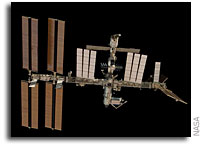
All ISS systems continue to function nominally, except those noted previously or below.
Continuing preparations for the Orlan EVA-21 on 12/22, CDR Fincke & FE-1 Lonchakov had ~90 min reserved for configuring the DC1 (Docking Compartment) and SM PkhO (Service Module Transfer Compartment) for the spacewalk dry-run on 12/19 and the EVA itself. [Work focused on making room in these compartments by temporarily removing & relocating equipment, based on an uplinked IMS (Inventory Management System) list of 79 items. The relocation involved such items as Bioecology canisters, electronics units, Biorisk gear, BRTA-2 radio-telemetry units, a UFK cosmonaut seat, electrical umbilicals, tools, bags, etc. Also included were two Orlan spacesuits (type M & MK) which were temporarily moved, by agreement, to the US Node-2.]
As part of the DC1 cleanup, the FE-1 performed a brief data check of the MATRYOSHKA-R (RBO-3-2) radiation suite’s LULIN-5 electronics box, then removed the LULIN unit and the associated antroph-amorphous (human torso) "Phantom" unit from their locations and stowed them temporarily in the FGB. [Data being accumulated by LULIN comprise measurement date, time, mode, three-directional flux data (per sq.cm per sec.), and three-directional dose rate.]
Later, Lonchakov also transferred BIO-2/BIORISK-MSV containers to the SM and set them up at various sites for exposure to the local environment. [BIORISK entails a series of experiments designed to expose samples of materials to study adaptation and changes of bacteria & fungi within the typical micro biota residing on structural materials of space-flown equipment. Early data from these experiments already point to significant effects of space flight on growth, reproduction, and biological properties of test microbes and fungi. BIORISK-KM experiments deal with “passive” materials, BIORISK-MSV with microorganisms-materials within the SM and BIORISK-MSN with microorganisms-materials outside the ISS.]
Two additional hours were reserved for Yuri & Mike to set up EVA tools & hardware clusters in the DC1, prepare the KPU-EVA tool carrier (“caddy”), bundle the EXPOSE-R & IPI-SM monoblocs and pack the Langmuir Probe with its connectors & cables for taking outside.
FE-2 Magnus spent more time with WRS (Water Recovery System) sample analysis. [After first installing the TOCA (Total Organic Carbon Analyzer) by connecting its power cable to the UOP1 outlet panel and hooking up its water sample hose to the WRS Rack 1, Magnus collected samples from the PWD (Potable Water Dispenser) Hot needle outlet for subsequent inflight processing using the TOCA and WMK (Water Microbiology Kit) with MCD (Microbial Capture Device) and CDB (Coliform Detection Bag). The usual water reclamation from the sample bags via an absorbing towel (to be dried by airing) and data recording after the analyses concluded the activities. This was the first time TOCA sampled from the WPA (Water Processing Assembly) hose (which had to be primed beforehand).]
Using the ISS vacuum cleaner, Sandy worked on the OGS (Oxygen Generation System) Rack in the Lab to clean the foam sound muffler filter of its AAA (Avionics Air Assembly) and to take documentary photographs of the cleaned filter.
After inspecting the AAA, Magnus configured the OGS Rack for activation. [Initial activation steps involved accessing the OGS Rack front and mating the O2 outlet jumper QD (Quick Disconnect) at the N2 Purge ORU (Orbit Replaceable Unit, LAB1PD1 panel). Sandy’s preps included placing a securing tape over the OGS De-Ionizing Bed front-end cap fasteners (to prevent them from coming loose in the event of accidental internal high pressure). Powering up the OGA (Oxygen Generation Assembly), configuring its software and activating the OGA for O2 production were then to be ground-commanded from MCC-H.]
Yuri Lonchakov, with Mike Fincke assisting, performed the periodic (monthly) functional closure test of the Vozdukh CO2 (carbon dioxide) removal system’s spare emergency vacuum valves (AVK), in the spare parts kit. [The AVKs are crucial because they close the Vozdukh’s vacuum access lines in the event of a malfunction in the regular vacuum valves (BVK) or a depressurization in the Vozdukh valve panel (BOA). Access to vacuum is required to vent CO2 during the regeneration of the absorbent cartridges (PP).]
Sandra Magnus conducted the regular bi-monthly reboots of the OCA Router and File Server SSC (Station Support Computer) laptops.
Following up on the on-going X2 INTR4 software updates by the ground, the FE-2 unstowed the three Warning Books from Lab, SM and FGB and performed Part 2 of updating them with replacement pages and P&I (pen & ink) changes, for the INT R4 upgrading of INT MDMs. [Part 1, for the new PVCU (Photovoltaic Controller Unit) MDM upgrades with PVCU R3 software, was done by Sandy on 12/10.]
CDR Fincke unstowed and set up the NUTRITION w/Repository hardware for this weekend’s sessions by himself and FE-2 Magnus for urine and blood collection. For his own blood draw tomorrow, Mike’s 8-hr fast begins tonight (~7:40pm EST). [The new NUTRITION sessions will be Mike’s 60-day collection and Sandy’s 30-day collection.]
Sandy filled out the regular FFQ (Food Frequency Questionnaire), her third, on the MEC (Medical Equipment Computer). Mike Fincke’s third FFQ session is currently shown on his discretionary “job jar” task list. [On the FFQs, NASA astronauts keep a personalized log of their nutritional intake over time on special MEC software. Recorded are the amounts consumed during the past week of such food items as beverages, cereals, grains, eggs, breads, snacks, sweets, fruit, beans, soup, vegetables, dairy, fish, meat, chicken, sauces & spreads, and vitamins. The FFQ is performed once a week to estimate nutrient intake from the previous week and to give recommendations to ground specialists that help maintain optimal crew health. Weekly estimation has been verified to be reliable enough that nutrients do not need to be tracked daily.]
Magnus completed the routine daily servicing of the SOZh system (Environment Control & Life Support System, ECLSS) in the SM. [Regular daily SOZh maintenance consists, among else, of checking the ASU toilet facilities, replacement of the KTO & KBO solid waste containers and replacement of EDV-SV waste water and EDV-U urine containers.]
The FE-2 also took care of the daily IMS maintenance, updating/editing its standard “delta file” including stowage locations, for the regular weekly automated export/import to its three databases on the ground (Houston, Moscow, Baikonur).
Working off his discretionary job list, Yuri conducted the frequent status check on the Russian BIO-5 Rasteniya-1 ("Plants-1") experiment, verifying proper operation of the BU Control Unit and MIS-LADA Module fans (testing their air flow by hand). [Rasteniya-1 researches growth and development of plants under spaceflight conditions in the LADA-14 greenhouse from IBMP (Institute of Bio-Medical Problems, Russian: IMBP).]
Sandra completed another one of the periodic inspections of the RED (Resistive Exercise Device) canister cords and accessories, currently done every two weeks.
In the Kibo JPM (JEM Pressurized Module), the FE-2 deactivated the UDC (Utility DC/DC Converter) and MMA (Microgravity Measurement Apparatus) components at the Ryutai Rack.
At ~3:15am EST, the crew held the regular (nominally weekly) tagup with the Russian Flight Control Team (GOGU), including Shift Flight Director (SRP), at TsUP via S-band/audio, phone-patched from Houston and Moscow.
At ~9:15am EST, CDR Fincke powered up the SM’s amateur radio equipment (Kenwood VHF transceiver with manual frequency selection, headset, & power supply) and conducted, at 9:20am, a ham radio session with 2 Circolo Didattico, San Giuseppe, Mola di Bari, Italy. [The Didactic Center "San Giuseppe" is located in Mola di Bari, a city in Southern Italy. The school center includes two primary schools and three kindergartens. There are more than 800 pupils and 70 teachers. The primary schools have multimedia facilities and scientific laboratories. The pupils play an active role in a numerous projects, they gain experience on music, dance, theatre, physical education and more. Questions to Mike were uplinked beforehand. “How do you feel in Space?”; “How many satellites are flying in the Earth’s orbit?”; “How do you rest onboard the ISS?”; “What studies are necessary to become an astronaut?”; “Which tools do you use when you work outside the ISS?”; “Can you see the hole in the ozone layer from the ISS?”; “How is the junction between two spaceships made?”; “Why do you have zero gravity in Space?”; “Have you ever seen anything strange outside the ISS?”; “What do you see at this moment when you look through the window of the ISS?”]
At ~2:40pm, the ISS crew had their regular weekly tagup with the Lead Flight Director at JSC/MCC-H via S-band/audio. [S/G-2 (Space-to-Ground 2) phone patch via SSC (Station Support Computer).]
At ~4:30pm, Sandy is scheduled for her weekly PFC (Private Family Conference) via S-band/audio and Ku-band/MS-NetMeeting application (which displays the uplinked ground video on an SSC laptop).
The station residents conducted their regular daily 2.5-hr. physical workout program (about half of which is used for setup & post-exercise personal hygiene) on the CEVIS cycle ergometer (CDR, FE-2), TVIS treadmill (FE-1), RED (CDR, FE-2) and VELO bike with bungee cord load trainer (FE-1).
X2 INT R4 Software Transition Update: Starting 12/9 and running through tomorrow, MCC-Houston is executing procedures to transition several ISS MDMs (Multiplexer/Demultiplexer) computers to new software versions (without requiring crew participation). Today’s transition involved the remaining INT MDM from INTSYS R3 to R4, then swapping it to Primary. [Last night, an unexpected failure of the PVCU (Photovoltaic Controller Unit) 2B MDM was experienced. 4B is now prime, with 2B in backup mode. The ”signatures” look very similar to the 2A/4A failure that occurred earlier in the week. The anomaly is under investigation.]
Conjunction Update: The conjunction with the Cosmos satellite debris, Object 2421, for 12/12 (Friday) at 7:45pm EST, has moved out of the threshold box. No DAM (Debris Avoidance Maneuver) planning is required. Another conjunction, with Object 24076 (Pegasus rocket debris) is being assessed. TCA: 12/13 (Saturday) at 3:16pm EST with a predicted miss distance of ~11.3 km (to be updated). Maneuver Go/No-Go: 12/12, 3:46pm.
No CEO (Crew Earth Observations) photo target uplinked for today due to lighting conditions in the northern hemisphere that place targets outside the CEO team’s criteria for illumination and visibility. Normal targets are expected to return on 12/18.
CEO photography can be studied at this “Gateway” website:
http://eol.jsc.nasa.gov (as of 9/1/08, this database contained 770,668 views of the Earth from space, with 324,812 from the ISS alone).
ISS Orbit (as of this morning, 7:44am EST [= epoch]):
Mean altitude — 353.6 km
Apogee height — 358.2 km
Perigee height — 349.1 km
Period — 91.61 min.
Inclination (to Equator) — 51.64 deg
Eccentricity — 0.0006749
Solar Beta Angle — -70.6 deg (magnitude increasing)
Orbits per 24-hr. day — 15.72
Mean altitude loss in the last 24 hours — 22 m
Revolutions since FGB/Zarya launch (Nov. 98) — 57659.
Significant Events Ahead (all dates Eastern Time, some changes possible!):
12/19/08 — Russian EVA-21 Suited Exercise (wake 11:30pm 12/18; sleep 3:00pm 12/19);
12/22/08 — Russian EVA-21 (wake 9:30am; hatch opening ~7:15pm; sleep 7:10am 12/23);
02/09/09 — Progress M-01M/31P undocking & deorbit
02/10/09 — Progress 32P launch
02/12/09 — Progress 32P docking
02/12/09 — STS-119/Endeavour/15A launch – S6 truss segment
02/14/09 — STS-119/Endeavour/15A docking
02/24/09 — STS-119/Endeavour/15A undocking
02/26/09 — STS-119/Endeavour/15A landing (nominal)
03/25/09 — Soyuz TMA-14/18S launch
03/27/09 — Soyuz TMA-14/18S docking (DC1)
04/05/09 — Soyuz TMA-13/17S undocking
04/07/09 — Progress 32P undocking & deorbit
05/12/09 — STS-125/Atlantis Hubble Space Telescope Service Mission 4 (SM4)
05/15/09 — STS-127/Endeavour/2J/A launch – JEM EF, ELM-ES, ICC-VLD
05/27/09 — Soyuz TMA-15/19S launch
Six-person crew on ISS
08/06/09 — STS-128/Discovery/17A – MPLM (P), LMC, last crew rotation
08/XX/09 — Soyuz 5R/MRM2 (Russian Mini Research Module, MIM2) on Soyuz
09/XX/09 — H-IIB (JAXA HTV-1)
11/12/09 — STS-129/Atlantis/ULF3 – ELC1, ELC2
12/10/09 — STS-130/Endeavour/20A – Node-3 + Cupola
02/11/10 — STS-131/Atlantis/19A – MPLM(P), LMC
04/08/10 — STS-132/Discovery/ULF4 – ICC-VLD, MRM1
05/31/10 — STS-133/Endeavour/ULF5 – ELC3, ELC4
12/XX/11– Proton 3R/MLM w/ERA.



