
NASA ISS On-Orbit Status 10 August 2011
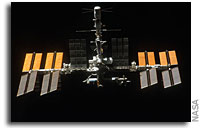
All ISS systems continue to function nominally, except those noted previously or below.
As part of the regular Daily Morning Inspection, FE-1 Samokutyayev checked out the SM (Service Module) PSS caution & warning panel.
As his first activity of the day, FE-5 Furukawa concluded the periodic personal acoustic measurement protocol, today downloading the recorded data from the crew-worn dosimeters from the SMK (Sound Measurement Kit) deployed yesterday to the Increment 28 crew, i.e., Sergei (#1011), Mike (#1013) & himself (#2012) for a 24-hr data take.
CDR Borisenko took his 4th MBI-24 “SPRUT-2” (“Squid-2”) test, part of Russian medical research on the distribution and behavior of human body fluids in zero gravity, along with PZEh-MO-8 body mass measurement using the IM device. [Supported by the RSS-Med A31p laptop with new software (Vers. 1.6) in the SM, the test uses the Profilaktika kit, with data recorded on PCMCIA memory cards, along with Andrey’s body mass values and earlier recorded MO-10 Hematocrit value, but skipping “fat fold” measurements. Experiment requisites are the Sprut securing harness, skin electrodes (cuffs), and RSS-Med for control and data storage. The “Pinguin” suit or Braslet-M cuffs, if worn, have to be taken off first. Electrode measurements are recorded at complete rest and relaxed body position. The actual recording takes 3-5 minutes, during which the patient has to remain at complete rest.]
Afterwards, Andrey inspected the newly activated Russian BIO-5 Rasteniya-2 (“Plants-2”) payload with its LADA-01 greenhouse, checking for proper fan operation by testing the air flow from the ventilators BO A04 & BO A05 and verifying that both LEDs (Light Emitting Diodes) are lit. [Rasteniya-2 researches growth and development of plants (currently wheat) under spaceflight conditions in the LADA greenhouse from IBMP (Institute of Bio-Medical Problems, Russian: IMBP).]
Samokutyayev configured the hardware for the Russian MBI-21 PNEVMOKARD experiment, then conducted the 1h15m session, his 5th, which forbids moving or talking during data recording. The experiment is controlled from the RSE-med A31p laptop and uses the TENZOPLUS sphygmomanometer to measure arterial blood pressure. The experiment was then closed out and the test data were downlinked via OCA. [PNEVMOKARD (Pneumocard) attempts to obtain new scientific information to refine the understanding about the mechanisms used by the cardiorespiratory system and the whole body organism to spaceflight conditions. By recording (on PCMCIA cards) the crewmember’s electrocardiogram, impedance cardiogram, low-frequency phonocardiogram (seismocardiogram), pneumotachogram (using nose temperature sensors), and finger photoplethismogram, the experiment supports integrated studies of (1) the cardiovascular system and its adaptation mechanisms in various phases of a long-duration mission, (2) the synchronization of heart activity and breathing factors, as well as the cardiorespiratory system control processes based on the variability rate of physiological parameters, and (3) the interconnection between the cardiorespiratory system during a long-duration mission and the tolerance of orthostatic & physical activities at the beginning of readaptation for predicting possible reactions of the crewmembers organism during the their return to ground.]
FE-3 Garan concluded his latest NUTRITION w/Repository 24-hr urine collection period after ~3:39am EDT, with samples deposited in MELFI (Minus Eighty Laboratory Freezer for ISS). Additionally, Ron underwent the associated generic blood draw, with Mike Fossum assisting with the phlebotomy as CMO (Crew Medical Officer). FE-3 then set up the RC (Refrigerated Centrifuge) for spinning the samples prior to stowing them in the MELFI. [The operational products for blood & urine collections for the HRP (Human Research Program) payloads were revised some time ago, based on crew feedback, new cold stowage hardware, and IPV capabilities. Generic blood & urine procedures have been created to allow an individual crewmember to select their payload complement and see specific requirements populated. Individual crewmembers will select their specific parameter in the procedures to reflect their science complement. Different crewmembers will have different required tubes and hardware configurations, so they must verify their choice selection before continuing with operations to ensure their specific instruction.]
FE-5 Furukawa will start his new NUTRITION w/Repository 24-hr urine collection period tomorrow morning. His equipment was set up by Ron on 8/8.
With the Piren-B battery charged overnight, Aleksandr Samokutyayev & Sergei Volkov used the Russian KPT-12 payload with its BAR science instruments suite for about 2 hrs of taking ultrasound measurements with Piren-B in the MRM1 Rassvet SM to inspect microconditions of the module’s pressurized shell behind Panels 206, 205, 407 & 408. Problem area monitoring is necessary to predict local shell micro-destruction rate and to develop measures to extend station life. Data were downlinked via OCA, and the activities were supported by ground specialist tagup as required. [Objective of the Russian KPT-12/BAR science payload is to measure environmental parameters (temperature, humidity, air flow rate) and module shell surface temperatures behind RS (Russian Segment) panels and other areas susceptible to possible micro-destruction (corrosion), before and after insolation (day vs. night). Piren-B is a video-endoscope with pyrosensor, part of the methods & means being used on ISS for detecting tiny leaks in ISS modules which could lead to cabin depressurization. Besides KPT-2 Piren-B, the payload uses a remote infrared thermometer (Kelvin-Video), a thermohygrometer (Iva-6A), a heat-loss thermoanemometer/thermometer (TTM-2) and an ultrasound analyzer (AU-1) to determine environmental data in specific locations and at specific times. Activities include documentary photography with the NIKON D2X camera and flash.]
FE-6 Fossum opened the protective window shutters of the Lab WORF (Window Observational Research Facility) for the ISSAC (ISS Agriculture Camera) equipment, so ground images can be captured by ground commanding. At sleeptime tonight, Ron Garan will close the shutters again. [ISSAC takes frequent visible-light & infrared images of vegetated areas on the Earth. The camera focuses principally on rangelands, grasslands, forests, and wetlands in the northern Great Plains and Rocky Mountain regions of the United States. The images may be delivered directly upon request to farmers, ranchers, foresters, natural resource managers and tribal officials to help improve their environmental stewardship of the land. The images will also be shared with educators for classroom use.]
FE-6 also inspected the WHC COT (Waste & Hygiene Compartment / Wring Collector), particularly its T-Adapter A8T connection and Pump Separator Vent Port. [Purpose: to ascertain if the amount of PT (Pre-Treat) fluid in the COT has changed since yesterday. If not, WHC continues to be Go for use. This late-added activity replaced the originally scheduled completion of the UMS (Urine Monitoring System) validation, which was postponed after several trips of the UMS circuit breaker. Near the time these trips were occurring, the WHC went down. A small amount of Pre-Treat solution was seen at the bottom of the COT. Once the WHC was verified as functional once again, the crew was given a Go to use it overnight. Today’s COT check for possible additional PT was to provide data on any possible degradation of the pump separator (which had failed in 2010 in similar fashion).].
Other activities conducted during the workday by FE-6 Fossum included – Using the CANON G1 camcorder to film a video survey of the internal volume of the ISS for later downlink, to be used for risk assessment/verification and stowage, Continuing the unpacking & stowing of Progress 42P-delivered US cargo unloaded yesterday by Aleks Samokutyayev, Finishing up on stowing US EVA tools & equipment used by Sasha & Sergei in the recent Russian EVA-29 and by Ron & Mike on the earlier ULF7 spacewalk, Verifying the stowage location of the T2 PAU (Power Avionics Unit) in the PMM (Permanent Multipurpose Module), [downlink from Mike: “Confirmed – I put my own eyeballs onto the T2 PAU in specified location. When I can’t find it tomorrow, you can quote me on this. Cheers!”] Conducting the regular (~weekly) inspection & maintenance, as required, of the CGBA-4 (Commercial Generic Bioprocessing Apparatus 4) and CGBA-5 payloads in their ERs (EXPRESS Racks), and Verifying the contents of MELFI-2 dewars and reporting results to POIC, [this is intended to update ground records of these contents, bringing them “in sync” with what is really contained in them].
Working in the Kibo JPM (JEM Pressurized Module) and JLP (JEM Logistics Pressurized Segment), FE-5 Furukawa installed EEGS (Emergency Egress Guidance System) glow-in-the-dark decals near hatches on the egress paths of the Japanese modules.
Afterwards, Satoshi’s schedule called for the periodic CSA-O2 calibration, which FE-5 successfully completed after finding the missing calibration adapter unit.
FE-4 Volkov concluded his latest session of the standard 24-hour ECG (electrocardiogram) recording under the Russian MedOps PZE MO-2-1 protocol, started yesterday, and FE-1 Samokutyayev initiated his own session of the 24-hour PZE MO-2-1 protocol. [After the ECG recording and blood pressure measurements with the Kardiomed system, Sergei doffed the five-electrode Holter harness that read his dynamic (in motion) heart function from two leads over the past 24 hours, recording data on the “Kardioregistrator 90205” unit. The examination results were then downloaded from the Holter ECG device to the RSE-Med laptop, controlled by the Kardiomed application. Later, the data were downlinked as a compressed .zip-file via OCA.]
Later, FE-1 recabled a lighting fixture (SD-1-7 A2) in the FGB (Funktsionalnyi-Grusovoi Blok) by installing a jumper cable for it behind Panel 305 to provide unobstructed opening of the panel.
Also in the FGB, Sasha replaced both ventilation fans TsV1 & TsV2 with new spares after moving stowed cargo from panels 102, 203, 403 (not to be restored until Fungistat antibacterial treatment behind panels 403 & 203 has been done tomorrow).
After Fossum had installed the 4 PaRIS (Passive Rack Isolation System) lock-down alignment guides on the CIR (Combustion Integrated Rack) in the Lab to protect the rack from external loading (dynamic disturbances), Ron Garan had ~3h20m for configuring the Lab camcorder to provide live view of his subsequent work on the FIR FCF (Fluids Integrated Rack Fluids & Combustion Facility) to run a session with the PACE (Preliminary Advanced Colloids Experiment) hardware using the first PACE sample (#2001) for processing. [PACE is a Technology experiment, designed to investigate the capability of conducting high magnification colloid experiments with the LMM (Light Microscopy Module) for determining the minimum size particles which can be resolved with it. Today’s activity steps included opening the AFC front door, rotating the LMM SBA (Light Microscopy Module Spindle Bracket Assembly) from the Operate to Service position and removing the Bio Base from the LMM X-Y Stage, then configuring the LMM objective lenses from Bio to PACE, mixing the first particle sample with the BCAT magnet, mounting the PACE test target and installing the sample and the PACE oil dispenser into the LMM AFC. The AFC front door was closed and the oil started to be dispensed onto the sample. The LMM Spindle Bracket Assembly was then rotated to the Operate position and the rack doors were closed.]
In the JAXA JPM, Ron later disconnected the ICS (Inter-Orbit Communication System) main power umbilical in support of SSIPC (Space Station Integration & Promotion Center/Tsukuba) in troubleshooting an ICS trip. [The trip (short) happened on 7/31 on RPC-5 (Remote Power Controller 5) of the JPM PDU (Power Distribution Unit), which feeds power to the ICS rack. At the same time an overcurrent was observed at the Node-2 DDCs (DC-to-DC-Converter Units), upstream of JEM Channel A. To help in identifying where the short circuit exists, Ron disconnected the power cable on the ICS Z-panel, isolating the ICS rack from the JPM. Results of further tests by SSIPC will determine the troubleshooting scheduled for 8/12.]
CDR Borisenko continued the the periodic condition assessment of loops KOB1 & KOB2 of the Russian SOTR Thermal Control System started yesterday. Working several hours with tagup support from ground specialists via S-Band & VHF, Andrey checked for leaks, monitored loop parameter signatures, set working pressures, and measured the free air volume in both cooling loops.
Activities completed by Sergei Volkov included –
The periodic checkout & performance verification of IP-1 airflow sensors in the various RS (Russian Segment) hatchways, [inspected IP-1s are in the passageways PrK (SM Transfer Tunnel)-RO (SM Working Compartment), PrK-Progress, DC1-Progress, PkhO (SM Transfer Compartment) – RO, PkhO-DC1, PkhO-FGB PGO, PkhO-MRM2, FGB GA-MRM1, FGB PGO-FGB GA, and FGB GA-Node-1],
Routine maintenance on the KN1(2) and KV1(2) valves of the SM Rodnik tanks, to prevent their failure during the long-term water stowage, [each of the four valves was activated twice (On/Off) from the IKR (Rodnik Control System Indicator) panel],
Installation of new fasteners on the mounting platform of the Russian IM “scales” (izmeritelya mass, Mass Meter),
The daily IMS (Inventory Management System) maintenance, updating/editing its standard “delta file” including stowage locations, for the regular weekly automated export/import to its three databases on the ground (Houston, Moscow, Baikonur),
The routine daily servicing of the SOZh system (Environment Control & Life Support System, ECLSS) in the SM, [regular daily SOZh maintenance consists, among else, of checking the ASU toilet facilities, replacement of the KTO & KBO solid waste containers, replacement of EDV-SV waste water and EDV-U urine containers and filling EDV-SV, KOV (for Elektron), EDV-ZV & EDV on RP flow regulator], and
Completing his first data collection session for the psychological MBI-16 Vzaimodejstvie (“Interactions”) program, accessing and completing the computerized study questionnaire on the RSE-Med laptop and saving the data in an encrypted file, [the software has a “mood” questionnaire, a “group & work environment” questionnaire, and a “critical incidents” log. Results from the study, which is also mirrored by ground control subjects, could help to improve the ability of future crewmembers to interact safely and effectively with each other and with Mission Control, to have a more positive experience in space during multi-cultural, long-duration missions, and to successfully accomplish mission activities].
Before sleeptime, Sergei will also prepare the Russian MBI-12 payload and start his 3rd Sonokard experiment session, using a sports shirt from the Sonokard kit with a special device in the pocket for testing a new method for acquiring physiological data without using direct contact on the skin. Measurements are recorded on a data card for return to Earth. [Sonokard objectives are stated to (1) study the feasibility of obtaining the maximum of data through computer processing of records obtained overnight, (2) systematically record the crewmember’s physiological functions during sleep, (3) study the feasibility of obtaining real-time crew health data. Investigators believe that contactless acquisition of cardiorespiratory data over the night period could serve as a basis for developing efficient criteria for evaluating and predicting adaptive capability of human body in long-duration space flight.]
FE-5 Furukawa conducted another session with the JAXA SSHDTV (Super Sensitive High-Definition Television) camera for night views, setting its zoom lens plus the automatic recorder clock & time code and starting the recording for about 5 minutes of night view video, focused on the Japanese islands.
In order to familiarize himself with procedures, Satoshi set up the SHERE (Shear History Extensional Rheology Experiment) equipment and conducted a dry run using a test (dry) FM (Fluid Module). [Activity steps included activating the MSG (Microgravity Science Glovebox) from its laptop (SSC-12) and powering up the hardware, unstowing an FM (Fluid Module) from the CGBA (Commercial Generic Bioprocessing Apparatus) for the dry run, then stowing the FM. Background: Rheology is the study of the deformation and flow of matter under the influence of an applied stress (“preshearing” = rotation) which might be, for example, a shear stress or extensional stress. In practice, rheology is principally concerned with extending the “classical” disciplines of elasticity and (Newtonian) fluid mechanics to materials whose mechanical behavior cannot be described with the classical theories. SHERE is designed to study the effect of preshear (rotation) on the transient evolution of the microstructure and viscoelastic tensile stresses for solutions with long chains of monodisperse dilute polymer molecules in the MSG. Collectively referred to as “Boger fluids,” these polymer solutions have become a popular choice for rheological studies of non-Newtonian fluids and are the non-Newtonian fluid used in this experiment. The SHERE hardware consists of the Rheometer, Camera Arm, Interface Box, Cabling, Keyboard, Tool Box, Fluid Modules, and Stowage Tray.]
Satoshi also unpacked & stowed US cargo delivered on Progress M-11M/43P, currently docked at SM aft end (to be undocked on 8/23).
Borisenko will conclude his day by initiating recharge on the SONY HVR-Z7 camcorder battery for another run of the GFI-1 “Relaksatsiya” (Relaxation) Earth Observation experiment. [Using the GFI-1 UFK “Fialka-MV-Kosmos” ultraviolet camera, SP spectrometer and SONY HVR-Z7 HD (High Definition) camcorder, the experiment observes the Earth atmosphere and surface from windows #9 & #6, with spectrometer measurements controlled from Laptop 3. “Relaxation”, in Physics, is the transition of an atom or molecule from a higher energy level to a lower one, emitting radiative energy in the process as equilibrium is achieved.]
Before “Presleep” period tonight, Ron Garan powers on the MPC (Multi-Protocol Converter) and starts the data flow of video recorded during the day to the ground, with POIC (Payload Operations & Integration Center) routing the onboard HRDL (High-Rate Data Link). After about an hour, MPC will be turned off again. [This is a routine operation which regularly transmits HD onboard video (live or tape playback) to the ground on a daily basis before sleeptime.]
FE-3, FE-5 & FE-6 had their standard PMCs (Private Medical Conferences) via S- & Ku-band audio/video, Satoshi at ~8:50am, Ron at ~11:10am, Mike at ~1:45pm EDT.
At ~11:45am, Ron & Mike supported a PAO TV event, responding to interview questions from KTRK-TV, Houston, TX (Ted Oberg) and KTRH Radio, Houston, TX (Matt Patrick & Lois Melkonian.)
At ~1:00pm, Andrey, Sasha & Sergei joined for a Russian TV event, downlinking a message of greetings and congratulation to Lyudmila Vasiljevna Shaposhnikova for her 85th birthday on 7/26. [L.V. Shaposhnikova is General Director of the Museum named after Rerikh, President of Rerikh Foundation, Academician of the Russian Academy of Natural Science and the Russian Academy of Cosmonautics named after Tsiolkovsky. The event dedicated to Lyudmila Vasiljevna’s jubilee will take place in Moscow in September this year. From the crew: “…You are one of the rare women of our time who dedicate themselves to validation of basics of high culture and cosmism ideas in social conscience. Space and Culture are closely interrelated notions, also cooperation between countries and peoples in the future are unthinkable without ecclesiastical and ethical values. These ideas turned out to be close to the mind of many Russian cosmonauts, as proven by their cooperation with the Nikolay Konstantinovich Rerikh International Center/Museum. One of the milestones of such cooperation was the “Banner of Peace in Space” International Project, implemented in the 90s of the last century with your organization involved. The Center led by you is an explorer of progressive thoughts in science, arts and philosophic thought. We wish you many years of creative work and success to the Museum for the benefits of Russia and the whole world!”]
SPDM Checkout: More checkout activities of the Special Purpose Dexterous Manipulator “Dextre” will be conducted tonight by ground control in preparation of the RPCM R&R. No onboard exercise is allowed from 3:45pm-11:45pm, and the Russian ACS (Attitude Control System) thrusters will be disabled during this period for load reasons.
Conjunction Alert: Flight controllers are tracking a conjunction with Object #30187, debris from the Chinese satellite Fengyun 1C. TCAs (Times of Closest Approach) are 9:59pm EDT and 11:31pm on 8/11 (Thursday). This conjunction is classified as of Medium concern because of the small radial miss distance (0.801 km) and the high-drag characteristics of the debris object. Due to the Soyuz 26S landing constraint on 9/8, a DAM (Debris Avoidance Maneuver) delta-V will be limited to no more than about 0.5 m/s. If required, the DAM would be conducted tomorrow at ~7:41pm EDT.
The crew worked out with their regular 2-hr physical exercise protocol on the CEVIS cycle ergometer with vibration isolation (FE-3, FE-5, FE-6), TVIS treadmill with vibration isolation & stabilization (CDR, FE-4), ARED advanced resistive exercise device (FE-1, FE-3, FE-4, FE-5, FE-6), and VELO ergometer bike with load trainer (CDR, FE-1).
CEO (Crew Earth Observation) targets uplinked for today were Southern African Fires (DYNAMIC EVENT: ISS had an early morning pass for this event with smoky, but otherwise cloudless viewing conditions. At this time, as it tracked southeastward for the next several minutes, the crew was to look obliquely left to document numerous fires and their prominent smoke plumes. Generalized oblique views were requested by our Japanese colleagues. This region, which includes the savanna biome between the rainforest to the north and the Kalahari semi-desert to the south, is one of the most fire-prone on Earth. Fires are both natural and set by people to clear savanna woodlands for crop-growing and to help green up pastures), Aurora Borealis, NW North America (DYNAMIC EVENT: The NOAA Space Weather Prediction Center suggests that statistically the strongest Auroral activity in the Northern Hemisphere will be found over the polar regions from the longitudes of 90E [central Asia] to 90W [central North America]. At the uplinked time, the crew was to begin looking obliquely left of track towards the atmospheric limb of polar region for Aurora during the next 7 minutes), and Noctilucent Clouds, Northern Europe (DYNAMIC EVENT: At the uplinked time, as ISS tracked northeastward over the Mediterranean Sea, the crew was to begin looking for these bluish, sun-illuminated cloud elements, well above the horizon, trying for high oblique panning views of the atmospheric limb looking left of track for about 7 to 9 minutes).
ISS Orbit (as of this morning, 8:58am EDT [= epoch])
Mean altitude – 386.7 km
Apogee height – 395.3 km
Perigee height – 378.1 km
Period — 92.29 min.
Inclination (to Equator) — 51.64 deg
Eccentricity — 0.0012698
Solar Beta Angle — 61.1 deg (magnitude increasing)
Orbits per 24-hr. day — 15.60
Mean altitude loss in the last 24 hours — 37 m
Revolutions since FGB/Zarya launch (Nov. 98) – 72,939
Significant Events Ahead (all dates Eastern Time and subject to change):
————–Six-crew operations————-
08/23/11 — Progress M-11M/43P undocking (5:35am EDT)
08/24/11 — Progress M-12M/44P launch (~9:00am)
08/26/11 — Progress M-12M/44P docking (SM aft) (~10:40am)
09/08/11 — Soyuz TMA-21/26S undock/landing (End of Increment 28)
————–Three-crew operations————-
09/22/11 — Soyuz TMA-03M/28S launch – D.Burbank (CDR-30)/A.Shkaplerov/A.Ivanishin
09/24/11 — Soyuz TMA-03M/28S docking (MRM2)
————–Six-crew operations————-
10/25/11 — Progress M-10M/42P undocking
10/26/11 — Progress M-13M/45P launch
10/28/11 — Progress M-13M/45P docking (DC-1)
11/16/11 — Soyuz TMA-02M/27S undock/landing (End of Increment 29)
————–Three-crew operations————-
11/30/11 — Soyuz TMA-04M/29S launch – O.Kononenko (CDR-31)/A.Kuipers/D.Pettit
12/02/11 — Soyuz TMA-04M/29S docking (MRM1)
————–Six-crew operations—————-
12/26/11 — Progress M-13M/45P undock
12/27/11 — Progress M-14M/46P launch
12/29/11 — Progress M-14M/46P docking (DC-1)
02/29/12 — ATV3 launch readiness
03/05/12 — Progress M-12M/44P undock
03/16/12 — Soyuz TMA-03M/28S undock/landing (End of Increment 30)
————–Three-crew operations————-
03/30/12 — Soyuz TMA-05M/30S launch – G.Padalka (CDR-32)/J.Acaba/K.Volkov
04/01/12 — Soyuz TMA-05M/30S docking (MRM2)
————–Six-crew operations—————-
05/05/12 — 3R Multipurpose Laboratory Module (MLM) w/ERA – launch on Proton (under review)
05/06/12 — Progress M-14M/46P undock
05/07/12 — 3R Multipurpose Laboratory Module (MLM) – docking (under review)
05/16/12 — Soyuz TMA-04M/29S undock/landing (End of Increment 31)
————–Three-crew operations————-
05/29/12 – Soyuz TMA-06M/31S launch – S.Williams (CDR-33)/Y.Malenchenko/A.Hoshide
05/31/12 – Soyuz TMA-06M/31S docking
————–Six-crew operations—————-
09/18/12 — Soyuz TMA-05M/30S undock/landing (End of Increment 32)
————–Three-crew operations————-
10/02/12 — Soyuz TMA-07M/32S launch – K.Ford (CDR-34)/O.Novitskiy/E.Tarelkin
10/04/12 – Soyuz TMA-07M/32S docking
————–Six-crew operations————-
11/16/12 — Soyuz TMA-06M/31S undock/landing (End of Increment 33)
————–Three-crew operations————-
11/30/12 — Soyuz TMA-08M/33S launch – C.Hadfield (CDR-35)/T.Mashburn/R.Romanenko
12/02/12 – Soyuz TMA-08M/33S docking
————–Six-crew operations————-
03/xx/13 — Soyuz TMA-07M/32S undock/landing (End of Increment 34)
————–Three-crew operations————-
03/xx/13 – Soyuz TMA-09M/34S launch – P.Vinogradov (CDR-36)/C.Cassidy/A.Misurkin
03/xx/13 – Soyuz TMA-09M/34S docking
————–Six-crew operations————-
05/xx/13 – Soyuz TMA-08M/33S undock/landing (End of Increment 35)
————–Three-crew operations————-
05/xx/13 – Soyuz TMA-10M/35S launch – M.Suraev (CDR-37)/K.Nyberg/L.Parmitano
05/xx/13 – Soyuz TMA-10M/35S docking
————–Six-crew operations————-
09/xx/13 – Soyuz TMA-09M/34S undock/landing (End of Increment 36)
————–Three-crew operations————-
09/xx/13 – Soyuz TMA-11M/36S launch – M.Hopkins/TBD (CDR-38)/TBD
09/xx/13 – Soyuz TMA-11M/36S docking
————–Six-crew operations————-
11/xx/13 – Soyuz TMA-10M/35S undock/landing (End of Increment 37)
————–Three-crew operations————-
11/xx/13 – Soyuz TMA-12M/37S launch – K.Wakata (CDR-39)/R.Mastracchio/TBD
11/xx/13 – Soyuz TMA-12M/37S docking
————–Six-crew operations————-
03/xx/14 – Soyuz TMA-11M/36S undock/landing (End of Increment 38)
————–Three-crew operations————-



