
NASA ISS On-Orbit Status 09 May 2012
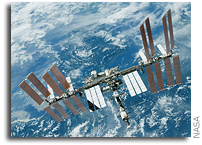
ISS On-Orbit Status 05/09/12
All ISS systems continue to function nominally, except those noted previously or below. >>>Den’ Pobedy (Victory Day), one of the most sacred national holidays for the Russian people, commemorating the 28 millions of their countrymen fallen in the Great Patriotic War (VOV – Velíkaya Otéchestvennaya voyná, World War II).<<<
After breakfast, CDR Kononenko performed the routine inspection of the SM (Service Module) PSS Caution & Warning panel as part of regular Daily Morning Inspection.
For his on-going 4th (FD135) Ambulatory Monitoring session of the ESA ICV (Integrated Cardiovascular) Alternate experiment, FE-6 Pettit reached midpoint at about 8:19am EDT, after which he began the second 24h data collection period. [For the second 24 hr period, the Cardiopres was temporarily doffed and the HM2 HiFi CF Card and AA Battery were changed out to allow continuation of the session for another 24 hours. After data collection is complete, the Actiwatches and both HM2 HiFi CF Cards are downloaded to the HRF PC1, while Cardiopres data are downloaded to the EPM (European Physiology Module) Rack and transferred to the HRF PC1 via a USB key for downlink. The sessions are scheduled at or around FD14, FD30, FD75, FD135 and R-15 (there will be fewer sessions if mission duration is less than six months). (ICV activities consist of two separate but related parts over a one-week time period: an ultrasound echo scan & an ambulatory monitoring session.)]
After a standardized (instead of “normal”) breakfast from the ENERGY food kit, FE-5 Kuipers had most of his work day dedicated to his first session with the ESA ENERGY experiment. FE-6 Pettit also contributed a urine sample later in the day. [Activities included powering on, calibrating and checking out the PFS PFM/PAM (Pulmonary Function System Pulmonary Function Module/Photoacoustic Analyzer Module), then starting urine sample collections at specific intervals throughout the 4.5-hr oxygen uptake measurement period, undertaking PAM oxygen uptake measurements in four periods (lasting 45, 50, 80 & 50 minutes) plus logging all ISS food & drinks consumed during ENERGY experiment performance from lunch and dinner on Day 1 until breakfast on Day 10. André wears an armband monitor, positioned on the right triceps where it started automatically on skin contact. The instrument must be worn for the entire 10-day ENERGY measurement period and removed only during showers or if needed during blood draws. Activities without the armband monitor on the triceps must be carefully logged. The monitor will be removed at the end of the 10-day period, then data will be downloaded from the device. Background: The observed loss of astronauts’ body mass during space flight is partly due to the systematic ongoing negative energy balance in micro-G, in addition to disuse. Unfortunately, the reason for such unbalanced match between intake and output is not clear, but appealing data suggest a relation between the degree of energy deficit and the exercise level prescribed as a countermeasure. Purpose of the ENERGY experiment is (1) to measure changes in energy balance during long term space flight, (2) to measure adaptations in the components of the Total Energy Expenditure TEE (consumption), and (3) to derive an equation for the energy requirements of astronauts. TEE is the sum of resting metabolic rate (RMR, measured), diet-induced thermogenesis (DIT, measured oxygen-uptake minus RMR) and activity-related energy expenditure (AEE, calculated).]
Kononenko completed the daily IMS (Inventory Management System) maintenance, updating/editing its standard “delta file” including stowage locations, for the regular weekly automated export/import to its three databases on the ground (Houston, Moscow, Baikonur).
The CDR also took care of the routine daily servicing of the SOZh system (Environment Control & Life Support System, ECLSS) in the SM. [Regular daily SOZh maintenance consists, among else, of checking the ASU toilet facilities, replacement of the KTO & KBO solid waste containers, replacement of EDV-SV waste water and EDV-U urine containers and filling EDV-SV, KOV (for Elektron), EDV-ZV & EDV on RP flow regulator.]
Pettit had ~90 min set aside for more ATV-3 (Automated Transfer Vehicle 3) cargo operations (unloading & unpacking into stowage) and bag cleaning, i.e., stowing discarded bags and foam packing material in “Edoardo Amaldi”, including a tagup with the ground at ~7:30am EDT for a status report.
In the Lab, Don supported POIC (Payload Operations & Integration Center) ops by setting up the camcorder on the overhead seat track for an angled view of the CIR (Combustion Integrated Rack) Rack (Node-1 side) and then readied the rack for more experiment runs. [After opening the combustion chamber front end cap, Don removed one MDCA (Multi-user Droplet Combustion Apparatus) fuel reservoir (loc. 2) and replaced it with a new one (#2015, with 5 mL Decane fuel). Afterwards, he closed both CIR rack doors, turned on two switches and notified POIC that the rack was ready for remotely commanding the RPC (Remote Power Controller). MTL (Moderate Temperature Loop) lines were disconnected at the start of this activity and reconnected at the end.]
Pettit also removed power from the RWS DCPs (Robotic Workstation Data & Control Panels) in the Lab and Cupola to preserve operational life.
Oleg Kononenko worked with the CMS (Countermeasure System), a component of the SKDS GANK-4M suite, to check for CO (Carbon Monoxide) and Formaldehyde contamination in the SM, recording the measurements. [CMS uses preprogrammed microchips to measure for numerous contaminants such as O-Xylol (1,2-Dimethylbenzol, C8H10), Hydrogen Chloride (HCl), Formaldehyde, Isopropanol, Methanol, Toluene, Mercaptan, Sulphur Dioxide, Hydrogen Cyanide, Phosgene, Ozone, Acetic Acid, Ammonia, Nitrogen Dioxide, Nitrous Oxides, Acetone, Benzene, Carbon Monoxide, etc.]
Afterwards, the CDR continued the current round of periodic preventive maintenance of RS (Russian Segment) ventilation systems, today working in the FGB (Funktsionalnyi-Grusovoj Blok). [Using a vacuum cleaner and soft brush, Oleg cleaned filter and fan grille of the TsV1 central circulation ventilator, replaced the PS1 & PS2 dust filter cartridges with fresh units, and cleaned the detachable VT7 fan screens of the three SOTR gas-liquid heat exchangers (GZhT4), plus the fixed GZhT4 grill.]
At ~10:35am, André conducted the weekly ESA crew conference via phone with the EAC (European Astronaut Center) near Cologne /Germany.
At ~1:00pm, Don had his regular weekly PMC (Private Medical Conference), via S- & Ku-band audio/video.
Before Presleep, Pettit will turn on the MPC (Multi-Protocol Converter) and start the Ku-band data flow of video recorded during the day to the ground, with POIC (Payload Operations & Integration Center) routing the onboard HRDL (High-Rate Data Link). After about an hour, André turns MPC routing off again. [This is a routine operation which regularly transmits HD onboard video (live or tape playback) to the ground on a daily basis before sleeptime.]
The crew worked out with their regular 2-hr physical exercise protocol on the CEVIS (cycle ergometer with vibration isolation (FE-6), TVIS treadmill with vibration isolation & stabilization (CDR), ARED advanced resistive exerciser (CDR, FE-5, FE-6), and T2/COLBERT advanced treadmill (FE-5). [FE-6 is on the special experimental SPRINT protocol which diverts from the regular 2.5 hrs per day exercise regime and introduces special daily sessions, followed by a USND (Ultrasound) leg muscle self scan in COL. No exercise is being timelined for Fridays. If any day is not completed, Don picks up where he left off, i.e., he would be finishing out the week with his last day of exercise on his off day.]
Tasks listed for Kononenko on the Russian discretionary “time permitting” job for today were –
• A ~30-min. session for Russia’s EKON Environmental Safety Agency, making observations and taking KPT-3 aerial photography of environmental conditions on Earth using the NIKON D3X camera with the RSK-1 laptop, and
• More preparation & downlinking of reportages (written text, photos, videos) for the Roskosmos website to promote Russia’s manned space program (max. file size 500 Mb).
CEO (Crew Earth Observation) targets uplinked for today were Aral Sea, central Asia (looking right of track to document the present status of the reduced waterbodies of the Aral Sea), Sarajevo, Bosnia and Herzegovina (CAPITAL CITY COLLECTION. Looking right for this city of 311,000, located opposite the linear islands of the northern Adriatic Sea. The city itself appears as a bright patch within the forested mountains), Podgorica, Montenegro (CAPITAL CITY COLLECTION. Looking right of track for Podgorica, near the coast of the Adriatic Sea and next to the large Lake Scutari. Podgorica is the capital and largest city [pop. 136,000] of Montenegro), Skopje, Macedonia (CAPITAL CITY COLLECTION. Looking right, the city lies inland of two lakes and a prominent deforested mountain range. With ~500,000 people, Skopje accounts for fully one third of Macedonia’s population).
ISS Orbit (as of this morning, 9:12am EDT [= epoch])
Mean altitude – 399.3 km
Apogee height – 406.3 km
Perigee height – 392.3 km
Period — 92.55 min.
Inclination (to Equator) — 51.64 deg
Eccentricity — 0.0010305
Solar Beta Angle — -33.7 deg (magnitude increasing)
Orbits per 24-hr. day — 15.56
Mean altitude loss in the last 24 hours — 55 m
Revolutions since FGB/Zarya launch (Nov. 98) — 77,199
Time in orbit (station) — 4919 days
Time in orbit (crews, cum.) — 4206 days
Significant Events Ahead (all dates Eastern Time and subject to change):
————–Three-crew operations————-
05/14/12 — Soyuz TMA-04M/30S launch – G.Padalka (CDR-32)/J.Acaba/S.Revin (~11:02 pm EDT)
05/17/12 — Soyuz TMA-04M/30S docking (MRM2) (~12:39am EDT)
05/19/12 — SpaceX Falcon/Dragon launch (~4:55am EDT)
05/22/12 — SpaceX Dragon berthing (~12:15pm EDT)
————–Six-crew operations—————-
07/01/12 — Soyuz TMA-03M/29S undock/landing (End of Increment 31)
————–Three-crew operations————-
07/15/12 — Soyuz TMA-05M/31S launch – S.Williams (CDR-33)/Y.Malenchenko/A.Hoshide
07/17/12 — Soyuz TMA-05M/31S docking
07/20/12 — HTV3 launch (~10:18pm EDT)
07/22/12 — Progress M-15M/47P undock
07/24/12 — Progress M-15M/47P re-docking
07/30/12 — Progress M-15M/47P undocking/deorbit
07/31/12 — Progress M16M/48P launch
08/02/12 — Progress M16M/48P docking
————–Six-crew operations—————-
09/17/12 — Soyuz TMA-04M/30S undock/landing (End of Increment 32)
————–Three-crew operations————-
10/15/12 — Soyuz TMA-06M/32S launch – K.Ford (CDR-34)/O.Novitskiy/E.Tarelkin
10/17/12 — Soyuz TMA-06M/32S docking
————–Six-crew operations————-
11/01/12 — Progress M-17M/49P launch
11/03/12 — Progress M-17M/49P docking
11/12/12 — Soyuz TMA-05M/31S undock/landing (End of Increment 33)
————–Three-crew operations————-
12/05/12 — Soyuz TMA-07M/33S launch – C.Hadfield (CDR-35)/T.Mashburn/R.Romanenko
12/07/12 — Soyuz TMA-07M/33S docking
————–Six-crew operations————-
12/26/12 — Progress M-18M/50P launch
12/28/12 — Progress M-18M/50P docking
03/19/13 — Soyuz TMA-06M/32S undock/landing (End of Increment 34)
————–Three-crew operations————-
04/02/13 — Soyuz TMA-08M/34S launch – P.Vinogradov (CDR-36)/C.Cassidy/A.Misurkin
04/04/13 — Soyuz TMA-08M/34S docking
————–Six-crew operations————-
05/16/13 — Soyuz TMA-07M/33S undock/landing (End of Increment 35)
————–Three-crew operations————-
05/29/13 — Soyuz TMA-09M/35S launch – M.Suraev (CDR-37)/K.Nyberg/L.Parmitano
05/31/13 — Soyuz TMA-09M/35S docking
————–Six-crew operations————-
09/xx/13 — Soyuz TMA-08M/34S undock/landing (End of Increment 36)
————–Three-crew operations————-
09/xx/13 — Soyuz TMA-10M/36S launch – M.Hopkins/TBD (CDR-38)/TBD
09/xx/13 — Soyuz TMA-10M/36S docking
————–Six-crew operations————-
11/xx/13 — Soyuz TMA-09M/35S undock/landing (End of Increment 37)
————–Three-crew operations————-
11/xx/13 — Soyuz TMA-11M/37S launch – K.Wakata (CDR-39)/R.Mastracchio/TBD
11/xx/13 — Soyuz TMA-11M/37S docking
————–Six-crew operations————-
03/xx/14 — Soyuz TMA-10M/36S undock/landing (End of Increment 38)
————–Three-crew operations————-



