
NASA ISS On-Orbit Status 07 September 2012
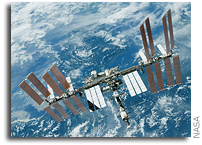
ISS On-Orbit Status 09/07/12
All ISS systems continue to function nominally, except those noted previously or below.
After wakeup, CDR Padalka performed the routine inspection of the SM (Service Module) PSS Caution & Warning panel as part of regular Daily Morning Inspection.
Also after wakeup, FE-2 Revin serviced the BTKh-26 KASKAD experiment, extracting the top of the bioreactor (#6) from the TBU-V incubator (+29 degC), shaking it with “moderately strong” movements for 2 minutes without taking it out of the case and inserting it again in TBU-V. [Started on 8/23, this activity is being carried out for 21 days, once in the morning and once in the evening.]
Revin terminated his 5th Sonocard experiment session, started last night for the long-term Russian sleep study MBI-12/Sonokard, taking the recording device from his Sonokard sports shirt pocket and later copying the measurements to the RSE-Med laptop for subsequent downlink to the ground. [Sonokard objectives are stated to (1) study the feasibility of obtaining the maximum of data through computer processing of records obtained overnight, (2) systematically record the crewmember’s physiological functions during sleep, (3) study the feasibility of obtaining real-time crew health data. Investigators believe that contactless acquisition of cardiorespiratory data over the night period could serve as a basis for developing efficient criteria for evaluating and predicting adaptive capability of human body in long-duration space flight.]
FE-5 Williams had Day 2 of her 3rd (FD60) suite of sessions with the controlled Pro K diet protocol (Dietary Intake Can Predict and Protect against Changes in Bone Metabolism during Spaceflight and Recovery) with diet logging after the urine pH spot test, for a 5-day period after start of pH testing. After recording her diet input today, Sunita will begin the urine collections on Day, 4 Sunday (9/9) and blood sampling (fasted) on Day 5, Monday (9/10), with Pro K photography. [For the Pro K (Dietary Intake Can Predict and Protect against Changes in Bone Metabolism during Spaceflight and Recovery) protocol, there are five in-flight sessions (FD15, FD30, FD60, FD120, FD180) of samplings, to be shared with the NUTRITION w/Repository protocol, each one with five days of diet & urine pH logging and photography on the last day. The crewmember prepares a diet log and then annotates quantities of food packets consumed and supplements taken. Urine collections are spread over 24 hrs; samples go into the MELFI (Minus Eighty Laboratory Freezer for ISS) within 30 min after collection. Blood samples, on the last day, are centrifuged in the RC (Refrigerated Centrifuge) and placed in MELFI at -80 degC. There is an 8-hr fasting requirement prior to the blood draw (i.e., no food or drink, but water ingestion is encouraged). MELFI constraints: Maximum MELFI Dewar open time: 60 sec; at least 45 min between MELFI dewar door openings. Background on pH: In chemistry, pH (Potential Hydrogen) is a measure of the acidity or basicity of a watery solution. Pure water is neutral, with a pH close to 7.0 at 25 degC. Solutions with a pH less than 7 are “acidic” and solutions with a pH greater than 7 are “basic” or “alkaline”. pH measurements are important in medicine, biology, chemistry, agriculture, forestry, food science, environmental science, oceanography, civil engineers and many others.]
FE-6 Hoshide performed the periodic maintenance of the ARED advanced resistive exercise machine of evacuating its cylinder flywheels to re-establish proper vacuum condition & sensor calibration.
Afterwards, Akihiko worked in the Kibo JPM (JEM Pressurized Module) on the MSPR (Multipurpose Small Payload Rack), supporting the ground by activating MSPR components VRU (Video Compression & Recording Unit), MPC (Multi-Protocol Converter), Hub, AQH Control and ELT (Experiment Laptop Terminal) for the new JAXA AQH (Aquatic Habitat) payload for a ~9h 45m functional checkout from the ground, before deactivating the components at sleeptime. [The JAXA AQH is a closed-water circulatory system, which provides a new facility option ISS-based research. Scientists will use the habitat to study small, freshwater fish on orbit. For the first investigations, they plan to examine the Medaka fish (Oryzias latipes), looking at the impacts of radiation, bone degradation, muscle atrophy, and developmental biology. The investigations could last up to 90 days and provide data that may lead to a better understanding of related human health concerns here on Earth. Medaka fish are ideal specimens for many reasons. They are transparent, making it easy to view the inner workings of their organs. They also breed quickly and easily in micro-G environments, enabling multi-generation studies. Researchers can take advantage of a variety of genetic modifications to these fish, as well. Also, scientists already have all of the Medaka genome identified, which makes it easier to recognize any alterations to the fishes’ genes, due to factors like space radiation.]
Gennady Padalka supported the ground-commanded initiation of the 2nd repressurization of the cabin atmosphere with gas from ATV3 (Automated Transfer Vehicle 3) tankage, for about 11h 30min. [CDR was told to reorient the AED (Air Exhaust Duct) outlet towards the GCP (Gas Control Panel) to maximize airflow to the GCP base since photos had shown that AED was not oriented suitably.]
FE-3 Acaba had ~1h 20m for the periodic microbial/fungal surface sample collection/incubation, using the Microbiology SSK (Surface Sampling Kit) with incubation bag to collect samples at selected sites in the Lab, Node-1, Node-2, Node-3, FGB, COL (Columbus Orbital Laboratory) and JPM. After five-day incubation, the media slides (microbial & fungal) will be inspected (9/12).
During RGS (Russian Groundsite) overflight at 3:20am-3:44am EDT, FE-4 Malenchenko used the SONY HVR-Z7E camcorder for a BRTK (TV System) test of the new KSPE insert cables installed by him on 9/4 in RS (Russian Segment) modules MRM1 Rassvet, MRM2 Poisk & DC1 Pirs for PAO HD video events/transmissions.
Later, Yuri had ~5 hrs set aside for working in the FGB to collect surface samples with microbial growth wipes and using Fungistat disinfectant to clean areas on equipment & structure surfaces and behind wall panels which have shown some microbial contamination in the past. [Today’s treatment focused on spaces behind panels 430, 114, 115, 230. The time-consuming work requires clearing cargo out of the way, removing bungees, photographing enclosure spaces, etc. Areas of interest are accessible frame sections, attachments, mounting bracket, pressurized shell surface areas, panel internal surfaces, etc.]
In COL (Columbus Orbital Laboratory), Joe Acaba performed his 3rd (FD75) ESA ICV (Integrated Cardiovascular) Resting Echo Scan in the US Lab, assisted by Aki Hoshide, serving as Operator/CMO (Crew Medical Officer) operating the USND (Ultrasound) scans after setting up the equipment and powering it on. Aki later downloaded the data and restowed the gear. [Wearing electrodes, ECG (Electrocardiograph) cable & VOX, Joe underwent the USND scan for ICV assessment, with video being recorded from the HRF (Human Research Facility) Ultrasound and COL cabin camera. Heart rate was tracked with the HRM (Heart Rate Monitor). There are dietary constraints, and no exercise is allowed 4 hrs prior to scan. After confirmed file transfer, the gear was powered down and stowed. Later, the data from the two HM-2 (Holter Monitor 2) HiFi Cards and two Actiwatch Spectrums were transferred from the USND-2 (Ultrasound 2) hard drive to the USND-2 USB drive. Voice required last 5 minutes for crew to inform ground copy process is complete. The USND echo experiment uses the Image Collector software on the laptop and requires VOX/Voice plus RT Video downlink during the activity. Goal of the ICV experiment is to quantify the extent, time course, and clinical significance of cardiac atrophy and identify its mechanisms. The ICV experiment consists of two separate but related activities over a one-week time period: an ultrasound echo scan & an ambulatory monitoring session. The sessions are scheduled at or around FD14, FD30, FD75, FD135 and R-15 (there are fewer sessions if mission duration is less than six months).]
FE-2 Sergei Revin completed his 3rd preliminary (predvariteljnaya) orthostatic hemodynamic endurance test run with the Russian Chibis suit in preparation for his return to gravity on 9/16 with Soyuz 30S (along with Gennady Padalka & Joe Acaba), conducting the ODNT exercise protocol in the below-the-waist reduced-pressure device (ODNT, US: LBNP/Lower Body Negative Pressure) on the TVIS treadmill. CDR Padalka acted as CMO (Crew Medical Officer). FE-2 was supported in his one-hour session by telemetry downlink/monitoring via VHF at 4:56am-5:14am EDT. [The Chibis provides gravity-simulating stress to the body’s cardiovascular/circulatory system for evaluation of the crewmember’s orthostatic tolerance (e.g., the Gauer-Henry reflex) after his long-term stay in zero-G. The preparatory training consists of first imbibing 150-200 milliliters of water or juice, followed by a sequence of progressive regimes of reduced (“negative”) pressure, set at -20, -25, -30, and -35 mmHg for five min. each while shifting from foot to foot at 10-12 steps per minute, wearing a sphygmomanometer to measure blood pressure and the REG ShKO Rheoencephalogram Biomed Cap, supported by the Gamma-1M biomed data control system. The body’s circulatory system interprets the pressure differential between upper and lower body as a gravity-like force pulling the blood (and other liquids) down. Chibis data and biomed cardiovascular readings are recorded. The Chibis suit (not to be confused with the Russian “Pinguin” suit for spring-loaded body compression, or the “Kentavr” anti-g suit worn during reentry) is similar to the U.S. LBNP facility (not a suit) used for the first time on Skylab in 1973/74, although it appears to accomplish its purpose more quickly.]
Joe completed another weekly 10-min. CWC (Contingency Water Container) inventory as part of continuing WRM (Water Recovery & Management) assessment of onboard water supplies. Updated “cue cards” based on the crew’s water calldowns are sent up every other week for recording changes. [The current card (32-0027H) lists 20 CWCs (270.25 L total), including 5 empty bags, for the five types of water identified on board: 1. Silver technical water (4 CWCs with 171 7 L), plus 1 empty bag; 2. Condensate water (3 CWCs with 14.0 L, plus 2 empty bags); 3. Iodinated water (8 CWCs with 84.55 L), plus 1 empty bag; and 4. Waste water (1 empty bag EMU waste water). Also one leaky CWC (#1024) with 8.5 L, stowed in ATV3 for disposal. No bags with Wautersia bacteria. Other CWCs are stowed behind racks and are currently not being tracked due to unchanging contents. Wautersia bacteria are typical water-borne microorganisms that have been seen previously in ISS water sources. These isolates pose no threat to human health.]
In the DC1 Docking Compartment, Revin continued his work on the BTKh-39 ASEPTIK experiment in the TVU incubator with the “Vozdukh” (Air) air sampler #7.2 in the Russian Glavboks-S (Glovebox-S), letting it collect another batch of air samples for subsequent incubation in the TVU for incubation to check for asepsis. The BTKh-39 experiment was then terminated and the Glovebox prepared for stowage. [Objective of ASEPTIK: Development of methods and onboard equipment to provide aseptic conditions to conduct biotechnological experiments in a space flight. Asepsis is the state of being free from microorganisms such as bacteria, viruses, fungi and parasites, or preventing contact with microorganisms.]
Later, Sergei took the periodic documentary photographs of the running educational experiment OBR-1-2/Fizika-Obrazovaniye, currently featuring the “Physics-Phase” (FAZA) demo, initiated on 8/14. As usual, images were downlinked through the high-speed RSPI Data Transmission Radio Link. [Obrazovaniye (Education) is a suite of three educational demonstrations of physics in micro-G, viz., OBR-1-1/”Fizika-LT” (Motion), OBR-1-2/”Fizika-Faza” (Phase) and OBR-1-3/”Fizika-Otolit”. The current “FAZA” demo studies a complete gas-liquid phase separation of fine dispersion particles in micro-G with diffusion and surface tension of the fluid.]
Acaba had ~30 min set aside for disconnecting & removing the LTC (Lab Truss Contingency) jumper which he had installed on 8/29 to transfer critical power loads from the failed MBSU1 (Main Bus Switching Unit 1) during the recent power “rationing”. The cable was then restowed in Node-1 along with the SPDA (Secondary Power Distribution Assembly), taken down yesterday. [For the LTC de-installation, the ITCS (Internal Thermal Control System) Loop A, the PMM (Permanent Multipurpose Module) and some other loads have to be taken down temporarily.]
In the US A/L (Airlock), Sunita Williams continued the post-EVA deconfiguring of the EMU (Extravehicular Mobility Unit) suits, today scrubbing the cooling loops of backup suits 3005 & 3015 and performing a water dump/fill for EMU 3005 only (due to the suspect water in EMU 3015 which will be sampled at a later date). Aki joined in for ~90 min of EVA tool stowage, including relocating the hatch contingency tool kit to the PMA-1 (Pressurized Mating Adapter 1). The suits were then stowed in the A/L’s E-LK (Equipment Lock).
In preparation for their return on Soyuz 30S in 9 days, Gennady Padalka, Sergei Revin & Joe Acaba donned their Sokol intravehicular pressure suits to perform the standard leak check in their spacecraft, a 60-min job. After doffing the suits, Sergei set them up along with their gloves for drying and then stowed the gear.
In MRM2 (Mini Research Module 2), CDR Padalka conducted another active session for the Russian experiment KPT-10 “Kulonovskiy Kristall” (Coulomb Crystal), followed by downlinking the video footage obtained with a SONY HVR-Z1J camcorder via RSPI (Data Transmission Radio Link), assisted by Yuri. [KPT-10 studies dynamic and structural characteristics of the Coulomb systems formed by charged dispersed diamagnetic macroparticles in the magnetic trap, investigating the following processes onboard the ISS RS: condensed dust media, Coulomb crystals, and formation of Coulomb liquids due to charged macroparticles. Coulomb systems are structures following Coulomb’s Law, a law of physics describing the electrostatic interaction between electrically charged particles. It was essential to the development of the theory of electromagnetism.]
FE-3 Acaba, FE-6 Hoshide & FE-5 Williams filled out their standard FFQs (Food Frequency Questionnaires) on the MDLT (Medical Laptop). It was Aki’s & Suni’s 6th, Joe’s 13th. [On the FFQs, USOS astronauts keep a personalized log of their nutritional intake over time on special MDLT software. Recorded are the amounts consumed during the past week of such food items as beverages, cereals, grains, eggs, breads, snacks, sweets, fruit, beans, soup, vegetables, dairy, fish, meat, chicken, sauces & spreads, and vitamins. The FFQ is performed once a week to estimate nutrient intake from the previous week and to give recommendations to ground specialists that help maintain optimal crew health. Weekly estimation has been verified to be reliable enough that nutrients do not need to be tracked daily.]
In preparation for release & undocking of HTV3 (H-2 Transfer Vehicle 3) Kounotori 3 on 9/12, Suni & Aki undertook the first of two 45-min self-study OBT (Onboard Training) sessions, followed by a 15-min teleconference with Robotics, VVO (Visiting Vehicle Officer) & Robotics personnel at 1:30pm EDT. [The 2nd session will be on Monday, 9/10, without teleconference.]
Aki activated the ISSAC (ISS Agriculture Camera) laptop to enable ground testing. Window shutters remain closed [ISSAC takes frequent visible-light & infrared images of vegetated areas on the Earth. The camera focuses principally on rangelands, grasslands, forests, and wetlands in the northern Great Plains and Rocky Mountain regions of the United States. The images may be delivered directly upon request to farmers, ranchers, foresters, natural resource managers and tribal officials to help improve their environmental stewardship of the land. The images will also be shared with educators for classroom use.]
Padalka conducted the routine daily servicing of the SOZh system (Environment Control & Life Support System, ECLSS) in the SM. [Regular daily SOZh maintenance consists, among else, of checking the ASU toilet facilities, replacement of the KTO & KBO solid waste containers, replacement of EDV-SV waste water and EDV-U urine containers and filling EDV-SV, KOV (for Elektron), EDV-ZV & EDV on RP flow regulator.]
Gennady also took care of the daily IMS (Inventory Management System) maintenance from the discretionary “time permitting” task list, updating/editing its standard “delta file” including stowage locations, for the regular weekly automated export/import to its three databases on the ground (Houston, Moscow, Baikonur).
At ~4:05am EDT, the three Russian crewmembers held the regular (nominally weekly) tagup with the Russian Main Flight Control Team (GOGU/Glavnaya operativnaya gruppa upravleniya), including Shift Flight Director (SRP), at TsUP-Moscow via S-band/audio, phone-patched from Houston and Moscow.
At ~4:20am, Yuri Malenchenko & Sergei Revin linked up with TsUP-Moscow stowage specialists via S-band to conduct the weekly IMS tagup, discussing inventory & stowage issues, equipment locations and cargo transfers.
At ~4:40am, Suni Williams powered up the SM’s amateur radio equipment (Kenwood VHF transceiver with manual frequency selection, headset, & power supply) and at 4:50am conducted a ham radio session with students at the Gymnasium Michelstadt in Michelstadt, Germany.
At ~9:20am, Joe & Suni conducted the regular IMS stowage conference with Houston stowage specialists.
At ~12:40pm, Williams supported a PAO TV downlink, extending deferred (i.e., recorded) messages of greetings and congratulations for two events,- the 50th anniversary of President John F. Kennedy’s famous speech at the Rice University Stadium in Houston on 9/12 (…we are flying to the Moon “…not because it is easy but because it is hard…”), and the 50th anniversary of the Kennedy Space Center on 9/22 on the occasion of festivities at KSC headed by Charlie Bolden, Lori Garver and Bob Cabana.
The Russian 30S crewmembers, Padalka & Revin, again had an hour set aside each for personal crew departure preparations which is standard pre-return procedure for homecoming crewmembers.
Before Presleep (~3:40pm), Acaba turns on the MPC (Multi-Protocol Converter) and starts the Ku-band data flow of video recorded during the day to the ground, with POIC (Payload Operations & Integration Center) routing the onboard HRDL (High-Rate Data Link). After about an hour, Joe turns MPC routing off again. [This is a routine operation which regularly transmits HD onboard video (live or tape playback) to the ground on a daily basis before sleeptime.]
The crew worked out on the CEVIS cycle ergometer with vibration isolation (FE-3), TVIS treadmill with vibration isolation & stabilization (CDR, FE-2/2x, FE-4), ARED advanced resistive exercise device (FE-3, FE-5, FE-6), T2/COLBERT advanced treadmill (CDR, FE-5, FE-6), and VELO ergometer bike with load trainer (FE-4). [FE-6 & FE-5 are on the special experimental SPRINT protocol which diverts from the regular 2.5 hrs per day exercise regime and introduces special daily sessions involving resistive and aerobic (interval & continuous) exercise, followed by a USND (Ultrasound) leg muscle self scan in COL. No exercise is being timelined for Suni on Friday, for Aki on Thursday. If any day is not completed, Suni & Aki pick up where they left off, i.e., they would be finishing out the week with the last day of exercise on her off day. Suni’s protocol for today showed T2 (interval, 4min.), with T2 (int., 2 min.), ARED/T2 (cont.), T2 (int., 30 sec.), ARED/VO2max, T2 (int., 4 min.) and ARED/CEVIS (cont.) for the next 6 days. Aki’s protocol for today showed ARED/T2 (cont.), with T2 (int., 2 min.), ARED/CEVIS (cont.), T2 (int., 30 sec.), ARED/CEVIS (cont.) and T2 (int., 4 min.) on the following 5 days.]
Tasks listed for Revin, Malenchenko & Padalka on the Russian discretionary “time permitting” job for today were –
• More preparation & downlinking of reportages (written text, photos, videos) for the Roskosmos website to promote Russia’s manned space program (max. file size 500 Mb), and
• A detailed & general view photo session with TEKh-52 Vizir of the disastrous flooding which occurred overnight on 8/21-22 at the Black Sea, and
• A ~30-min. session for Russia’s EKON Environmental Safety Agency, making observations and taking KPT-3 aerial photography of environmental conditions on Earth using the NIKON D3X camera with the RSK-1 laptop.
ISS Orbit (as of this morning, 9:35am EDT [= epoch])
Mean altitude — 415.4 km
Apogee height — 426.0 km
Perigee height — 404.8 km
Period — 92.88 min.
Inclination (to Equator) — 51.64 deg
Eccentricity — 0.0015569
Solar Beta Angle — -45.8 deg (magnitude peaking)
Orbits per 24-hr. day — 15.50
Mean altitude loss in the last 24 hours — 83 m
Revolutions since FGB/Zarya launch (Nov. 98) — 79,082
Time in orbit (station) — 5040 days
Time in orbit (crews, cum.) — 4327 days.
CEO (Crew Earth Observation) targets uplinked for today were Yangtze River Delta (the Yangtze is the world’s third longest river and reaches the East China Sea at Shanghai. The delta region is one of the most densely populated areas on Earth. The ISS pass was at midday with fair weather expected. As ISS approached the Chinese coast from the NW, the crew was to look just right of track for this target, trying for context mapping of the area), Lisbon, Portugal (Capital Cities Collection: ISS had a mid-morning pass over the capital city of Portugal in clear weather. At this time, as the crew approached the coast from the SW, they were to aim just left of track for the great estuary of the Tagus River. Greater Lisbon appears as a gray zone on either side of the estuary. The city center is at the narrow, coastal end of the estuary. Bridges over the estuary may also have been visible), Brussels, Belgium (Capital Cities Collection: ISS had a late morning pass today with good weather for this capital city target. Brussels, with a population of nearly 2 million, is located in central Belgium about 70 miles inland from the North Sea. As ISS tracked ENE and inland at this time, the crew was to shoot just right of track for this major city), Budapest, Hungary (Capital Cities Collection: The beautiful Hungarian capital city of 1.75 million sits astride the Danube River in the north central part of the country. ISS had an early afternoon pass in fair weather with an approach from the NW. At this time the crew was to look right of track for views Budapest located just SE of a major right-angle bend in the course of the Danube, trying for views of the entire urban area within a single frame), Vatican City (as ISS hugged the Italian coastline, the crew was to aim nadir to capture images of Rome and the Holy See. The urban area of Rome appears gray near the coastline. The Vatican City lies on the Tiber River and appears as one of the smaller tree-filled), West Hawk Impact, MB-CAN (Terrestrial Impact Craters: ISS had a mid-day pass in fair weather over this target area with its approach from the SW. West Hawk Lake, which fills the impact structure, is about 100 miles east of Winnipeg, Manitoba and 50 miles north of Lake of the Woods on the US/Canadian border. This 4.5 km-diameter crater was formed 350 million years ago. Despite several episodes of glacial erosion in the last 2 million years, it is still evident in the landscape. At this time, as ISS tracked over the city of Winnipeg, the crew was to look just right of track to begin an overlapping mapping strip and acquire this small feature), and Coast Mts., BC, Canada (ISS had a mid-afternoon pass in fair weather over these beautiful snowcapped mountains rising above the forests of western British Columbia. The glaciers here have been in a well-documented, heavy retreat for the past couple of decades even though they are located in a moist, marine environment, with heavy winter snowfalls and elevations ranging from 10,000 to 13,000 feet. As the crew tracked eastward north of Vancouver Island, they were to look right of track for context views of this target area).
Significant Events Ahead (all dates Eastern Time and subject to change):
————–Six-crew operations—————-
09/12/12 — HTV3 undocking
09/14/12 — HTV3 reentry
09/14/12 — ISS/ATV reboost
09/16/12 — Soyuz TMA-04M/30S undock/landing – 7:11pm/10:55pm
(End of Increment 32)
————–Three-crew operations————-
09/25/12 — ATV3 undocking
10/15/12 — Soyuz TMA-06M/32S launch – K.Ford (CDR-34)/O.Novitsky/E.Tarelkin
10/17/12 — Soyuz TMA-06M/32S docking
————–Six-crew operations————-
10/31/12 — Progress M-17M/49P launch
10/31/12 — Progress M-17M/49P docking
11/12/12 — Soyuz TMA-05M/31S undock/landing (End of Increment 33)
————–Three-crew operations————-
12/05/12 — Soyuz TMA-07M/33S launch – C.Hadfield (CDR-35)/T.Mashburn/R.Romanenko
12/07/12 — Soyuz TMA-07M/33S docking
————–Six-crew operations————-
02/11/13 — Progress M-16M/48P undocking
02/12/13 — Progress M-18M/50P launch
02/14/13 — Progress M-18M/50P docking
03/15/13 — Soyuz TMA-06M/32S undock/landing (End of Increment 34)
————–Three-crew operations————-
04/02/13 — Soyuz TMA-08M/34S launch – P.Vinogradov (CDR-36)/C.Cassidy/A.Misurkin
04/04/13 — Soyuz TMA-08M/34S docking
04/23/13 — Progress M-18M/50P undock/landing
————–Six-crew operations————-
05/16/13 — Soyuz TMA-07M/33S undock/landing (End of Increment 35)
————–Three-crew operations————-
05/29/13 — Soyuz TMA-09M/35S launch – M.Suraev (CDR-37)/K.Nyberg/L.Parmitano
05/31/13 — Soyuz TMA-09M/35S docking
————–Six-crew operations————-
09/xx/13 — Soyuz TMA-08M/34S undock/landing (End of Increment 36)
————–Three-crew operations————-
09/xx/13 — Soyuz TMA-10M/36S launch – M.Hopkins/TBD (CDR-38)/TBD
09/xx/13 — Soyuz TMA-10M/36S docking
————–Six-crew operations————-
11/xx/13 — Soyuz TMA-09M/35S undock/landing (End of Increment 37)
————–Three-crew operations————-
11/xx/13 — Soyuz TMA-11M/37S launch – K.Wakata (CDR-39)/R.Mastracchio/TBD
11/xx/13 — Soyuz TMA-11M/37S docking
————–Six-crew operations————-
03/xx/14 — Soyuz TMA-10M/36S undock/landing (End of Increment 38)
————–Three-crew operations————-



