NASA Hubble Space Telescope Daily Report #4124
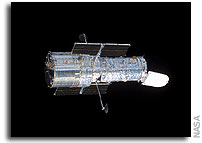
HUBBLE SPACE TELESCOPE – Continuing to collect World Class Science
DAILY REPORT # 4124
PERIOD COVERED: UT May 30, 2006 (DOY 150)
OBSERVATIONS SCHEDULED
ACS/HRC 10474
Shooting Stars: Looking for Direct Evidence of Massive Central Black Holes in Globular Clusters
We propose to make observations that directly test the proposition that globular clusters contain massive black holes. Our targets are the bulge globular clusters NGC 6388 and NGC 6441. These are probably among the most massive in the galaxy, but are understudied compared to more familiar objects such as M15. Our analysis suggests that these two clusters are the most likely to show unambiguous evidence for a central massive black hole if such things exist in globular clusters. The observations proposed will give us the first thorough kinematic and photometric studies of these two clusters. The combination of the two epochs will give us proper motions good to of order 6 km/s. In addition, they will provide us with the first good, deep, color-magnitude diagrams for these clusters. These diagrams will be used to investigate the make up of the stellar population in the clusters, to more firmly establish their distances, ages, and metallicities, and to search for a binary sequence.
ACS/HRC/WFC 10737
CCD Stability Monitor
This program will verify that the low frequency flat fielding, the photometry, and the geometric distortion are stable in time and across the field of view of the CCD detectors. A moderately crowded stellar field in the cluster 47 Tuc is observed every three months with the HRC {at the cluster core} and WFC {6′ West of the cluster core} using the full suite of broad and narrow band imaging filters. The positions and magnitudes of objects will be used to monitor local and large scale variations in the plate scale and the sensitivity of the detectors and to derive an independent measure of the detector CTE. An additional orbit is required to compare WFC observations taken at gain 1 with those taken at the new default gain 2.
ACS/WFC 10496
Decelerating and Dustfree: Efficient Dark Energy Studies with Supernovae and Clusters
We propose a novel HST approach to obtain a dramatically more useful “dust free” Type Ia supernovae {SNe Ia} dataset than available with the previous GOODS searches. Moreover, this approach provides a strikingly more efficient search-and-follow-up that is primarily pre- scheduled. The resulting dark energy measurements do not share the major systematic uncertainty at these redshifts, that of the extinction correction with a prior. By targeting massive galaxy clusters at z > 1 we obtain a five-times higher efficiency in detection of Type Ia supernovae in ellipticals, providing a well-understood host galaxy environment. These same deep cluster images then also yield fundamental calibrations required for future weak lensing and Sunyaev-Zel’dovich measurements of dark energy, as well as an entire program of cluster studies. The data will make possible a factor of two improvement on supernova constraints on dark energy time variation, and much larger improvement in systematic uncertainty. They will provide both a cluster dataset and a SN Ia dataset that will be a longstanding scientific resource.
ACS/WFC 10592
An ACS Survey of a Complete Sample of Luminous Infrared Galaxies in the Local Universe
At luminosities above 10^11.4 L_sun, the space density of far-infrared selected galaxies exceeds that of optically selected galaxies. These `luminous infrared galaxies’ {LIRGs} are primarily interacting or merging disk galaxies undergoing enhanced star formation and Active Galactic Nuclei {AGN} activity, possibly triggered as the objects transform into massive S0 and elliptical merger remnants. We propose ACS/WFC imaging of a complete sample of 88 L_IR > 10^11.4 L_sun luminous infrared galaxies in the IRAS Revised Bright Galaxy Sample {RBGS: i.e., 60 micron flux density > 5.24 Jy}. This sample is ideal not only in its completeness and sample size, but also in the proximity and brightness of the galaxies. The superb sensitivity, resolution, and field of view of ACS/WFC on HST enables a unique opportunity to study the detailed structure of galaxies that sample all stages of the merger process. Imaging will be done with the F439W and F814W filters {B and I-band} to examine as a function of both luminosity and merger state {i} the evidence at optical wavelengths of star formation and AGN activity and the manner in which instabilities {bars and bridges} in the galaxies may funnel material to these active regions, {ii} the relationship between star formation and AGN activity, and {iii} the structural properties {AGN, bulge, and disk components} and fundamental parameters {effective radius and surface brightness} of LIRGs and their similarity with putative evolutionary byproducts {elliptical, S0 and classical AGN host galaxies}. This HST survey will also bridge the wavelength gap between a Spitzer imaging survey {covering seven bands in the 3.6-160 micron range} and a GALEX UV imaging survey of these galaxies, but will resolve complexes of star clusters and multiple nuclei at resolutions well beyond the capabilities of either Spitzer or GALEX. The combined datasets will result in the most comprehensive multiwavelength study of interacting and merging galaxies to date.
ACS/WFC 10775
An ACS Survey of Galactic Globular Clusters
We propose to conduct an ACS/WFC imaging survey of Galactic globular clusters. We will construct the most extensive and deepest set of photometry and astrometry to-date for these systems reaching a main sequence mass of ~0.2 solar mass with S/N >= 10. We will combine these data with archival WFPC2 and STIS images to determine proper motions for the stars in our fields. The resultant cleaned cluster CMDs will allow us to study a variety of scientific questions. These include [but are not limited to] 1} the determination of cluster ages and distances 2} the construction of main sequence mass functions and the issue of mass segregation 3} the internal motions and dynamical evolution of globular clusters, and 4} absolute cluster motions, orbits, and the Milky Way gravitational potential. We anticipate that the unique resource provided by the proposed treasury archive will play a central role in the field of globular cluster studies for decades, with a stature comparable to that of the Hubble Deep Field for high redshift studies.
FGS 10613
Calibrating the Mass-Luminosity Relation at the End of the Main Sequence
We propose to use HST-FGS1R to calibrate the mass-luminosity relation {MLR} for stars less massive than 0.2 Msun, with special emphasis on objects near the stellar/brown dwarf border. Our goals are to determine M_V values to 0.05 magnitude, masses to 5 than double the number of objects with masses determined to be less than 0.20 Msun. This program uses the combination of HST-FGS3/FGS1R at optical wavelengths and ground-based infrared interferometry to examine nearby, subarcsecond binary systems. The high precision measurements with HST-FGS3/FGS1R {to 1 mas in the separations} for these faint targets {V = 10–15} simply cannot be equaled by any ground based technique. As a result of these measurements, we are deriving high quality luminosities and masses for the components in the observed systems, and characterizing their spectral energy distributions from 0.5 to 2.2 Mum. Several of the objects included have M < 0.1 Msun, placing them at the very end of the stellar main sequence. Three of the targets are brown dwarf candidates, including the current low mass record holder, GJ 1245C, with a mass of 0.062 +/- 0.004 Msun. The payoff of this proposal is high because all 10 of the systems selected have already been resolved with HST- FGS3/FGS1R during Cycles 5--10 and contain most of the reddest objects for which masses can be determined.
NICMOS 8791
NICMOS Post-SAA calibration – CR Persistence Part 2
A new procedure proposed to alleviate the CR-persistence problem of NICMOS. Dark frames will be obtained immediately upon exiting the SAA contour 23, and every time a NICMOS exposure is scheduled within 50 minutes of coming out of the SAA. The darks will be obtained in parallel in all three NICMOS Cameras. The POST-SAA darks will be non-standard reference files available to users with a USEAFTER date/time mark. The keyword ‘USEAFTER=date/time’ will also be added to the header of each POST-SAA DARK frame. The keyword must be populated with the time, in addition to the date, because HST crosses the SAA ~8 times per day so each POST-SAA DARK will need to have the appropriate time specified, for users to identify the ones they need. Both the raw and processed images will be archived as POST-SAA DARKSs. Generally we expect that all NICMOS science/calibration observations started within 50 minutes of leaving an SAA will need such maps to remove the CR persistence from the science images. Each observation will need its own CRMAP, as different SAA passages leave different imprints on the NICMOS detectors.
WFPC2 10745
WFPC2 CYCLE 14 INTERNAL MONITOR
This calibration proposal is the Cycle 14 routine internal monitor for WFPC2, to be run weekly to monitor the health of the cameras. A variety of internal exposures are obtained in order to provide a monitor of the integrity of the CCD camera electronics in both bays {both gain 7 and gain 15 — to test stability of gains and bias levels}, a test for quantum efficiency in the CCDs, and a monitor for possible buildup of contaminants on the CCD windows. These also provide raw data for generating annual super-bias reference files for the calibration pipeline.
WFPC2 10751
WFPC2 CYCLE 14 Intflat Linearity Check and Filter Rotation Anomaly Monitor
Intflat observations will be taken to provide a linearity check: the linearity test consists of a series of intflats in F555W, in each gain and each shutter. A combination of intflats, visflats, and earthflats will be used to check the repeatability of filter wheel motions. {Intflat sequences tied to decons, visits 1-18 in prop 10363, have been moved to the cycle 14 decon proposal 10744 for easier scheduling.} Note: long-exposure WFPC2 intflats must be scheduled during ACS anneals to prevent stray light from the WFPC2 lamps from contaminating long ACS external exposures.
WFPC2 10767
Further Resolving the Puzzle of Hybrid Star X-rays
Do Alpha TrA {K2II} and Beta Ind {K1II} have previously unrecognized X-ray active dwarf companions, leading us astray concerning the coronal properties of the “hybrid-chromosphere” class? Establishing the true X-ray luminosities of the hybrids is a basis for understanding magnetic field generation in evolved supergiants, the driving of their winds, and the seeding of coronal conditions in their extended outer envelopes. It also bears on the issue of late-type dwarfs orbiting main sequence B stars, the evolutionary predecessors of K bright giants. We propose to directly image the putative hybrid companions using Chandra, with supporting observations from HST/WFPC2.
FLIGHT OPERATIONS SUMMARY:
Significant Spacecraft Anomalies: (The following are preliminary reports of potential non-nominal performance that will be investigated.)
HSTARS:
10287 – GSAcq(1,2,1) failed to RGA Control @ 02:50:28z The primary GSAcq(1,2,1)scheduled at 151/02:50:28 – 02:58:33 failed to RGA Hold (SRLEX) on FGS-1, because the primary FGS guide star is in fact a galaxy. Per PCS SE, it is the same galaxy (ID# N59N000166, at RA 195.38265 and DEC 27.84767, with catalog magnitude 9.534) that was identified as the cause of the HSTAR 10283 failure (the Acq and 4 REacqs). Therefore the REacqs at 151/04:25, 06:01, 07:37 and 09:12 are all going to fail, with or without real-time OBAD intervention. Pre-GSAcq OBAD’s were successful with (RSS) attitude error corrections of 1030.32 and 14.78 arcseconds. OBAD/MAP at 151/03:28 had (RSS) value of 2563.85 arcseconds. One ESB message “a05” (Search Radius Limit Exceeded) was received at 151/02:56:50.
10288 – FHST OBAD/MAP Failure @ 151/05:03:38z
FHST OBAD (But no maneuver) scheduled at 151/05:03:38 failed due to too many angle checks. One 486 ESB message (OBAD_TooMany_Anglchks) was received at 151/05:06:14. OBAD/MAP had 3-axis (RSS) value of 14879.32 arcseconds.
COMPLETED OPS REQUEST:
- 17775-0 – Genslew for proposal 10539 – slot 4 @ 150/19:53z
- 17776-0 – Genslew for proposal 10539 – slot 5 @ 150/19:54z
- 17777-0 – Genslew for proposal 10539 – slot 6 @ 150/19:55z
- 17543-2 – Dump OBAD tables after failed OBAD (Generic OR) @ 151/05:17z
COMPLETED OPS NOTES: (None)
                          SCHEDULED      SUCCESSFUL      FAILURE TIMES
FGS GSacq                07                      06                Hstar #
10287
FGS REacq                 07                      04               Hstar #
10287
OBAD with Maneuver   18                       17               Hstar # 10288
SIGNIFICANT EVENTS: (None)