Mars Odyssey THEMIS Image: Trouvelot Crater Deposit
 |
|
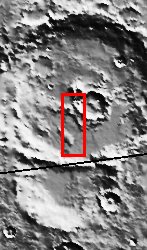
| Like many of the craters in the Oxia Palus region of Mars, Trouvelot Crater hosts an eroded, light-toned, sedimentary deposit on its floor. Compared with the much larger example in Becquerel Crater to the NE, the Trouvelot deposit has been so eroded by the scouring action of dark, wind-blown sand that very little of it remains. Tiny outliers of bright material separated from the main mass attest to the once, more areally extensive coverage by the deposit. A similar observation can be made for White Rock, the best known example of a bright, crater interior deposit. The origin of the sediments in these deposits remains enigmatic but they are likely the result of fallout from ash or dust carried by the thin martian atmosphere. [Questions? Email images@themis.asu.edu] [Source: ASU THEMIS Science Team] |
NASA’s Jet Propulsion Laboratory manages the 2001 Mars Odyssey mission for NASA’s Office of Space Science, Washington, D.C. The Thermal Emission Imaging System (THEMIS) was developed by Arizona State University, Tempe, in collaboration with Raytheon Santa Barbara Remote Sensing. The THEMIS investigation is led by Dr. Philip Christensen at Arizona State University. Lockheed Martin Astronautics, Denver, is the prime contractor for the Odyssey project, and developed and built the orbiter. Mission operations are conducted jointly from Lockheed Martin and from JPL, a division of the California Institute of Technology in Pasadena.
Image Credit: NASA/JPL/Arizona State University
| Parameter | Value | Parameter | Value | |
|---|---|---|---|---|
| Latitude | 15.6 |   | Instrument | VIS |
| Longitude | 346.7E (13.3W) |   | Resolution (m) | 19 |
| Image Size (pixels) | 3025×1230 |   | Image Size (km) | 57.5×23.4 |




