Mars Odyssey THEMIS Image: Reull Vallis
 |
|
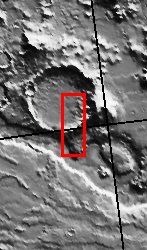
| The channels and impact crater rim shown in this THEMIS image provide insight to the forces that have sculpted the surface within the extensive Reull Vallis network. Drainage features and dissected materials observed around and within the impact crater wall demonstrate the erosional and depositional effects of possible fluvial processes. A portion of a possible landslide is also observed within the crater as lobes of material emanate from the crater wall. Reull Vallis is a large and morphologically diverse outflow channel system, and this small view from within demonstrates the combination of mass movement processes that have persisted over an extended time period.
[Questions? Email images@themis.asu.edu] [Source: ASU THEMIS Science Team] |
NASA’s Jet Propulsion Laboratory manages the 2001 Mars Odyssey mission for NASA’s Office of Space Science, Washington, D.C. The Thermal Emission Imaging System (THEMIS) was developed by Arizona State University, Tempe, in collaboration with Raytheon Santa Barbara Remote Sensing. The THEMIS investigation is led by Dr. Philip Christensen at Arizona State University. Lockheed Martin Astronautics, Denver, is the prime contractor for the Odyssey project, and developed and built the orbiter. Mission operations are conducted jointly from Lockheed Martin and from JPL, a division of the California Institute of Technology in Pasadena.
Image Credit: NASA/JPL/Arizona State University
| Parameter | Value | Parameter | Value | |
|---|---|---|---|---|
| Latitude | -39.9 |   | Instrument | VIS |
| Longitude | 99.3E (260.7W) |   | Resolution (m) | 19 |
| Image Size (pixels) | 3061×1186 |   | Image Size (km) | 58.2×22.5 |




