Mars Odyssey THEMIS Image: Impact Crater with Peak
 |
|
| The Science | The Story | |||
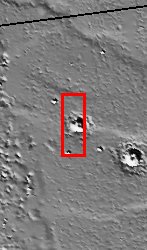
| This THEMIS visible image shows a classic example of a martian impact crater with a central peak. Central peaks are common in large, fresh craters on both Mars and the Moon. This peak formed during the extremely high-energy impact cratering event. In many martian craters the central peak has been either eroded or buried by later sedimentary processes, so the presence of a peak in this crater indicates that the crater is relatively young and has experienced little degradation. Observations of large craters on the Earth and the Moon, as well as computer modeling of the impact process, show that the central peak contains material brought from deep beneath the surface. The material exposed in these peaks will provide an excellent opportunity to study the composition of the martian interior using THEMIS multi-spectral infrared observations. The ejecta material around the crater can is well preserved, again indicating relatively little modification of this landform since its initial creation. The inner walls of this approximately 18 km diameter crater show complex slumping that likely occurred during the impact event. Since that time there has been some downslope movement of material to form the small chutes and gullies that can be seen on the inner crater wall. Small (50-100 m) mega-ripples composed of mobile material can be seen on the floor of the crater. Much of this material may have come from the walls of the crater itself, or may have been blown into the crater by the wind. [Source: ASU THEMIS Science Team] | When a meteor smacked into the surface of Mars with extremely high energy, pow! Not only did it punch an 11-mile-wide crater in the smoother terrain, it created a central peak in the middle of the crater. This peak forms kind of on the “rebound.” You can see this same effect if you drop a single drop of milk into a glass of milk. With craters, in the heat and fury of the impact, some of the land material can even liquefy.
Central peaks like the one above are common in large, fresh craters on both Mars and the Moon. In many older Martian craters, however, the central peak has either been eroded or was buried by later deposits of sand, dust, and “dirt” on the terrain. With the pronounced, non-eroded peak in this crater, you can tell that it hasn’t been around for a long time. Its youth is also apparent because of the ejected material around the crater that spreads out from it in an almost flame-or petal-like pattern with little evidence of erosion. Observations of large craters on the Earth and the Moon, as well as computer modeling of the impact process, show that central peaks contain material brought from deep beneath the surface. The material exposed in these peaks will provide an excellent opportunity to study what the interior of Mars is made of. In addition to providing images of Mars like the one above, the THEMIS camera system has the capability to analyze the mineral composition of the surface. That means it will be able to look at this area and “see” both the composition of the top surface, as well as the exposed interior that is uplifted in the central peak. Stay tuned for more news later from this crater! Until then, take a closer look at the walls of this crater. Particularly on the western side, you can see how whole portions of the wall have slid or “slumped” downward, probably sometime during the impact event. Since then, smaller amounts of material have slid downslope as well, forming small chutes and gullies that streak down the inner crater wall. On the floor of the crater, you can also see small, mobile mega-ripples that extend up to a football field in length. (Look for the tiny, bright, white ripples especially to the north of the crater floor.) These ripples were probably created from material coming down from the wall of the crater or alternatively from dust and “dirt” that was blown into the crater by the wind. [Questions? Email marsoutreach@jpl.nasa.gov] [Source: NASA/JPL Mars Outreach] | |||
NASA’s Jet Propulsion Laboratory manages the 2001 Mars Odyssey mission for NASA’s Office of Space Science, Washington, D.C. The Thermal Emission Imaging System (THEMIS) was developed by Arizona State University, Tempe, in collaboration with Raytheon Santa Barbara Remote Sensing. The THEMIS investigation is led by Dr. Philip Christensen at Arizona State University. Lockheed Martin Astronautics, Denver, is the prime contractor for the Odyssey project, and developed and built the orbiter. Mission operations are conducted jointly from Lockheed Martin and from JPL, a division of the California Institute of Technology in Pasadena.
Image Credit: NASA/JPL/Arizona State University
| Parameter | Value | Parameter | Value | |
|---|---|---|---|---|
| Latitude | 13.3 |   | Instrument | VIS |
| Longitude | 277.4W (82.6E) |   | Resolution (m) | 19 |
| Image Size (pixels) | 3025×1233 |   | Image Size (km) | 57.5×23.4 |




