Mars Odyssey THEMIS Image: Impact Crater 10-04-2002
 |
|
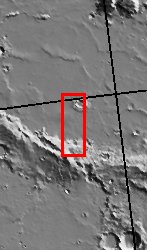
| This scene shows several interesting geologic features associated with impact craters on Mars. The continuous lobes of material that make up the ejecta blanket of the large impact crater are evidence that the crater ejecta were fluidized upon impact of the meteor that formed the crater. Volatiles within the surface mixed with the ejecta upon impact thus creating the fluidized form. Several smaller impact craters are also observed within the ejecta blanket of the larger impact crater giving a relative timing of events. Layering of geologic units is also observed within the large impact crater walls and floor and may represent different compositional units that erode at variable rates. Cliff faces, dissected gullies, and heavily eroded impact craters are observed in the bottom half of the image at the terminus of a flat-topped plateau.
[Questions? Email images@themis.asu.edu] [Source: ASU THEMIS Science Team] |
NASA’s Jet Propulsion Laboratory manages the 2001 Mars Odyssey mission for NASA’s Office of Space Science, Washington, D.C. The Thermal Emission Imaging System (THEMIS) was developed by Arizona State University, Tempe, in collaboration with Raytheon Santa Barbara Remote Sensing. The THEMIS investigation is led by Dr. Philip Christensen at Arizona State University. Lockheed Martin Astronautics, Denver, is the prime contractor for the Odyssey project, and developed and built the orbiter. Mission operations are conducted jointly from Lockheed Martin and from JPL, a division of the California Institute of Technology in Pasadena.
Image Credit: NASA/JPL/Arizona State University
| Parameter | Value | Parameter | Value | |
|---|---|---|---|---|
| Latitude | -40.4 |   | Instrument | VIS |
| Longitude | 239E (121W) |   | Resolution (m) | 19 |
| Image Size (pixels) | 3079×1186 |   | Image Size (km) | 58.5×22.5 |




