Mars Odyssey THEMIS Iimage: Water Ice Clouds over the Northern Plains
 |
|
| The Science | The Story | |||
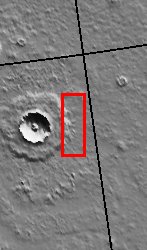
| This image, centered near 48.5 N and 240.5 W, displays splotchy water ice clouds that obscure the northern lowland plains in the region where the Viking 2 spacecraft landed. This image is far enough north to catch the edge of the north polar hood that develops during the northern winter. This is a cap of water and carbon dioxide ice clouds that form over the Martian north pole. As Mars progresses into northern spring, the persistent north polar hood ice clouds will dissipate and the surface viewing conditions will improve greatly. As the season develops, an equatorial belt of water ice clouds will form. This belt of water ice clouds is as characteristic of the Martian climate as the southern hemisphere summer dust storm season. Seasons on Mars have a dramatic effect on the state of the dynamic Martian atmosphere. [Source: ASU THEMIS Science Team] | Muted in an almost air-brushed manner, this image doesn’t have the crispness that most THEMIS images have. That’s because clouds were rising over the surface of the red planet on the day this picture was taken. Finding clouds on Mars might remind us of conditions here on Earth, but these Martian clouds are made of frozen water and frozen carbon dioxide—in other words, clouds of ice and “dry ice.”
Strange as that may sound, the clouds seen here form on a pretty regular basis at the north Martian pole during its winter season. As springtime comes to the northern hemisphere of Mars (and fall comes to the southern), these clouds will slowly disappear, and a nice belt of water ice clouds will form around the equator. So, if you were a THEMIS camera aimer, that might tell you when your best viewing conditions for different areas on Mars would be. As interesting as clear pictures of Martian landforms are, however, you wouldn’t want to bypass the weather altogether. Pictures showing seasonal shifts are great for scientists to study, because they reveal a lot about the patterns of the Martian climate and the circulation of the atmosphere. There are a lot of interesting global climate relationships to study. For example, when it’s winter in the north of Mars and clouds like the ones in this image form, dust storms rage in the south of Mars, where it’s summer. So why does Mars have these wild seasons? Like the Earth, Mars is tilted on its axis. As it travels in its orbit around the sun, the angle between the Earth’s axis and the Earth-Sun line changes. That’s true for Mars as well. As each point on Mars spins on the rotating red planet each day, the part of the cycle spent in sunlight (day) and shadow (night) just aren’t equal because of these angles. When day is longer than night (summer) in the north, night is longer than day (winter) in the south. Half a year later, when Mars has traveled in its orbit to the other side of the sun, the situation is exactly reversed. All this sounds familiar to Earthlings, but there’s yet one more difference. Mars is farther away from the sun than the Earth. That means it takes longer for Mars to make a trip around the sun in its orbit than the Earth does — about twice as long, in fact. That means that the seasons on Mars also last twice as long! [Questions? Email marsoutreach@jpl.nasa.gov] [Source: NASA/JPL Mars Outreach] | |||
NASA’s Jet Propulsion Laboratory manages the 2001 Mars Odyssey mission for NASA’s Office of Space Science, Washington, D.C. The Thermal Emission Imaging System (THEMIS) was developed by Arizona State University, Tempe, in collaboration with Raytheon Santa Barbara Remote Sensing. The THEMIS investigation is led by Dr. Philip Christensen at Arizona State University. Lockheed Martin Astronautics, Denver, is the prime contractor for the Odyssey project, and developed and built the orbiter. Mission operations are conducted jointly from Lockheed Martin and from JPL, a division of the California Institute of Technology in Pasadena.
Image Credit: NASA/JPL/Arizona State University
| Parameter | Value | Parameter | Value | |
|---|---|---|---|---|
| Latitude | 48.9 |   | Instrument | VIS |
| Longitude | 240.5W (119.5E) |   | Resolution (m) | 19 |
| Image Size (pixels) | 2989×1157 |   | Image Size (km) | 56.8×22 |




