
ISS On-Orbit Status 9 June 2002
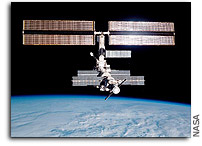 All ISS systems continue to function nominally, except as noted
previously or below. It is Day 186 for the Expedition 4 crew
(184 days onboard ISS).
Both crews received emphatic kudos from the ground for their
"terrific work" on the first full docked day.
Everything was right on target for today’s first UF-2
spacewalk.
EVA-1, by Franklin Chang-Diaz (EV1) and Philippe Perrin (EV2),
was completed successfully, with the station robotarm (SSRMS)
used for worksite access and the Shuttle SRMS for acquisition of EVA
video.
Hatch opening was at 11:23 am EDT, and the EVA began officially at
11:27 am with EMU spacesuit switchover to battery power. During
their excursion, the spacewalkers installed a PDGF (power and data
grapple fixture) for the SSRMS about halfway up the station’s P6
truss (1:38 pm). It will be used during a later assembly flight
when the P6 will be relocated with its two solar array wings from its
current position. Perrin also installed a temporary attachment
fixture on the PMA-1 (pressurized mating adapter), which they used
later (3:25 pm) to hold a pack of SMDP (Service Module debris panel)
shields transferred from the Shuttle PLB (payload bay). They
will be installed on the outside of the SM during a future spacewalk.
In a small change to the EVA timeline, Chang-Diaz (at 3:40 pm)
visually inspecthe thermal blanket covering the failed CMG1 (see
below), also taking video and still photography, with the objective
to look for possible damage from an MMOD (micrometeoroid/orbital
debris) hit to the blanket. After Peggy Whitson had latched the
SSRMS to the MBS (mobile base system) in the PLB (5:23 pm) to provide
keep-alive power to its electronics heaters, the final task of the
spacewalkers was the removal of thermal protection blankets from the
MBS (6:00 pm), The base unit was then unberthed by CDR Cockrell
(6:23 pm) and moved above the MT (mobile transporter) into the
overnight pre-install position. The EVA, which was the first
spacewalks for both Chang-Diaz and Perrin, ended at 6:41 pm, after a
total duration of 7h 14m. It was the 39th ISS spacewalk, bringing total assembly EVA time
to 243h 41m, and the 14th EVA conducted from
the ISS itself (total time: 76h 26m).
Unloading of MPLM (multi-purpose logistics module) Leonardo and cargo
transfers to the ISS continue on schedule. MPLM was
successfully activated yesterday at 3:10 pm EDT. [Average
MPLM cabin air pressure at activation was 762.2 mmHg (14.74 psia).
The calculated MPLM cabin air temperature was 64.17°F (17.87¡C) based
on this pressure and the environmental check data from Launch +
4h44m. After the dew point temperature in the ISS was
determined yesterday to be of 53.9°F, activation of the MPLM 120 Vdc
heaters was not required because the calculated MPLM cabin air
temperature was greater than 10¡F above the dew point.]
As reported yesterday, a suspected spin bearing seizure on 6/8 caused
the station’s CMG1 (control moment gyroscope #1) to be declared
failed (at approximately 11:00 am EDT). The wheel has
completely spun down and is out of the control system.
The cause of the failure is still under investigation.
Maintaining attitude control was not affected by this failure
as the system is designed to function nominally with three CMGs (and
two CMGs for most cases). [An attitude workaround was developed
which allowed the MBS to be transferred with minimal vibrational
impacts to ISS. The workaround utilizes an LVLH Yaw/Pitch/Roll
attitude of +5/+23/0, also referred as an MBS Thermal Attitude, and
the maneuver was successfully executed this morning at 5:42 am EDT.
A spare CMG is available on the ground and should be ready for
flight before the end of this year. Since it must be manifested
in the Shuttle PLB due to its size, mission selection for its flight
will be done at a later time. ]
Last night MCOR (medium-rate communications outage recorder) was
powered down to prevent it from reaching its operational limit of 46
deg C and subsequently preventing unwanted MCOR beeping during crew
sleep. This morning MCOR was powered back up.
On 6/8, BGA 2B (beta gimbal assembly 2B) stalled during
Autotrack slewing. MCC-H commanded a back drive through 45
degrees, and the SAW (solar array wing) returned to nominal
operations.
Due to crew time limitations POC (Payload Operations Center) could
not get the desired EVARM (EVA radiation monitoring) pre-EVA and
post-EVA readings scheduled. The Shuttle crew had been notified of
this before the flight, and MS2 Chang-Diaz agreed to wear the badges
for his first spacewalk and possible the subsequent two EVAs.
[Since the badges can be read only after the joint
operations of the docked phase, a cumulative radiation exposure
amount will be recorded. The pre-EVA readings already performed
before UF-2 will be used in support of background data collection for
the EVARM investigation.]
FE-2 Sergei Treschev was scheduled to activate the PCG-STES 008
(protein crystal growth-single locker thermal enclosure system #8) in
the Lab, which contains six PCAM devices (protein crystallization
apparatus for microgravity) with a large number of growth chambers
each. The chambers consist each of a sample well with
protein/precipitant solution, surrounded by a reservoir with more
precipitant solution. Treschev activated all six cylinders in
order, using a torque wrench to rotate activation/deactivation knobs
at one end of the cylindrical housing, and then attached a muffler to
the STES with Velcro.
MS3 Carl Walz performed Shuttle middeck descent checks, including the
BPS (biomass production system). Later in the day, he repeated
the BPS descent status check.
Descent status checks were also performed by CDR Valery Korzun, while
Sergei Treschev completed the daily routine ISS UF-2 payload status
check, referring to a procedure readout from the OSTPV computerized
procedures viewer.
RCS (reaction control system) propellant margins in the Shuttle are
positive (100 lbs forward tanks and 550 lbs aft tanks).
O2 consumable margin is positive (13 hrs).
Science Update (Expedition Four — 26th):
One final time, the Lead Scientist expressed his thanks to the
Expedition 4 crew, on behalf of the research community, for their
outstanding accomplishments. "It’s been truly an exemplary
expedition, certainly one for the record books for science".
Hoffman-Reflex: Complete.
Extra-Vehicular Activity Radiation Monitors (EVARM): In
progress.
Ultrasound: Complete.
GASMAP/Pulmonary Function in Flight (PuFF): Complete.
Renal (Kidney) Stone Experiment: Complete.
Interactions (NTXN): In progress.
Human Research Facility/Workstation (HRF WS): Dan
Bursch was thanked for taking time during his pre-sleep to complete
the Workstation activities. The information he gathered from
the WS has helped the ground to get ahead in preparations for
Increment 5 and close out activities for Increment 4.
Cellular Biotechnology Support Systems (CBOSS): Complete.
Commercial refrigerator incubator module-commercial Stelsys
(CRIM-CS): New payload for Increment 5 has arrived.
Advanced Astroculture (ADVASC): ADVASC is scheduled
to be activated on Tuesday, 6/11 (FD7). Tuesday’s activities
include ADVASC Cable Connections, ADVASC Activation, and the ADVASC
Nutrient Replenishment Activity.
Solidification Using a Baffle in Sealed Ampoules (SUBSA): New
payload for Increment 5 has arrived.
Pore Formation and Mobility Investigation (PFMI): New
payload for Increment 5 has arrived.
Physics of Colloids in Space (EXPPCS): Complete.
Payload transferred to Shuttle for return.
Space Acceleration Measurement System (SAMS): SAMS
captured several exercise periods for TEVIS and RED. Still
working on positive identification for these events. STS-111
docking was captured on all four heads.
Microgravity Acceleration Measurement System (MAMS): Attitude
maneuver and center of mass shift for STS-111docking were measured
with MAMS OSS sensor. MAMS HiRAP data downlink was activated to
capture hard and soft mating events.
Protein Crystal Growth-Single Locker Thermal Enclosure System
(PCG-STES): New payload for Increment 5 has arrived.
Protein Crystal Growth-Enhanced Gaseous Nitrogen (PCG-EGN): In
progress. This passive payload will be transferred to the
Shuttle for return.
Materials ISS Experiment (MISSE): Nominal and collecting
data.
Educational Payload Operations (EPO): Complete.
Active Rack Isolation System – Isolation Characterization
Experiment (ARIS-ICE): ARIS-ICE testing is now complete,
and ARIS and the ARIS-ICE Payload On-orbit Processor are powered down
for the UF-2 docked period. ARIS-ICE will continue to be used
to support ZCG UF-2 science, and the ground is looking forward to
further success as ARIS continues to support microgravity science for
the life of the ISS.
EarthKAM: Currently complete. All EarthKAM images
are available for public access on the EarthKAM data system at:
http://EarthKAM.sdsc.edu/cgi-bin/datasys/ek_images_station
Zeolite Crystal Growth (ZCG): Complete. A new set of
samples arrived for Increment 5 operations.
ARCTIC Refrigerator/Freezer 1 (ARCTIC-1): The ARCTIC
unit is performing nominally.
ARCTIC Refrigerator/Freezer 2 (ARCTIC-2): New payload
for Increment 5 has arrived.
Biomass Production System-Photosynthesis Experiment & System
Testing Operation (BPS-PESTO): The BPS team was
disappointed by the launch slips but is grateful to be able to add
operations and maximize the time available. Due to plant age
and a failing chamber, it was necessary to harvest the wheat plants
in chamber 4. The water operations put the unit in good shape
for the middeck operations and additional gas samples will add to the
valuable samples already collected. Dan Bursch’s observations of the
BPS chambers and plants have been invaluable, and if the fans
continue to stop rotating he is free to give them a spin whenever you
have the time.
Commercial Protein Crystal Growth-High Density (CPCG-H):
CPCG-H Crystal Growth continues nominally. Was transferred to
middeck on FD4.
Commercial Generic Bioprocessing Apparatus (CGBA): The
CGBA experiment continues to function nominally. At this point, 42 of
48 antibiotic samples have been autonomously taken in the payload and
were confirmed via downlink. Transferred to middeck on F5.
Crew Earth Observations (CEO): The majority of
Expedition 4 digital images have been reviewed and released to the
STIC website at JSC — many first-ever and very topical views.
The ground is eager to see the crew’s film and to present some
of the current research that will benefit from their photographic
data. — With the procedures that the Exp. 4 crew has helped
develop, the ground expects Expedition 5 to continue to improve its
dialogue with them and looks forward to working with them.
Today’s target areas of combined ISS and Shuttle earth observations
were South Asia (obliques left and right of track requested
to document reported poor air quality [mainly dust]. Detailed views
of Ganges floodplain at nadir 1 min later. Then panoramas of the
Himalayan ranges. Weather continues good across the Tibetan
plateau), Southwestern Africa (approaching Namib Sand
Sea said to be spectacular. Crew to shoot obliques for possible
aerosol masses in the atmosphere. Then detailed views of vast
threatened Okavango wetland [green triangle in desert at nadir].
Crew also to shoot complex river patterns at nadir immediately
after. Then East African rift geology: detailed views of Lake
Tanganyika coasts and the "step-over" of the rift
axis to Lake Malawi), Horn of Africa (crew to look
right for panoramas of the Horn. Also to look left for obliques north
up the Red Sea and just left for the unusual geological fault
patterns [intersecting straight lines in black lavas]. Such
"seafloor" patterns only visible above sea level in few
places on the planet), Central Africa river patterns
(chance for mapping subtle but geologically interesting river
patterns [deltas far from the sea], immediately left of track.
Similar opportunity two minutes later in SW Sudan, right of
track), Toshka Lakes, SW Egypt (large new lakes growing
rapidly in Egypt’s southern deserts, just west of Lake Nasser. Nadir
views needed to document change. Then views of Sinai left. Then views
of Mesopotamia right [Baghdad off right on the Tigris River]. Then
the Caspian Sea, with oil city Baku on a prominent cape, and panorama
of the entire Caucasus Mts beyond), South America pass
(pass over Andes, Lake Titicaca [nadir views to document change in
shorelines coastal swamps] and La Paz city. Southern Amazonia
relatively cloud free: mapping pass of nadir views requested for
river patterns), France (possible views between cloud
masses, from Nantes across all of northern France. Paris at
nadir), Tuamotu islands (mapping pass to document coral
reefs left and right of track), Baja-Chicago pass
(panorama left of track. Big Bend country of Texas at nadir 2
mins later. Then Dallas-Fort Worth metroplex 1.5 mins later. Then St
Louis 2 mins later. Then Chicagoland and Lake Michigan),
Western US pass (Los Angeles basin right of track. Then
shoot snow cover on Sierras. Then nadir pass over Salt Lake
City), Hawaii (nadir pass over Molokai. Kauai left of
track, Hawaii right), and Oregon (opportunity near the
coast).
CEO images can be viewed at the website http://eol.jsc.nasa.gov
U.S. and Russian Segment Status (as of 3:10 am
EDT):
Environmental Control and Life Support (ECLSS) and
Thermal Control (TCS):
Elektron O2 generator is powered On (32-amp mode). Vozdukh
CO2 scrubber is ON in MANUAL cycle mode #5 (vacuum pump failed).
U.S. CDRA CO2 scrubber is Off. BMP Harmful Impurities
unit: Absorbent bed #1 in Purify mode, bed #2 in Regeneration
mode.
SM Working Compartment: Pressure (mmHg) — 753,
temperature (deg C) — 26.7, ppO2 (mmHg) — 143.4, ppCO2 (mmHg) —
2.4.
SM Transfer Compartment: Pressure (mmHg) — 752,
temperature (deg C) — 20.2.
FGB Cabin: Pressure (mmHg) — 744, temperature (deg C)
— 20.7.
Node: Pressure (mmHg) — 738.16, temperature (deg C) —
21.9 (shell); ppO2 (mmHg) — n/a; ppCO2 (mmHg) — n/a.
U.S. Lab: Pressure (mmHg) — 740.27, temperature (deg C)
— 23.8, ppO2 (mmHg) — n/a; ppCO2 (mmHg) — n/a;
Joint Airlock (Equip. Lock): Pressure (mmHg) — 739.87,
temperature (deg C) — 22.1; shell heater temp (deg C) — 21.4, ppO2
(mmHg) — n/a; ppCO2 (mmHg) — n/a.
PMA-1: Shell heater temp (deg C) — 22.5
PMA-2: Shell heater temp (deg C) — 20.1
(Note: Partial pressures ppO2 and ppCO2 in U.S. segment [USOS] not
available because MCA [major constituent analyzer] is failed and in
Extended Life mode [= a state that preserves mass spectrometer
vacuum but produces no pp data]). MSA (mass spectrometer assembly)
and VGA (verification gas assembly) have been removed for return to
Earth.
Electrical Power Systems (EPS):
Beta Gimbal Assembly (BGA) 2B in Autotrack mode, BGA 4B in
Autotrack mode.
SM batteries: (data not available)
FGB: Battery #3 is offline (ROM mode). All other batteries (5)
are in ãpartial chargeä mode.
Plasma Contactor Unit PCU-1 in Standby mode; PCU-2 in Standby
mode.
Thermal Control Systems:
Air conditioner SKV-1 is Off. SKV-2 is On.
Command & Data Handling Systems:
C&C-3 MDM is prime, C&C-2 is back-up, and C&C-1
is in standby.
GNC-1 MDM is prime; GNC-2 is Backup.
LA-1, LA-2 and LA-3 MDMs are all operating.
PL-1 MDM is operational; PL-2 MDM on Standby.
APS-1 (automated payload switch #1) and APS-2 are both On.
SM Terminal Computer (TVM): 2 redundant lanes (of 3) operational.
SM Central Computer (TsVM): 2 redundant lanes (of 3) operational.
Communications Systems:
All Russian communications & tracking systems are
nominal.
S-band is operating nominally.
Ku-band is operating nominally.
Audio subsystem operating nominally.
Video subsystem operating nominally.
MCOR (medium-rate communications outage recorder) is operating
nominally.
Robotics:
SSRMS/Canadarm2 at Progress viewing position, with Keep Alive
power on both strings.
RWS (robotics workstations) are Off.
SSRMS Prime string Wrist Roll (WR) joint to be replaced on UF-2.
ISS Orbit (as of this morning, 7:07 am EDT [=
epoch]):
Mean altitude — 385.4 km
Apogee — 389.4 km
Perigee — 381.3 km
Period — 92.3 min.
Inclination (to Equator) — 51.64 deg
Eccentricity — 0.0005979
Orbits per 24-hr. day — 15.60
Altitude decrease — 280 m (mean) in last 24 hours
Revolutions since FGB/Zarya launch (Nov. ’98) — 20282
Current Flight Attitude — LVLH (local vertical/local horizontal =
“earth-fixed”: z-axis in local vertical, x-axis in velocity vector
[yaw: 5 deg, pitch: 23 deg., roll: 0 deg])
For more on ISS orbit and naked-eye visibility dates/times,
see



