ISS On-Orbit Status 7 Nov 2002
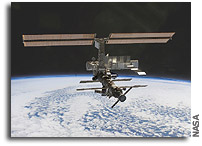 All ISS systems continue to function nominally, except as noted previously or below. A full day of joint operations (155th day in space for Expedition 5, of a total expected stay of 169 days).
Before breakfast, VC CDR Sergei Zalyotin and VC FE-1 Frank De Winne completed the daily saliva sample collection for the VIRUS (VRS) experiment, and later, with VC FE-2 Yuri Lonchakov, filled out the routine sleep study questionnaire for SLEEP (SLP).
Working on the MSG (microgravity science glovebox) in the Lab, Frank De Winne deinstalled and stowed the NANOSLAB payload (study of aggregation mechanisms and kinetics of ZSM-5 and Silicate-1 nanoslabs into hybrid phases under micro-G conditions).
In the SM, De Winne then started biological strain incubation for the next biological sample of the MESSAGE experiment (effects of micro-G on bacterial gene expression with special attention to genes involved in the response to stress).
Back at the MSG after the morning DPC (daily planning conference), Frank set up imaging equipment (TV/photo ops) and hardware for the COSMIC experiment (study of microstructure formation in titanium-aluminum-beryllium powder using self-propagating high-temperature combustion synthesis [SHS]). COSMIC operations in MSG were conducted six times during the day, followed by film removal and equipment stowage in the late afternoon. [Activation and ignition of the experiment were timed for good Ku-band coverage to allow observation by ground scientists, intent on capturing two critical coordination steps, viz., (1) the first ignition, with close coordination of subsequent ignitions with POC (Payload Operations Center), and (2) ISS crew performing no TVIS ops during the ignition process to ensure high-quality microgravity conditions.]
Also on the MSG, Frank De Winne removed tape #6 of the PROMISS experiment (protein crystal growth monitoring by digital holographic microscope) and installed tape #7.
NEUROCOG activities by Zalyotin and Lonchakov, experimenting with visual, vestibular (inner ear) and proprioceptive (posture sensor) cues during various body positionings in zero-G, today focused on setting the subjects up with the Halley configuration (electrodes behind ears and near eyes, with recording), followed by virtual turns in strapped-down and free-float condition, and, after termination of Halley recording, by orientation studies both strapped down and in free float.
Yuri Lonchakov had another session with the Diatomeya program of world ocean observations, performing still photography with the Nikon-F5 camera. [Observation targets today were open water starting at sunrise to determine and record the time at which the blue of background water is clearly visible, and areas in the Pacific where subsurface water rises to the surface.]
Lonchakov also took photos, with the Kodak 760 with 800mm focal-length lens, for the Uragan program. [Target areas were Sicily and the volcanic activity of Mt. Etna, the Nile River, Ethiopia, and the Amazon Basin.]
Valery Korzun set up the Russian MO-21 “Ecosphera” air sampler and incubation equipment, for atmospheric microbial air sampling scheduled for tomorrow.
Shortly before sleep time, Sergei Zalyotin is scheduled to set up the equipment for the SYMPATHO (SYM) experiment, which involves collection of venous blood samples from the entire VC-4 crew to test a hypothesis explaining changes in the sympathoadrenal activity during spaceflight. The experiment was conducted on Day 2 of the joint flight and will be run one more time tomorrow.
At about 4:05pm EST, Lonchakov will install the French LSO experiment at SM window #9, a hold-over from Claudie Haigneré’s “Andromeda” payload package of taxi mission 3S which observes lightning and “sprites” in the upper atmosphere. [Sprites occur in the form of red luminescence over storm clouds and extend from the upper layer of the clouds to the base of the ionosphere (100 km), occupying a horizontal space of approximately 50 km. They were first discovered on photographs taken from the Shuttle. They are fairly rare phenomena (one luminance per 300 lightning discharges); therefore long recording sessions are required to capture them. The LSO run will continue until 11/9, when taxi mission 5S ends.]
Sergei Zalyotin and Yuri Lonchakov spent several hours for initial packing and stowing for the return of the taxi crew in Soyuz TM-34/4S.
FE-1/SO Peggy Whitson installed the REBA batteries (rechargeable EVA battery assembly) for the 11A spacewalks. Then she and CDR Valery Korzun worked in the Airlock to prepare it for the EVAs. Whitson also activated the EVARM (EVA radiation monitoring) reader and took pre-EVA background readings. The three EVAs on 11A are scheduled as follows: EVA-1: 11/13 at 8:30pm (EST), EVA-2: 11/15 at 7:30pm, EVA-3: 11/17 at 7:30pm, each to last approximately 6:30h.
For FE-2 Sergei Treschev and Valery Korzun, it was again time for the “Chibis” exercise as part of their preparations for returning into gravity. [Both cosmonauts assisted each other in working out in the below-the-waist reduced-pressure device (US: LBNP), which provides gravity-simulating stress to the body’s cardiovascular/circulatory system for reestablishing the body’s orthostatic tolerance (e.g., the Gauer-Henry reflex) after their five-months stay in zero-G.]
Valery Korzun completed his daily task of inspecting the Rasteniya-2 plant growth payload, with data transfer to Laptop 3 for downlink via Regul packet. He also did the daily routine maintenance of the SOSh life support system, while Treschev prepared the IMS update file for downlink, and Peggy Whitson conducted the regular status checkup of Lab payloads.
At 2:44pm EST, both crews are scheduled for a live TV interactive PAO event with His Royal Highness Prince Philippe of Belgium via Ku-band. Accompanied by Philippe Busquin, European Commissioner for Research, Antonio Rodota, ESA Director General, and Charles Picque, Belgian Minister for Economic Affairs & Scientific Research, Prince Philippe will be at Odissea Mission Center at the Planetarium de Bruxelles in Brussels, Belgium.
About an hour later, Yuri Lonchakov will downlink the regular daily TV coverage for Belgian media.
The transition back to the original software (R1) in the LSYS3 MDM (Lab systems computer #3) was successfully completed this morning. Soon thereafter several unexpected CDRA “funnies” (anomalies) were encountered which drove ground specialists to perform a second power cycle (off/on) on the MDM. All systems have been reconfigured except the vacuum system. Since CDRA continues to operate offnominally, troubleshooting is continuing.
After yesterday’s attitude maneuver to earth-pointing LVLH (local vertical/local horizontal) in support of the Russian solar array efficiency test, the ISS currently continues in LVLH (yaw/pitch/roll = -13/-9/0 deg) under CMG momentum management. This will support Soyuz TM-34/4S undocking, which is scheduled for Saturday, 11/9, at 3:41pm EST. Deorbit burn will start at 6:10pm, for 4min 19s. Landing in Kazakhstan, near the city of Arkalykh, is at about 7:04pm EST (3:04am DMT, 11/10).
Today’s targets for the CEO program were Eastern Mediterranean Dust (looking left of track for dust emanating from North Africa ahead of a stalled front), Lake Nasser, Toshka Lakes; Egypt (nadir views. Looking left for Toshka Lakes. Pass continued down the W coast of the Red Sea, with panoramas of Saudi Arabia left. Then over the Afar Triangle volcanoes [angle of Africa at the south end of the Red Sea] with oblique views of the Ethiopian Plateau [source of the Nile River]. Then views of the Horn of Africa), Angolan Biomass Burning (high pressure system securely occupying the subcontinent. Numerous fires in the region are making news), Industrialized SE Africa (ISS overflew the high plateau [above 8000 feet] of the small country of Lesotho: crew was asked to document possible contrast between clear air over the plateau and hazy air in the lower levels), Denver, Colorado (nadir pass. ESC [electronic still camera] requested), Havana, Cuba (slightly left of track. ESC), and Los Angeles, California (nadir pass. ESC requested).
CEO images can be viewed at the website
http://eol.jsc.nasa.gov
U.S. and Russian Segment Status (as of 4:00am EST).
Environmental Control and Life Support (ECLSS) and Thermal Control (TCS):
- Elektron O2 generator is powered Off. Vozdukh CO2 scrubber is ON in AUTO air flow mode (ppCO2 limit: 3.5 mmHg). U.S. CDRA CO2 scrubber is Off. TCCS is operational. BMP Harmful Impurities unit: Absorbent bed #1 in Purify mode, bed #2 in Purify mode.
Propulsion System (PS):
Total propellant load available (SM + FGB + Progress) — 3903 kg (8605 lb) [as of 10/24/02].
Electrical Power Systems (EPS):
- Both P6 channels fully operational. Beta Gimbal Assembly (BGA) 2B and BGA 4B in Autotrack mode (solar-tracking).
- SM batteries: All batteries (8) in “Partial Charge” mode.
- FGB batteries: Battery #1 is offline; all other batteries (5) are in “Partial Charge” mode.
- Plasma Contactor Unit PCU-1 in Standby mode; PCU-2 in Standby mode.
Thermal Control Systems:
- Air conditioner SKV-1 is On; SKV-2 is Off.
Command & Data Handling Systems:
- C&C-1 MDM is prime, C&C-2 is back-up, and C&C-3 is in standby.
- GNC-1 MDM is prime; GNC-2 is Backup.
- EXT-1 is On (primary), EXT-2 is off.
- LA-1, LA-2 and LA-3 MDMs are all operating.
- PL-1 MDM is On (primary); PL-2 MDM is off (diagnostic
- APS-1 (automated payload switch #1) and APS-2 are both On.
- SM Terminal Computer (TVM): 3 redundant lanes (of 3) operational.
- SM Central Computer (TsVM): 3 redundant lanes (of 3) operational.
Attitude Source:
- 3 CMGs on-line.
- State vector — U.S. SIGI-1
- Attitude — Russian segment (RS)
- Angular rates — U.S. RGA-1 (from RS attitude)
Communications & Tracking Systems:
- All Russian communications & tracking systems are nominal.
- S-band is operating nominally.
- Ku-band is operating nominally.
- Audio subsystem operating nominally.
- Video subsystem operating nominally.
- MCOR (medium-rate communications outage recorder) is operating nominally.
Robotics:
- SSRMS/Canadarm2 at MBS PDGF3 (mobile base system/power & data grapple fixture 3) and 11A park position, with Keep Alive power on both strings.
- MBS: Keep Alive power on both strings. POA: Keep Alive power on both strings.
- RWS (robotics workstations): Lab RWS is Off; Cupola RWS is Off.
ISS Orbit (as of this morning, 6:53am EST [= epoch]):
- Mean altitude — 392.6 km
- Apogee — 402.2 km
- Perigee — 382.9 km
- Period — 92.41 min.
- Inclination (to Equator) — 51.64 deg
- Eccentricity — 0.0014233
- Orbits per 24-hr. day — 15.58
- Solar Beta Angle — -18.5 deg (magnitude decreasing)
- Altitude loss — 280 m (mean) in last 24 hours
- Revolutions since FGB/Zarya launch (Nov. ’98) — 22632
- Current Flight Attitude — LVLH (local vertical/local horizontal = “earth-fixed”: z-axis in local vertical, x-axis in velocity vector [yaw: -13 deg, pitch: -9 deg, roll: 0 deg]).
For more on ISS orbit and worldwide naked-eye visibility dates/times, see
http://www.hq.nasa.gov/osf/station/viewing/issvis.html